


To be honest, before diving into Web3, I spent nearly a decade in traditional supply chains around Jiangsu and Zhejiang, dealing with warehousing, logistics, raw materials, and circulation cycles daily. A couple of years ago, I jumped into the crypto space thinking I’d witness some groundbreaking business models, but it left me utterly shocked.
Just look at the current market vibe; everyone is swimming naked in a massive, unfounded financial bubble. Today, Bitcoin (BTC) fakes a breakout to lure in longs, and tomorrow Ethereum (ETH) and SOL hit a liquidation wick. The 'fam' in the group stares at those erratic candlesticks, trying to decipher Wall Street’s big players’ intentions with moving averages and MACD. To put it bluntly, this isn’t investment building; it’s a zero-sum casino that doesn’t even have real supply, just relying on thin air. I’ve paid a hefty tuition in this market meat grinder, and at one point, I was completely disillusioned with the so-called decentralization, even considering going back to my old trade.
Then, by chance, my cousin, who usually loves messing with chain games, dragged me to check out his operations in @Pixels . At first, looking at the retro pixelated characters farming and chopping trees, I chuckled to myself: isn't this just QQ Farm from over a decade ago? But when I used my supply chain expertise to thoroughly analyze the underlying logic of this project running on the Ronin chain, I was left in a cold sweat—this isn't just some casual game; it's an extremely tight-running, perfectly self-consistent 'cyber micro-economy'.
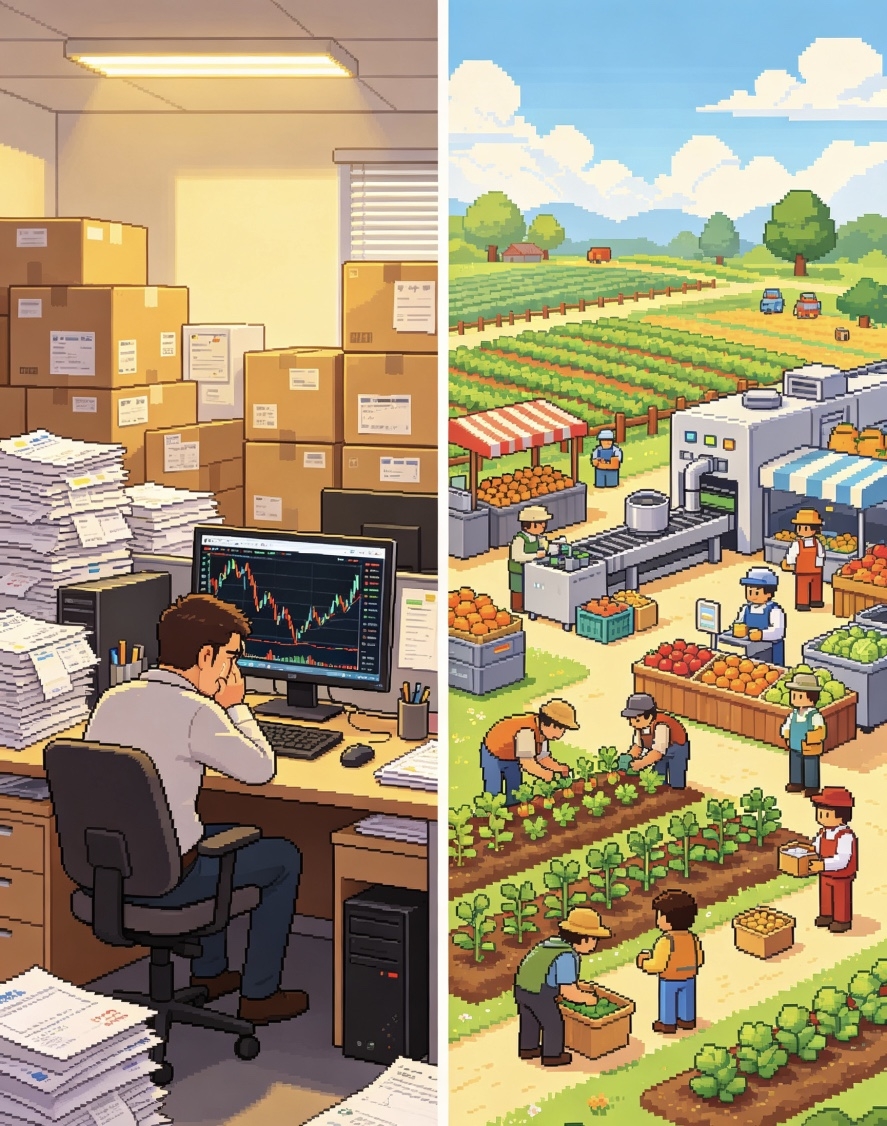
Those old chain games that just harvested retail investors died because they lacked real 'consumption scenarios', with tokens relying on infinite issuance to attract new users—a classic game of hot potato. But in the world of Pixels, I've seen the most authentic 'physical business' framework.
It has established a complete upstream and downstream supply chain. Ordinary retail investors are the bottom-tier 'raw material suppliers', earning wood and crops by selling their time; high-level players are the 'factories', responsible for synthesizing high-end items; and those holding land NFTs, the landlords and top guilds, are the 'super distributors' and 'conglomerates'. In this ecosystem, $PIXEL is not just paper for speculation, but the 'operating capital' that keeps the entire business empire running. If you want to monopolize core resources, ensure your guild wins in fierce business competition, or just want to boost logistics efficiency as a VIP, you must pay real money to the system and burn $PIXEL.
This design is wicked! It cleverly leverages the 'competitive needs' and 'business ambitions' of top players, creating a massive token deflationary black hole. Every bit of profit a player earns comes from another player paying for efficiency and experience, forming a true business loop that's ten thousand times more hardcore than those DeFi models built purely on capital.
The rules of doing business have never changed: without real demand and consumption, no matter how grand the financial model, it's just a castle in the air. We keep shouting that Web3 needs to break through and achieve mass adoption—do we really expect the average Joe to come and bet big with 100x leverage?
Real digital infrastructure has to seamlessly embed complex token rights into the everyday lives of millions of regular folks who 'earn their keep and build'. When countless players stop fretting over market ups and downs and willingly start planning their own supply chains and managing their small businesses in this digital land, the metaverse business landscape constructed by #pixel has already become an unshakeable fortress. Instead of serving as liquidity fuel in the secondary market, being a 'cyber entrepreneur' here is the true long-term play.