

Over the past few years, blockchain developers have explored new ways to smoothly integrate BTC (and the entire Bitcoin network) with decentralized finance (DeFi) applications, with most development teams focusing their efforts on wrapping Bitcoin (WBTC) solution, but while WBTC does offer some benefits, these tokens (and similar counterfeits) have proven to be seriously flawed — fraught with ongoing security and counterparty risks.
But don’t worry, engineers working on the Internet Computer Protocol (ICP) have found a way to use chain key Bitcoin, commonly known as ckBTC and powered by chain key cryptography. Coin may change DeFi forever for the greater good.
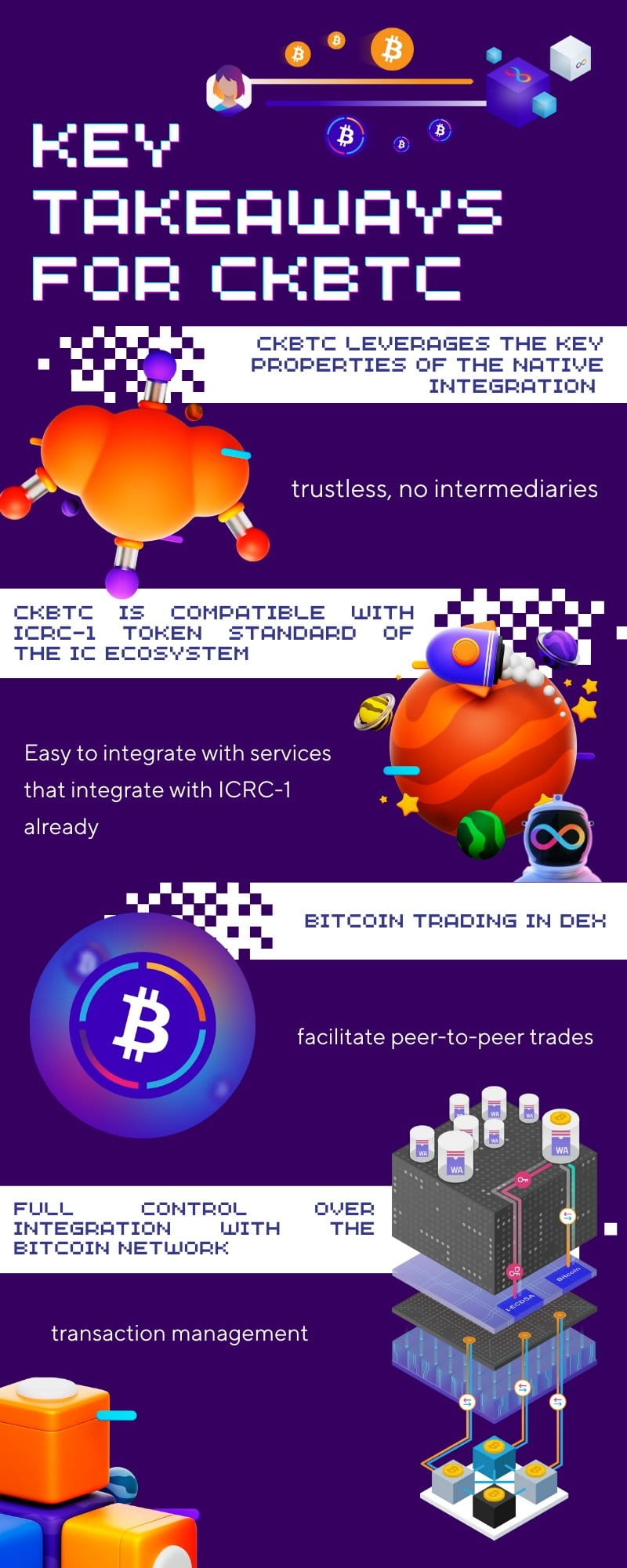
ckBTC is an ICP native token backed 1:1 by real BTC and managed on-chain by Internet computer smart contracts. Think of ckBTC as Bitcoin's (highly fungible) twin token - a 100% mirror asset , which uses chain-key cryptography to own and control all underlying Bitcoins.
ckBTC extends the ICP protocol stack so the blockchain acts like a virtual layer 2 solution that is faster, cheaper, and greener than the Bitcoin network.
Note that ckBTC is not a bridge or wrapper token, these are important distinctions and point to the core of what makes chain-key Bitcoin so valuable.
chain bridge problem
In February 2021, now-defunct cryptocurrency exchange FTX launched a new token called Solana Wrapped Bitcoin (SOBTC), a BTC clone designed to run on the Solana blockchain.
The token received great acclaim at the time and continues to be traded on multiple exchanges including FTX and Serum DEX, the largest cryptocurrency exchange on the Solana blockchain.
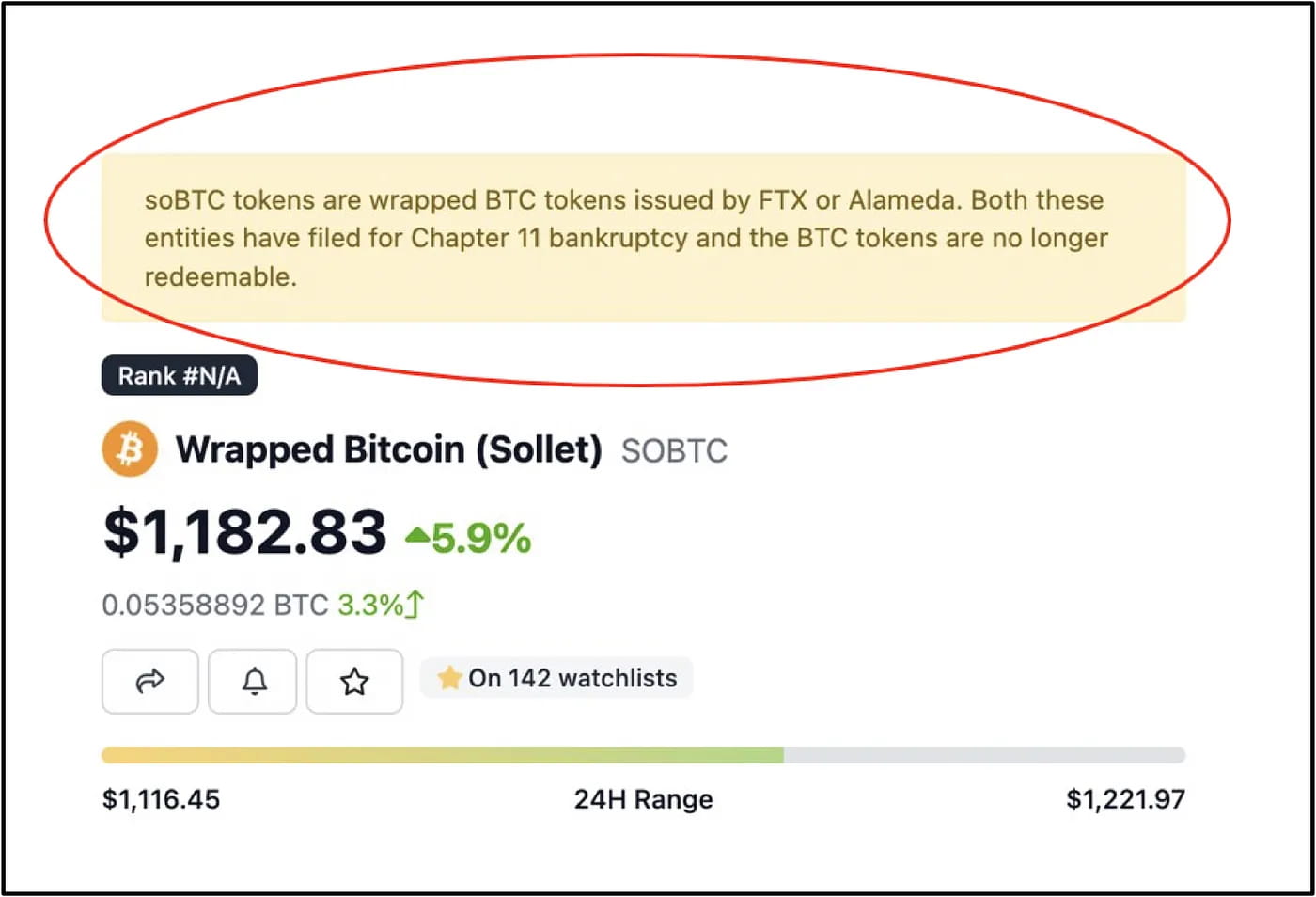
However, during the week of November 6, 2022, the price of SOBTC fell off a cliff, losing almost all value in a matter of minutes.
As of this writing, SOBTC’s market price is $1,191.89, approximately one-fifteenth of BTC’s value.
Purported to be pegged one-to-one with BTC, SOBTC was created to provide faster and cheaper BTC transactions than the Bitcoin network. On paper, Solana Wrapped Bitcoin’s token economics look sound. After all, FTX Is the main issuer of SOBTC tokens.
However, once SOBTC’s leading liquidity provider, FTX, crashed and collapsed, the value of its ironically famous BTC derivative token also fell.
Like many wrapper tokens, SOBTC was designed to enhance blockchain interoperability, increase inter-chain liquidity and create new use cases for decentralized finance (DeFi), but in the throes of its rapid demise, it only gave holders Investors with this currency suffered heavy losses.
Traditionally wrapped BTC tokens are doomed because they require "chain bridges," where users move their Bitcoin to a bridge and a third-party custodian on the bridge says, "Okay, I'll keep this for you," Please hold on to this equivalent wrapped token and don’t worry about your Bitcoins. I am completely safe on this bridge and use all these Bitcoins I wrapped to conduct your business on the blockchain.”
However, this type of chain bridge model is problematic for several key reasons:
Centralization: WBTC relies on a centralized system to hold and manage the underlying BTC reserves backing the token, so users must trust the custodian who holds the reserves (this goes against the decentralized ethos of Web3).
Counterparty Risk: As we have seen many times in recent years, entrusting your tokens to a third party is rarely a good idea, and there is always the possibility that the custodian may mismanage the reserves or be subject to a hack, theft, or other type of Risk of security breaches.
In the case of SOBTC, it appears that FTX may have been covertly stealing its customers’ bridge funds through a “backdoor” on a regular basis.
Many chain bridge custodians are involved in staking bridge assets and lending client tokens to questionable third parties, thereby introducing "fractional reserve" risk to the package assets within their purview.
Complexity: The process of converting BTC to WBTC and back can be complex and time-consuming for users and developers, WBTC requires a higher level of technical expertise and knowledge, as processing Bitcoin UXTO is tedious and error-prone.
Chain Bridge Hacked: Last year alone, cybercriminals stole more than $3.6 billion in cross-chain bridge hacks through code exploits, fake token issuance, and transaction manipulation. In 2022, attacks on Chain Bridge accounted for 10% of stolen funds. More than 70% of the total amount.
Fortunately, the era of token bridging and wrapping, with its never-ending issues of liquidity, latency, security, and complexity, is coming to an end, thanks to the Internet Computer Protocol and ckBTC, a superior method of executing native Bitcoin transactions Already appeared.
There is a better way
With ckBTC, Bitcoin-based commerce is trustless, running natively on ICP smart contracts, code is law, and BTC transactions do not need to be processed through traditional chain bridges or anonymous trustees.
The Internet Computer extends its underlying protocols and technology architecture to virtually "attach" to the Bitcoin network to manage the holding, redemption, and trading of BTC without an intermediary. The same technology stack used to power ICP directly manages all BTC on the chain and execute smart contracts on its behalf.
The keys that govern BTC are controlled by a subnet powered by ICP's groundbreaking chain key technology - the same handshake threshold solution that powers the entire ICP network, ckBTC does not require users to trust third parties or bridge-centric vaults (although they One really has to have faith in the Internet Computer Protocol and the Bitcoin network).
It is worth noting that ICP native BTC integration is very different from Lightning Network, as Lightning Network is only a payment channel, there are no smart contracts in its ecosystem, and there are no decentralized financial applications or exchanges (so liquidity is very Small).
ICP Containers: Where the Magic Happens
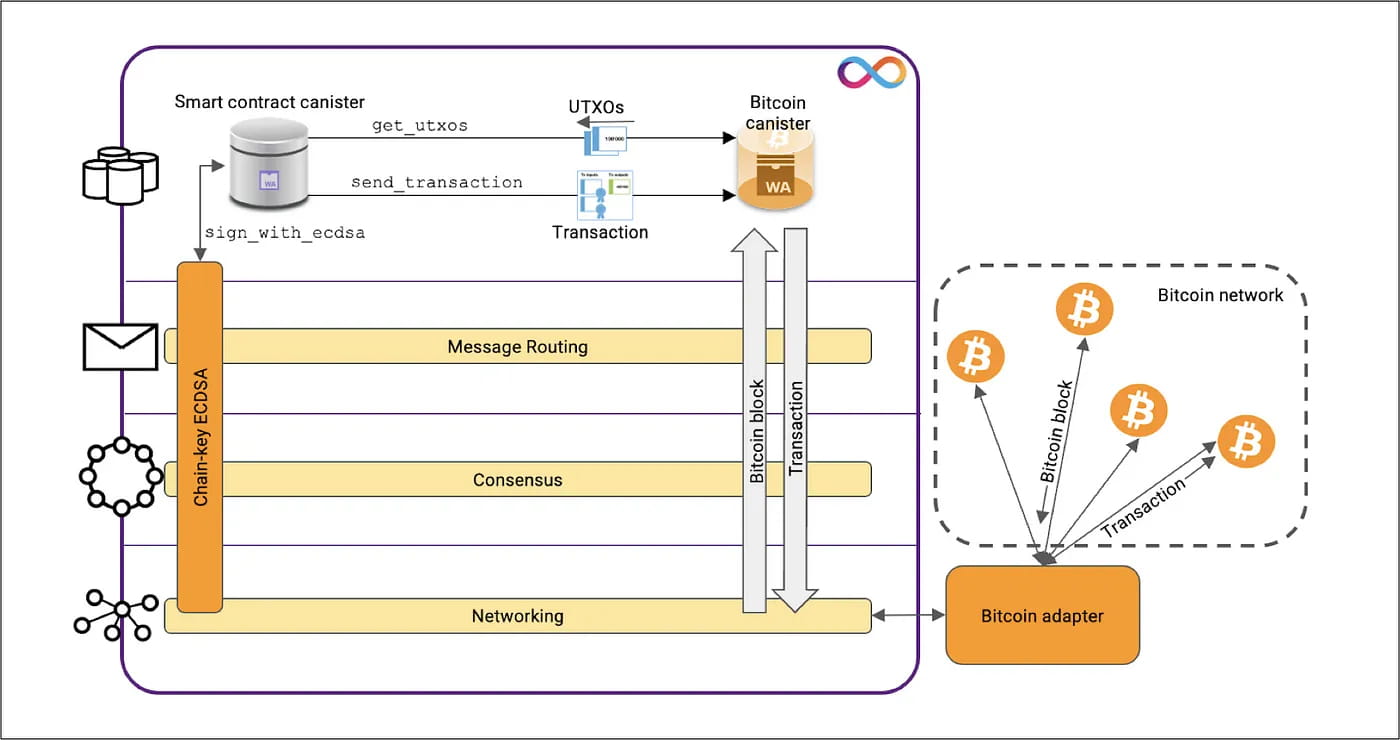
Containers on Internet computers can receive, hold and send Bitcoin, integrate directly with the Bitcoin ledger, and sign BTC transactions in real time at the protocol level. All BTC still exists on its native chain, and the tokens never leave Bitcoin. network.
However, control of the assets originates from a subnet of computers on the Internet, similar to how DAOs control dApps.
ICP containers are essentially BTC users, technically the BTC network doesn't know the difference between IC containers or Ledger hardware wallets, the ultimate controller of the asset is more or less an "artifact" using the chain key ECDSA signature (for An advanced variant of ECDSA (an advanced variant of Internet Computer Tailored Threshold) to sign transactions.
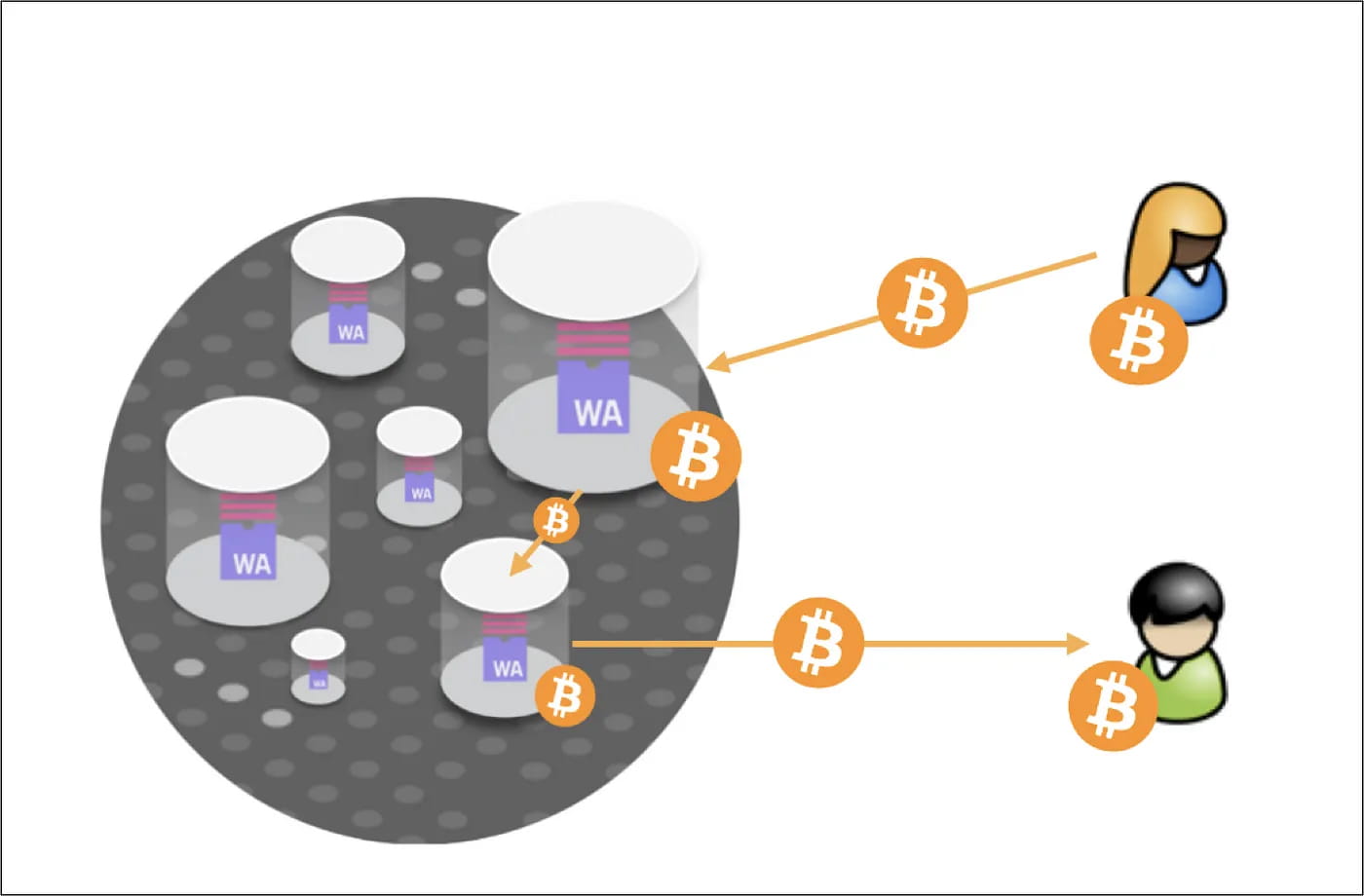
A subnet of Internet computers connects to the Bitcoin network, using their numerous nodes to pull its full transaction ledger (approximately 30 gigs), while, via ICP threshold ECDSA signatures, containers have Bitcoin addresses that allow them to be submitted via smart contracts Hold BTC safely when trading BTC.
A new dawn for BTC
Since ckBTC is a new paradigm in blockchain technology, it is difficult to break down its value proposition in an easy-to-understand way. As with all innovations in blockchain technology, a whole new vocabulary is needed to accurately describe the mechanics and benefits of ckBTC. .
ckBTC provides the first real-world use case for bringing smart contracts to BTC, and all DeFi will soon start to be built on ICP, where processing is safer, faster, greener, and more cost-effective.
About internet computers
Developed by the DFINITY Foundation, the Internet Computer (IC) blockchain is the world’s first truly decentralized and infinitely scalable public blockchain. The Internet Computer (IC) blockchain runs at network speeds on dedicated nodes hosted by independent node providers around the world. Runs end-to-end on a machine-sovereign network, making IC the only blockchain that does not rely on centralized cloud nodes.
The Internet Computer Blockchain is governed by the Network Nervous System, a protocol-integrated DAO that gives token holders the power to vote on the future of the network.
As ICP increasingly becomes a decentralized alternative to the current public internet, hundreds of dApps are now hosting Web2-style applications (websites, mobile apps, etc.) entirely on-chain at network speeds.
Internet computers currently process more than 500 million transactions per day – significantly reducing energy consumption and costs – making ICP the most efficient blockchain in the world.
With the Internet Computer, the promise of a truly decentralized Internet—a trustless “world computer” in which the broadest range of Internet services can exist on a massively distributed computer—has been realized.
About the DFINITY Foundation
The Switzerland-based DFINITY Foundation, a non-profit organization dedicated to developing blockchain for computers on the Internet, was founded in 2016 by its chief scientist, Dominic Williams.
DFINITY's Zurich headquarters houses the largest blockchain R&D center in the region, with one of the most extensive R&D teams in the industry, featuring many world-renowned cryptographers, researchers and engineers.
Including its research center in San Francisco, California, DFINITY has more than 200 employees worldwide.
IC content you care about
Technology Progress | Project Information | Global Events

Collect and follow IC Binance Channel
Stay up to date with the latest information