



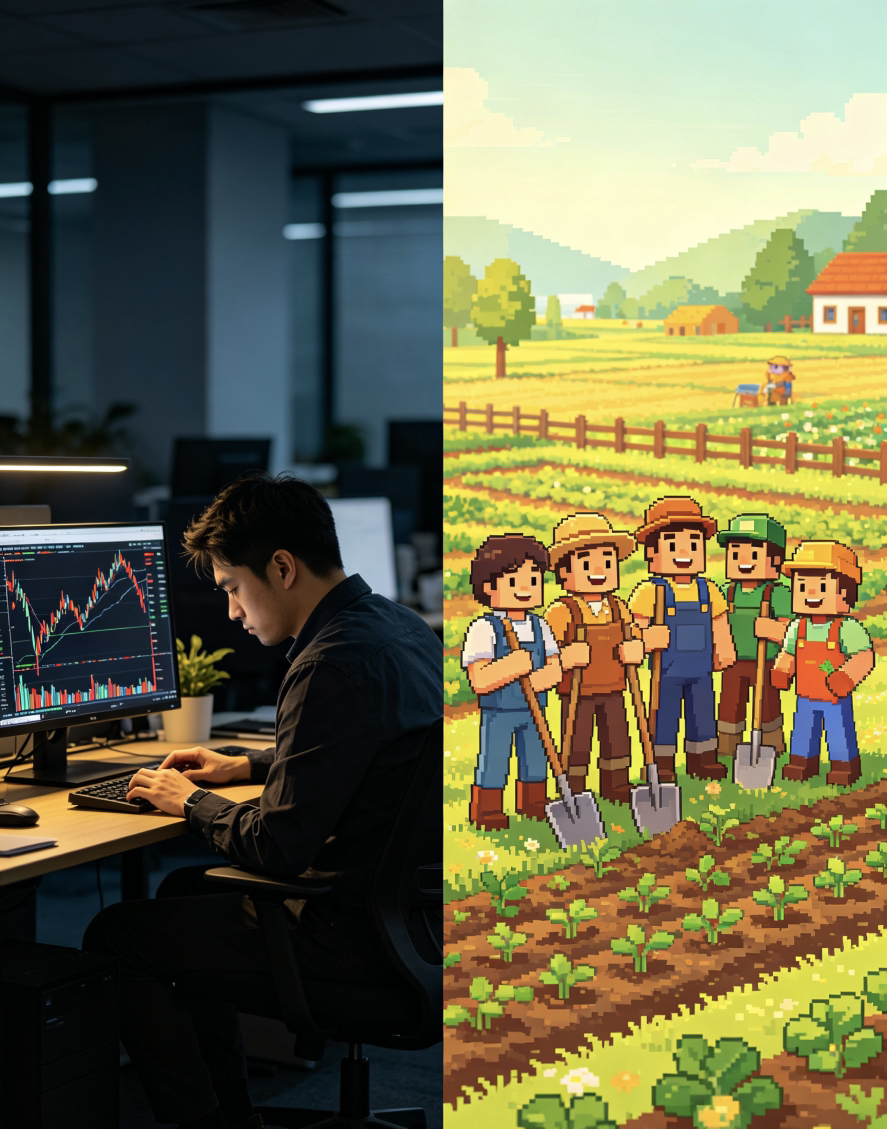
At the end of last month, I held my nose and officially gave up the company's office, declaring my Web3 startup project a dead end. Over the past year and a half, my tech partners and I have been grinding on an extremely complex derivatives protocol on the SOL chain, obsessively watching the volatility of the big coin (BTC) to try and catch a piece of the action in this bull run. We wrote the most beautiful smart contracts and secured seed funding from institutions, boasting in our PPT about 'Mass Adoption'.
So, what happened? The market had a slight wide-range shake, and the relentless spikes completely obliterated our core user pool. When the tide went out, I sadly realized that our proud financial innovation was merely handing a sharper scythe to those degens (gamblers) who were bloodthirsty in the secondary market. Everyone was playing a zero-sum game, picking each other's pockets, and as soon as new funds stopped flowing in, the entire ecosystem turned into a chaotic mess.
To shake off the gloom of my team's dissolution, I took a long break, forcing myself to uninstall all trading apps. By sheer coincidence, I opened @Pixels . Honestly, at first, as a 'professional,' I looked at it with a critical, even disdainful eye. In this era filled with ZK (zero-knowledge proofs), L2, and modularization, creating a retro pixel-style farm seems like a step backward, right?
But after I followed my professional instinct and spent a week completely dissecting the underlying economic model running on the Ronin chain, I felt a chill down my spine. This isn't just a casual mini-game; it's clearly the 'real digital economy' that we, as entrepreneurs, have hyped in white papers countless times but never actually delivered.
Why have most past projects' token economies collapsed? Because tokens are only good for 'mine, withdraw, and sell'—a one-way street. Tokens are distributed as rewards, which means it's a bottomless pit. But Pixels shows a nearly ruthless 'top-level design wisdom.' In this micro-society, retail investors produce basic resources through labor, but that's just the foundation. The real brilliance lies in its design for the 'essential consumption' of $PIXEL.
When those big players, landowners, and ambitious guilds want to establish their own barriers in the ecosystem—like boosting manor output, unlocking higher-level supply chains, or simply crushing opponents on the guild leaderboard—they face extremely harsh system thresholds. Want to cross the threshold? Sure, burn $PIXEL. Buying VIP, speeding up production, unlocking privileges; the system exploits these top players' 'vanity' and 'operational needs,' creating a bottomless token burn black hole. It perfectly transforms players' pursuit of power and efficiency into an anti-inflation underlying logic. This closed loop of treating tokens as 'industrial consumables' is leagues above our fragile DeFi staking models.
Now, watching people in the circle lose sleep over a few hundred points of fluctuation in Bitcoin, or hurl insults at each other over some shitcoin's impending zero, I actually feel quite calm.
The true decentralized future is not built on a few lines of cold, bloodthirsty financial code. When regular folks stop viewing Web3 as a casino and voluntarily log in to find a guild in this pixelated world, socializing and collaborating for the harvest of a piece of land, turning their time into recognized assets, that's when the gears of the metaverse really start turning. In this war transitioning from financial mutual destruction to 'cyber entities,' #pixel is already ahead of everyone else. Stop drawing fantasies on candlesticks; come here and see what real Web3 infrastructure can survive the cycles.