

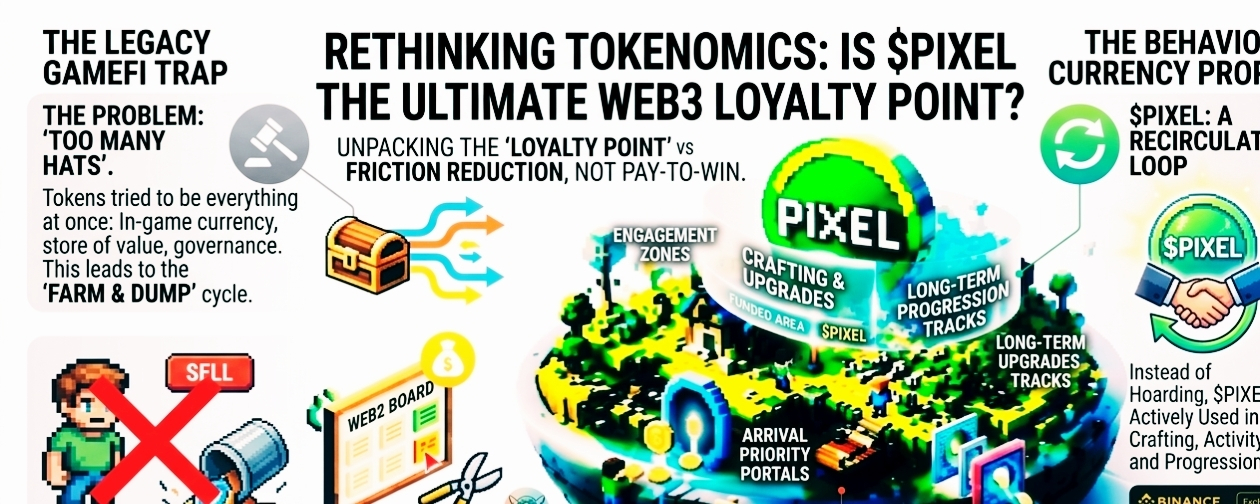

Let’s be real—most GameFi tokens try to wear too many hats. They want to be the in-game currency, the reward mechanism, a store of value, and the governance token all at once. It sounds great on paper, but that’s exactly why the system usually snaps.
When the thing you earn is the exact same thing you want to sell, the urge to dump is almost hardwired into the game. Anyone who has survived a few crypto cycles knows the pattern: Rewards peak → Player count moons → Token gets dumped into oblivion → Incentives die.
So, I’ve started looking at PIXEL through a different lens. What if we treat it as a behavioral currency?
Instead of an asset you just hoard in a wallet, it reflects your actual engagement. In Pixels, the token isn't just minted and forgotten. It’s actively cycled back through the economy—crafting, upgrading, paying for activities, and looping into long-term progression. It feels much more like a self-sustaining loop than a one-way street out the door.
This naturally got me thinking about traditional Web2 loyalty programs. You engage, you earn points, and you spend them inside the ecosystem. They aren't meant for wild speculation, but they crush it at user retention.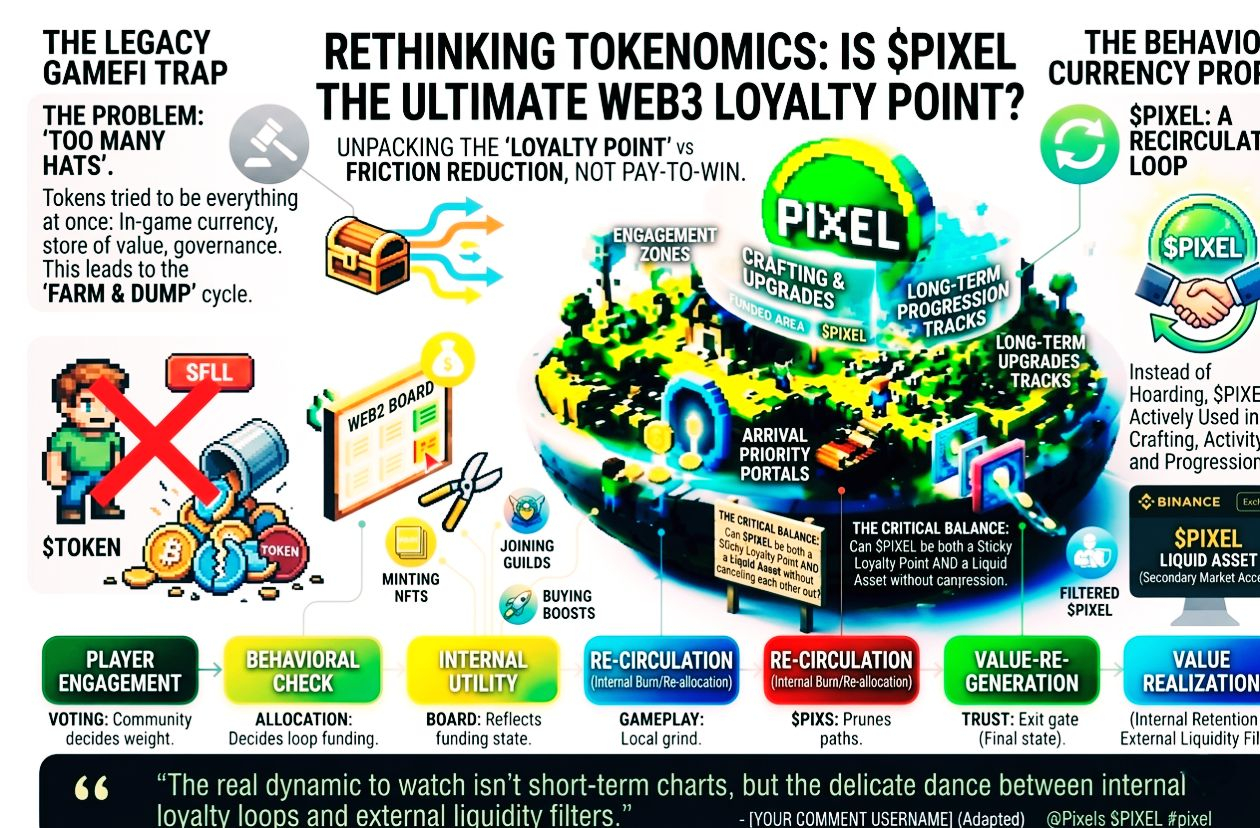
Obviously, $PIXEL isn't a pure Web2 loyalty point. It’s listed on Binance. It has a very real secondary market. And that’s where the design tension gets incredibly interesting.
External liquidity is a double-edged sword. On one side, you get price discovery, deep liquidity, and easy onboarding. On the flip side, it leaves the door wide open for value extraction.
If the player base treats PIXEL strictly as a farm-and-dump asset, that "loyalty loop" completely falls apart. But if you lock the system down completely and remove the exit liquidity, it loses its Web3 appeal and feels restrictive. Balancing these two extremes is brutally difficult. Forget the short-term charts—this is the real dynamic to watch.
It brings up a massive question that I don't quite have the answer to yet:
Can a single token successfully act as both a sticky loyalty mechanism AND a liquid, tradable asset without those two forces canceling each other out?
It sounds like a paradox. But Pixels is actively walking that tightrope. They aren't killing off the open-market aspect, but they also aren't letting pure speculation run the entire show.
If they actually pull this off, it fundamentally changes the GameFi playbook. We’d have to stop looking at tokens purely as "assets" and start evaluating them as "behavioral drivers."
It’s still early days, and there’s a lot left to prove. But it is definitely an experiment worth keeping a close eye on