
Honestly, I've got a special attachment to Pixels since I started with its early "farming and mining" phase. Unlike many Web3 projects that hype up their launch, it took a more laid-back, almost "Buddhist" approach, allowing players to gradually enjoy the fun of on-chain gaming. Early Pixels felt like a community-driven "digital farm" where everyone was planting, trading, and socializing, and the production and consumption of PIXEL tokens were quite balanced.
But recently, Pixels rolled out its new Union mechanism and the accompanying Yieldstone system, which made this old player feel a bit "jolted". To be honest, I started researching it out of curiosity, after all, games need to iterate and keep things fresh. But after diving deeper, I couldn't help but question: is this true innovation, or just an "invisible discouragement" for retail investors?$PIXEL
First, let's talk about the faction-switching mechanism that really makes me "feel the pinch." In the new gameplay, players can choose different Unions (factions), but want to switch factions? That’ll cost you 50PIXEL in fees, plus there’s a cooldown period. For early low-cost entrants, 50PIXEL might not be a big deal, but for someone like me who bought PIXEL at high prices in the secondary market, or for retail traders with light participation, that’s a significant expense. Not to mention the cooldown period; once you pick the wrong faction or find another one that’s more advantageous, you can’t just "jump ship" immediately—you can only watch opportunities slip away or stubbornly bear the losses.$HYPER
This reminds me of the "server transfer fees" and "job change fees" in traditional MMORPGs, but @Pixels as a Web3 game, it should emphasize asset fluidity and player autonomy. This high switching cost and cooldown period, in my view, resemble a "locking" mechanism, encouraging players to "stick to their guns," yet inadvertently increasing the trial-and-error costs and decision pressures for retail traders. I can’t help but wonder: Is this design meant for the long-term healthy development of the game, or is it to filter out "die-hard fans" and "whales," trapping retail traders deeper in "sunk costs"?
Now let’s talk about Yieldstone, the core resource of the new gameplay. Yieldstone isn’t tradeable between factions, which means what? It means that the Yieldstone you invest time and money to acquire will be entirely "sunk" if you switch factions, rendering all your previous efforts useless. For retail traders who like to operate on multiple fronts and want to flexibly adjust strategies, this is a disaster. Whales can leverage their funding advantage to diversify across factions or withstand the losses from switching, but what about retail traders? They can only "bet" on one faction; if they pick the wrong one, their early investments go down the drain.
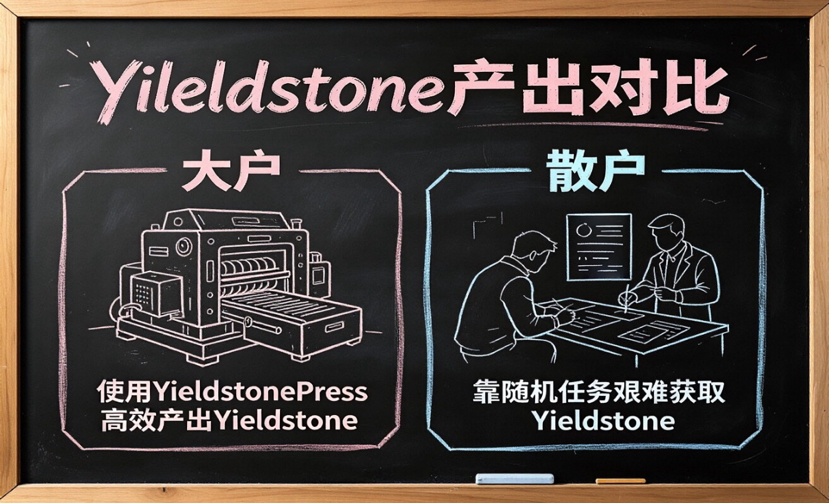
What really makes me feel the "zero-cost struggle" is YieldstonePress. To build the key facility for Yieldstone, you need NFT land. Players without NFT land, especially those who are zero or low investment, can only earn Yieldstone through luck-based tasks. This randomness is inherently unfavorable for retail traders, and task acquisition efficiency may be far below that of players with Press. It's like a race; the whales take off in their sports cars while we retail traders are left running on two legs, hoping "the universe" will bless us with some returns.
 Another mechanism that makes the "whale advantage" glaring is Sabotage. This mechanism requires intel support, and gathering and utilizing intel often demands a ton of resources and information advantages. Whales can team up to gather intel and strike precisely at their opponents, while retail traders might not even have a shadow of that intel and can only passively take hits. This asymmetry in information and resources significantly undermines the fairness of the game, greatly reducing retail traders’ sense of participation and achievement.
I understand the Pixels team wants to enhance fun and strategy with the new gameplay and boost player belonging and community cohesion through the Union mechanism. But to me, these new mechanisms feel more like a "feast" tailored for whales, leaving retail traders as mere "spectators" or even "sacrificial lambs." $AXS
So my advice is for new players or retail traders who are still on the sidelines: maybe just "let the bullets fly for a while." Observe a season, see how different factions develop, check out the actual Yieldstone output and its value, and assess how Sabotage impacts game balance. Don’t rush to invest large amounts of money and time, and definitely don’t get swept up in "FOMO". DYOR is always the golden rule in Web3.
I still hold hope for Pixels' future; after all, it has brought me a lot of joy and witnessed the journey of Web3 gaming from its inception to growth. But I hope the Pixels team can hear the voice of retail traders and focus more on fairness and inclusivity in future iterations, so that every player, regardless of their funding, can find fun and value in this "digital pastoral." Otherwise, when retail traders start to "break defense" and leave, leaving only whales to "entertain themselves," the "pastoral dream" of Pixels might come to an end.#pixel #Web3游戏