


Today we continue to explain the Bitcoin layer2 project. Today is very popular science and useful information. Yesterday we talked about satoshiVM, which just came out and has doubled many times. The BEVM we talked about today is also a layer2 project. Let’s take a look at this project. So, which Bitcoin layer 2 project will stand out in the next bull market?
Overview of existing Bitcoin Layer2 solutions
1.Vitalik. As early as 2014, some developers proposed solutions to the Turing incompleteness and scalability problems of the Bitcoin network, the most famous of which is Vitalik. Vitalik originally wanted to build a Turing-complete VM for the Bitcoin network so that it could not only serve as a currency system, but be able to perform more complex operations, especially smart contracts. Due to concerns about network security and stability, the Bitcoin community at the time was conservative about making major changes to the core protocol, which forced Vitalik to establish Ethereum.
2. Lightning Network. After VB, the most famous Bitcoin Layer 2 is Lightning Network. Its goal is to realize the "global payment" of Bitcoin, and the core is to enable Bitcoin to realize fast and convenient small-amount payments on the Lightning Network, a second-tier network. However, Lightning Network does not support smart contracts, so it is not possible to develop ecological applications related to Bitcoin on Lightning Network. Currently, the number of BTC pledged on the Lightning Network network is approximately 4,000. In addition, the cost of user education for fraudulent proofs in the Lightning Network is high, and it is difficult for non-developers to submit fraudulent proofs to maintain asset security. Therefore, the Lightning Network has its natural advantages for Bitcoin micropayments, but there is still a long way to go before large-scale adoption.
3.Stacks. Stacks is positioned as the smart contract layer of Bitcoin, and the mainnet will be launched in 2018. It uses the "hook" method to realize BTC cross-chain, which is achieved by issuing sBTC on the Stacks network, which is essentially a centralized mapping method; its network Gas uses its main network token STX instead of BTC, and miners participate Stacks’ network mining will consume pledged BTC to mine its network tokens. Such a network design will not only not be supported by Bitcoin users, but will even generate great resentment; its ecosystem uses the relatively niche Clarity as a programming language , which also greatly limits the influx of developers. Its ecology has been developed for 5 years, but most projects have received mediocre response or are in a stagnant state. The TVL of the entire ecology is currently less than 25 million US dollars.
4. Rootstock. RSK is positioned as Bitcoin Layer 2 that supports smart contracts. It uses a Hash lock to cross the main network BTC to the RSK network. However, the Hash lock is still a centralized method and it is difficult to gain the trust of Bitcoin users. Therefore, using The number of BTC cross-chained by RSK is only a handful; at the same time, the current consensus algorithm of the RSK network is still POW. As a second-layer network, it still uses the POW consensus mechanism with poor performance. Its ecology is naturally difficult to develop. Therefore, the RSK main Although the Internet was launched in 2018, its ecology has hardly developed at all. As one of the "top ten king-level projects" of that year, it has gradually been forgotten by people.
5. Liquid. Liquid is a second-layer Bitcoin network launched by Blockstream. Essentially, Liquid is a Bitcoin side chain. Liquid serves mainly institutions and asset issuers, and provides asset issuance and circulation based on Bitcoin side chains for the B-side. Therefore, Liquid's Bitcoin cross-chain solution is relatively centralized, using 11 certified multi-signature nodes to host Bitcoin. Liquid's solution is similar to a consortium chain with a permission mechanism. Since it provides financial asset issuance services to institutions, Liquid considers security and privacy more. Therefore, the Liquid network is a consortium chain solution that requires permission for access. As a Bitcoin side chain network for B-side services, Liquid has its own rationality. However, in order to gain broad support and use from the Bitcoin community and crypto users, decentralized and permissionless BTC Layer 2 is the more promising direction.
6. RGB. RGB's goal is to build BTC Layer2 based on BTC UTXO and Lightning Network. The core design of RGB is divided into three points: UTXO state compression and encapsulation, client verification, and bridging the Lightning Network to run non-shared smart contracts. The most orthodox thing about RGB is that the data running on RGB will be compressed and encapsulated into Bitcoin. In each UTXO, that is, the core data running on RGB is attached to the Bitcoin blockchain with the help of UTXO, and the Bitcoin network is used to ensure the security of assets. However, this is also a function that RGB has not been able to achieve; even if this function The implementation still faces two problems. Since the client needs to trace the upstream UTXO of each asset when verifying assets, a large amount of data verification is involved. The more times the assets are transferred, the greater the verification difficulty and verification cost; even if the assets can However, the Bitcoin blockchain only serves as a certificate ledger for off-chain data. Bitcoin miners do not really participate in the verification of RGB assets. Therefore, it is difficult to say that the RGB ledger shares the security of the Bitcoin ledger; and , RGB smart contracts do not really run on the chain. Each RGB-based smart contract cannot interact and is independent. If two tokens issued based on RGB need to build a Swap, they cannot be issued on EVM. Instead of directly implementing Swap interaction like assets, it needs to be transferred to the Lightning Network for interaction, and its complexity is evident.
7.ChainX. ChainX is the first WASM-compatible Bitcoin second layer based on Substrate. More than 100,000 Bitcoins have been cross-chained from the Bitcoin network to ChainX. The biggest problem with ChainX is that it uses an 11-person multi-signature solution to host users’ Bitcoin assets, which has a certain degree of centralization risk.
8.BitVM. It is a BTC Layer2 solution proposed in 2023 and is still in the theoretical stage. The most discussed thing about BitVM is its relatively "hard-core" technical implementation solution. Its core logic is to run a fraud proof similar to optimistic rollups on the BTC script. The so-called fraud proof means that when an asset transaction has objections, the user can initiate a report. If there is a problem with the transaction, the assets of the dishonest party will be will be confiscated. Generally, the effective reporting time is within 7 days (which can be simply understood as unconditional return within 7 days). However, if the user initiates a reporting after 7 days, it will be invalid. Even if there is a problem with the asset transaction, it will be automatically saved in Continue to run on the blockchain. BitVM's smart contract layer runs off-chain, and each smart contract does not share state; BTC cross-chain uses traditional Hash locks for asset anchoring, and does not achieve truly decentralized BTC cross-chain.
All the Bitcoin second-layer solutions mentioned above cannot respond well to three problems:
1. How to transfer Bitcoin from Layer 1 to Layer 2 in a decentralized manner;
2.2. Whether BTC Layer2 can gain the consensus and support of Layer1 mainnet users;
3.3. Is BTC Layer2 friendly enough for developers and users?
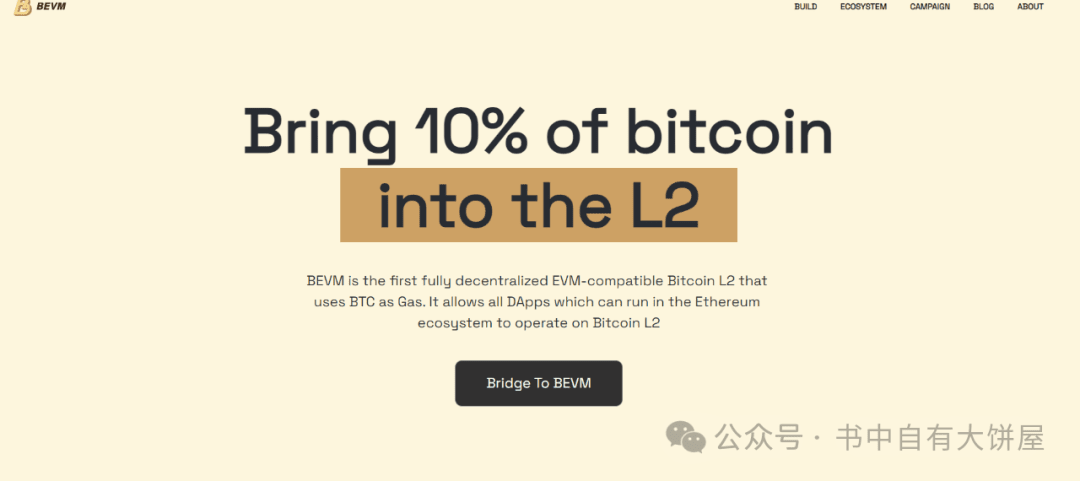
Based on this, BEVM was created, an EVM-compatible, BTC-based, fully decentralized Bitcoin second layer. BEVM has made outstanding contributions to maintaining the security of the BTC network, including: increasing BTC consumption scenarios, bringing new sources of income to miners, decentralized custody of user assets with Taproot technology, and realizing decentralized Bitcoin financial business scenarios, etc. .
Positioning of BEVM
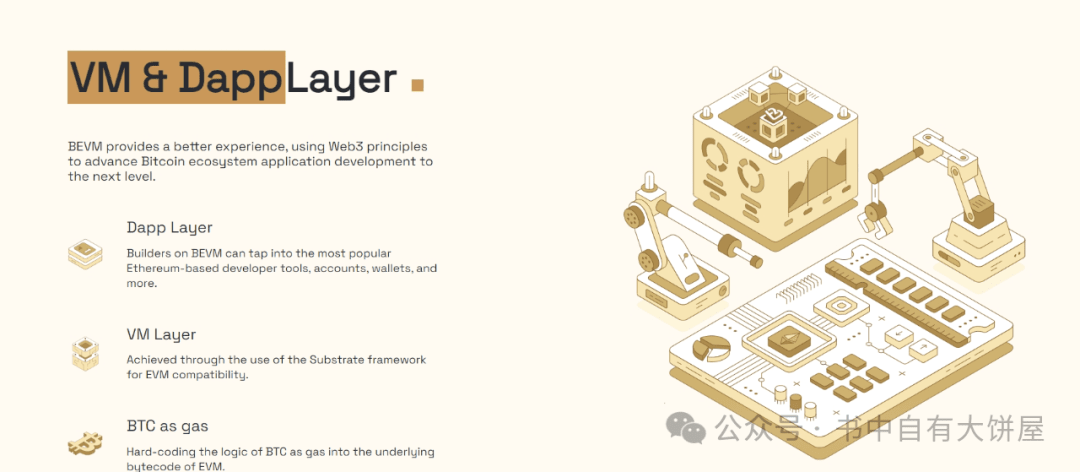
˙BEVM is a decentralized BTC Layer2 that uses BTC as Gas and is compatible with EVM.
˙BEVM is based on the Schnorr's signature algorithm and MAST contract technology brought by the Taproot upgrade, allowing BTC to cross-chain from the Bitcoin main chain to Layer 2 in a completely decentralized manner. Since BEVM is compatible with EVM, all decentralized applications that can be run in the Ethereum ecosystem can be run on BTC Layer2. In this process, BTC can not only be used as the Gas for the operation of Layer 2, but can also be completely decentralized and circulated to any blockchain using BEVM as a bridge.
3. 6 years of BTC Layer2 exploration by the BEVM team
The BEVM team began exploring Bitcoin Layer 2 in 2017. In 2018, the BTCLayer2-ChainX launched by the BEVM team achieved 100,000+ BTC cross-chain. However, due to industry development, ChainX did not usher in a real explosion.
In 2021, Bitcoin completed the Taproot upgrade, and BTC can achieve true decentralization and cross-chain. Therefore, the BEVM team began to build BTC Layer2 based on the Taproot upgrade. In 2023, Bitcoin currency issuance protocols such as Ordinals broke out, allowing the BEVM team to see Bitcoin The ecosystem will usher in a new era, so the BEVM advanced network was launched and the main network is planned to be launched in Q1 2024.
The birth background of BEVM
1. SegWit upgrade and Taproot upgrade
The birth of BEVM is completely based on Bitcoin's SegWit upgrade in 2017 and Taproot upgrade in 2021. The SegWit upgrade allows Bitcoin blocks to accommodate larger data, and the Taproot upgrade not only allows the expanded space to accommodate larger Complex data, and due to the introduction of Schnorr's signature algorithm in the Taproot upgrade, decentralized Bitcoin multi-signature has become a reality, and thus decentralized Bitcoin cross-chain can be realized. In the end, decentralized BTC Layer2 has also become In reality, BEVM is the best example of decentralized BTC Layer 2.
SegWit upgrade and Taproot upgrade make Bitcoin great again, allowing Bitcoin to evolve from the 1.0 era to the Bitcoin 2.0 era, allowing us to see a richer Bitcoin ecosystem.
2. The outbreak of Bitcoin currency issuance protocols such as Ordinals in 2023
The explosion of Bitcoin currency issuance protocols such as Ordinals in 2023 is the result of the Bitcoin SegWit upgrade and Taproot upgrade. This allows the Bitcoin community to see that it is possible to issue assets based on Bitcoin. Issuing assets is only the first step. More and richer ecological applications need to be built on BTC Layer2. Thus, BEVM was born.
3. 6 years of BTC Layer2 exploration by the BEVM team
The BEVM team began exploring Bitcoin Layer 2 in 2017. In 2018, the BTCLayer2-ChainX launched by the BEVM team achieved 100,000+ BTC cross-chain. However, due to industry development, ChainX did not usher in a real explosion.
In 2021, Bitcoin completed the Taproot upgrade, and BTC can achieve true decentralization and cross-chain. Therefore, the BEVM team began to build BTC Layer2 based on the Taproot upgrade. In 2023, Bitcoin currency issuance protocols such as Ordinals broke out, allowing the BEVM team to see Bitcoin The ecosystem will usher in a new era, so the BEVM advanced network was launched and the main network is planned to be launched in Q1 2024.
BEVM’s technical framework and solutions
BEVM technically aims to break through two important things. The first is how to implement BTC layer2 in a decentralized manner; the second is how to use BTC as a gas fee to be compatible with EVM and the EVM surrounding ecosystem.
1. How to implement decentralized BTC layer2?
The biggest problem with the existing Bitcoin second-layer solution is that it cannot achieve decentralization. That is, there is no guarantee that the user's Bitcoin can be bridged to the second layer in a decentralized manner; or there is no guarantee that the user's assets and data can be bridged back to the Bitcoin network from the second layer in a decentralized manner.
1.1 How to decentralize BTC and BTC assets (such as #BRC20) across the chain to BTC layer2?
BEVM ensures the security and decentralization of assets from the Bitcoin network to Layer 2 by implementing Bitcoin light nodes on the chain.
1.1.1 Synchronizing the complete Bitcoin block header is used to prove the certainty of BTC network data.
1.1.2 Synchronize cross-chain related transactions and transaction merkle proof on BEVM to prove the correctness of the data.
The entire BTC light node data is implemented on the BEVM chain and will be confirmed by the BEVM consensus. The BTC light node data will be synchronized to the underlying account system of EVM to complete the decentralized transaction of data and assets from BTC to BEVM. toward interaction.
1.2 How to decentralize the assets and data on BEVM across the chain to the Bitcoin main network?
Most of the current second-layer Bitcoins use private key sharding and multi-signature schemes. The multi-signature scheme has no more than 15 multi-signature custodians at most, and the amount of data to be uploaded is huge and expensive. Private key sharding may require a trusted central entity to coordinate the sharding process or provide initial security settings. This step is completed on a centralized server, and there is a risk of fragmentation leakage. BEVM uses Taproot technology to realize the decentralized transfer of second-layer data and assets back to the Bitcoin main network through POS consensus nodes.
1.2.1 POS consensus node on BEVM. Each POS consensus node on BEVM comes with three private keys, namely: POS block production private key, POS management private key, and BTC threshold signature private key
POS private key for block production: The private key for block production is an online private key, which is responsible for the block production and maintenance of BFT consensus on the POS network on BEVM.
POS management private key: The management private key is an offline private key, responsible for updating and replacing any one of the three private keys.
BTC threshold signature private key: It is N threshold contract private keys generated through Taproot (shnorr + Mast contract) technology, which is responsible for hosting the assets and data on the interactive BTC network. The BTC threshold signature private key is generated by selecting n consensus nodes through POS Staking logic, and n can support up to 1,000. Then, the POS consensus nodes respectively send on-chain transactions to set their own BTC taproot threshold public keys, completing the mapping of their own three public keys. Finally, n consensus nodes form a ⅔ threshold custody contract, similar to the BFT consensus of the POS network
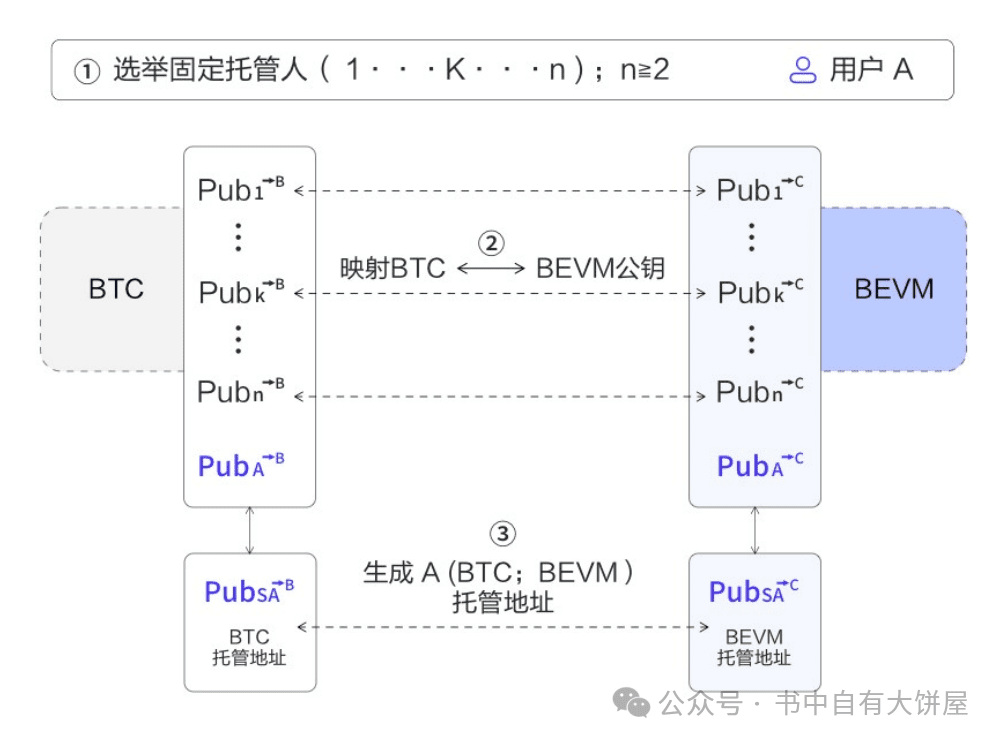
1.2.2 How do interactive transactions on BEVM return to the layer1 settlement layer BTC network?
First, the user submits a transaction across the BTC network on BEVM's EVM platform, and then BEVM's n POS consensus nodes will use the BTC threshold custody contract to conduct a BFT vote of greater than 2/3. After the vote is passed, a BTC taproot transaction will be generated.
Subsequently, the BTC taproot transaction will be submitted to the BTC network to complete the interaction of assets on the BTC chain.
The solution to cross assets and data from BEVM back to the BTC main network integrates BEVM's POS consensus node and BTC's threshold signature custody contract, making BTC's custody security as decentralized as BFT POS by fully trusting the code instead of people. culture and safety.
2. How to use BTC as gas to be compatible with EVM and surrounding ecology?
2.1 EVM compatibility achieved using the Substrate framework.
2.2 Hard-coding BTC as gas logic into the underlying bytecode of the EVM.
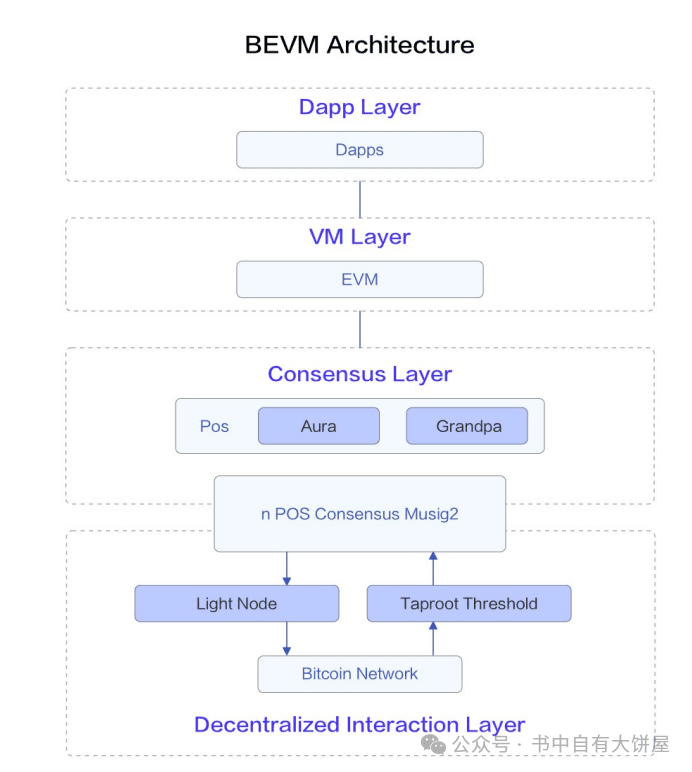
overall framework
Cross-chain interaction layer: Between Bitcoin and BEVM, a decentralized interaction layer is realized through Bitcoin light nodes and the taproot threshold contract integrating POS consensus.
Consensus layer: Aura consensus is used for polling and block generation, and Grandpa is used for BFT consensus confirmation.
VM layer: Smart contract platform layer fully compatible with EVM
Dapp layer: decentralized Dapp application layer that supports writing in various Solidity languages
Future technology expansion
The BTC hosted on BEVM participates in BEVM's POS consensus pledge to ensure that the entire BEVM chain is subject to the security control of the BTC mainnet from the economic game layer.
Currently, BEVM forms the consensus layer of BEVM by using threshold contracts generated by taproot accounts of nearly 1,000 BTC. We can go one step further and add BTC to participate in Layer 2’s POS pledge to ensure that the security of the Layer 2 consensus layer is controlled by the BTC main network.
The corresponding principle of BTC custody volume is:
When the BTC custody amount is much greater than the market value of BEVM governance tokens, the entire network is pledged by the custodial BTC to ensure the security of the network.
When the proxy market value of BEVM is much larger than the BTC custody amount, the governance weight of the entire network is ensured by the BEVM governance token to ensure the security of the network.
When in between, BEVM will co-pledge the governance tokens and BTC to maintain the security of the network.
Current ecology
At present, there are not many ecosystems on the official website. There are about a dozen, all of which are published on Xianxing.com.
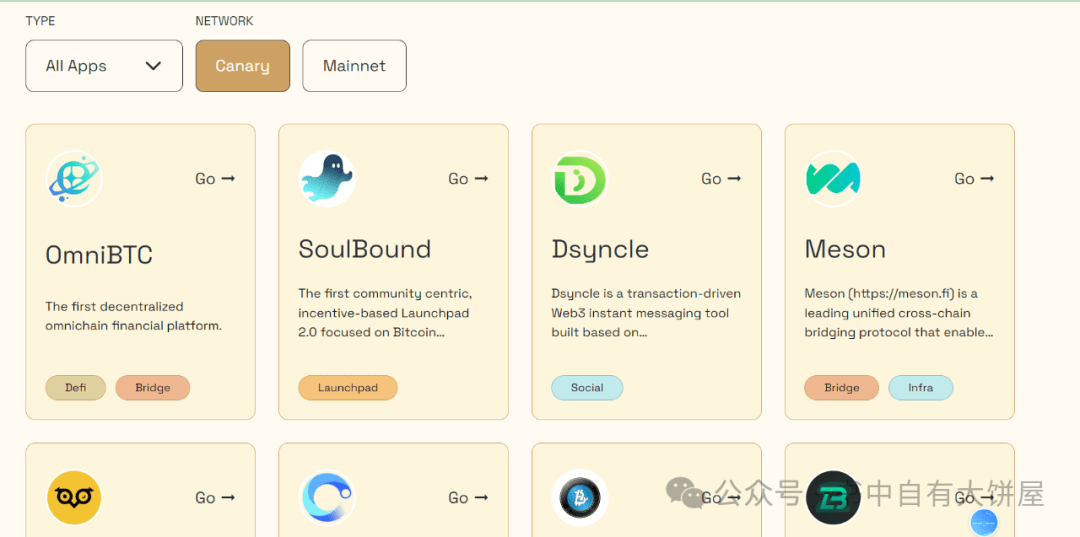
Finally, let me summarize this project. Currently, this project is still in the stage of Xianxing.com. The advantage is that the team is one of the very early ones to do Bitcoin layer 2 and has a certain amount of technical accumulation. In fact, at the beginning, although it compared 8 other Bitcoins The layer2 project, but its principle is actually to build a side chain, without using a very orthodox rollup method, and the full text does not mention the issue of its efficiency, because the consensus speed of POS is actually not fast. Bitvm, which is still in the theoretical stage as mentioned above, is a more orthodox rollup method. Fortunately, this project also said that there will be governance tokens in the future, so you can still do interactive short selling.