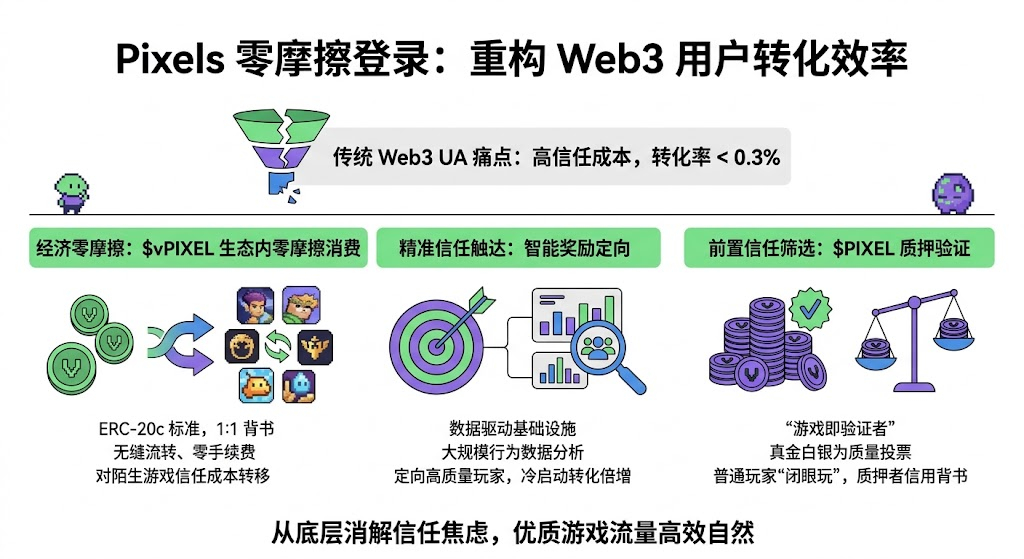
In the years I've spent making Web3 games, I've crunched some painful numbers: our team has spent hundreds of thousands of dollars on marketing, and from user clicks on ads to actually entering the game and making their first purchase, the full funnel conversion rate is less than 0.3%. The bottleneck in the conversion funnel has never been a lack of engaging gameplay; it's the inherent high trust costs of Web3.
In the traditional Web2 world, the trust barrier for players trying out a new game is almost zero—just click to download, and if they don't like it, they can uninstall anytime without any extra costs. But in the Web3 gaming space, this conversion funnel is ridiculously steep: the requirement to hold NFTs, complicated wallet signature authorizations, confusing cross-chain operations, and the ever-present Gas fees. Every interaction drains player trust a bit more, ultimately leading to sky-high user acquisition (UA) costs for the entire industry. This is a major headache for me and most of the folks in the field.
It wasn't until I thoroughly deconstructed the complete architecture of @Pixels 2.0's whitepaper that I realized it didn't, like most projects, focus solely on optimizing the UI of the front-end login interface. Instead, it has reshaped the underlying economic architecture, particularly through the decentralized publishing flywheel and the implementation of ERC-20c technology, completing a grand 'zero friction economic login' experiment that fundamentally restructures user conversion efficiency within the ecosystem. This is the core reference it provides for the entire industry to solve conversion challenges.
In my view, the biggest barrier for Web3 players when it comes to trying new games is not the operational barriers but the distrust of unfamiliar project economic models. As soon as players want to play a new game, they have to buy new tokens on exchanges and acquire exclusive entry assets, instantly raising their guard — after all, no one knows if the assets they purchase will drop to zero overnight, which is the biggest roadblock to conversion.
And #pixel , through the design of vPIXEL, skillfully resolves this trust crisis. The whitepaper explicitly states that vPIXEL is an ecosystem-exclusive consumption token based on the ERC-20c standard, backed 1:1 by the core token $PIXEL . Its most critical feature is that it can flow seamlessly and trade with zero fees across all partner games within the Pixels ecosystem.
This means that when players of the core farming game on Pixels want to experience newly onboarded games within the ecosystem, they no longer need to buy tokens on exchanges, endure the friction of cross-chain operations, or fear the economic models of unfamiliar projects. They can directly enter the world of new games with their existing $vPIXEL in hand, with 'zero friction'. This design successfully shifts the trust cost of players regarding 'unknown individual games' onto the trust in the 'mature Pixels platform', instantly smoothing out the user conversion barriers for new games.
Traditional Web3 game customer acquisition is basically a 'cast a wide net, high air-drop' model, which essentially uses high marketing costs to forcibly buy players' initial trust. But this bought trust is extremely fragile; once subsidies stop, user retention and conversion rates plummet dramatically. This is also the core reason I've seen countless projects fail in cold starts.
Pixels 2.0 has completely abandoned this inefficient user acquisition logic. The whitepaper clearly states that it has built a data-driven infrastructure that benchmarks next-generation advertising networks, capable of accurately identifying which players have real spending intentions, high retention traits, and long-term contributions to the ecosystem through large-scale behavioral data analysis from millions of players.
When developers cold start a new game within the $PIXEL ecosystem, the system's 'smart reward targeting' acts like a precision surgical operation. Rewards aren't indiscriminately scattered across the network but directly airdropped to high-quality players who have been validated by data and have deep trust in the ecosystem. These users are already deep participants in the platform, highly receptive to new content within the ecosystem, naturally lacking the distrust barrier towards unfamiliar projects. This data-driven 'zero friction' trust reach not only significantly boosts the early conversion rates of new games but also continuously lowers the customer acquisition costs across the entire ecosystem through decentralized publishing flywheels.
In Pixels' decentralized publishing network, the most surprising design is that it has front-loaded the 'trust filtering' action before players even engage with the game.
According to the core model in the whitepaper, 'Games as Validators', whether a newly onboarded sub-game can receive traffic tilt and reward allocation from the ecosystem primarily depends on whether $PIXEL stakers are willing to vote and stake tokens for it. Stakers, motivated by protecting their own assets and seeking higher RORS (Return on Reward Spend), will conduct extremely rigorous business audits, model validations, and gameplay screenings for these new games, essentially voting for the game's quality with real money.
For the average player, this means that any game appearing in the Pixels ecosystem's recommended spots and receiving ecosystem rewards has undergone rigorous due diligence by smart capital within the ecosystem. Stakers are backing the game's reliability with their own assets, greatly reducing the trial-and-error costs and trust anxiety for regular players. They no longer need to research whitepapers, check contract risks, or validate economic models; their confidence to 'play with their eyes closed' stems from this pre-existing trust filtering mechanism.
While the vast majority of projects in the industry are still fixated on optimizing webpage loading speeds and simplifying wallet authorization steps in an attempt to improve conversion funnels from an operational perspective, Pixels has identified the core friction in Web3 gaming: it has never been at the code level, but rather at the economic and trust levels.
Through the seamless flow of $vPIXEL within the ecosystem, precise trust reach from the data engine, and collective credit backing from the staking mechanism, Pixels has built a 'zero friction' funnel for traffic within the ecosystem that has almost no trust barriers. Under this framework, quality games no longer have to worry about high customer acquisition costs, because the flow of traffic in this giant trust reservoir built by Pixels is as natural and efficient as mercury flowing.
For all of us working in Web3 gaming, this is the most worthwhile underlying logic to learn from: to truly enhance user conversion, it has never been about forcing users to adapt to the complex rules of Web3, but about using underlying design to help users dissolve all invisible trust anxieties.