In the old era of Web3 games, I have seen too many sub-game developers' dilemmas: to attract new users, either spend a lot of money to buy traffic or blindly throw tokens 'sprinkling coins', which seems to have users in the short term, but in reality, it is like draining the pond to catch the fish, and in the end, either the traffic is lost or the token inflation collapses. But the transformation of $PIXEL 2.0 has poured a bucket of cold water on all developers — the days of relying on inflation to exchange for traffic are completely over.
When the white paper designated RORS as the core ecological indicator, I realized that the way to cold start sub-games had completely changed. It is no longer 'the more coins you sprinkle, the more users you have,' but rather 'the higher the efficiency, the farther you go.' As a long-term participant rooted in Pixels, I have witnessed that those developers who refuse to blindly sprinkle coins have instead achieved low-cost, high-quality customer acquisition through a completely new logic.
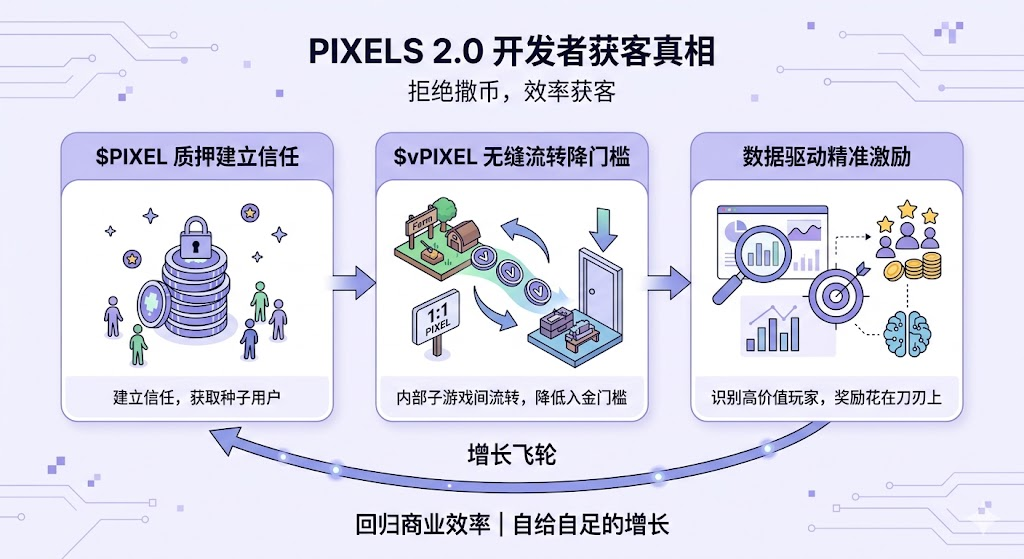
I found that the cold start of sub-games in @Pixels doesn’t require spending money to buy users from exchanges; the core is first to set up the staking pool and accumulate enough trust. This is completely contrary to traditional user acquisition logic: developers do not need to exhaust cash flow on advertising but should instead provide real value — such as the game's retention mechanism and profit potential, encouraging $PIXEL holders to stake their tokens for this game.
More critically, holders willing to stake are themselves the most precise early seed users. This process of "staking is recognition" effectively filters out speculators who only want to take advantage, leaving only those willing to participate in the long term, where user acquisition costs directly transform into "credit assets" in the ecosystem, much more efficient than spending on ads.
In addition, the existence of $vPIXEL also helps developers solve the biggest pain point in user acquisition — troublesome deposits/indirect losses. I have tried it myself; vPIXEL relies on ERC-20c technology, and is pegged 1:1 to the main token, allowing for nearly fee-less transfers between different sub-games. Players in the core farm can enter new sub-games with their "purchasing power" directly without complex exchanges, which is equivalent to seamless traffic diversion, allowing developers not to spend extra effort on lowering user entry barriers.
Moreover, players will not easily cash out and crash the market after receiving rewards — within the $vPIXEL internal cycle, reinvesting earnings into other sub-games is more cost-effective, extending the user lifecycle and alleviating developers' concerns about the "come and go" issue.
There is one more thing that impressed me deeply, the data analysis capabilities of #pixel are simply a "customer acquisition tool" for developers. It doesn’t blindly distribute rewards like traditional Web3 projects; instead, it's like a Web3 version of AppsFlyer, using machine learning to analyze player behavior, accurately identifying those willing to invest long-term and not just here to take advantage. Developers can allocate limited rewards precisely to these high-value players, wasting not a penny, a level of accuracy that the traditional token distribution model cannot match.
When sub-games complete the initial user acquisition through these steps, the growth flywheel of Pixels will start to turn automatically: the more precise the data, the more efficient the targeted incentives, and the lower the customer acquisition cost; the lower the cost, the more it can attract high-quality players, forming a virtuous cycle and ultimately achieving self-sustaining growth.
In my opinion, the key to low-cost customer acquisition for developers in Pixels has never been about "how much reward to give" but rather "spending rewards wisely." Refusing to distribute tokens is essentially about returning sub-games from a "spending money to gain users" approach to "competing on business efficiency." By building trust through staking, lowering thresholds with $vPIXEL, and using data to find precise users, this combination allows developers who truly understand games and operations to leverage the huge traffic in the ecosystem without spending a lot.