
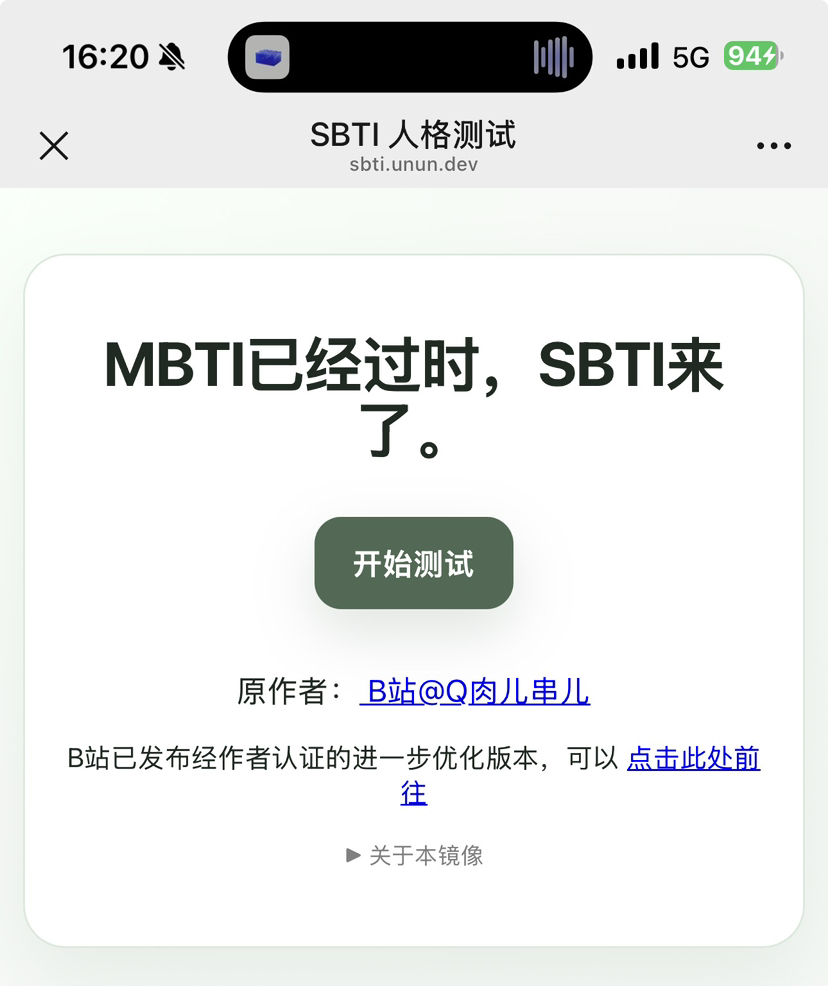
Have you heard about the recent SBTI personality test mini-program? It's quite shocking. A bunch of counterfeit mini-programs, claiming to provide free in-depth analysis, immediately ask you to log in with WeChat authorization, and end up secretly stealing your contacts, location, and device information, selling it off to scammers. As a result, many people receive precise scam calls out of the blue, and the source is this thing.
To be honest, it's really not surprising to see such things nowadays. Centralized platforms love to require authorization, and if you don't click agree, they won't let you use it. Data regulation is just for show, and user privacy is basically exposed. This also reveals a major issue with traditional internet and gaming - you don't have sovereignty over your own data, virtual identities can be banned at any time, and privacy security depends entirely on the platform's conscience. Unfortunately, in this day and age, conscience is not worth much.
@Pixels has taken a completely different development path. The project always prioritizes user rights, does not view players merely as traffic resources, nor sets coercive authorization terms. From the bottom design, $PIXEL returns the ownership of players' digital assets and virtual identities to users, allowing the achievements obtained by players in the game to truly belong to them and not be arbitrarily deprived.
In simple terms, the land, outfits, virtual avatars, and other assets owned by users in Pixels have unique and tamper-proof identifiers, with clear ownership and traceable sources, effectively issuing reliable digital certificates for virtual property. At the same time, the platform will not excessively collect users' private information, and the authorization of permissions is decided by the users, thereby avoiding the risks of illegal collection, leakage, and resale of privacy from the source.
Compared to traditional game modes, its advantages are more evident. In traditional games, the skins, characters, and other items that players spend a lot of time and money on may be deleted or reclaimed due to platform operational adjustments, and personal information is often used for commercial marketing or even illegal transactions. In the Pixels ecosystem, users can experience the game normally without being forced to give up their privacy, with virtual assets and identities having clear ownership protection, and social and entertainment experiences are unaffected, truly achieving a balance between security and experience.
In addition, the virtual identities in Pixels have verifiable and non-falsifiable characteristics that can effectively prevent issues such as virtual avatars being stolen or counterfeited. Whether in social interactions within the game or in future integration into metaverse scenarios, users can have a sense of security and credibility that traditional platforms cannot provide.
Many people mistakenly think it is just an ordinary game token, but in fact, it is an important circulation certificate for the entire metaverse ecosystem. Whether it is land unlocking, asset upgrading, or item purchasing, outfit exchanging, it all relies on the support of PIXEL. At the same time, mechanisms such as community governance, welfare distribution, and ecological incentives are also deeply bound. As more users participate and application scenarios continue to expand, PIXEL will form a real and sustainable ecological cycle, rather than relying solely on market speculation.
Currently, the casual GameFi sector is continuously heating up, and social games are also accelerating their evolution towards the metaverse, with users' demand for digital identity confirmation and data autonomy becoming increasingly strong. The market is not lacking in speculative projects that pursue short-term benefits, but truly low-threshold, implementable ecosystems that focus on user rights are quite rare. #pixel precisely aligns with this market trend, and its long-term value will become increasingly prominent in the context of growing attention to privacy and security.