

On April 14, the Shanghai Xuhui police reported a major case of illegal gaming operations: a criminal gang targeting popular games such as (Genshin Impact), (Honkai: Star Rail), and (Honkai: Zero) has been completely dismantled, having illegally obtained over 10,000 pieces of citizen information, registered accounts in bulk, and sold accounts at high prices. Ten people were arrested, and the amount involved exceeded 2 million yuan.
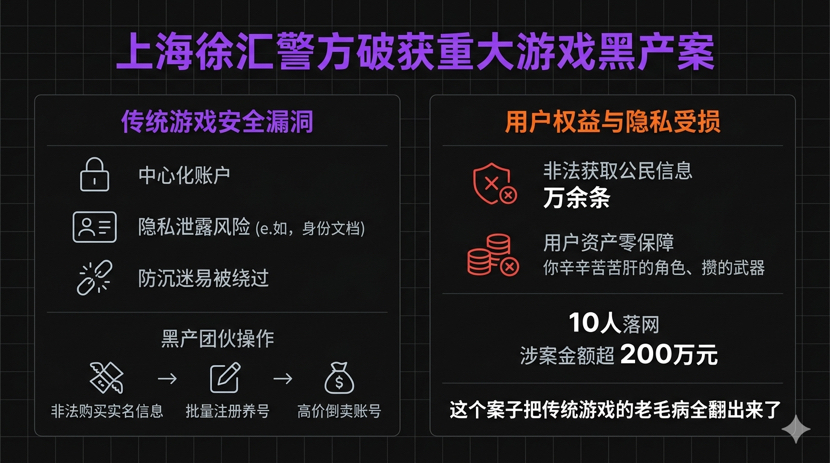
They bypassed anti-addiction measures using illegally purchased real-name information and employed cheats to automate account leveling, ultimately selling them on e-commerce platforms. This not only undermines game fairness, but crucially, your real-name information may have already been used as 'raw material'. The characters you painstakingly leveled and the weapons you accumulated are essentially just a string of code in the platform's database. The platform can ban you whenever they want, and if they shut down the server, everything resets to zero, leaving you with no recourse.
This case actually exposes all the old problems of traditional gaming: your account is not yours, your virtual assets are not yours, and your privacy can be exploited by hackers at any time. Web3 games, including @Pixels , aim to fundamentally solve this issue.
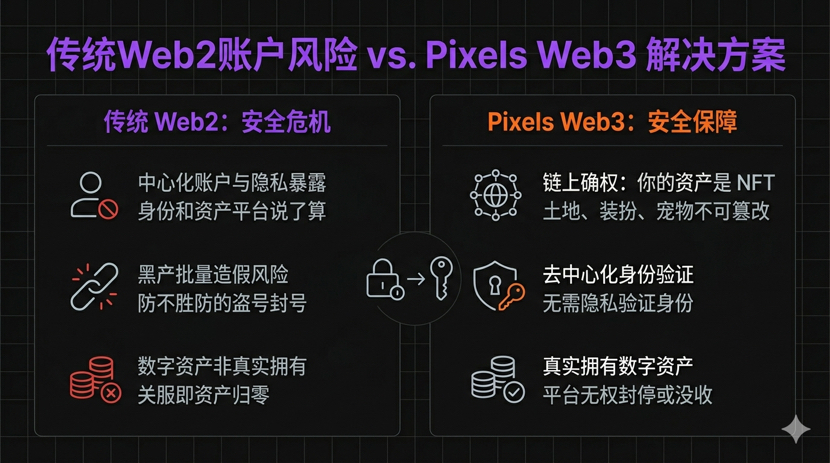
Traditional games rely on centralized accounts, where identity and assets depend on the platform's whims. Hackers can easily create fake accounts, steal information, and arbitrarily ban accounts, which is fundamentally unpreventable. Pixels, however, implements on-chain verification of rights and decentralized identity, truly returning your virtual identity and digital assets to you. Hackers wanting to create accounts in bulk? Not a chance. No one can modify or freeze your on-chain identity and assets.
Specifically, Pixels is built on the Ronin blockchain, combining gaming, social interaction, and on-chain identity. In simple terms: your land, outfits, and pets are all NFTs, verifiable on-chain and immutable, essentially providing a 'property certificate' for your virtual assets. Your on-chain identity can also be verified without leaking privacy; hackers wanting to steal it? No way.
So what exactly is $PIXEL for? Many people think it's just an ordinary game currency, but it has real utility within the ecosystem—buying land, purchasing items, raising characters, speeding up construction, all require it. You can also stake, participate in community governance, and earn rewards. Moreover, the game has a low entry barrier, allowing casual players to join; with more real users, the usage scenarios for $PIXEL continue to exist.
On the security front, it's even more straightforward: traditional game accounts can be banned at will, while Pixels' assets are NFTs, which the platform has no right to take. Traditional games have real-name information that is easily stolen; #pixel uses on-chain identity, eliminating the need to disclose privacy. Traditional gaming is plagued by hackers, but Pixels' on-chain rules are transparent, and cheats and fraud can be traced.
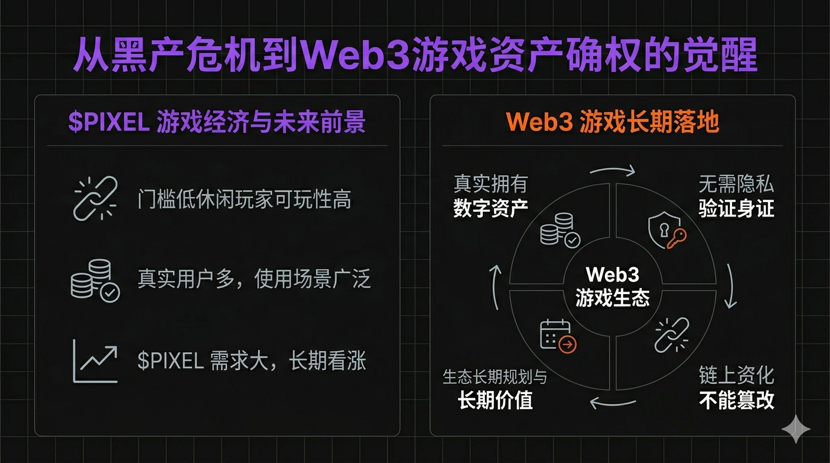
Now, the crackdown on gaming-related hacking is becoming increasingly strict, and players are starting to awaken, realizing they should own their digital assets. GameFi is shifting from short-term speculation to long-term implementation, $PIXEL perfectly aligns with the point of virtual identity security and asset verification.
To put it plainly, this case with miHoYo has made it clear to us: games should be for playing and companionship, not tools for platforms to harvest profits or hackers to make money. PIXEL doesn't engage in the aircoin routine; it focuses on building Web3 games, returning identity and assets to players. In today's world, where virtual existence is increasingly important, only your own on-chain identity and assets can be trusted, allowing you to truly enjoy gaming.