
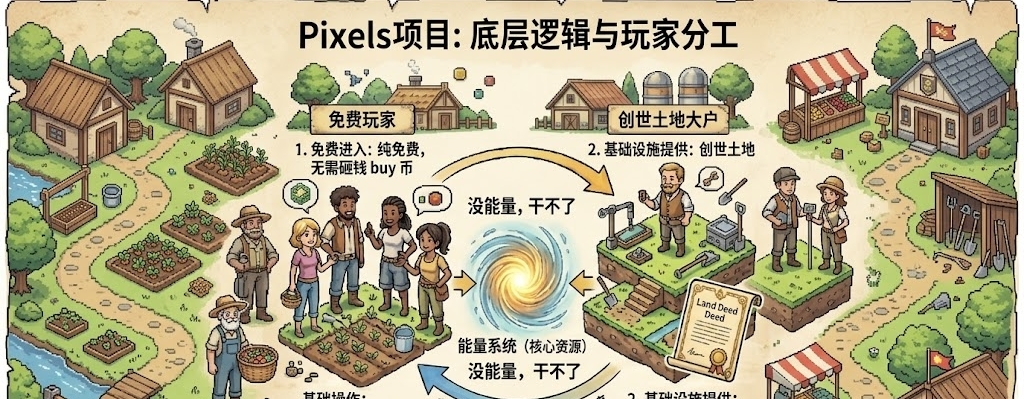

When I first came across @Pixels I scoffed at it. Web3 farm chain games? It sounds like another project under the banner of 'play to earn,' demanding you buy this and that, set up a wallet, deal with gas fees, it's so annoying. But when I really dug into it, I found it was completely different from the vast majority of chain games on the market; it doesn't force you to spend money to buy coins to play. Newcomers can join for free. In the game, there is an off-chain point system called BERRY, which has now basically been replaced by Coins, and everything from planting to harvesting to daily tasks relies on it. The $PIXEL token is actually a more advanced existence; you can completely ignore it and just enjoy playing a pixel-style farm simulator, watering when you want and planting when you want. This kind of 'play whenever you want' design is indeed an outlier in today's Web3 space where high barriers to entry are common.
What left a deep impression on me was when founder Luke Barwikowski said, 'If you want to save crypto games, don't just focus on the crypto circle; you need to serve traditional players by hiding complex crypto operations in the background.' I initially thought this was just a platitude, but after getting into it, I realized he was genuinely doing this. Once you connect your wallet, you hardly feel the presence of all on-chain interactions; planting crops, harvesting, and completing tasks to earn rewards – the whole process is no different from playing a regular mobile game. In simple terms, he aims to let ordinary people naturally experience the process of earning, consuming, and owning assets, rather than being overwhelmed by gas fees and various authorizations right from the start.
Of course, in 2024, Pixels also went through a difficult phase. At that time, daily active users looked very high, but mainly relied on token subsidies, leading to a serious imbalance between production and consumption. I felt at that time that the things produced couldn't be sold at a good price, and the rewards were becoming less valuable. Fortunately, in 2025, the team adjusted quite quickly, introducing the RORS metric, which tied every reward to real value, no longer wasting tokens. This shift helped it survive the industry's low point. By early 2026, the effects began to emerge. After the launch of Merchant Ships and Chapter 3 updates, player feedback was indeed positive. Daily active users surged from 45,000 in January to 120,000, and the price of $PIXEL also rebounded. It wasn't just driven up by some gimmick; users are truly playing and consuming, and the fundamentals are improving. At the same time, they are also promoting the mobile pet game Chubkins and the cross-game rewards platform Stacked, with a clear goal of allowing more traditional players to onboard without feeling the burden. Chubkins does not require understanding blockchain, and Stacked consolidates rewards from multiple games into a single entry point, significantly reducing the operational burden. Breaking into new circles is never accomplished by just one or two updates. Traditional players still have reservations about the term 'chain games.' Pixels is now on a fairly stable path: maintaining every function and every user well, without engaging in short-term volume spikes. This patience for long-termism has become a rare advantage in the Web3 gaming circle.
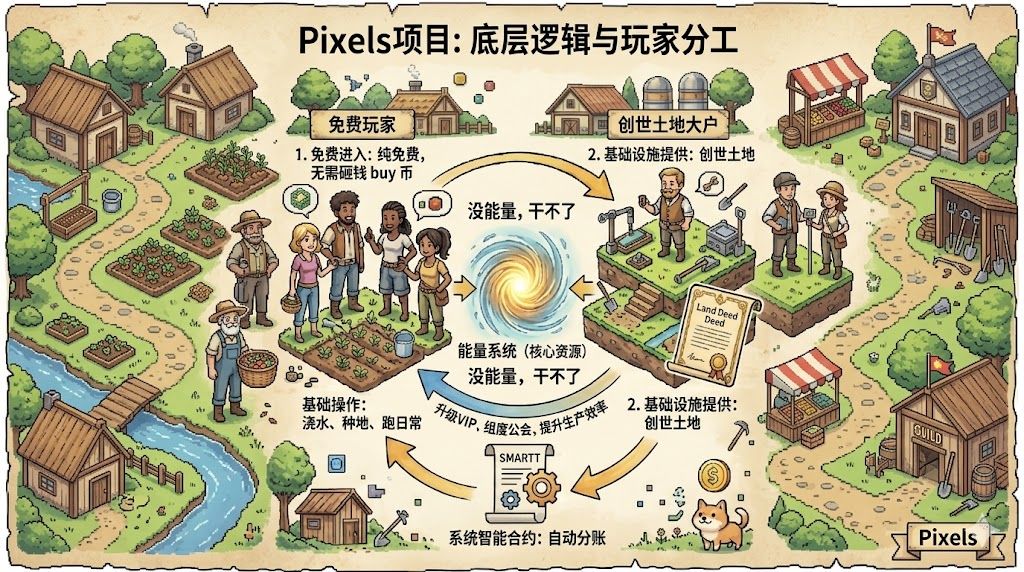
What I personally admire the most is its underlying social division of labor model. On the surface, it looks like a cute pixel farm, but when you actually play it, you'll find that the energy system is the core resource. Without energy, many operations cannot be performed. This naturally divides players into different roles: those with genesis land provide infrastructure, while free players earn rewards by helping others with tasks, and the system uses smart contracts to automatically distribute profits. This design is very clever; it neither forces you to spend money nor lets the entire economy operate on its own. PIXEL, as the core asset, has a relatively high barrier to entry, while being designed as a consumable for many advanced functions: upgrading VIP, forming guilds, and improving production efficiency all require it. This makes the token serve more for the long-term development and governance of the game, rather than just being traded back and forth. When the guild competition phase starts, the real ecological game begins. Large guilds need to optimize resources and rankings through various configurations and trades in the market. This way of transforming player collaboration into ecological power creates a positive cycle for the whole system. When it initially migrated to the Ronin chain, it also recognized the mature community ecology there, and this move turned out to be quite right.
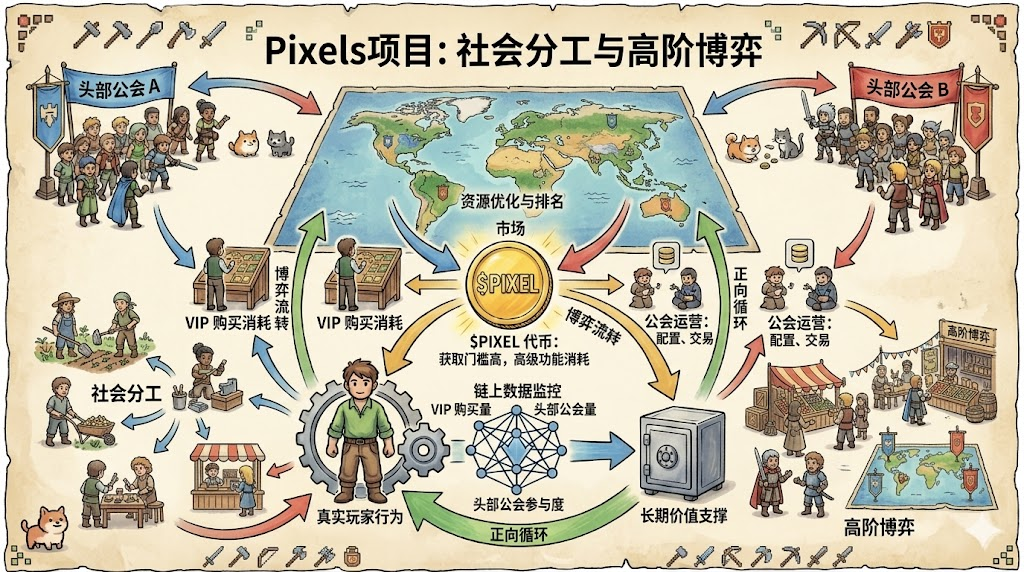
I am currently looking at the market of $PIXEL and mainly focusing on two on-chain data: the consumption of VIP purchases and the participation of top guilds. As long as the user activity and ecological competition of the game continue, there will be support for long-term value. This is not just a single-player farming game, but a system that combines real player behavior and economic models. In this fast-paced market, Pixels stands out as particularly different. There are no flashy special effects, no exaggerated high-return promotions; it requires time and effort to play. But precisely because of this 'realness,' it attracts a group of players who truly regard it as a long-term home. The stable, active addresses that log in every day are not the result of short-term behavior but are gradually building a resilient community network. So for me, Pixels is one of the projects in Web3 gaming that is worth long-term observation. It puts user experience first and speaks through time and real data. In this restless circle, it is taking a solid and sustainable path. I will continue to play and wait to see it move forward step by step. (This article is a platform task and does not constitute any investment advice.) #pixel