


An epic market crash, an algorithmic stablecoin rumored to have 'crashed by 38%', and a major exchange caught in technical doubts. When the smoke cleared, we were surprised to find that the truth of the story was not simply 'the stablecoin malfunctioned', but possibly a maximum stress test on centralized exchange infrastructure. The core issue of this event directly points to Binance.
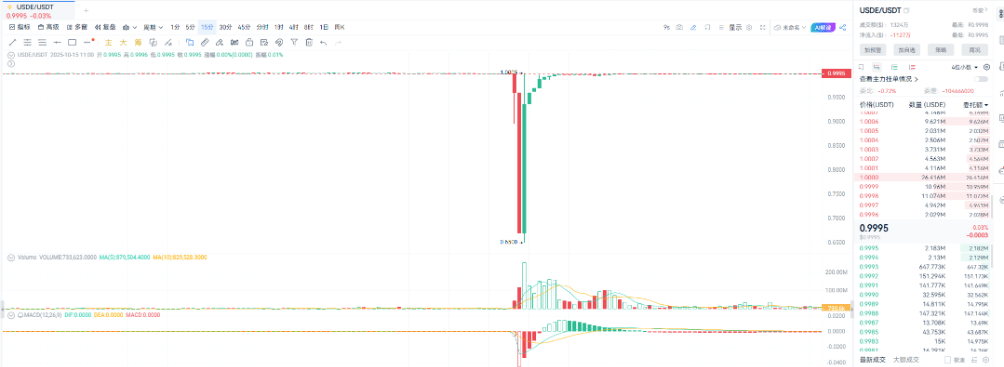
1. Event Backtracking: A 35% 'Decoupling' Illusion?
On October 11, 2024, the cryptocurrency market encountered a 'black swan', with core assets like Bitcoin experiencing a dramatic price crash. In the midst of this chaos, the stablecoin USDe issued by Ethena Labs became the eye of the storm in public opinion.
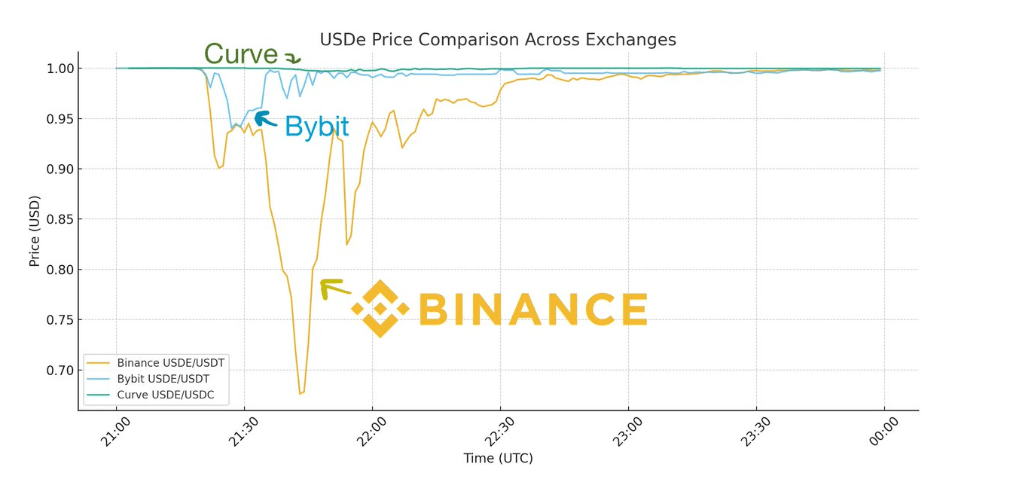
● Rumors of a "peg-off" spread like wildfire: Data showed that the price of USDe on decentralized exchanges like Binance plummeted to as low as $0.65, a 35% deviation from its theoretical peg of $1. Market panic spread instantly, and USDe's market capitalization evaporated by over $2 billion in a short period of time.
● Investors scramble to put out the fire: Faced with a crisis of trust, Haseeb Qazi, managing partner of Dragonfly, an Ethena investor and a top venture capital firm, personally refuted the allegations. Through detailed data analysis, he pointed out a fact overlooked by many: USDe was not truly depegged; it was merely a localized fire within the Binance exchange.
Was this a complete failure or a misinterpreted accident? All clues point to Binance.
II. In-depth Analysis: Fragmented Mobility and a Failed Fire Fighting System
Why does the USDe price vary so drastically across different trading venues at the same time? The answer lies in the fragmentation of liquidity and the paralysis of the market maker arbitrage mechanism.
● Main battlefield remains intact: Haseeb's core argument is that USDe's primary liquidity pool isn't on Binance, but on the decentralized exchange protocol Curve. On Curve, USDe boasts hundreds of millions of dollars in liquidity. Throughout the flash crash, the USDe price on Curve remained close to $1, with a maximum deviation of only 0.3%. This demonstrates the robustness of its core redemption mechanism and market demand.
● Binance became an isolated island: By comparison, the USDe liquidity pool on Binance held only tens of millions of dollars. When the market crashed and a massive influx of sell orders flooded in, the thin order book was easily breached. More critically, Binance's API frequently failed, nearly paralyzing deposit and withdrawal channels. This meant that even if Curve had ample USDe per dollar, market makers couldn't exploit cross-market arbitrage by buying at a low price on Binance and selling at par on Curve.
● A vivid metaphor: Haseeb compared Binance at the time to a "burning building with all exits blocked." The "firefighters" (market makers and arbitrageurs) outside the exchange couldn't enter to put out the blaze, even though they saw a huge arbitrage opportunity inside. As a result, the "fire" within the exchange (price deviation) continued to spread, while the "fire" outside had already been extinguished.
3. Binance’s Double “Evidence”: The Collapse of Infrastructure and Risk Model
If the liquidity issue is a natural disaster, then Binance’s design flaws are a true man-made disaster. This incident exposed Binance’s major shortcomings in two core areas.
● Evidence 1: The inherent deficiency of lacking a “main market maker relationship”
Ethena has established a primary market maker relationship with exchanges such as Bybit, allowing market makers to mint and redeem USDe directly within the exchange, thereby quickly smoothing price fluctuations.
However, Binance does not have this type of relationship. On Binance, market makers who want to conduct arbitrage must withdraw funds from Binance, complete Ethena’s official arbitrage process on-chain, and then deposit them back into Binance.
Under conditions of extreme market volatility, network congestion, and API failure, this complex process is simply impossible to execute, turning Binance into a "financial island" lacking an internal stability mechanism.
● Evidence 2: Oracle flaws trigger the tragedy of “serial liquidation”
This is the most controversial point in this incident. Binance's liquidation system used an oracle to determine the value of user collateral based solely on the distorted USDe price on Binance's own order book. When the USDe price on Binance flash-crashed to $0.80 or even lower, Binance's risk management system foolishly assumed that all USDe collateral was worth that price.
As a result, a large number of users who used USDe as collateral had their positions mistakenly judged by the system as insolvent, triggering forced liquidation.
These forced sells further exacerbated the market's downward pressure, creating a death spiral of liquidations. Ironically, Binance later acknowledged the system's responsibility and announced full compensation to users who were mistakenly liquidated, totaling approximately $283 million. This move was tantamount to an admission of failure in its own risk control model.
IV. Enlightenment and Warning: When “Stability” Depends on the “Uninterrupted Chain” of Exchanges
This USDe incident has left the industry with far more than just a war of words; it is also a heavy warning.
● To exchanges: Infrastructure is the cornerstone of trust
As an industry leader, Binance's system stability is a key concern for the entire market. This incident demonstrates that competition among exchanges goes beyond simply listing the number of coins and transaction fees. It hinges on the robustness of infrastructure, the rigor of oracle design, and the intelligence of risk models. A single failure in any link could trigger a chain-wide disaster. For Binance and its BNB ecosystem, this incident represents a loss of trust.
● For project owners and investors: Re-examine the definition of “stability”
For algorithmic stablecoin projects like Ethena, this incident presents a severe test, but it also provides a counter-argument. It demonstrates that a project designed with sufficient collateral and robust arbitrage mechanisms can maintain stability in mainstream markets. However, investors must also clearly understand that the "stability" of any asset depends on the health of its trading environment. Storing assets on an exchange with weak infrastructure and fragmented liquidity exposes you to additional risks.
● The mirror of history: real de-anchoring and price dislocation
As Haseeb compared, when USDC depegged in 2023 due to a banking crisis, it could no longer be purchased for $1 on any trading platform, and redemptions were completely suspended. That was a true credit crisis and systemic depegging. The current USDe incident, on the other hand, was more like a localized price dislocation caused by a technical glitch at a specific exchange. Understanding this fundamental difference is crucial for determining market truth.
 Conclusion: The real "black swan" may never be far away
The flash crash on October 11 was an external shock, but the illusion of USDe’s “depegging” on Binance exposed a potential and more dangerous “black swan” within the industry – the vulnerability of the key infrastructure of centralized exchanges.
When an exchange's API, oracle, and clearing systems are overwhelmed by extreme market conditions, they transform from market stabilizers into risk amplifiers. This time, it was USDe and Binance; who will be next? For every market participant, it's time to incorporate "exchange infrastructure risk" into their core risk assessment framework.
Join our community, discuss and become stronger together!
Official Telegram group: https://t.me/aicoincn
AiCoin Chinese Twitter: https://x.com/AiCoinzh
OKX Welfare Group: https://aicoin.com/link/chat?cid=l61eM4owQ
Binance Welfare Group: https://aicoin.com/link/chat?cid=ynr7d1P6Z