


Xu Jiayin's overseas asset disposal has made new progress.
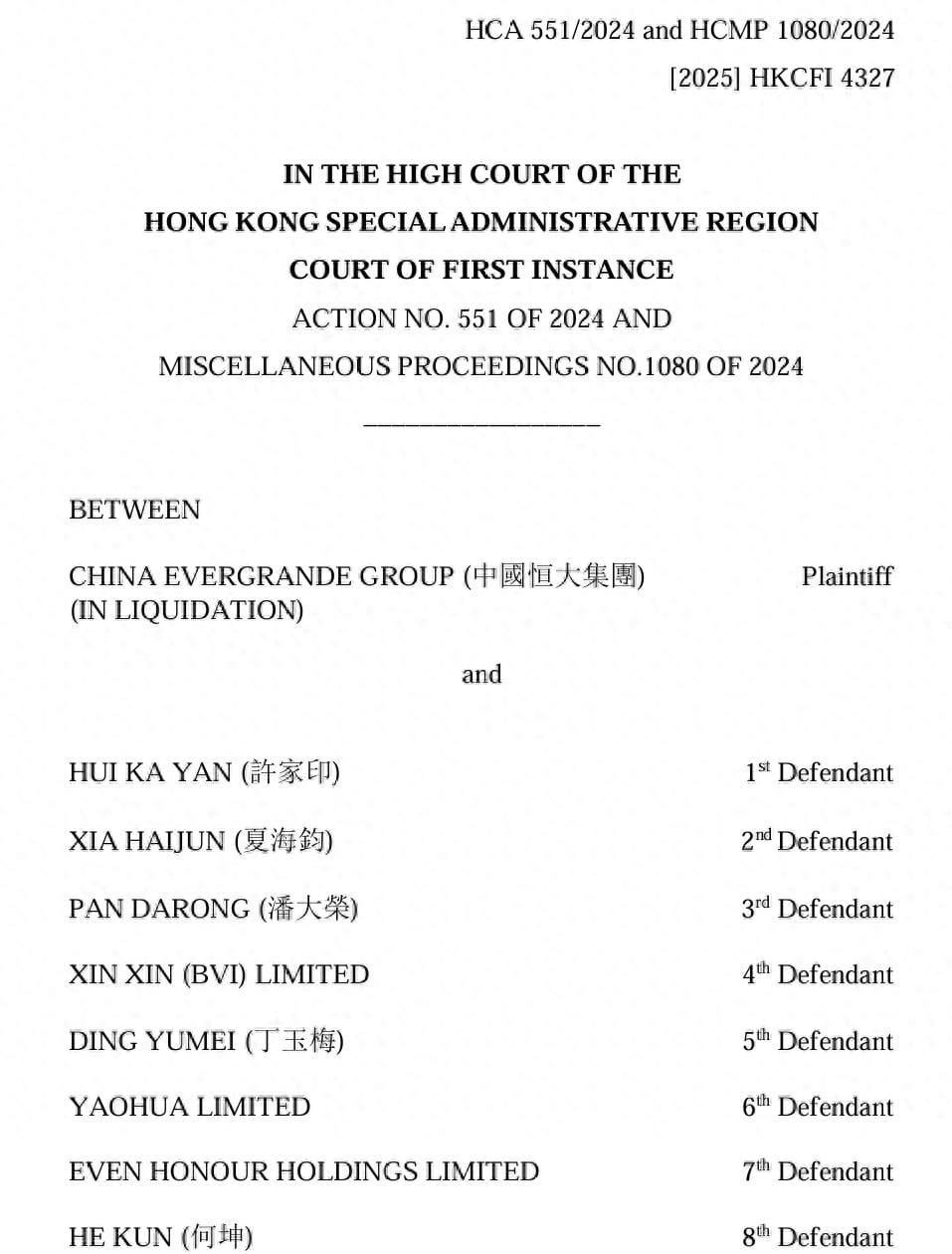
Recently, the High Court of the Hong Kong Special Administrative Region (hereinafter referred to as the Hong Kong High Court) ruled that the liquidator of China Evergrande Group is the custodian of assets related to the Xu Jiayin family. Previously, the Hong Kong High Court had issued a global injunction against assets under Xu Jiayin's name, explicitly prohibiting him from disposing of assets with a global value limit of 7.7 billion US dollars (approximately 55 billion yuan).
33 overseas family companies, private jets, luxury cars, etc.
Custodianship by the liquidator
(Daily Economic News) A lawsuit obtained by reporters from the Hong Kong High Court shows that the liquidator of China Evergrande requests the freezing of Xu Jiayin family assets involving 33 overseas companies and 7 bank accounts opened in Xu Jiayin's name or by overseas companies.
In this judgment, the Hong Kong High Court allowed China Evergrande’s liquidator to take over the above-mentioned overseas companies, and 7 related bank accounts have been frozen.
Among the frozen bank accounts, those at Bank of China (Hong Kong), HSBC, and DBS Bank were held directly under Xu Jiayin's real name. Four other accounts at the Industrial and Commercial Bank of China were held through four offshore companies, two of which were controlled by Xu Jiayin and the other two by Ding Yumei.
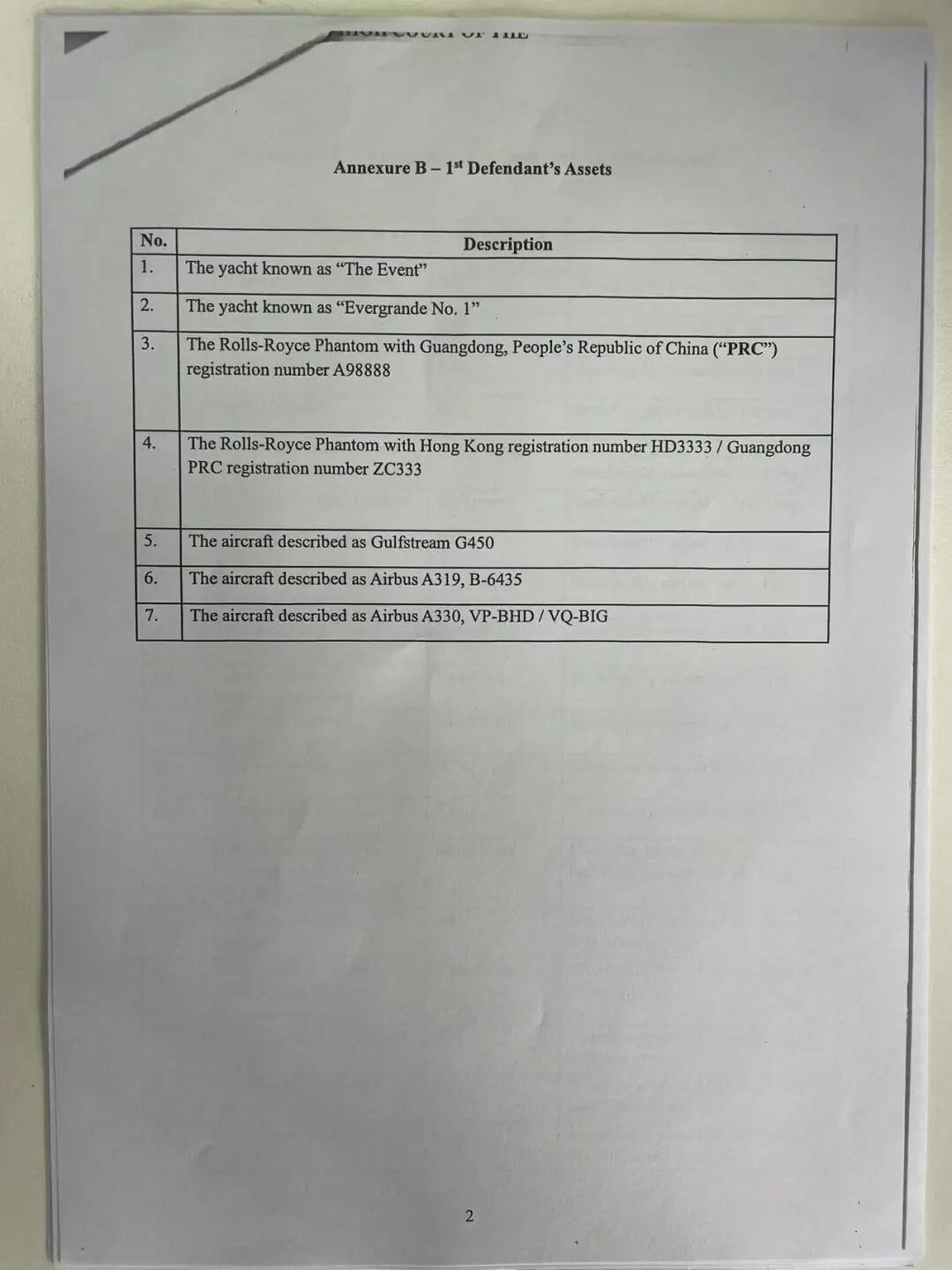
Specifically, the assets of Xu Jiayin taken over by the liquidator of China Evergrande include multiple properties in Hong Kong, the United Kingdom and the United States, as well as private jets, luxury cars, yachts, etc., such as two Rolls-Royce Phantoms, with license plates of Guangdong A98888 in mainland China and HD3333 in Hong Kong. 3333 was the previous stock code of China Evergrande.
The 33 overseas companies are also distributed in Hong Kong, the British Virgin Islands, the Cayman Islands, etc. Some of these companies are directly held by Xu Jiayin, some are held by Xu Jiayin’s ex-wife Ding Yumei, and one British Virgin Islands company is held by Xu Jiayin’s son.
Previously, the Hong Kong High Court also agreed to the request of China Evergrande's liquidator, requiring Xu Jiayin to inform the liquidator of all his assets with a single value of not less than HK$50,000 (including but not limited to assets held in his own name/other people's names, domestic/foreign assets), and whether the assets prohibited from disposal have been sold.
However, Xu Jiayin ultimately failed to comply with the asset disclosure order. Consequently, China Evergrande's liquidators filed an application with the Hong Kong High Court in April this year to take over all of Xu Jiayin's assets.
On August 25, China Evergrande was officially delisted from the Hong Kong Stock Exchange.
$2.3 billion offshore family trust breached?
Lawyer: There are related risks
Some market sources speculate that the Hong Kong High Court's decision indicates that Xu Jiayin's overseas trust has been compromised. According to media reports, Xu Jiayin and his wife established a $2.3 billion (approximately 16.38 billion RMB) single-family trust in the United States around 2019, designating their two sons as beneficiaries. The ostensible purpose of the trust was to ensure intergenerational wealth transfer and asset protection, isolating family assets from the liability of debtors in the event of debt risks. The substantial trust funds were primarily sourced from dividends and cash proceeds received by Xu Jiayin and his wife from Evergrande over the years. Since Evergrande's IPO (2009-2022), Xu Jiayin and Ding Yumei have collectively received over 50 billion RMB in dividends.
However, the (Daily Economic News) reporter did not find any relevant judgment regarding the trust in the verdict.
However, in the judgment, the judge cited a foreign case, in which the judge's opinion stated, "Even if assets are placed in a discretionary trust (a trust form in which the trustee can independently decide the distribution of trust benefits), if the substantive facts show that the relevant defendant can control the operation of the discretionary trust, the court may still exercise a 'Chabra Injunction' (an asset freezing order) against the discretionary trust. The placement of assets in a discretionary trust cannot hinder the exercise of the injunction. In my opinion, whether this operation is described as deeming the discretionary trust a 'sham trust', lifting the corporate veil, or deeming a controlled discretionary trust a simple trust, there is not much difference. Of course, at the interim relief stage, the only important thing is to determine whether there is sufficient reason to believe that the relevant defendant has control over the assets in the discretionary trust."
A senior lawyer explained that the judge's implication is that even if a person isn't legally designated as the "owner" of assets (for example, if they're held in a trust or company), as long as they have actual control or dominion over those assets (for example, the power to decide how to invest them), the court can deem them the actual controller. If someone sets up a complex network of trusts or companies specifically to hide assets or evade debt or legal liability, the court has the power to "penetrate" these layers of pretense and directly freeze or execute against those assets.
In other words, if the family trust established by Xu Jiayin and his wife is actually still controlled by them or is considered to be deliberately hiding assets to evade debts, it may also be breached.
A key advantage of family trusts has long been that they allow settlors to isolate risks through the independence of trust assets, thereby avoiding family property division issues arising from business and marital risks. Family trusts are also highly favored by high-net-worth individuals for their risk isolation capabilities. However, in recent judicial practice, there have been cases where family trusts have been breached.
Previously, the offshore family trust established by South Beauty founder Zhang Lan was breached. According to the Singapore High Court's ruling at the time, the judge determined that Zhang Lan was the actual owner of the funds under the family trust, primarily based on the following reasons: First, after the establishment of the family trust, Zhang Lan was still able to freely transfer funds from her bank account to herself. Second, before receiving the freezing order notice from Hong Kong, China and the freezing order from Singapore, Zhang Lan was eager to transfer the funds under the family trust. Third, Zhang Lan's agent explicitly stated in an email to the bank where the funds under the family trust were located that the relevant bank accounts under the family trust belonged to Zhang Lan and requested that she be "promptly informed of changes in the account assets."
Based on this, the Singapore High Court held that although the relevant funds were in the name of a family trust, Zhang Lan was the actual beneficiary of such funds, and the purpose of Zhang Lan establishing the family trust was to circumvent the execution or claims of creditors on the property under her name.
Wang Xu (TEP), Executive Director of the Family Office Law Center at Dacheng Law Firm, believes that the issue of trust breach should be viewed from two perspectives. On a legal design level, when the settlor retains excessive control over the trust property in the trust deed or trust structure, and this retention of rights allows the trust property to be freely disposed of by the settlor, the likelihood of a trust breach increases significantly. On a practical operational level, even if the settlor of a family trust does not ostensibly retain excessive rights, if the trustee blindly and strictly follows all of the settlor's instructions, this situation may constitute a substantive sham trust, compromising its asset protection function. (Daily Economic News)
