
"I have been an excellent student since childhood, always attending prestigious schools. After graduation, I entered a major company, and my life has been smooth sailing. My parents are the kind of people who are very good at observing my talents and spare no effort in nurturing them. After being someone else's child for 24 years, the only lesson I have never learned is how to fail."
Teacher Tai Chu's words remind me of Shi Tiesheng's (Good Luck Design).
What kind of life have you thought about? Breaking through to great results, making 100 million dollars? I think everyone has fantasized about it.
Shi Tiesheng's article can be regarded as an immersive guide to reincarnation. How to achieve a perfect life and what is the ultimate form of life after four versions of evolution?
The first kind of perfect life
You are smart, beautiful, and healthy; you cannot be born into poverty, but you also cannot be born into a wealthy family.
In life, you want to see all the scenery; you cannot be constrained by your original family, nor can you be limited by having everything from birth.
So it's best if you are born into an intellectual family, feel the light of civilization, and understand the hardships of life.
Your parents encourage you to grow up, you have a happy childhood, and you have gained many friends. Your mother guides you to love the world with love and freedom. Your talents bloom during adolescence, you can win awards in various competitions, excel in sports and arts, enter a prestigious university at 18, encounter true love, and your life goes smoothly, it's a 'everything goes well' version.
But Shi Tiesheng points out:
Too perfect a design is dangerous. Because without setbacks, there is no sense of happiness.
Just like if the Earth hugs the Moon, there would be no distance and tides, and thus no gravity, which would be death. The universe is magnificent precisely because it is still rotating, collapsing, burning, and waiting.
Everything we designed just now seems perfect, but without pain and hardship, you cannot strongly feel happiness.
That is just comfort.
So we need to design a second kind of life, the suffering version.
It is to give you an additional difficulty, so that after overcoming this difficulty, you can obtain happiness.
In the end, Shi Tiesheng decides to simulate a serious illness in life; do not be afraid (of the simulation).
This illness starts off very painful; you have been lying on the sickbed for many years, unable to get up, feeling very desperate. You envy any healthy person you see, and you vow that as long as you recover, no matter how bitter it is, you will not feel苦.
What if you are anonymous? What if you are destitute? As long as you recover, you will love this world and love everyone.
At this moment, a miracle descends; you regain your health, not only regaining health but also full of energy, walking briskly.
Shi Tiesheng says: After great disasters and difficulties, one should not lose their sharpness, nor their heat. You are calm, but still burning; you are stable, but even more majestic.
As long as you can endure苦 and then enjoy sweetness... actually, you don't need much sweetness; after enduring苦, it will be very sweet.
The problem is, after苦, and then what? The sense of happiness is only temporary, whether it is the first time holding hands with a loved one, kissing, or the first time buying a bag, a car, a house, or the first time your savings reach one million, there will be a sense of happiness, but how long it lasts is uncertain. However, the days you live will definitely be longer than that, and you will continue to fall into boredom and pain; this design is still not a happy life.
Thus, the third kind of life comes.
We will constantly set small difficulties, small obstacles for you, and let you overcome them again and again, just like debugging.
Through the setting of these levels, let you continuously gain a sense of happiness, and always be a winner, so you can continuously eliminate pain and boredom, and be happy. Sounds perfect, right?
But if we follow this line of thought down, we will find it has a fatal problem:
If a person is always victorious and always happy, he will think he is the master of life, even the master of the universe. He expands infinitely until he encounters an insurmountable problem—death.
This time, death tells you that you cannot escape like everyone else; your so-called victories in the first half of life are merely luck, some coincidences, completely insignificant things. Faced with death, you can only bow your head and listen to the disposal.
Fate finally settles accounts with you, canceling all your victories with an inescapable dilemma; at this time, you will become the most painful person, even more painful than someone who has been unfortunate all their life.
Glory, greatness, heroism, erudition, and so on; all the beautiful words you can think of focus on the result, and any result is not the opponent of a dead end.
So we arrived at the fourth kind of life design.
In order to make you happy, we must give you pain; not only small pain but also big pain, not only temporary pain but also life-long pain.
Only through continuous ups and downs can a person accumulate experience and create value; when you truly understand these fluctuations, you can calmly face everything and excitedly appreciate all of life, understanding the brilliance and tragedy of life.
This is Shi Tiesheng's lucky design; he painstakingly designed a perfect life. After various versions of iteration, he ultimately had to admit that life can only be like this.
The best life can only be like this, which is our daily life: happiness must coexist with regrets and imperfections.
This is the final conclusion he arrived at after sitting in a wheelchair and pondering.
At the end, I want to mention another article of his—(My Dreams).
In this article, he writes about how he loves watching various sports competitions because he cannot walk due to his legs. He is very fond of the American black athlete Lewis, describing that when you watch Lewis run, you feel he is 'running from the origins of humanity towards the future of mankind.' In Shi Tiesheng's eyes, Lewis is the happiest person in the world.
However, in one Olympic event, Lewis lost and came in second; he was no longer the fastest runner. The loudest cheers and shouts in the audience were all given to the first place. Looking at Lewis's bewildered eyes, Shi Tiesheng found it completely unacceptable; he kept thinking why? He felt he had failed too, even more so than Lewis.
Later he figured it out:
I saw the misfortune of so-called the happiest person. Lewis's bewildered gaze shook my definition of the happiest and then shattered it. God never bestows the words 'the happiest' on anyone; he establishes an eternal distance in front of everyone's desires, fairly giving everyone limitations.
If one cannot understand happiness on the endless road of transcending self-limitations, then Shi Tiesheng's inability to run and Lewis's inability to run faster are completely equivalent; both are the roots of frustration and pain.
The next day, Lewis won the championship in another event, and Shi Tiesheng finally felt relieved. He sincerely felt happy for Lewis, saying:
He knows why the sacred fire on Mount Olympus burns; it is not for one person to defeat another, but for the opportunity to showcase humanity's resilience to the gods. The destined limitations may always exist, but the unyielding challenge cannot be lacking for a moment.
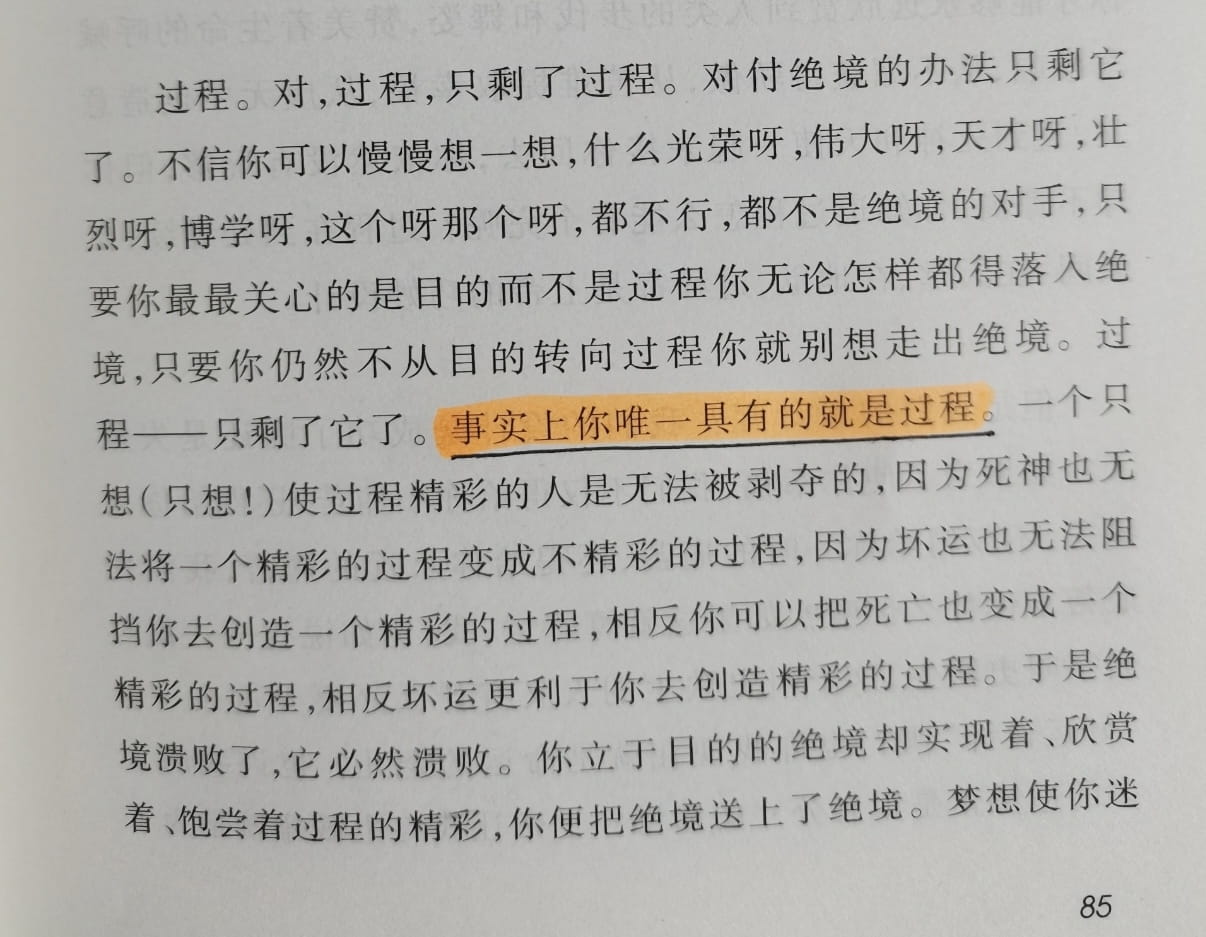
To sum up, since losses, failures, setbacks, and frustrations are foreseeable paths, no matter how designed, they are actually quite similar to current life.
Selling off, blowing up, FOMO, and going to zero are all unavoidable in the cryptocurrency circle. What truly decides the height is how one can manage oneself amidst the turbulence; mindset is the dividing line between mediocrity and excellence.