

Binance News
400.9k Posts

Binance News
 Binance Officially Verified Account
Report
Follow Binance News to stay on top of industry trends & news
9 Following
2.3M+ Followers
2.8M+ Liked
Top
Replies
Videos
·
--
Article
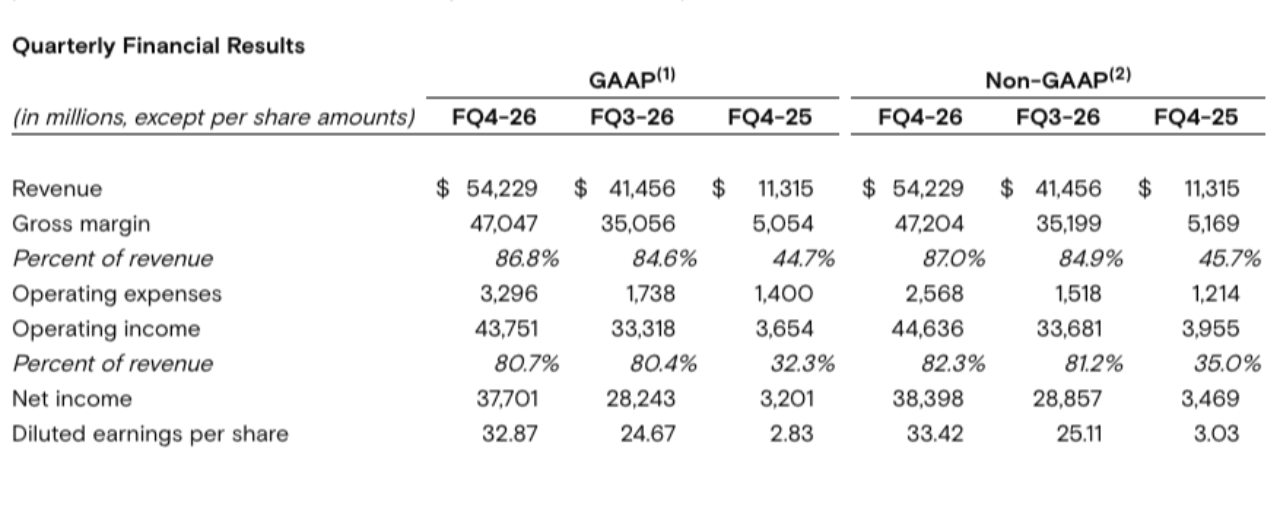
Micron Beats on Earnings and Lifts Guidance as AI Memory Crunch DeepensMicron Technology (Nasdaq: MU) $MUB reported better-than-expected quarterly results on Wednesday and issued strong guidance as the memory maker continues to benefit from soaring AI-infrastructure demand, according to CNBC, Bloomberg and the Wall Street Journal. For the fiscal fourth quarter ended Sept. 3, adjusted earnings were $33.42 a share, topping the $31.61 LSEG consensus, while revenue nearly quadrupled from a year earlier to $54.23 billion, versus about $51.07 billion expected. Net income climbed to $37.7 billion, or $32.87 a share, from $3.2 billion, or $2.83, a year ago. For the current first quarter, Micron guided to revenue of about $61.5 billion and adjusted EPS of about $38.15, well above analyst estimates. The stock, up more than 500% over the past year, was the best performer in the Philadelphia Stock Exchange Semiconductor Index this year through Wednesday's close, gaining 273%, with a market cap topping $1.2 trillion.
The results reflect a worldwide supply crunch driven by historic demand for AI memory, which has lifted prices and raised costs for consumer electronics like Apple's iPads and MacBooks. Micron, the only US-based maker of high-bandwidth memory (HBM), saw fourth-quarter DRAM revenue jump 343% from a year earlier to $39.8 billion, or 73% of total sales. Chief Executive Officer Sanjay Mehrotra said the company has a "strong roadmap for future HBM products" and is working with Nvidia on the industry's "first custom HBM implementation." He struck a notably confident tone on the memory cycle: "Industry demand has strengthened since our last earnings call, and we expect memory and storage supply demand conditions to be much tighter in fiscal 2027 and 2028 than they were in 2026." Gabelli Funds' Hendi Susanto called it "another strong beat and raise," adding he had "not heard any negative data points pointing to the memory cycle reversing toward a decline anytime soon."
Micron warned margins would tighten slightly this quarter, partly on higher worker pay. Adjusted gross margin was 87% last quarter and is seen narrowing to 86.3% in the current period. "We made the decision to increase incentive compensation," Chief Financial Officer Mark Murphy said. "Incentive comp is the big driver to that gross margin outlook." President and Chief Operating Officer Manish Bhatia said manufacturing pay increases, booked through inventory, would make this quarter the low point for margins. S&P Global's Melissa Otto said investors "will likely want to understand the impact of pricing on gross margin and the durability of earnings." Micron is investing $250 billion to build two new HBM campuses — the largest broke ground in Clay, New York, in January, with a Boise, Idaho fab due online next year — and guided to about $25 billion in first-half capital spending, including roughly $11.5 billion this quarter. It has signed 26 long-term supply agreements, up from 16 in June, totaling $32 billion and representing more than 35% of expected revenue through 2030, some extending into 2031. Mehrotra attended an AI-regulation summit hosted by President Donald Trump on Tuesday, days after a White House dinner with Chinese President Xi Jinping; separately, hundreds of Micron staff threatened to strike at its Taiwan factories over pay, after similar strikes at rivals SK Hynix and Samsung yielded bonuses upwards of $500,000.
{spot}(MUBUSDT)
Micron Beats on Earnings and Lifts Guidance as AI Memory Crunch Deepens
Micron Technology (Nasdaq: MU) $MUB reported better-than-expected quarterly results on Wednesday and issued strong guidance as the memory maker continues to benefit from soaring AI-infrastructure demand, according to CNBC, Bloomberg and the Wall Street Journal. For the fiscal fourth quarter ended Sept. 3, adjusted earnings were $33.42 a share, topping the $31.61 LSEG consensus, while revenue nearly quadrupled from a year earlier to $54.23 billion, versus about $51.07 billion expected. Net income climbed to $37.7 billion, or $32.87 a share, from $3.2 billion, or $2.83, a year ago. For the current first quarter, Micron guided to revenue of about $61.5 billion and adjusted EPS of about $38.15, well above analyst estimates. The stock, up more than 500% over the past year, was the best performer in the Philadelphia Stock Exchange Semiconductor Index this year through Wednesday's close, gaining 273%, with a market cap topping $1.2 trillion.
The results reflect a worldwide supply crunch driven by historic demand for AI memory, which has lifted prices and raised costs for consumer electronics like Apple's iPads and MacBooks. Micron, the only US-based maker of high-bandwidth memory (HBM), saw fourth-quarter DRAM revenue jump 343% from a year earlier to $39.8 billion, or 73% of total sales. Chief Executive Officer Sanjay Mehrotra said the company has a "strong roadmap for future HBM products" and is working with Nvidia on the industry's "first custom HBM implementation." He struck a notably confident tone on the memory cycle: "Industry demand has strengthened since our last earnings call, and we expect memory and storage supply demand conditions to be much tighter in fiscal 2027 and 2028 than they were in 2026." Gabelli Funds' Hendi Susanto called it "another strong beat and raise," adding he had "not heard any negative data points pointing to the memory cycle reversing toward a decline anytime soon."
Micron warned margins would tighten slightly this quarter, partly on higher worker pay. Adjusted gross margin was 87% last quarter and is seen narrowing to 86.3% in the current period. "We made the decision to increase incentive compensation," Chief Financial Officer Mark Murphy said. "Incentive comp is the big driver to that gross margin outlook." President and Chief Operating Officer Manish Bhatia said manufacturing pay increases, booked through inventory, would make this quarter the low point for margins. S&P Global's Melissa Otto said investors "will likely want to understand the impact of pricing on gross margin and the durability of earnings." Micron is investing $250 billion to build two new HBM campuses — the largest broke ground in Clay, New York, in January, with a Boise, Idaho fab due online next year — and guided to about $25 billion in first-half capital spending, including roughly $11.5 billion this quarter. It has signed 26 long-term supply agreements, up from 16 in June, totaling $32 billion and representing more than 35% of expected revenue through 2030, some extending into 2031. Mehrotra attended an AI-regulation summit hosted by President Donald Trump on Tuesday, days after a White House dinner with Chinese President Xi Jinping; separately, hundreds of Micron staff threatened to strike at its Taiwan factories over pay, after similar strikes at rivals SK Hynix and Samsung yielded bonuses upwards of $500,000.
The results reflect a worldwide supply crunch driven by historic demand for AI memory, which has lifted prices and raised costs for consumer electronics like Apple's iPads and MacBooks. Micron, the only US-based maker of high-bandwidth memory (HBM), saw fourth-quarter DRAM revenue jump 343% from a year earlier to $39.8 billion, or 73% of total sales. Chief Executive Officer Sanjay Mehrotra said the company has a "strong roadmap for future HBM products" and is working with Nvidia on the industry's "first custom HBM implementation." He struck a notably confident tone on the memory cycle: "Industry demand has strengthened since our last earnings call, and we expect memory and storage supply demand conditions to be much tighter in fiscal 2027 and 2028 than they were in 2026." Gabelli Funds' Hendi Susanto called it "another strong beat and raise," adding he had "not heard any negative data points pointing to the memory cycle reversing toward a decline anytime soon."
Micron warned margins would tighten slightly this quarter, partly on higher worker pay. Adjusted gross margin was 87% last quarter and is seen narrowing to 86.3% in the current period. "We made the decision to increase incentive compensation," Chief Financial Officer Mark Murphy said. "Incentive comp is the big driver to that gross margin outlook." President and Chief Operating Officer Manish Bhatia said manufacturing pay increases, booked through inventory, would make this quarter the low point for margins. S&P Global's Melissa Otto said investors "will likely want to understand the impact of pricing on gross margin and the durability of earnings." Micron is investing $250 billion to build two new HBM campuses — the largest broke ground in Clay, New York, in January, with a Boise, Idaho fab due online next year — and guided to about $25 billion in first-half capital spending, including roughly $11.5 billion this quarter. It has signed 26 long-term supply agreements, up from 16 in June, totaling $32 billion and representing more than 35% of expected revenue through 2030, some extending into 2031. Mehrotra attended an AI-regulation summit hosted by President Donald Trump on Tuesday, days after a White House dinner with Chinese President Xi Jinping; separately, hundreds of Micron staff threatened to strike at its Taiwan factories over pay, after similar strikes at rivals SK Hynix and Samsung yielded bonuses upwards of $500,000.
Voting
Micron sees tighter supply into 2028 — real AI supercycle?
Yes — AI memory demand is just ramping
No — memory cycles always turn, this peaks soon
Risk/reward looks stretched
Missed the whole run, cope mode on
156 votes • Voting
102
20
185
19.6k
·
--
Article
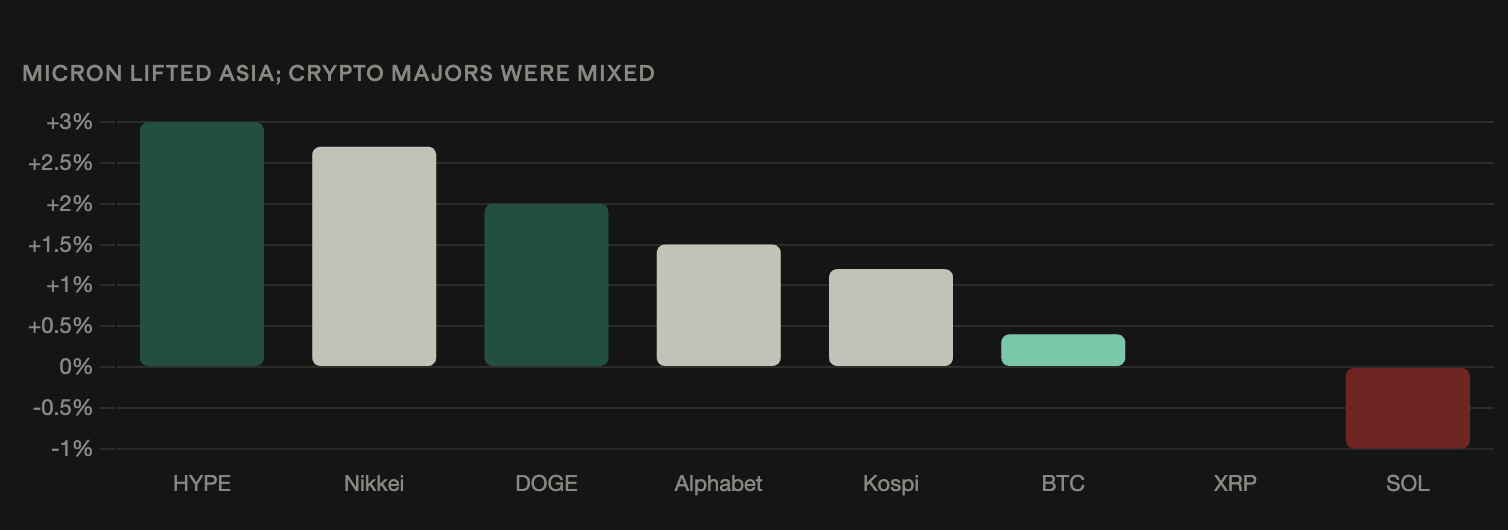
Bitcoin News | Bitcoin Gives Back Its PCE Pop as the 10-Year Holds Near 5.3%Bitcoin rose 0.4% to just above $83,700 in Thursday's Asian morning, having reached $85,500 on Wednesday after a softer-than-expected US inflation report.The gains drained away as Treasury yields stayed near their highest levels since 2002.HYPE led the majors, up 3% to about $89, and Dogecoin gained nearly 2% to just under 10 cents. Ether, BNB, Tron and Zcash each added less than 1%, XRP was flat at $1.50, and Solana slipped nearly 1% to just under $119.The Inflation Print Did Its Job. The Bond Market Did Not Respond.August PCE showed prices up 3.4% from a year earlier and 3.0% excluding food and energy."That has reduced the odds of another Federal Reserve rate increase in October and made December look like the more likely next move," said Dan Khus, chief analyst at LVRG Research."Crypto markets took that as a relief signal, and bitcoin jumped back above $85,000 as bond yields slipped and investors became more willing to buy risk assets again."The yield relief did not last. The 10-year traded around 5.28%, close to Wednesday's peak, and the 30-year steadied at 5.62% after reaching its highest since 2002 during New York trading.Oil declining helped pause the bond selloff, and the dollar strengthened.This Is the Scenario 10x Research DescribedThe session is a direct test of a distinction Markus Thielen drew on Tuesday."When yields rise because the Fed is tightening, bitcoin suffers. When yields rise on fiscal and term-premium concerns, the picture flips," the 10x Research founder said, forecasting the 10-year reaching 6%.Wednesday removed part of the tightening argument. October hike odds had already fallen from about 71% to 50% after New York Fed President John Williams downplayed the urgency of raising rates, and a cooler PCE print pushed the expected next move to December.Long yields did not fall with it. That is the fiscal and term-premium component Thielen identified, and it is the part a softer inflation reading does not address. Thielen's argument rests on yields sitting below both nominal GDP growth of 6.56% and federal debt growth of roughly 8.5% annually since 2020.The Gap Between Headline and Core MattersHeadline PCE at 3.4% against core at 3.0% means food and energy added 40 basis points rather than subtracting.That is the opposite of the usual pattern when energy prices fall, and it reflects the oil move that ran through August and September. Brent rose about 14% in September before retreating to $96.43.If energy continues easing, headline converges toward core. If it reverses again, the headline figure the Fed watches alongside core moves the wrong way regardless of what underlying prices do.Micron Lifted AsiaTechnology carried the risk mood into the Asian session.Nasdaq 100 futures climbed 0.8% and S&P 500 futures rose 0.4%. Japan's Nikkei jumped 2.7% and South Korea's Kospi rose 1.2% after Micron Technology's upbeat forecast lifted chip stocks.Micron guided first quarter revenue to $60-63 billion against $56.77 billion expected, alongside a fourth quarter beat on revenue, EPS and cloud memory.The Kospi move is the notable one. It had fallen 19.3% across the third quarter, its steepest since the first quarter of 2020, with Samsung Electronics and SK Hynix down more than 5% on Monday alone. Micron's guidance applies to the DRAM market all three compete in.Alphabet gained 1.5% in extended trading as Google began rolling out Gemini 4 Argon, its new flagship AI model.What Would Give the Next Rally RoomA soft inflation print on its own was not enough to hold Bitcoin above $85,000 with the 10-year near 5.3%.A sustained drop in that yield is the move that would change it.The rally also lacks confirmation from flow data. CryptoQuant estimated Bitcoin's spot demand shrank by about 170,000 BTC over the 30 days to Tuesday, deteriorating from −145,000 BTC on September 11 while price rose. Futures open interest fell to 625,000 BTC on Wednesday, the lowest since January 1.Bitcoin remains roughly 12% above the $74,887 low struck on September 15 and 4% below its September 21 high of $87,300.Friday's non-farm payrolls report is the next release, with Kalshi pricing nearly 60% odds of a figure above 90,000 against Goldman Sachs at 80,000 and Bank of America at 60,000. ADP reported private payrolls rising 90,000 on Wednesday.
Bitcoin News | Bitcoin Gives Back Its PCE Pop as the 10-Year Holds Near 5.3%
Bitcoin rose 0.4% to just above $83,700 in Thursday's Asian morning, having reached $85,500 on Wednesday after a softer-than-expected US inflation report.The gains drained away as Treasury yields stayed near their highest levels since 2002.HYPE led the majors, up 3% to about $89, and Dogecoin gained nearly 2% to just under 10 cents. Ether, BNB, Tron and Zcash each added less than 1%, XRP was flat at $1.50, and Solana slipped nearly 1% to just under $119.The Inflation Print Did Its Job. The Bond Market Did Not Respond.August PCE showed prices up 3.4% from a year earlier and 3.0% excluding food and energy."That has reduced the odds of another Federal Reserve rate increase in October and made December look like the more likely next move," said Dan Khus, chief analyst at LVRG Research."Crypto markets took that as a relief signal, and bitcoin jumped back above $85,000 as bond yields slipped and investors became more willing to buy risk assets again."The yield relief did not last. The 10-year traded around 5.28%, close to Wednesday's peak, and the 30-year steadied at 5.62% after reaching its highest since 2002 during New York trading.Oil declining helped pause the bond selloff, and the dollar strengthened.This Is the Scenario 10x Research DescribedThe session is a direct test of a distinction Markus Thielen drew on Tuesday."When yields rise because the Fed is tightening, bitcoin suffers. When yields rise on fiscal and term-premium concerns, the picture flips," the 10x Research founder said, forecasting the 10-year reaching 6%.Wednesday removed part of the tightening argument. October hike odds had already fallen from about 71% to 50% after New York Fed President John Williams downplayed the urgency of raising rates, and a cooler PCE print pushed the expected next move to December.Long yields did not fall with it. That is the fiscal and term-premium component Thielen identified, and it is the part a softer inflation reading does not address. Thielen's argument rests on yields sitting below both nominal GDP growth of 6.56% and federal debt growth of roughly 8.5% annually since 2020.The Gap Between Headline and Core MattersHeadline PCE at 3.4% against core at 3.0% means food and energy added 40 basis points rather than subtracting.That is the opposite of the usual pattern when energy prices fall, and it reflects the oil move that ran through August and September. Brent rose about 14% in September before retreating to $96.43.If energy continues easing, headline converges toward core. If it reverses again, the headline figure the Fed watches alongside core moves the wrong way regardless of what underlying prices do.Micron Lifted AsiaTechnology carried the risk mood into the Asian session.Nasdaq 100 futures climbed 0.8% and S&P 500 futures rose 0.4%. Japan's Nikkei jumped 2.7% and South Korea's Kospi rose 1.2% after Micron Technology's upbeat forecast lifted chip stocks.Micron guided first quarter revenue to $60-63 billion against $56.77 billion expected, alongside a fourth quarter beat on revenue, EPS and cloud memory.The Kospi move is the notable one. It had fallen 19.3% across the third quarter, its steepest since the first quarter of 2020, with Samsung Electronics and SK Hynix down more than 5% on Monday alone. Micron's guidance applies to the DRAM market all three compete in.Alphabet gained 1.5% in extended trading as Google began rolling out Gemini 4 Argon, its new flagship AI model.What Would Give the Next Rally RoomA soft inflation print on its own was not enough to hold Bitcoin above $85,000 with the 10-year near 5.3%.A sustained drop in that yield is the move that would change it.The rally also lacks confirmation from flow data. CryptoQuant estimated Bitcoin's spot demand shrank by about 170,000 BTC over the 30 days to Tuesday, deteriorating from −145,000 BTC on September 11 while price rose. Futures open interest fell to 625,000 BTC on Wednesday, the lowest since January 1.Bitcoin remains roughly 12% above the $74,887 low struck on September 15 and 4% below its September 21 high of $87,300.Friday's non-farm payrolls report is the next release, with Kalshi pricing nearly 60% odds of a figure above 90,000 against Goldman Sachs at 80,000 and Bank of America at 60,000. ADP reported private payrolls rising 90,000 on Wednesday.
2
2
11
9.1k
·
--
Article
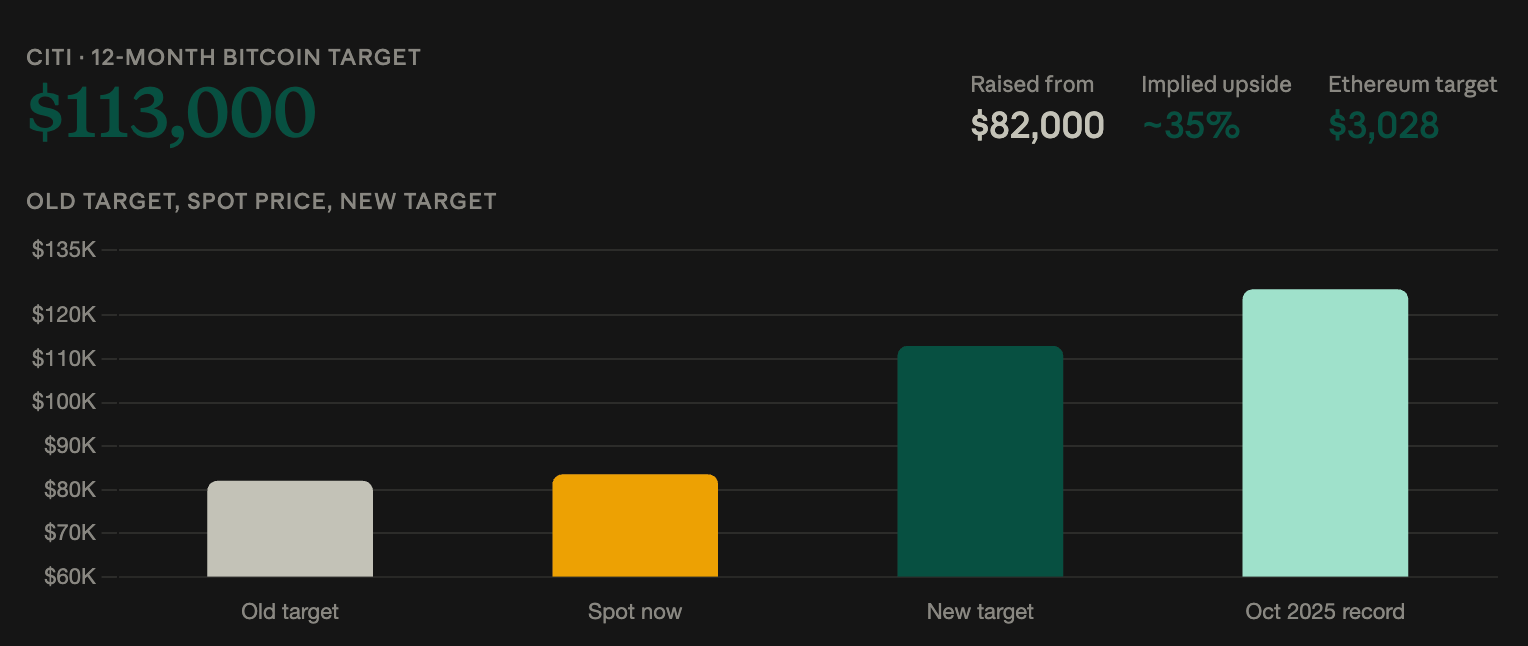
Bitcoin News | Citi Lifts Bitcoin Target to $113,000 While Forecasting Just $5 Billion of InflowsCitigroup raised its 12-month Bitcoin target price from $82,000 to $113,000, a 38% increase, and its Ethereum target from $2,240 to $3,028, up 35%.The bank expects cryptocurrency inflows to reach $5 billion over the next 12 months, with inflows recovering at a slower but steadier pace.The Flow Forecast Is Lower Than Last Quarter AloneUS spot Bitcoin ETFs drew about $6.34 billion in net inflows in the third quarter, per SoSoValue. Ether funds added $3.05 billion.Citi's $5 billion covers twelve months.That implies either a definition narrower than ETF flows — possibly net new capital across the asset class rather than fund subscriptions — or an expectation that the pace slows substantially from here.The second reading has support. September ETF inflows of $2.65 billion were down about 25% from August's $3.52 billion, and Bitcoin funds recorded roughly $149 million of outflows on Wednesday, snapping a nine-day streak.Either way, the bank is forecasting a 38% price gain alongside modest flows, which means the target does not rest on demand volume. The Upgrade Follows the Move Rather Than Anticipating ItThe previous Bitcoin target of $82,000 sat below where the asset currently trades at roughly $83,500.Bitcoin gained 42.71% in the third quarter, its best third-quarter performance since 2017, and reached $87,300 on September 21.Raising a target after a 43% quarter is standard practice rather than a criticism, but it does mean the revision reflects what has happened more than a new view on what will.The $113,000 target sits about 35% above the current price and roughly 10% below the record above $126,000 reached in October last year.Ethereum Carries the Smaller Implied GainAt $3,028 against roughly $2,690, Citi's Ethereum target implies about 13% upside.Bitcoin's implies 35%.That ordering runs against the quarter just completed, when ether gained about 71% to Bitcoin's 42.71% — its best quarter since the first quarter of 2021.A bank forecasting Bitcoin to outperform ether over the next twelve months is taking the opposite side of the rotation currently underway. CoinMarketCap's altcoin season index has held above 60 for five consecutive days at 61/100, a level not reached in more than three months.The Macro Case Cuts Both WaysCiti's targets land against a bond market that has been the main constraint on crypto prices.The 10-year Treasury yield reached 5.30% on Wednesday, its highest since 2002, and the 30-year touched 5.65%. Both reversed earlier declines that followed softer August PCE data showing headline inflation at 3.4% and core at 3%.Bitfinex analysts identify real yields as the specific pressure, with the 10-year inflation-adjusted yield climbing to 2.83% from 2.68% in the week to September 25.10x Research's Markus Thielen offers the counter-argument, forecasting the 10-year reaching 6% while noting the driver matters more than the level: "When yields rise because the Fed is tightening, bitcoin suffers. When yields rise on fiscal and term-premium concerns, the picture flips."A 38% Bitcoin gain over twelve months is consistent with the second scenario and difficult under the first.The Supply Picture Supports a Thin-Flow ThesisOne reading makes Citi's low flow forecast compatible with its price target.Glassnode's HODL Waves data shows long-term holders — coins unmoved for at least 155 days — at 80% of supply, an all-time high, up from 65% a year ago.Supply held that tightly means less selling pressure to absorb, so a given quantity of buying moves price further than it otherwise would.CryptoQuant's measure runs the other way, estimating spot demand shrank by about 170,000 BTC over the 30 days to Tuesday. The September rally leaned substantially on short liquidations rather than accumulation.Friday's non-farm payrolls report is the next macro test, with Kalshi pricing nearly 60% odds of a figure above 90,000 against Goldman Sachs at 80,000 and Bank of America at 60,000.
Bitcoin News | Citi Lifts Bitcoin Target to $113,000 While Forecasting Just $5 Billion of Inflows
Citigroup raised its 12-month Bitcoin target price from $82,000 to $113,000, a 38% increase, and its Ethereum target from $2,240 to $3,028, up 35%.The bank expects cryptocurrency inflows to reach $5 billion over the next 12 months, with inflows recovering at a slower but steadier pace.The Flow Forecast Is Lower Than Last Quarter AloneUS spot Bitcoin ETFs drew about $6.34 billion in net inflows in the third quarter, per SoSoValue. Ether funds added $3.05 billion.Citi's $5 billion covers twelve months.That implies either a definition narrower than ETF flows — possibly net new capital across the asset class rather than fund subscriptions — or an expectation that the pace slows substantially from here.The second reading has support. September ETF inflows of $2.65 billion were down about 25% from August's $3.52 billion, and Bitcoin funds recorded roughly $149 million of outflows on Wednesday, snapping a nine-day streak.Either way, the bank is forecasting a 38% price gain alongside modest flows, which means the target does not rest on demand volume. The Upgrade Follows the Move Rather Than Anticipating ItThe previous Bitcoin target of $82,000 sat below where the asset currently trades at roughly $83,500.Bitcoin gained 42.71% in the third quarter, its best third-quarter performance since 2017, and reached $87,300 on September 21.Raising a target after a 43% quarter is standard practice rather than a criticism, but it does mean the revision reflects what has happened more than a new view on what will.The $113,000 target sits about 35% above the current price and roughly 10% below the record above $126,000 reached in October last year.Ethereum Carries the Smaller Implied GainAt $3,028 against roughly $2,690, Citi's Ethereum target implies about 13% upside.Bitcoin's implies 35%.That ordering runs against the quarter just completed, when ether gained about 71% to Bitcoin's 42.71% — its best quarter since the first quarter of 2021.A bank forecasting Bitcoin to outperform ether over the next twelve months is taking the opposite side of the rotation currently underway. CoinMarketCap's altcoin season index has held above 60 for five consecutive days at 61/100, a level not reached in more than three months.The Macro Case Cuts Both WaysCiti's targets land against a bond market that has been the main constraint on crypto prices.The 10-year Treasury yield reached 5.30% on Wednesday, its highest since 2002, and the 30-year touched 5.65%. Both reversed earlier declines that followed softer August PCE data showing headline inflation at 3.4% and core at 3%.Bitfinex analysts identify real yields as the specific pressure, with the 10-year inflation-adjusted yield climbing to 2.83% from 2.68% in the week to September 25.10x Research's Markus Thielen offers the counter-argument, forecasting the 10-year reaching 6% while noting the driver matters more than the level: "When yields rise because the Fed is tightening, bitcoin suffers. When yields rise on fiscal and term-premium concerns, the picture flips."A 38% Bitcoin gain over twelve months is consistent with the second scenario and difficult under the first.The Supply Picture Supports a Thin-Flow ThesisOne reading makes Citi's low flow forecast compatible with its price target.Glassnode's HODL Waves data shows long-term holders — coins unmoved for at least 155 days — at 80% of supply, an all-time high, up from 65% a year ago.Supply held that tightly means less selling pressure to absorb, so a given quantity of buying moves price further than it otherwise would.CryptoQuant's measure runs the other way, estimating spot demand shrank by about 170,000 BTC over the 30 days to Tuesday. The September rally leaned substantially on short liquidations rather than accumulation.Friday's non-farm payrolls report is the next macro test, with Kalshi pricing nearly 60% odds of a figure above 90,000 against Goldman Sachs at 80,000 and Bank of America at 60,000.
16
·
--
TRON Releases GreatVoyage-v4.8.2.3 With Smart Contract and Node Performance UpgradesTRON has released GreatVoyage-v4.8.2.3 (Anaxagoras), a new version that updates smart contract storage access, improves BN128 pairing performance, and optimizes the parsing process for JSON data generated by nodes. According to Foresight News, the upgrade is intended to improve node efficiency and stability.
The release is mandatory, and TRON urged node operators to complete the update as soon as possible to avoid affecting block synchronization. After upgrading, related nodes can report deployment status so the community can track network-wide progress. Details on version changes, GPG signature verification, and deployment methods are available in the official release notes and upgrade documentation.
TRON Releases GreatVoyage-v4.8.2.3 With Smart Contract and Node Performance Upgrades
TRON has released GreatVoyage-v4.8.2.3 (Anaxagoras), a new version that updates smart contract storage access, improves BN128 pairing performance, and optimizes the parsing process for JSON data generated by nodes. According to Foresight News, the upgrade is intended to improve node efficiency and stability.
The release is mandatory, and TRON urged node operators to complete the update as soon as possible to avoid affecting block synchronization. After upgrading, related nodes can report deployment status so the community can track network-wide progress. Details on version changes, GPG signature verification, and deployment methods are available in the official release notes and upgrade documentation.
The release is mandatory, and TRON urged node operators to complete the update as soon as possible to avoid affecting block synchronization. After upgrading, related nodes can report deployment status so the community can track network-wide progress. Details on version changes, GPG signature verification, and deployment methods are available in the official release notes and upgrade documentation.
1
3
2.1k
·
--
Tom Lee Says Bitmine's Ethereum Holdings Equal 7% of ETH SupplyBitmine Chairman Tom Lee said the company's Ethereum DAT currently holds 7% of ETH supply and could rise to 15% during this cycle. According to ChainCatcher, Lee made the remarks without providing additional details.
Tom Lee Says Bitmine's Ethereum Holdings Equal 7% of ETH Supply
Bitmine Chairman Tom Lee said the company's Ethereum DAT currently holds 7% of ETH supply and could rise to 15% during this cycle. According to ChainCatcher, Lee made the remarks without providing additional details.
3
9
4.6k
·
--
Article
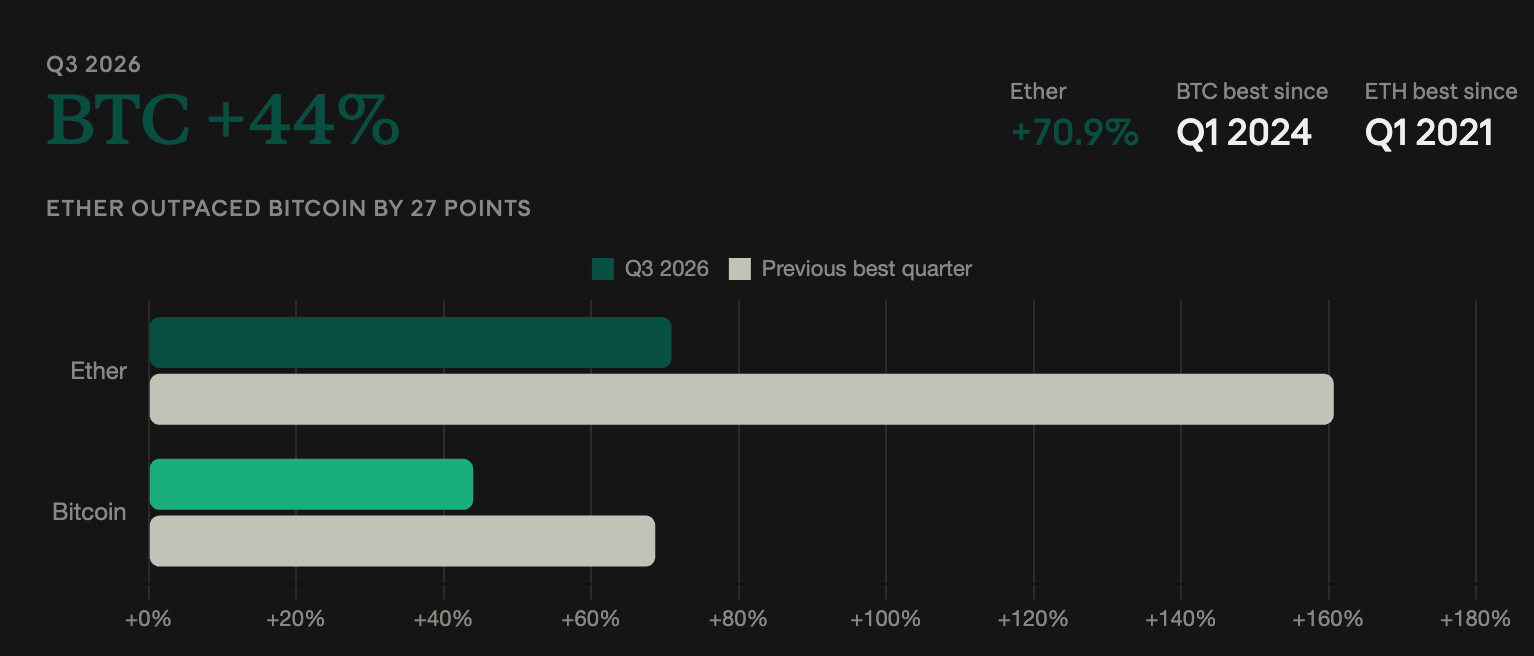
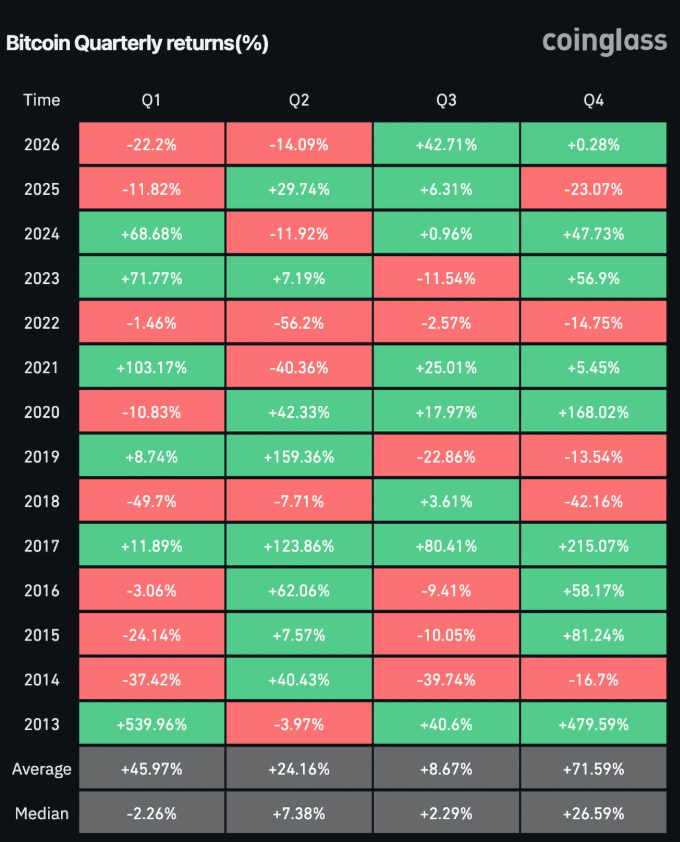
Bitcoin News | Bitcoin Closes Its Best Quarter Since Early 2024 as Ether Gains 70.9%Assuming a close around $84,000, Bitcoin will end the third quarter about 44% higher — its best quarterly result since the first quarter of 2024, when it rose 68.7%, per Coinglass.Ether gained 70.9% over the three months, its strongest quarter since the first quarter of 2021, when it rose 160.7%.Both followed three consecutive down quarters.Ether Outperformed Bitcoin by a Wide MarginThe 70.9% against 44% is the detail worth sitting with.Ether has been the laggard through most of the cycle, and a quarter where it outpaces Bitcoin by 27 percentage points marks a change in leadership rather than a proportional lift.That fits the broader rotation. CoinMarketCap's altcoin season index has held above 60 for five consecutive days at 61/100, a level not reached in more than three months, and Bitcoin's share of total market value slipped to roughly 57% from 59.2% earlier in September.The fourth quarter has historically been Bitcoin's strongest. Since 2013 it has averaged a 77% gain with a median of 47.7% — though the gap between those two figures shows the average is pulled by a small number of extreme quarters.Long-Term Holders Now Control 80% of SupplyGlassnode's HODL Waves data shows long-term holders — coins unmoved for at least 155 days — at 80% of supply, an all-time high.That share has risen from 65% over the past year, a period in which Bitcoin fell from $126,000 to $60,000.The reading means accumulation continued through the drawdown rather than distribution. The 155-day threshold currently falls around late April, so coins last moved before then qualify.It sits against a more cautious signal from the same period. CryptoQuant estimates spot demand shrank by about 170,000 BTC over the past 30 days, with growth in futures demand down 90% since September 14.Both can be true. Existing holders are not selling; new buyers are not arriving in size.The Day Itself Was a Round TripAugust PCE came in softer than forecast across all four measures.Headline rose 0.3% month over month against 0.4% expected, and 3.4% year over year against 3.7%. Core rose 0.2% against 0.3% expected, and 3% year over year against 3.3%.Bitcoin jumped more than 2% to above $85,500 within minutes. Within two hours it had returned to $84,000, with leveraged shorts squeezed out of their positions. It now sits at $83,500, down 0.4% over 24 hours.CME FedWatch showed October hike odds falling to 47.1%, from 70% about 48 hours earlier.The Methodology Change Is a Real CaveatThe PCE data was the first released under new Bureau of Labor Statistics benchmarking, which changed how certain components are measured.That is a reason to discount the beat rather than dismiss it. A methodology revision can produce a one-off level shift that does not reflect underlying prices, and the next print under the same framework is what establishes the trend.The data is also for August, and at 3.4% headline and 3% core it remains well above the Fed's 2% target.Yields Reversed Within HoursThe 10-year fell as low as 5.20% before closing 1.6 basis points higher at 5.276%. It reached 5.30% during the session, its highest since 2002.The 30-year declined to 5.54% before rising 3.6 basis points to 5.63%, having touched 5.65% — also a 24-year high."Those betting against 'the house' keep winning," wrote Jeff Gundlach.Oil is the driver behind that reversal. WTI rose more than 2%, with gasoline and diesel each up 4%. Refined products are what actually feed consumer inflation, and they moved harder than crude.Equities gave back gains too. The Nasdaq closed up 0.25% after being more than 1% higher, with the S&P 500 and Dow moving into the red.Real Yields Are the Specific HeadwindBitfinex analysts identify inflation-adjusted Treasury yields as the main pressure on Bitcoin.The 10-year real yield climbed to 2.83% from 2.68% in the week to September 25. A note offering nearly 3% after inflation raises the opportunity cost of holding non-yielding assets.LMAX Group's Joel Kruger sees the opposite case if the trend holds. "If that headwind now eases alongside lower US yields, it could provide an additional tailwind for bitcoin and ETH by improving global financial conditions and reducing the relative appeal of holding cash in dollars," he said.Fitch Ratings' Olu Sonola noted inflation remains around 3% or higher. Truflation's Oliver Rust pointed to energy prices and tariffs as continuing sources of pressure.Micron Beat on Revenue and GuidanceMicron reported fiscal fourth quarter revenue of $54.23 billion against estimates of $51.1 billion, with adjusted EPS of $33.42 against forecasts of $33.61.First quarter 2027 revenue is guided to $61.5 billion against forecasts of $57 billion, with EPS at $38.15 against $35.40."As strong as fiscal 2026 was, we expect fiscal 2027 to be even better," said CEO Sanjay Mehrotra. "Industry demand has strengthened since our last earnings call, and we expect memory and storage supply-demand conditions to be much tighter in fiscal 2027 and 2028 than they were in 2026."Shares rose 1.1% after hours. The guidance is the material part — it addresses the DRAM pricing question that determines whether the memory cycle extends.Three Other ItemsHut 8 insider filing. CEO Asher Genoot said a filing suggesting Chief Strategy Officer Michael Ho sold 1.5 million shares reflected collateral against borrowing rather than a sale. "Mike has not sold any shares since we started the company," Genoot said. HUT fell 4.8% in afternoon trading.Fed renovation report. The Office of Inspector General found no grounds to believe federal criminal law was violated in the $1.3 billion Eccles Building renovation, while noting management deficiencies. The finding removes one obstacle to Jerome Powell leaving the central bank, having remained a governor after his term as chair ended.Chicago PMI. The index jumped to 58.8 in September from 47.1, against forecasts of 51.2 — a possible preview of national ISM figures. It contributed to the yield reversal.
Bitcoin News | Bitcoin Closes Its Best Quarter Since Early 2024 as Ether Gains 70.9%
Assuming a close around $84,000, Bitcoin will end the third quarter about 44% higher — its best quarterly result since the first quarter of 2024, when it rose 68.7%, per Coinglass.Ether gained 70.9% over the three months, its strongest quarter since the first quarter of 2021, when it rose 160.7%.Both followed three consecutive down quarters.Ether Outperformed Bitcoin by a Wide MarginThe 70.9% against 44% is the detail worth sitting with.Ether has been the laggard through most of the cycle, and a quarter where it outpaces Bitcoin by 27 percentage points marks a change in leadership rather than a proportional lift.That fits the broader rotation. CoinMarketCap's altcoin season index has held above 60 for five consecutive days at 61/100, a level not reached in more than three months, and Bitcoin's share of total market value slipped to roughly 57% from 59.2% earlier in September.The fourth quarter has historically been Bitcoin's strongest. Since 2013 it has averaged a 77% gain with a median of 47.7% — though the gap between those two figures shows the average is pulled by a small number of extreme quarters.Long-Term Holders Now Control 80% of SupplyGlassnode's HODL Waves data shows long-term holders — coins unmoved for at least 155 days — at 80% of supply, an all-time high.That share has risen from 65% over the past year, a period in which Bitcoin fell from $126,000 to $60,000.The reading means accumulation continued through the drawdown rather than distribution. The 155-day threshold currently falls around late April, so coins last moved before then qualify.It sits against a more cautious signal from the same period. CryptoQuant estimates spot demand shrank by about 170,000 BTC over the past 30 days, with growth in futures demand down 90% since September 14.Both can be true. Existing holders are not selling; new buyers are not arriving in size.The Day Itself Was a Round TripAugust PCE came in softer than forecast across all four measures.Headline rose 0.3% month over month against 0.4% expected, and 3.4% year over year against 3.7%. Core rose 0.2% against 0.3% expected, and 3% year over year against 3.3%.Bitcoin jumped more than 2% to above $85,500 within minutes. Within two hours it had returned to $84,000, with leveraged shorts squeezed out of their positions. It now sits at $83,500, down 0.4% over 24 hours.CME FedWatch showed October hike odds falling to 47.1%, from 70% about 48 hours earlier.The Methodology Change Is a Real CaveatThe PCE data was the first released under new Bureau of Labor Statistics benchmarking, which changed how certain components are measured.That is a reason to discount the beat rather than dismiss it. A methodology revision can produce a one-off level shift that does not reflect underlying prices, and the next print under the same framework is what establishes the trend.The data is also for August, and at 3.4% headline and 3% core it remains well above the Fed's 2% target.Yields Reversed Within HoursThe 10-year fell as low as 5.20% before closing 1.6 basis points higher at 5.276%. It reached 5.30% during the session, its highest since 2002.The 30-year declined to 5.54% before rising 3.6 basis points to 5.63%, having touched 5.65% — also a 24-year high."Those betting against 'the house' keep winning," wrote Jeff Gundlach.Oil is the driver behind that reversal. WTI rose more than 2%, with gasoline and diesel each up 4%. Refined products are what actually feed consumer inflation, and they moved harder than crude.Equities gave back gains too. The Nasdaq closed up 0.25% after being more than 1% higher, with the S&P 500 and Dow moving into the red.Real Yields Are the Specific HeadwindBitfinex analysts identify inflation-adjusted Treasury yields as the main pressure on Bitcoin.The 10-year real yield climbed to 2.83% from 2.68% in the week to September 25. A note offering nearly 3% after inflation raises the opportunity cost of holding non-yielding assets.LMAX Group's Joel Kruger sees the opposite case if the trend holds. "If that headwind now eases alongside lower US yields, it could provide an additional tailwind for bitcoin and ETH by improving global financial conditions and reducing the relative appeal of holding cash in dollars," he said.Fitch Ratings' Olu Sonola noted inflation remains around 3% or higher. Truflation's Oliver Rust pointed to energy prices and tariffs as continuing sources of pressure.Micron Beat on Revenue and GuidanceMicron reported fiscal fourth quarter revenue of $54.23 billion against estimates of $51.1 billion, with adjusted EPS of $33.42 against forecasts of $33.61.First quarter 2027 revenue is guided to $61.5 billion against forecasts of $57 billion, with EPS at $38.15 against $35.40."As strong as fiscal 2026 was, we expect fiscal 2027 to be even better," said CEO Sanjay Mehrotra. "Industry demand has strengthened since our last earnings call, and we expect memory and storage supply-demand conditions to be much tighter in fiscal 2027 and 2028 than they were in 2026."Shares rose 1.1% after hours. The guidance is the material part — it addresses the DRAM pricing question that determines whether the memory cycle extends.Three Other ItemsHut 8 insider filing. CEO Asher Genoot said a filing suggesting Chief Strategy Officer Michael Ho sold 1.5 million shares reflected collateral against borrowing rather than a sale. "Mike has not sold any shares since we started the company," Genoot said. HUT fell 4.8% in afternoon trading.Fed renovation report. The Office of Inspector General found no grounds to believe federal criminal law was violated in the $1.3 billion Eccles Building renovation, while noting management deficiencies. The finding removes one obstacle to Jerome Powell leaving the central bank, having remained a governor after his term as chair ended.Chicago PMI. The index jumped to 58.8 in September from 47.1, against forecasts of 51.2 — a possible preview of national ISM figures. It contributed to the yield reversal.
1
1
5
4.4k
·
--

Article
South Korea Proposes Expanding Tokenized Securities Rules to Include Stocks, Bonds, and FundsSouth Korea's Financial Services Commission has announced a draft revision to lower-level regulations related to the institutionalization of token securities. According to Odaily, the proposal would expand the range of securities eligible for tokenization to include traditional assets such as stocks, bonds, and funds.Under the revision, traditional securities could be tokenized in addition to fragmented investment securities, including non-monetary trust beneficiary securities and investment contract securities. The draft would also clarify distributed ledger requirements for electronic securities rules, requiring participants to include an electronic registration institution and at least two account management institutions, while banning direct fees for distributed ledger use for electronic registration purposes.
South Korea Proposes Expanding Tokenized Securities Rules to Include Stocks, Bonds, and Funds
South Korea's Financial Services Commission has announced a draft revision to lower-level regulations related to the institutionalization of token securities. According to Odaily, the proposal would expand the range of securities eligible for tokenization to include traditional assets such as stocks, bonds, and funds.Under the revision, traditional securities could be tokenized in addition to fragmented investment securities, including non-monetary trust beneficiary securities and investment contract securities. The draft would also clarify distributed ledger requirements for electronic securities rules, requiring participants to include an electronic registration institution and at least two account management institutions, while banning direct fees for distributed ledger use for electronic registration purposes.
7
1.8k
·
--
Binance Launches Stocks Welcome Rewards Campaign With $200,000 Prize Pool and Transfer BonusesAccording to the announcement from Binance, the Binance Starter Carnival has opened a new edition featuring Binance Stocks Welcome Rewards, with users able to complete eligible tasks or transfer in stocks to earn activity attempts and compete for a share of a $200,000-valued prize pool. The campaign includes rewards such as variants of NVDAB, MUB, or QQQB token vouchers, bStocks trading fee rebates, and Spot trading fee rebate vouchers, with rewards distributed on a first-come, first-served basis until the pool is exhausted. The Activity Period runs from 2026-10-01 08:00 (UTC) to 2026-10-30 23:59 (UTC). Under Promotion A, new Stocks users can earn one activity attempt by completing their first trade of at least $5 equivalent on Stocks trading pairs, while all users can earn three attempts by trading at least $10,000 equivalent on eligible Stocks trading pairs or on Stock Options. Each spin can result in fixed rewards, including token vouchers and trading fee rebate vouchers, with the announcement stating that the reward pool is limited and that unused attempts expire after the campaign ends. The body of the announcement also notes that only verified users who opt in through the landing page and complete the required tasks during the Activity Period are eligible for rewards.Promotion B covers stock transfer-ins and offers tiered USDC token bonuses from a 100,000 USDC total reward pool for users who transfer U.S.-listed stocks and ETFs into Binance during the Activity Period. The reward tiers are based on the first transfer-in value and range from 150 USDC for transfers of at least $10,000 to 12,000 USDC for transfers of at least $1,500,000. Binance states that users must submit a transfer-out instruction with their delivering broker, then file a transfer-in request in the app, which must be updated to version 3.19.0 or above to access the feature. The announcement says U.S. equity transfers generally require at least 14 business days, and rewards depend on successful settlement within the program period. It also says the reward tier is determined by the value snapshot before the first transfer-in request, that later transfers do not increase the tier, and that users must not transfer out or withdraw the equivalent amount of stocks within 90 days after crediting to qualify for the full bonus. Rewards are distributed every 30 days after the Activity Period ends based on the initial transfer volume.
Binance Launches Stocks Welcome Rewards Campaign With $200,000 Prize Pool and Transfer Bonuses
According to the announcement from Binance, the Binance Starter Carnival has opened a new edition featuring Binance Stocks Welcome Rewards, with users able to complete eligible tasks or transfer in stocks to earn activity attempts and compete for a share of a $200,000-valued prize pool. The campaign includes rewards such as variants of NVDAB, MUB, or QQQB token vouchers, bStocks trading fee rebates, and Spot trading fee rebate vouchers, with rewards distributed on a first-come, first-served basis until the pool is exhausted. The Activity Period runs from 2026-10-01 08:00 (UTC) to 2026-10-30 23:59 (UTC). Under Promotion A, new Stocks users can earn one activity attempt by completing their first trade of at least $5 equivalent on Stocks trading pairs, while all users can earn three attempts by trading at least $10,000 equivalent on eligible Stocks trading pairs or on Stock Options. Each spin can result in fixed rewards, including token vouchers and trading fee rebate vouchers, with the announcement stating that the reward pool is limited and that unused attempts expire after the campaign ends. The body of the announcement also notes that only verified users who opt in through the landing page and complete the required tasks during the Activity Period are eligible for rewards.Promotion B covers stock transfer-ins and offers tiered USDC token bonuses from a 100,000 USDC total reward pool for users who transfer U.S.-listed stocks and ETFs into Binance during the Activity Period. The reward tiers are based on the first transfer-in value and range from 150 USDC for transfers of at least $10,000 to 12,000 USDC for transfers of at least $1,500,000. Binance states that users must submit a transfer-out instruction with their delivering broker, then file a transfer-in request in the app, which must be updated to version 3.19.0 or above to access the feature. The announcement says U.S. equity transfers generally require at least 14 business days, and rewards depend on successful settlement within the program period. It also says the reward tier is determined by the value snapshot before the first transfer-in request, that later transfers do not increase the tier, and that users must not transfer out or withdraw the equivalent amount of stocks within 90 days after crediting to qualify for the full bonus. Rewards are distributed every 30 days after the Activity Period ends based on the initial transfer volume.
6
2.7k
·
--
Article
Bitcoin News | Bitcoin ETFs Take $6.34 Billion in Q3 After $5 Billion of Q2 OutflowsUS spot Bitcoin ETFs recorded about $6.34 billion in net inflows in the third quarter, their strongest quarter of 2026, per SoSoValue.That reverses roughly $5 billion of net outflows in the second quarter, a swing of more than $11 billion between the two periods.Bitcoin gained 42.71% over the quarter, its strongest since the fourth quarter of 2024 and its best third-quarter performance since 2017, per CoinGlass.The Monthly Pattern Shows Momentum FadingThe quarter was front-loaded in its second half and is now decelerating.July delivered $172 million. August brought $3.52 billion. September closed with $2.65 billion — down about 25% from August.That ordering matters more than the quarterly total. A quarter that builds and then eases describes demand that arrived in response to price rather than demand that drove it.September also ended weakly. Bitcoin ETFs recorded roughly $149 million in net outflows on Wednesday, snapping a nine-day inflow streak that had attracted about $3.1 billion. The Flows Sit Against a Weaker Demand SignalETF inflows are one measure of spot demand, not the only one.CryptoQuant estimates Bitcoin's overall spot demand shrank by about 170,000 BTC over the 30 days to Tuesday, a figure that deteriorated from −145,000 BTC on September 11 while price rose.The two readings are compatible. ETFs absorbed capital while other holders distributed, meaning the regulated vehicles were buying from sellers elsewhere rather than adding to net demand.Glassnode's HODL Waves data adds a third piece. Long-term holders — coins unmoved for at least 155 days — now account for 80% of supply, an all-time high, up from 65% a year ago.Existing holders are not selling. New demand is arriving through ETFs. Neither of those explains a 42.71% quarterly gain on its own, and short liquidations supplied a substantial part of the September move.Ether Funds Delivered a Larger Proportional ReversalUS spot Ether ETFs attracted about $3.05 billion in Q3 after roughly $714 million of outflows in Q2.Ether gained about 71% over the quarter, its best since the first quarter of 2021.The ratio is the interesting part. Ether's ETF complex drew about 48% of what Bitcoin's did while delivering 66% more price appreciation — so ETF flows explain less of ether's move than of Bitcoin's.That is consistent with the broader rotation. CoinMarketCap's altcoin season index has held above 60 for five consecutive days at 61/100, a level not reached in more than three months.Altcoin Funds Are Building Smaller PositionsXRP ETFs attracted $308 million in Q3, lifting cumulative net inflows to $1.79 billion.Solana ETFs drew $272 million in September and Zcash ETFs $246 million.The Zcash figure is the standout relative to its market size. ZEC gained 130% over 30 days and reached a record near $1,488, and a single US fund has now pulled in substantial flows in its first months — including a $47 million day in mid-September when the broader complex was losing money.Privacy has been the quarter's most durable sector trade, and the ETF flows confirm institutional participation rather than purely retail speculation.What the Fourth Quarter FacesBitcoin's fourth quarter has historically been its strongest. Since 2013 it has averaged a 77% gain with a median of 47.7%, though the gap between those figures shows the average is pulled by a small number of extreme quarters.The macro setup is less supportive than the seasonal record.The 10-year Treasury yield reached 5.30% on Wednesday, its highest since 2002, and the 30-year touched 5.65%. Both reversed earlier declines that followed softer-than-expected August PCE data, which showed headline inflation at 3.4% and core at 3%.Bitfinex analysts identify real yields as the specific pressure, with the 10-year inflation-adjusted yield climbing to 2.83% from 2.68% in the week to September 25.Friday's non-farm payrolls report is the next test, with Kalshi pricing nearly 60% odds of a figure above 90,000 against Goldman Sachs at 80,000 and Bank of America at 60,000.
Bitcoin News | Bitcoin ETFs Take $6.34 Billion in Q3 After $5 Billion of Q2 Outflows
US spot Bitcoin ETFs recorded about $6.34 billion in net inflows in the third quarter, their strongest quarter of 2026, per SoSoValue.That reverses roughly $5 billion of net outflows in the second quarter, a swing of more than $11 billion between the two periods.Bitcoin gained 42.71% over the quarter, its strongest since the fourth quarter of 2024 and its best third-quarter performance since 2017, per CoinGlass.The Monthly Pattern Shows Momentum FadingThe quarter was front-loaded in its second half and is now decelerating.July delivered $172 million. August brought $3.52 billion. September closed with $2.65 billion — down about 25% from August.That ordering matters more than the quarterly total. A quarter that builds and then eases describes demand that arrived in response to price rather than demand that drove it.September also ended weakly. Bitcoin ETFs recorded roughly $149 million in net outflows on Wednesday, snapping a nine-day inflow streak that had attracted about $3.1 billion. The Flows Sit Against a Weaker Demand SignalETF inflows are one measure of spot demand, not the only one.CryptoQuant estimates Bitcoin's overall spot demand shrank by about 170,000 BTC over the 30 days to Tuesday, a figure that deteriorated from −145,000 BTC on September 11 while price rose.The two readings are compatible. ETFs absorbed capital while other holders distributed, meaning the regulated vehicles were buying from sellers elsewhere rather than adding to net demand.Glassnode's HODL Waves data adds a third piece. Long-term holders — coins unmoved for at least 155 days — now account for 80% of supply, an all-time high, up from 65% a year ago.Existing holders are not selling. New demand is arriving through ETFs. Neither of those explains a 42.71% quarterly gain on its own, and short liquidations supplied a substantial part of the September move.Ether Funds Delivered a Larger Proportional ReversalUS spot Ether ETFs attracted about $3.05 billion in Q3 after roughly $714 million of outflows in Q2.Ether gained about 71% over the quarter, its best since the first quarter of 2021.The ratio is the interesting part. Ether's ETF complex drew about 48% of what Bitcoin's did while delivering 66% more price appreciation — so ETF flows explain less of ether's move than of Bitcoin's.That is consistent with the broader rotation. CoinMarketCap's altcoin season index has held above 60 for five consecutive days at 61/100, a level not reached in more than three months.Altcoin Funds Are Building Smaller PositionsXRP ETFs attracted $308 million in Q3, lifting cumulative net inflows to $1.79 billion.Solana ETFs drew $272 million in September and Zcash ETFs $246 million.The Zcash figure is the standout relative to its market size. ZEC gained 130% over 30 days and reached a record near $1,488, and a single US fund has now pulled in substantial flows in its first months — including a $47 million day in mid-September when the broader complex was losing money.Privacy has been the quarter's most durable sector trade, and the ETF flows confirm institutional participation rather than purely retail speculation.What the Fourth Quarter FacesBitcoin's fourth quarter has historically been its strongest. Since 2013 it has averaged a 77% gain with a median of 47.7%, though the gap between those figures shows the average is pulled by a small number of extreme quarters.The macro setup is less supportive than the seasonal record.The 10-year Treasury yield reached 5.30% on Wednesday, its highest since 2002, and the 30-year touched 5.65%. Both reversed earlier declines that followed softer-than-expected August PCE data, which showed headline inflation at 3.4% and core at 3%.Bitfinex analysts identify real yields as the specific pressure, with the 10-year inflation-adjusted yield climbing to 2.83% from 2.68% in the week to September 25.Friday's non-farm payrolls report is the next test, with Kalshi pricing nearly 60% odds of a figure above 90,000 against Goldman Sachs at 80,000 and Bank of America at 60,000.
1
2.5k
·
--
Binance Futures to Delist PROMPTUSDT, PUMPBTCUSDT and 1000000BOBUSDT Perpetual ContractsAccording to the [announcement](https://www.binance.com/en/support/announcement/detail/2f1a743334f044abbd82e34093c7b771) from Binance, Binance Futures will close all positions and carry out automatic settlement for the USDⓈ-M PROMPTUSDT, PUMPBTCUSDT and 1000000BOBUSDT perpetual contracts on 2026-10-05 09:00 (UTC). The contracts will be delisted after settlement is completed. Binance said users should close any open positions before the delisting time to avoid automatic settlement. New non-reduce only orders for the affected contracts will not be allowed starting from 2026-10-05 08:30 (UTC). The notice said the decision follows periodic reviews of futures contracts based on factors including trading volume and liquidity, network stability and safety, new regulatory requirements, changes in token supply and tokenomics, project ownership structure, team commitment and development activity, responsiveness to due diligence requests, and evidence of unethical or fraudulent conduct or negligence.
The announcement also outlined how liquidation will be handled during the final hour before settlement. Binance said the Futures Insurance Fund will not be used to support liquidation for the affected contracts during that period. Any liquidation triggered in the final hour will be executed as a single Immediate or Cancel order, or IOCO, and sent to the market in one attempt. If the remaining assets in a user’s account are sufficient to meet the required Maintenance Margin after realized losses and any applicable Liquidation Clearance Fee, the liquidation will stop. If the IOCO does not fully reduce the position to the level needed to satisfy Maintenance Margin requirements, any unfilled portion will be resolved through the Auto-Deleveraging process. Binance also said additional protective measures may be applied without further announcement, including changes to maximum leverage, position value, maintenance margin in each margin tier, funding rates, price index constituents, and the Last Price Protected mechanism used to update the Mark Price.
Binance Futures to Delist PROMPTUSDT, PUMPBTCUSDT and 1000000BOBUSDT Perpetual Contracts
According to the announcement from Binance, Binance Futures will close all positions and carry out automatic settlement for the USDⓈ-M PROMPTUSDT, PUMPBTCUSDT and 1000000BOBUSDT perpetual contracts on 2026-10-05 09:00 (UTC). The contracts will be delisted after settlement is completed. Binance said users should close any open positions before the delisting time to avoid automatic settlement. New non-reduce only orders for the affected contracts will not be allowed starting from 2026-10-05 08:30 (UTC). The notice said the decision follows periodic reviews of futures contracts based on factors including trading volume and liquidity, network stability and safety, new regulatory requirements, changes in token supply and tokenomics, project ownership structure, team commitment and development activity, responsiveness to due diligence requests, and evidence of unethical or fraudulent conduct or negligence.
The announcement also outlined how liquidation will be handled during the final hour before settlement. Binance said the Futures Insurance Fund will not be used to support liquidation for the affected contracts during that period. Any liquidation triggered in the final hour will be executed as a single Immediate or Cancel order, or IOCO, and sent to the market in one attempt. If the remaining assets in a user’s account are sufficient to meet the required Maintenance Margin after realized losses and any applicable Liquidation Clearance Fee, the liquidation will stop. If the IOCO does not fully reduce the position to the level needed to satisfy Maintenance Margin requirements, any unfilled portion will be resolved through the Auto-Deleveraging process. Binance also said additional protective measures may be applied without further announcement, including changes to maximum leverage, position value, maintenance margin in each margin tier, funding rates, price index constituents, and the Last Price Protected mechanism used to update the Mark Price.
The announcement also outlined how liquidation will be handled during the final hour before settlement. Binance said the Futures Insurance Fund will not be used to support liquidation for the affected contracts during that period. Any liquidation triggered in the final hour will be executed as a single Immediate or Cancel order, or IOCO, and sent to the market in one attempt. If the remaining assets in a user’s account are sufficient to meet the required Maintenance Margin after realized losses and any applicable Liquidation Clearance Fee, the liquidation will stop. If the IOCO does not fully reduce the position to the level needed to satisfy Maintenance Margin requirements, any unfilled portion will be resolved through the Auto-Deleveraging process. Binance also said additional protective measures may be applied without further announcement, including changes to maximum leverage, position value, maintenance margin in each margin tier, funding rates, price index constituents, and the Last Price Protected mechanism used to update the Mark Price.
3
2
27
26k
·
--
Grayscale Completes 3-for-1 Share Split for Zcash ETF ZCSHGrayscale said its Zcash ETF, ZCSH, has completed the previously announced 3-for-1 share split, which took effect before the U.S. stock market opened on September 30. Shares began trading on a split-adjusted basis that day. According to Odaily, shareholders of record at the close on September 28 received two additional shares for each pre-split share, converting one pre-split share into three post-split shares. Grayscale said the split does not change the total value of shareholders' investments, and the fund's net asset value per share was adjusted to about one-third of its pre-split level. ZCSH continues to trade on NYSE Arca, with its ticker and CUSIP unchanged.
Grayscale Completes 3-for-1 Share Split for Zcash ETF ZCSH
Grayscale said its Zcash ETF, ZCSH, has completed the previously announced 3-for-1 share split, which took effect before the U.S. stock market opened on September 30. Shares began trading on a split-adjusted basis that day. According to Odaily, shareholders of record at the close on September 28 received two additional shares for each pre-split share, converting one pre-split share into three post-split shares. Grayscale said the split does not change the total value of shareholders' investments, and the fund's net asset value per share was adjusted to about one-third of its pre-split level. ZCSH continues to trade on NYSE Arca, with its ticker and CUSIP unchanged.
1
1
4
2.1k
·
--

Article
Binance Academy Replenishes Bitcoin Learn & Earn Rewards for October 2026According to the announcement from Binance, Binance Academy has replenished the Bitcoin Learn & Earn rewards for the month of October 2026, allowing eligible new users to complete an optional quiz and earn 0.00001 BTC in token vouchers. The activity period begins on 2026-10-01 00:00 (UTC) and continues until further notice. The program is available only to new users who registered on Binance after 2026-10-01 00:00 (UTC) and complete the Learn & Earn quiz with all correct answers. Rewards are limited to the first 5,000 new users each month and are distributed on a first-come, first-served basis. Each user may complete the Learn & Earn only once and claim a maximum of one reward. Once all rewards for the month are distributed, participation will close for that month, and the rewards will be renewed each month through future announcements.
Eligibility and reward details: Qualified users must complete KYC to receive rewards from this activity. The token voucher reward will be distributed within 48 hours to users who pass the quiz, and users may check their rewards via Profile > Rewards Hub. The token voucher is valid for 14 days from the day of distribution. Binance also stated that illegally bulk registered accounts and sub-accounts are not eligible to participate or receive rewards. The announcement notes that the actual value of the reward may change due to market fluctuation, and participation ends once all rewards are distributed. The program is presented as part of Binance Academy’s Bitcoin Learn & Earn offering for new users learning the basics of Bitcoin.
Binance Academy Replenishes Bitcoin Learn & Earn Rewards for October 2026
According to the announcement from Binance, Binance Academy has replenished the Bitcoin Learn & Earn rewards for the month of October 2026, allowing eligible new users to complete an optional quiz and earn 0.00001 BTC in token vouchers. The activity period begins on 2026-10-01 00:00 (UTC) and continues until further notice. The program is available only to new users who registered on Binance after 2026-10-01 00:00 (UTC) and complete the Learn & Earn quiz with all correct answers. Rewards are limited to the first 5,000 new users each month and are distributed on a first-come, first-served basis. Each user may complete the Learn & Earn only once and claim a maximum of one reward. Once all rewards for the month are distributed, participation will close for that month, and the rewards will be renewed each month through future announcements.
Eligibility and reward details: Qualified users must complete KYC to receive rewards from this activity. The token voucher reward will be distributed within 48 hours to users who pass the quiz, and users may check their rewards via Profile > Rewards Hub. The token voucher is valid for 14 days from the day of distribution. Binance also stated that illegally bulk registered accounts and sub-accounts are not eligible to participate or receive rewards. The announcement notes that the actual value of the reward may change due to market fluctuation, and participation ends once all rewards are distributed. The program is presented as part of Binance Academy’s Bitcoin Learn & Earn offering for new users learning the basics of Bitcoin.
Eligibility and reward details: Qualified users must complete KYC to receive rewards from this activity. The token voucher reward will be distributed within 48 hours to users who pass the quiz, and users may check their rewards via Profile > Rewards Hub. The token voucher is valid for 14 days from the day of distribution. Binance also stated that illegally bulk registered accounts and sub-accounts are not eligible to participate or receive rewards. The announcement notes that the actual value of the reward may change due to market fluctuation, and participation ends once all rewards are distributed. The program is presented as part of Binance Academy’s Bitcoin Learn & Earn offering for new users learning the basics of Bitcoin.
5
17
5.4k
·
--
Article
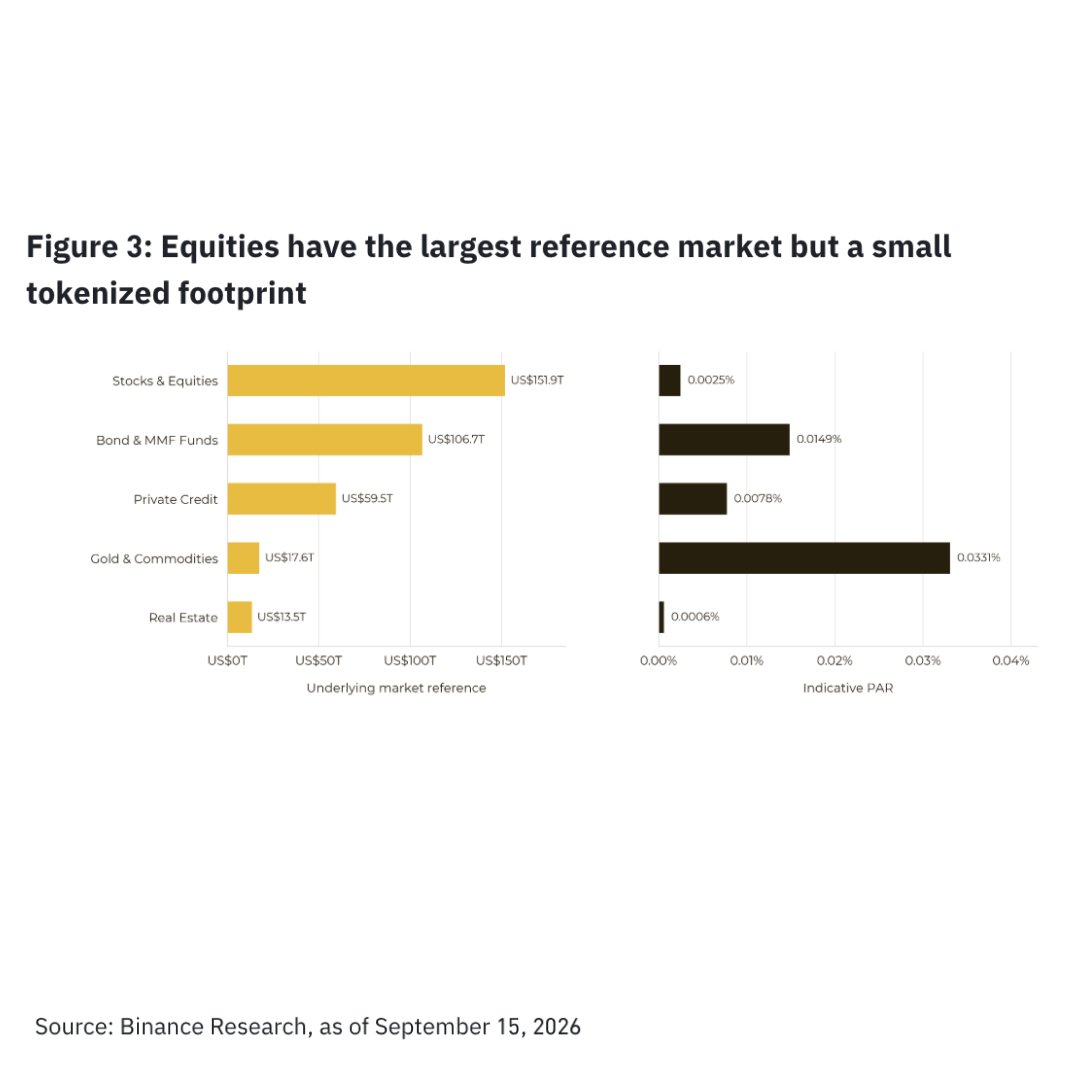
Richard Teng: Tokenization Could Reshape Equity-Market Access, But Not OvernightTokenization could change how the world accesses equity markets, though it will not happen overnight, Binance co-CEO Richard Teng said in a post on X. He noted that tokenized equities surged 390% in 2026, yet still cover just 0.0029% of the $151.9 trillion listed equity market. Citing Binance Research's base case, Teng said the segment could reach approximately $349 billion by 2030, up from $4.43 billion today.
Richard Teng: Tokenization Could Reshape Equity-Market Access, But Not Overnight
Tokenization could change how the world accesses equity markets, though it will not happen overnight, Binance co-CEO Richard Teng said in a post on X. He noted that tokenized equities surged 390% in 2026, yet still cover just 0.0029% of the $151.9 trillion listed equity market. Citing Binance Research's base case, Teng said the segment could reach approximately $349 billion by 2030, up from $4.43 billion today.
2
2.2k
·
--
Bitwise NEAR ETF Assets Reach $52.8 Million After $13.2 Million Daily InflowBitwise said its U.S. spot NEAR ETP, the Bitwise NEAR ETF (NRR), has reached $52.8 million in assets under management. According to ChainCatcher, the fund recorded $13.2 million in net inflows yesterday and $20.1 million in trading volume.
Bitwise previously said it plans to stake the NEAR tokens held by the fund internally to maximize participation in NEAR's average staking reward of about 5%.
Bitwise NEAR ETF Assets Reach $52.8 Million After $13.2 Million Daily Inflow
Bitwise said its U.S. spot NEAR ETP, the Bitwise NEAR ETF (NRR), has reached $52.8 million in assets under management. According to ChainCatcher, the fund recorded $13.2 million in net inflows yesterday and $20.1 million in trading volume.
Bitwise previously said it plans to stake the NEAR tokens held by the fund internally to maximize participation in NEAR's average staking reward of about 5%.
Bitwise previously said it plans to stake the NEAR tokens held by the fund internally to maximize participation in NEAR's average staking reward of about 5%.
6
8.1k
·
--

Article
MetaMask Removes Ethereum Validators From Lido After Security IncidentMetaMask said it is responding to a security incident affecting part of its infrastructure and has not found any direct threat to MetaMask wallets. According to Foresight News, the company is coordinating with customers, partners, and security advisers and is proactively exiting affected validator nodes in its non-custodial staking operations.
Lido said MetaMask's actions include removing its Ethereum validator nodes from the Lido protocol. The relevant validator nodes have begun the exit process and are expected to complete exiting by October 7, 2026, though they will not be fully withdrawn. stETH holders do not need to take any action. ETH exiting validator nodes operated by MetaMask Staking is expected to return to the protocol gradually as the validators complete the exit, withdrawal, and re-entry cycle. Due to long queue times, the process is expected to take about 45 days.
MetaMask Removes Ethereum Validators From Lido After Security Incident
MetaMask said it is responding to a security incident affecting part of its infrastructure and has not found any direct threat to MetaMask wallets. According to Foresight News, the company is coordinating with customers, partners, and security advisers and is proactively exiting affected validator nodes in its non-custodial staking operations.
Lido said MetaMask's actions include removing its Ethereum validator nodes from the Lido protocol. The relevant validator nodes have begun the exit process and are expected to complete exiting by October 7, 2026, though they will not be fully withdrawn. stETH holders do not need to take any action. ETH exiting validator nodes operated by MetaMask Staking is expected to return to the protocol gradually as the validators complete the exit, withdrawal, and re-entry cycle. Due to long queue times, the process is expected to take about 45 days.
Lido said MetaMask's actions include removing its Ethereum validator nodes from the Lido protocol. The relevant validator nodes have begun the exit process and are expected to complete exiting by October 7, 2026, though they will not be fully withdrawn. stETH holders do not need to take any action. ETH exiting validator nodes operated by MetaMask Staking is expected to return to the protocol gradually as the validators complete the exit, withdrawal, and re-entry cycle. Due to long queue times, the process is expected to take about 45 days.
2
3
7
20.6k
·
--
MetaMask Says Infrastructure Security Incident Did Not Directly Threaten WalletsMetaMask said some of its infrastructure was affected by a security incident, but it has not found signs of a direct threat to MetaMask wallets. According to Odaily, the company is coordinating with affected customers, partners, and security advisers as a precaution and is proactively exiting impacted validator nodes in its non-custodial staking business. MetaMask said the incident involves infrastructure and does not mean its wallets currently face a security risk. It said it will provide further updates in due course.
MetaMask Says Infrastructure Security Incident Did Not Directly Threaten Wallets
MetaMask said some of its infrastructure was affected by a security incident, but it has not found signs of a direct threat to MetaMask wallets. According to Odaily, the company is coordinating with affected customers, partners, and security advisers as a precaution and is proactively exiting impacted validator nodes in its non-custodial staking business. MetaMask said the incident involves infrastructure and does not mean its wallets currently face a security risk. It said it will provide further updates in due course.
1
950
·
--
SOL Spot ETFs Record $11.1 Million Net Outflow on September 30SOL spot ETFs recorded a total net outflow of $11.1 million on September 30, according to SoSoValue data. According to Odaily, Fidelity Solana Fund ETF (FSOL) posted a net inflow of $2.77 million, bringing its cumulative net inflow to $234 million.
Bitwise Solana Staking ETF (BSOL) saw a net outflow of $8.94 million, while its cumulative net inflow reached $1.225 billion. As of press time, SOL spot ETFs had total net assets of $1.906 billion, a SOL net asset ratio of 2.75%, and cumulative net inflows of $1.612 billion.
SOL Spot ETFs Record $11.1 Million Net Outflow on September 30
SOL spot ETFs recorded a total net outflow of $11.1 million on September 30, according to SoSoValue data. According to Odaily, Fidelity Solana Fund ETF (FSOL) posted a net inflow of $2.77 million, bringing its cumulative net inflow to $234 million.
Bitwise Solana Staking ETF (BSOL) saw a net outflow of $8.94 million, while its cumulative net inflow reached $1.225 billion. As of press time, SOL spot ETFs had total net assets of $1.906 billion, a SOL net asset ratio of 2.75%, and cumulative net inflows of $1.612 billion.
Bitwise Solana Staking ETF (BSOL) saw a net outflow of $8.94 million, while its cumulative net inflow reached $1.225 billion. As of press time, SOL spot ETFs had total net assets of $1.906 billion, a SOL net asset ratio of 2.75%, and cumulative net inflows of $1.612 billion.
2
13
7.7k
·
--
BNB Surpasses 770 USDT with a 0.22% Increase in 24 HoursOn Oct 01, 2026, 10:42 AM(UTC). According to Binance Market Data, BNB has crossed the 770 USDT benchmark and is now trading at 770.299988 USDT, with a narrowed 0.22% increase in 24 hours.
BNB Surpasses 770 USDT with a 0.22% Increase in 24 Hours
On Oct 01, 2026, 10:42 AM(UTC). According to Binance Market Data, BNB has crossed the 770 USDT benchmark and is now trading at 770.299988 USDT, with a narrowed 0.22% increase in 24 hours.
1
865
·
--

Article
Michael Saylor Says Digital Credit Issuers Can Strengthen One AnotherMichael Saylor said he wants Strive and every well-managed issuer of Bitcoin-powered "Digital Credit" to succeed, arguing in a post on X that firms built on the same Bitcoin foundation can compete for individual investments while strengthening one another's long-term opportunity. He framed the structure in three layers: Bitcoin as "Digital Capital," instruments like Strategy's STRC and Strive's SATA as "Digital Credit," and treasury equities such as MSTR and ASST as "Digital Equity." The biggest opportunity, he said, lies outside the industry: citing SIFMA, he noted global equity market capitalization reached $157.8 trillion and global fixed-income debt $160.7 trillion at the end of 2025, meaning one-tenth of one percent of either market is roughly $160 billion — the scale against which these young categories should be measured.
Saylor described the opportunity as a "triple amplifier." First, appreciation of Digital Capital: when any company raises capital to buy Bitcoin, it adds demand for a supply-constrained asset, so a successful acquisition by Strive can be constructive for Strategy and vice versa, since a stronger Bitcoin price lifts the value held on every Bitcoin balance sheet. Second, adoption of Digital Credit: multiple credible issuers can build trust in a new category faster than one alone, and as understanding and liquidity improve, investors may demand a smaller premium — narrowing spreads and lowering financing costs across qualified issuers, though he cautioned Bitcoin pays no coupon and any margin must be earned through disciplined management. Third, recognition of Digital Equity: as more firms show the model works across market conditions, valuations and multiples such as mNAV can expand, though he stressed a premium must be earned and more issuers do not automatically lift multiples.
The amplifiers reinforce one another, Saylor said, with benefits extending beyond any single transaction to more analyst coverage, institutional research and trading infrastructure. He argued many investors want category exposure but cannot concentrate it in one company, so additional credible issuers unlock capital that would otherwise stay out — noting that on March 11, 2026, Strive disclosed a $50 million purchase of STRC, illustrating how issuers can become customers of one another. Likening the ecosystem to Ford and Standard Oil, where complementary businesses expanded the whole system, he said Digital Capital, Credit, Equity, Money and Derivatives together can make digital assets more useful. He cautioned that shared foundations make standards matter — a weak issuer can damage confidence across the category — and that the positive-sum opportunity depends on sound capitalization, prudent liquidity and transparent disclosure, concluding: "When we build on Bitcoin, we have an interest in one another's success."
Michael Saylor Says Digital Credit Issuers Can Strengthen One Another
Michael Saylor said he wants Strive and every well-managed issuer of Bitcoin-powered "Digital Credit" to succeed, arguing in a post on X that firms built on the same Bitcoin foundation can compete for individual investments while strengthening one another's long-term opportunity. He framed the structure in three layers: Bitcoin as "Digital Capital," instruments like Strategy's STRC and Strive's SATA as "Digital Credit," and treasury equities such as MSTR and ASST as "Digital Equity." The biggest opportunity, he said, lies outside the industry: citing SIFMA, he noted global equity market capitalization reached $157.8 trillion and global fixed-income debt $160.7 trillion at the end of 2025, meaning one-tenth of one percent of either market is roughly $160 billion — the scale against which these young categories should be measured.
Saylor described the opportunity as a "triple amplifier." First, appreciation of Digital Capital: when any company raises capital to buy Bitcoin, it adds demand for a supply-constrained asset, so a successful acquisition by Strive can be constructive for Strategy and vice versa, since a stronger Bitcoin price lifts the value held on every Bitcoin balance sheet. Second, adoption of Digital Credit: multiple credible issuers can build trust in a new category faster than one alone, and as understanding and liquidity improve, investors may demand a smaller premium — narrowing spreads and lowering financing costs across qualified issuers, though he cautioned Bitcoin pays no coupon and any margin must be earned through disciplined management. Third, recognition of Digital Equity: as more firms show the model works across market conditions, valuations and multiples such as mNAV can expand, though he stressed a premium must be earned and more issuers do not automatically lift multiples.
The amplifiers reinforce one another, Saylor said, with benefits extending beyond any single transaction to more analyst coverage, institutional research and trading infrastructure. He argued many investors want category exposure but cannot concentrate it in one company, so additional credible issuers unlock capital that would otherwise stay out — noting that on March 11, 2026, Strive disclosed a $50 million purchase of STRC, illustrating how issuers can become customers of one another. Likening the ecosystem to Ford and Standard Oil, where complementary businesses expanded the whole system, he said Digital Capital, Credit, Equity, Money and Derivatives together can make digital assets more useful. He cautioned that shared foundations make standards matter — a weak issuer can damage confidence across the category — and that the positive-sum opportunity depends on sound capitalization, prudent liquidity and transparent disclosure, concluding: "When we build on Bitcoin, we have an interest in one another's success."
Saylor described the opportunity as a "triple amplifier." First, appreciation of Digital Capital: when any company raises capital to buy Bitcoin, it adds demand for a supply-constrained asset, so a successful acquisition by Strive can be constructive for Strategy and vice versa, since a stronger Bitcoin price lifts the value held on every Bitcoin balance sheet. Second, adoption of Digital Credit: multiple credible issuers can build trust in a new category faster than one alone, and as understanding and liquidity improve, investors may demand a smaller premium — narrowing spreads and lowering financing costs across qualified issuers, though he cautioned Bitcoin pays no coupon and any margin must be earned through disciplined management. Third, recognition of Digital Equity: as more firms show the model works across market conditions, valuations and multiples such as mNAV can expand, though he stressed a premium must be earned and more issuers do not automatically lift multiples.
The amplifiers reinforce one another, Saylor said, with benefits extending beyond any single transaction to more analyst coverage, institutional research and trading infrastructure. He argued many investors want category exposure but cannot concentrate it in one company, so additional credible issuers unlock capital that would otherwise stay out — noting that on March 11, 2026, Strive disclosed a $50 million purchase of STRC, illustrating how issuers can become customers of one another. Likening the ecosystem to Ford and Standard Oil, where complementary businesses expanded the whole system, he said Digital Capital, Credit, Equity, Money and Derivatives together can make digital assets more useful. He cautioned that shared foundations make standards matter — a weak issuer can damage confidence across the category — and that the positive-sum opportunity depends on sound capitalization, prudent liquidity and transparent disclosure, concluding: "When we build on Bitcoin, we have an interest in one another's success."
2
14
11.5k
·
--
TRUMP Meme Coin Announces November 22 Dinner With TrumpThe team behind Official Trump (TRUMP) said the top 185 holders on its leaderboard will get a gala dinner with President Donald Trump on November 22 at Trump National in Washington, D.C. according to BeInCrypto, with the top 29 also eligible for a VIP reception and the top 4 VIPs set to receive 18K gold Trump watches. Holders must register separately, and the site says there will be no private meetings with the president.
TRUMP Meme Coin Announces November 22 Dinner With Trump
The team behind Official Trump (TRUMP) said the top 185 holders on its leaderboard will get a gala dinner with President Donald Trump on November 22 at Trump National in Washington, D.C. according to BeInCrypto, with the top 29 also eligible for a VIP reception and the top 4 VIPs set to receive 18K gold Trump watches. Holders must register separately, and the site says there will be no private meetings with the president.
2
7
14.3k
·
--
Ripple, Cardano Strike Brazil Partnerships In Finance And EnergyRipple and Cardano struck major partnerships in Brazil, expanding blockchain use in the country’s regulated financial and energy sectors. According to BeInCrypto, CSD BR began testing XRP Ledger as a parallel record-keeping system for investment funds, while Cardano Foundation unveiled two applications with Petrobras for sustainable aviation fuel and renewable diesel tracking. Ripple said the pilot mirrors BTG Pactual fund shares onchain, and Cardano said the projects support emissions reporting. ADA traded near $0.2549, up 0.9% in 24 hours.
Ripple, Cardano Strike Brazil Partnerships In Finance And Energy
Ripple and Cardano struck major partnerships in Brazil, expanding blockchain use in the country’s regulated financial and energy sectors. According to BeInCrypto, CSD BR began testing XRP Ledger as a parallel record-keeping system for investment funds, while Cardano Foundation unveiled two applications with Petrobras for sustainable aviation fuel and renewable diesel tracking. Ripple said the pilot mirrors BTG Pactual fund shares onchain, and Cardano said the projects support emissions reporting. ADA traded near $0.2549, up 0.9% in 24 hours.
12
18.4k
·
--
Passengers Stop Pilot After Colleague Stabbing on Tel Aviv FlightPassengers on a jet carrying more than 170 people to Tel Aviv tackled a pilot after he stabbed his colleague and tried to crash the plane, according to Bloomberg.
Israeli Prime Minister Benjamin Netanyahu called it a serious security incident.
Passengers Stop Pilot After Colleague Stabbing on Tel Aviv Flight
Passengers on a jet carrying more than 170 people to Tel Aviv tackled a pilot after he stabbed his colleague and tried to crash the plane, according to Bloomberg.
Israeli Prime Minister Benjamin Netanyahu called it a serious security incident.
Israeli Prime Minister Benjamin Netanyahu called it a serious security incident.
3
4
13k
·
--
Ethereum Co-Founder Joseph Lubin-Linked Wallet Transfers 133,298 ETH to New WalletA wallet linked to Ethereum co-founder Joseph Lubin transferred 133,298 ETH to a new wallet five hours ago. According to Odaily, the transfer was worth $356 million.
Ethereum Co-Founder Joseph Lubin-Linked Wallet Transfers 133,298 ETH to New Wallet
A wallet linked to Ethereum co-founder Joseph Lubin transferred 133,298 ETH to a new wallet five hours ago. According to Odaily, the transfer was worth $356 million.
1
3
4.9k
·
--
Binance to Continue USD1 Airdrop Campaign With 150 Million WLFI Token RewardsAccording to the announcement from Binance, the platform will continue its airdrop campaign for eligible users holding World Liberty Financial USD (USD1) starting from 2026-10-02 00:00 (UTC). The campaign will distribute rewards from a total pool of 150 million World Liberty Financial (WLFI) tokens and up to 2.5 million USD1 tokens. Rewards will be paid as weekly airdrops to USD1 holders every Friday, with Stage 1 running from 2026-10-02 00:00 (UTC) to 2026-10-16 00:00 (UTC) and Stage 2 running from 2026-10-16 00:00 (UTC) to 2026-10-30 00:00 (UTC). Stage 1 will allocate 75 million WLFI tokens, while Stage 2 will allocate 75 million WLFI tokens and up to 2.5 million USD1 tokens. Binance said it will update the Stage 2 campaign terms on or before 2026-10-16. The announcement also said rewards will begin accruing from 2026-10-02 00:00 (UTC) and will be distributed by 18:00 (UTC) every Friday in WLFI tokens. Eligible balances may be held in Spot, Funding, Margin, or USDⓈ-M Futures accounts, and users with USD1 in Binance Futures or Margin accounts may receive a 1.2x bonus multiplier if their Daily Open Interest on USD1 Futures pair(s) remains at a minimum of 300 USD1. Binance said the campaign uses hourly snapshots to determine qualifying balances and Daily Open Interest, with rewards calculated from the lowest captured balance each day.
Binance said the campaign will calculate rewards based on users’ qualifying USD1 balances, with balances treated as net assets after liabilities. USD1 acquired through borrowing other stablecoins will receive a 70% haircut after accounting for liabilities in Margin Accounts from other stablecoins, including USDT, USDC, U, RLUSD, and FDUSD. Rewards will be airdropped directly to eligible users’ Binance Spot Accounts, and sub-account rewards will be distributed to the Spot Account of the corresponding sub-account. The exchange said there is no individual cap on rewards, and users’ payouts will depend on their qualifying balance relative to the total qualifying balance of all eligible users and other factors. Binance also said users must complete account verification and be from an eligible jurisdiction to participate, while broker accounts are not eligible. The announcement listed several excluded countries and regions, including the United States of America and its territories, and said the list may change due to legal, regulatory, or other considerations. Binance added that users may be disqualified for dishonest behavior, tampering with program code, or other interference, and said it reserves the right to amend, suspend, extend, terminate, or cancel the campaign at its discretion.
Binance to Continue USD1 Airdrop Campaign With 150 Million WLFI Token Rewards
According to the announcement from Binance, the platform will continue its airdrop campaign for eligible users holding World Liberty Financial USD (USD1) starting from 2026-10-02 00:00 (UTC). The campaign will distribute rewards from a total pool of 150 million World Liberty Financial (WLFI) tokens and up to 2.5 million USD1 tokens. Rewards will be paid as weekly airdrops to USD1 holders every Friday, with Stage 1 running from 2026-10-02 00:00 (UTC) to 2026-10-16 00:00 (UTC) and Stage 2 running from 2026-10-16 00:00 (UTC) to 2026-10-30 00:00 (UTC). Stage 1 will allocate 75 million WLFI tokens, while Stage 2 will allocate 75 million WLFI tokens and up to 2.5 million USD1 tokens. Binance said it will update the Stage 2 campaign terms on or before 2026-10-16. The announcement also said rewards will begin accruing from 2026-10-02 00:00 (UTC) and will be distributed by 18:00 (UTC) every Friday in WLFI tokens. Eligible balances may be held in Spot, Funding, Margin, or USDⓈ-M Futures accounts, and users with USD1 in Binance Futures or Margin accounts may receive a 1.2x bonus multiplier if their Daily Open Interest on USD1 Futures pair(s) remains at a minimum of 300 USD1. Binance said the campaign uses hourly snapshots to determine qualifying balances and Daily Open Interest, with rewards calculated from the lowest captured balance each day.
Binance said the campaign will calculate rewards based on users’ qualifying USD1 balances, with balances treated as net assets after liabilities. USD1 acquired through borrowing other stablecoins will receive a 70% haircut after accounting for liabilities in Margin Accounts from other stablecoins, including USDT, USDC, U, RLUSD, and FDUSD. Rewards will be airdropped directly to eligible users’ Binance Spot Accounts, and sub-account rewards will be distributed to the Spot Account of the corresponding sub-account. The exchange said there is no individual cap on rewards, and users’ payouts will depend on their qualifying balance relative to the total qualifying balance of all eligible users and other factors. Binance also said users must complete account verification and be from an eligible jurisdiction to participate, while broker accounts are not eligible. The announcement listed several excluded countries and regions, including the United States of America and its territories, and said the list may change due to legal, regulatory, or other considerations. Binance added that users may be disqualified for dishonest behavior, tampering with program code, or other interference, and said it reserves the right to amend, suspend, extend, terminate, or cancel the campaign at its discretion.
Binance said the campaign will calculate rewards based on users’ qualifying USD1 balances, with balances treated as net assets after liabilities. USD1 acquired through borrowing other stablecoins will receive a 70% haircut after accounting for liabilities in Margin Accounts from other stablecoins, including USDT, USDC, U, RLUSD, and FDUSD. Rewards will be airdropped directly to eligible users’ Binance Spot Accounts, and sub-account rewards will be distributed to the Spot Account of the corresponding sub-account. The exchange said there is no individual cap on rewards, and users’ payouts will depend on their qualifying balance relative to the total qualifying balance of all eligible users and other factors. Binance also said users must complete account verification and be from an eligible jurisdiction to participate, while broker accounts are not eligible. The announcement listed several excluded countries and regions, including the United States of America and its territories, and said the list may change due to legal, regulatory, or other considerations. Binance added that users may be disqualified for dishonest behavior, tampering with program code, or other interference, and said it reserves the right to amend, suspend, extend, terminate, or cancel the campaign at its discretion.
1
5
4.4k
·
--
Illinois Agrees to Delay 0.2% Crypto Tax for Six MonthsIllinois has agreed to postpone its 0.2% crypto tax for six months, according to industry groups that negotiated the delay. According to NS3.AI, a judge must approve the agreement before the postponement takes effect. The tax was scheduled to begin on January 1 and would apply to crypto activity involving firms with more than $100,000 in receipts.
Illinois Agrees to Delay 0.2% Crypto Tax for Six Months
Illinois has agreed to postpone its 0.2% crypto tax for six months, according to industry groups that negotiated the delay. According to NS3.AI, a judge must approve the agreement before the postponement takes effect. The tax was scheduled to begin on January 1 and would apply to crypto activity involving firms with more than $100,000 in receipts.
273
·
--
Lion Group Sells All SOL and Some BTC to Increase HYPE HoldingsLion Group, a Nasdaq-listed company, sold all of its SOL holdings and part of its BTC holdings on September 29 to increase its HYPE position. According to Foresight News, the proceeds were used to buy about 38,102 HYPE.
After the adjustment, Lion Group held about 232,900 HYPE, valued at about $20.1 million. The company did not sell any of its previously held HYPE.
Lion Group Sells All SOL and Some BTC to Increase HYPE Holdings
Lion Group, a Nasdaq-listed company, sold all of its SOL holdings and part of its BTC holdings on September 29 to increase its HYPE position. According to Foresight News, the proceeds were used to buy about 38,102 HYPE.
After the adjustment, Lion Group held about 232,900 HYPE, valued at about $20.1 million. The company did not sell any of its previously held HYPE.
After the adjustment, Lion Group held about 232,900 HYPE, valued at about $20.1 million. The company did not sell any of its previously held HYPE.
10
24.6k
·
--
Bitcoin Whales Cut Holdings by 30,000 BTC as Ethereum Whales Add 60,000 ETHCrypto analyst Ali said on X that whale positions across major assets diverged over the past week while the broader crypto market moved sideways. According to Odaily, Bitcoin whale holdings fell by about 30,000 BTC, while Ethereum whales added about 60,000 ETH and XRP whale holdings remained near 3.9 billion XRP.
Bitcoin Whales Cut Holdings by 30,000 BTC as Ethereum Whales Add 60,000 ETH
Crypto analyst Ali said on X that whale positions across major assets diverged over the past week while the broader crypto market moved sideways. According to Odaily, Bitcoin whale holdings fell by about 30,000 BTC, while Ethereum whales added about 60,000 ETH and XRP whale holdings remained near 3.9 billion XRP.
10
14.1k
·
--
U.S. Core PCE Inflation Slows to 3% in August, Lowest Since FebruaryAccording to Jin10, U.S. August core PCE price index annual inflation came in at 3%, down slightly from the previous month and the lowest since February, below the market forecast of 3.3%.
U.S. Core PCE Inflation Slows to 3% in August, Lowest Since February
According to Jin10, U.S. August core PCE price index annual inflation came in at 3%, down slightly from the previous month and the lowest since February, below the market forecast of 3.3%.
11
25.8k
·
--
ETH Faces $1.06 Billion Short Liquidations Above $2,830, Coinglass Data ShowsCoinglass data shows that if ETH breaks above $2,830, cumulative short liquidations across major centralized exchanges would reach $1.062 billion. According to ChainCatcher, if ETH falls below $2,561, cumulative long liquidations across major centralized exchanges would reach $1.01 billion.
ETH Faces $1.06 Billion Short Liquidations Above $2,830, Coinglass Data Shows
Coinglass data shows that if ETH breaks above $2,830, cumulative short liquidations across major centralized exchanges would reach $1.062 billion. According to ChainCatcher, if ETH falls below $2,561, cumulative long liquidations across major centralized exchanges would reach $1.01 billion.
1
1
3
4.9k
·
--
Binance Wallet to Launch CT Trading Competition on Binance AlphaAccording to the announcement from Binance, Binance Wallet will launch the CT Trading Competition on Binance Alpha, with eligible users able to trade Concrete (CT) in Binance Wallet (Keyless) or via Binance Alpha to receive token rewards. The promotion is open to any user eligible to trade Binance Alpha tokens, and rankings will be based on total purchase volume of CT during the Promotion Period. The first Promotion Period runs from 2026-10-01 13:00 (UTC) to 2026-10-08 13:00 (UTC), and the second runs from 2026-10-08 13:00 (UTC) to 2026-10-15 13:00 (UTC). The top 2,000 users by CT purchase volume during the Promotion Period will share 258,000 CT tokens equally, which equals 129 CT per user. Binance said the competition is designed to place greater emphasis on early trading and consistent participation through two boost mechanisms: the Early Bird Boost Multiplier and the Rising Trader Boost Multiplier.
Early Bird Boost Multiplier and Ranking Rules
The Early Bird Boost Multiplier gives higher weight to earlier trades during the Promotion Period. Daily Effective Trading Volume is calculated as Actual Trading Volume multiplied by the Early Bird Boost Multiplier, and total competition volume is the sum of daily effective trading volume across the Promotion Period. The multiplier starts at 3.0x for Day 1 and Day 2, then declines to 2.5x on Day 3, 2.0x on Day 4, 1.8x on Day 5, 1.3x on Day 6, and 1.0x on Day 7. Binance also introduced the Rising Trader Boost Multiplier for users who, as of three days before the Promotion Period begins, have won rewards in fewer than 3 previous Binance Wallet Alpha trading competitions. Eligible Rising Traders receive a 1.2x boost on actual trading volume during the Promotion Period, subject to a cap. If both boosts apply, Effective Trading Volume is calculated using both the Early Bird and Rising Trader formulas, and final rankings are based on total Effective Trading Volume during the Promotion Period. Rewards will be claimable in CT tokens by eligible users before 2026-10-29 13:00:00 (UTC), and claims must be completed within 14 days after rewards become claimable.
Binance Wallet to Launch CT Trading Competition on Binance Alpha
According to the announcement from Binance, Binance Wallet will launch the CT Trading Competition on Binance Alpha, with eligible users able to trade Concrete (CT) in Binance Wallet (Keyless) or via Binance Alpha to receive token rewards. The promotion is open to any user eligible to trade Binance Alpha tokens, and rankings will be based on total purchase volume of CT during the Promotion Period. The first Promotion Period runs from 2026-10-01 13:00 (UTC) to 2026-10-08 13:00 (UTC), and the second runs from 2026-10-08 13:00 (UTC) to 2026-10-15 13:00 (UTC). The top 2,000 users by CT purchase volume during the Promotion Period will share 258,000 CT tokens equally, which equals 129 CT per user. Binance said the competition is designed to place greater emphasis on early trading and consistent participation through two boost mechanisms: the Early Bird Boost Multiplier and the Rising Trader Boost Multiplier.
Early Bird Boost Multiplier and Ranking Rules
The Early Bird Boost Multiplier gives higher weight to earlier trades during the Promotion Period. Daily Effective Trading Volume is calculated as Actual Trading Volume multiplied by the Early Bird Boost Multiplier, and total competition volume is the sum of daily effective trading volume across the Promotion Period. The multiplier starts at 3.0x for Day 1 and Day 2, then declines to 2.5x on Day 3, 2.0x on Day 4, 1.8x on Day 5, 1.3x on Day 6, and 1.0x on Day 7. Binance also introduced the Rising Trader Boost Multiplier for users who, as of three days before the Promotion Period begins, have won rewards in fewer than 3 previous Binance Wallet Alpha trading competitions. Eligible Rising Traders receive a 1.2x boost on actual trading volume during the Promotion Period, subject to a cap. If both boosts apply, Effective Trading Volume is calculated using both the Early Bird and Rising Trader formulas, and final rankings are based on total Effective Trading Volume during the Promotion Period. Rewards will be claimable in CT tokens by eligible users before 2026-10-29 13:00:00 (UTC), and claims must be completed within 14 days after rewards become claimable.
Early Bird Boost Multiplier and Ranking Rules
The Early Bird Boost Multiplier gives higher weight to earlier trades during the Promotion Period. Daily Effective Trading Volume is calculated as Actual Trading Volume multiplied by the Early Bird Boost Multiplier, and total competition volume is the sum of daily effective trading volume across the Promotion Period. The multiplier starts at 3.0x for Day 1 and Day 2, then declines to 2.5x on Day 3, 2.0x on Day 4, 1.8x on Day 5, 1.3x on Day 6, and 1.0x on Day 7. Binance also introduced the Rising Trader Boost Multiplier for users who, as of three days before the Promotion Period begins, have won rewards in fewer than 3 previous Binance Wallet Alpha trading competitions. Eligible Rising Traders receive a 1.2x boost on actual trading volume during the Promotion Period, subject to a cap. If both boosts apply, Effective Trading Volume is calculated using both the Early Bird and Rising Trader formulas, and final rankings are based on total Effective Trading Volume during the Promotion Period. Rewards will be claimable in CT tokens by eligible users before 2026-10-29 13:00:00 (UTC), and claims must be completed within 14 days after rewards become claimable.
3
1.3k
·
--
Pentagon Taps Elon Musk, Palmer Luckey And Newt Gingrich For Project MeridianAccording to CNBC, the Pentagon is tapping Tesla and SpaceX CEO Elon Musk, defense technology entrepreneur and Anduril co-founder Palmer Luckey, and former House Speaker Newt Gingrich to identify the military capabilities, technologies and weapons the U.S. may need in future wars. Defense Secretary Pete Hegseth said the initiative, called Project Meridian, will spend 120 days looking years and decades ahead at how warfare could change and what capabilities the U.S. military will need to maintain a technological edge. Hegseth said Project Meridian is not about developing new strategies or policies, but about identifying the domains the U.S. must conquer and the capabilities it must master.
Pentagon Taps Elon Musk, Palmer Luckey And Newt Gingrich For Project Meridian
According to CNBC, the Pentagon is tapping Tesla and SpaceX CEO Elon Musk, defense technology entrepreneur and Anduril co-founder Palmer Luckey, and former House Speaker Newt Gingrich to identify the military capabilities, technologies and weapons the U.S. may need in future wars. Defense Secretary Pete Hegseth said the initiative, called Project Meridian, will spend 120 days looking years and decades ahead at how warfare could change and what capabilities the U.S. military will need to maintain a technological edge. Hegseth said Project Meridian is not about developing new strategies or policies, but about identifying the domains the U.S. must conquer and the capabilities it must master.
2
2
10.2k
·
--
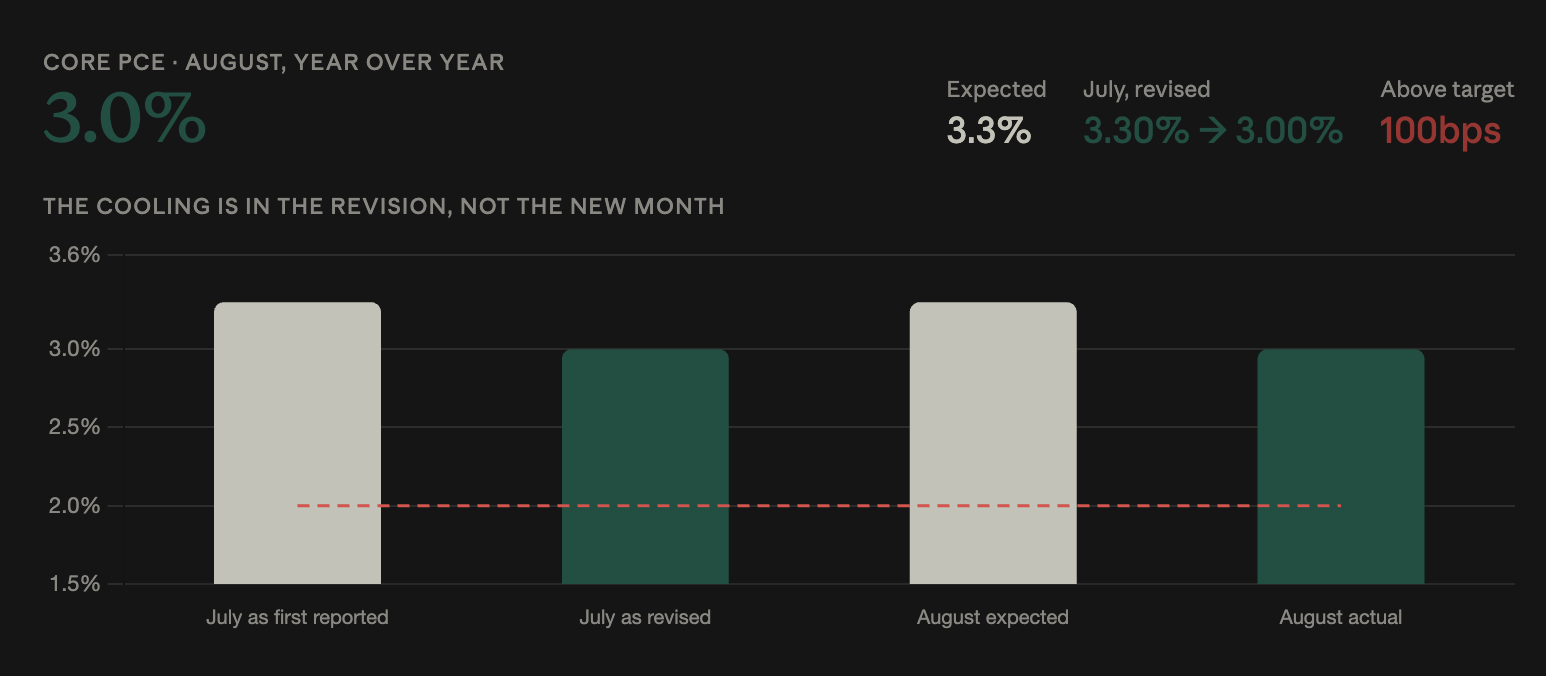
Article
Market News | Core PCE Holds at 3% in August as July Is Revised Down From 3.3%The US core personal consumption expenditures price index rose 3% year over year in August, below expectations of 3.3% and a six-month low.The July figure was revised down from 3.30% to 3%.That revision changes how the print reads. August is flat against a restated July rather than a decline from 3.3%, so the cooling shows up in the historical data rather than in the new month.The Revision Is the Larger EventA 30 basis point downward revision to the prior month is substantial for a series that moves in tenths.It means inflation was running cooler in July than the data showed at the time — including on September 16, when the Fed raised rates 25 basis points to 3.75%-4.00% partly on the strength of price pressures.Chair Kevin Warsh built his Jackson Hole case around PCE rather than CPI, citing a 12-month rate of 3.7% against a hotter six-month reading and arguing the recent trend was the operative measure. A downward revision to that recent trend weakens the specific argument he made.It Cuts Against Wednesday's Labour DataThe print arrives hours after ADP showed private payrolls rising 90,000 in September, above the 70,000 expected and more than double August's 38,000.ADP chief economist Nela Richardson described wage growth as remaining robust after three months of slowdown.The two releases point in opposite directions for policy. Firm hiring with solid wages supports further tightening; cooler inflation than expected does not.That combination is the one the Fed finds hardest to read, because it separates the labour market from the price data the tightening was meant to address.October Odds Were Already at a Coin FlipRate pricing was finely balanced going in.Federal funds futures showed October hike odds falling from about 71% to 50% on Tuesday after New York Fed President John Williams downplayed the urgency of raising rates.A softer inflation print supports Williams's position. The ADP beat runs against it. Which dominates depends on whether the market treats the PCE revision as evidence that price pressures were overstated or as a single data point in a series that remains well above the 2% target.At 3%, core PCE is still 100 basis points above target.The Long End Has Been Pricing Something ElseTreasury yields have set extremes independently of inflation expectations.The 30-year crossed 5.6% on Tuesday, its highest since June 2002, and the 10-year reached a fresh 2007 high near 5.3%. 10x Research's Markus Thielen forecasts the 10-year reaching 6%, attributing the move to fiscal concerns and term premium rather than the policy path.If that framing is correct, a softer inflation print does less for long yields than it would in a conventional cycle. The test is whether the 30-year responds at all.For Crypto, the Driver Matters More Than the LevelThielen's distinction bears directly on how Bitcoin reads this."When yields rise because the Fed is tightening, bitcoin suffers. When yields rise on fiscal and term-premium concerns, the picture flips," he said Tuesday.A cooler inflation print reduces the probability of the first scenario. It does nothing about the second.Bitcoin traded around $83,700 on Wednesday, consolidating since the failed breakout at $87,300 on September 21, with 30-day implied volatility contained all week.Gold, which carries roughly twice Bitcoin's sensitivity to the 10-year at −0.41 against −0.17, has more riding on the yield reaction. It fell to $4,144 on September 28 before recovering toward $4,200, the level XS.com identified as the line separating a recovery from a deeper pullback.Friday's non-farm payrolls report is the next release, with Kalshi pricing nearly 60% odds of a figure above 90,000 against Goldman Sachs at 80,000 and Bank of America at 60,000.
Market News | Core PCE Holds at 3% in August as July Is Revised Down From 3.3%
The US core personal consumption expenditures price index rose 3% year over year in August, below expectations of 3.3% and a six-month low.The July figure was revised down from 3.30% to 3%.That revision changes how the print reads. August is flat against a restated July rather than a decline from 3.3%, so the cooling shows up in the historical data rather than in the new month.The Revision Is the Larger EventA 30 basis point downward revision to the prior month is substantial for a series that moves in tenths.It means inflation was running cooler in July than the data showed at the time — including on September 16, when the Fed raised rates 25 basis points to 3.75%-4.00% partly on the strength of price pressures.Chair Kevin Warsh built his Jackson Hole case around PCE rather than CPI, citing a 12-month rate of 3.7% against a hotter six-month reading and arguing the recent trend was the operative measure. A downward revision to that recent trend weakens the specific argument he made.It Cuts Against Wednesday's Labour DataThe print arrives hours after ADP showed private payrolls rising 90,000 in September, above the 70,000 expected and more than double August's 38,000.ADP chief economist Nela Richardson described wage growth as remaining robust after three months of slowdown.The two releases point in opposite directions for policy. Firm hiring with solid wages supports further tightening; cooler inflation than expected does not.That combination is the one the Fed finds hardest to read, because it separates the labour market from the price data the tightening was meant to address.October Odds Were Already at a Coin FlipRate pricing was finely balanced going in.Federal funds futures showed October hike odds falling from about 71% to 50% on Tuesday after New York Fed President John Williams downplayed the urgency of raising rates.A softer inflation print supports Williams's position. The ADP beat runs against it. Which dominates depends on whether the market treats the PCE revision as evidence that price pressures were overstated or as a single data point in a series that remains well above the 2% target.At 3%, core PCE is still 100 basis points above target.The Long End Has Been Pricing Something ElseTreasury yields have set extremes independently of inflation expectations.The 30-year crossed 5.6% on Tuesday, its highest since June 2002, and the 10-year reached a fresh 2007 high near 5.3%. 10x Research's Markus Thielen forecasts the 10-year reaching 6%, attributing the move to fiscal concerns and term premium rather than the policy path.If that framing is correct, a softer inflation print does less for long yields than it would in a conventional cycle. The test is whether the 30-year responds at all.For Crypto, the Driver Matters More Than the LevelThielen's distinction bears directly on how Bitcoin reads this."When yields rise because the Fed is tightening, bitcoin suffers. When yields rise on fiscal and term-premium concerns, the picture flips," he said Tuesday.A cooler inflation print reduces the probability of the first scenario. It does nothing about the second.Bitcoin traded around $83,700 on Wednesday, consolidating since the failed breakout at $87,300 on September 21, with 30-day implied volatility contained all week.Gold, which carries roughly twice Bitcoin's sensitivity to the 10-year at −0.41 against −0.17, has more riding on the yield reaction. It fell to $4,144 on September 28 before recovering toward $4,200, the level XS.com identified as the line separating a recovery from a deeper pullback.Friday's non-farm payrolls report is the next release, with Kalshi pricing nearly 60% odds of a figure above 90,000 against Goldman Sachs at 80,000 and Bank of America at 60,000.
1
1
4
12.5k
·
--
Ripple and CSD BR Begin First Phase to Mirror BTG Pactual Fund-Share Records on XRPLRipple and CSD BR announced a first phase on Sept. 29 to mirror BTG Pactual fund-share ownership records on the XRP Ledger (XRPL). According to NS3.AI, CSD BR’s systems will remain the official record for registration, deposit and settlement.
RippleX executive Markus Infanger told Estadão's E-Investidor that about $2.7 billion of the $6.7 billion in tokenized real-world financial assets he counted on XRPL was in Brazil. Native issuance and trading are expected only after the record-mirroring phase is validated.
The project expands Ripple’s existing ties in Brazil across payments, stablecoins and investment assets. However, the announcements did not provide comparable figures for Brazil-only payment volume or active institutional usage.
Ripple and CSD BR Begin First Phase to Mirror BTG Pactual Fund-Share Records on XRPL
Ripple and CSD BR announced a first phase on Sept. 29 to mirror BTG Pactual fund-share ownership records on the XRP Ledger (XRPL). According to NS3.AI, CSD BR’s systems will remain the official record for registration, deposit and settlement.
RippleX executive Markus Infanger told Estadão's E-Investidor that about $2.7 billion of the $6.7 billion in tokenized real-world financial assets he counted on XRPL was in Brazil. Native issuance and trading are expected only after the record-mirroring phase is validated.
The project expands Ripple’s existing ties in Brazil across payments, stablecoins and investment assets. However, the announcements did not provide comparable figures for Brazil-only payment volume or active institutional usage.
RippleX executive Markus Infanger told Estadão's E-Investidor that about $2.7 billion of the $6.7 billion in tokenized real-world financial assets he counted on XRPL was in Brazil. Native issuance and trading are expected only after the record-mirroring phase is validated.
The project expands Ripple’s existing ties in Brazil across payments, stablecoins and investment assets. However, the announcements did not provide comparable figures for Brazil-only payment volume or active institutional usage.
2
4.2k
·
--
Cardano Futures Demand Cools as Open Interest Falls 9%, Analyst SaysCrypto analyst Ai said Cardano (ADA) futures demand is cooling, with open interest falling 9% over the past week from $1.99 billion to $1.81 billion. According to Odaily, Ai said whales have also taken profits, reducing holdings by about 90 million ADA since September 20, adding to recent selling pressure.
Ai added that ADA’s daily chart flashed a sell signal on September 26 and has since fallen 10%, with the pullback possibly not over. The analyst said $0.24 is a key mid-channel support level, while a break below it could send ADA toward the lower end of the channel near $0.21. If $0.21 holds, Ai said it could become the next buying opportunity, with an upside target near $0.28 at the top of the channel.
Cardano Futures Demand Cools as Open Interest Falls 9%, Analyst Says
Crypto analyst Ai said Cardano (ADA) futures demand is cooling, with open interest falling 9% over the past week from $1.99 billion to $1.81 billion. According to Odaily, Ai said whales have also taken profits, reducing holdings by about 90 million ADA since September 20, adding to recent selling pressure.
Ai added that ADA’s daily chart flashed a sell signal on September 26 and has since fallen 10%, with the pullback possibly not over. The analyst said $0.24 is a key mid-channel support level, while a break below it could send ADA toward the lower end of the channel near $0.21. If $0.21 holds, Ai said it could become the next buying opportunity, with an upside target near $0.28 at the top of the channel.
Ai added that ADA’s daily chart flashed a sell signal on September 26 and has since fallen 10%, with the pullback possibly not over. The analyst said $0.24 is a key mid-channel support level, while a break below it could send ADA toward the lower end of the channel near $0.21. If $0.21 holds, Ai said it could become the next buying opportunity, with an upside target near $0.28 at the top of the channel.
1
7
12.6k
·
--
ETH Buyer Loses $33,000 After On-Chain Purchase at $2,710.23A wallet bought 1,486.37 ETH on-chain at $2,710.23 each at 3 a.m., with the purchase valued at $4.028 million. According to Odaily, the address is now down $33,000.
ETH Buyer Loses $33,000 After On-Chain Purchase at $2,710.23
A wallet bought 1,486.37 ETH on-chain at $2,710.23 each at 3 a.m., with the purchase valued at $4.028 million. According to Odaily, the address is now down $33,000.
2
12.9k
·
--
Hyperliquid Labs Plans to Unstake $320 Million in HYPE for Monthly Team UnlocksHyperliquid Labs plans to unstake about $320 million worth of HYPE for monthly team token unlocks. According to ChainCatcher, the tokens will be sold through over-the-counter trading to an institution.
Hyperliquid Labs Plans to Unstake $320 Million in HYPE for Monthly Team Unlocks
Hyperliquid Labs plans to unstake about $320 million worth of HYPE for monthly team token unlocks. According to ChainCatcher, the tokens will be sold through over-the-counter trading to an institution.
1
6
8k
·
--
Robinhood CEO Says New Markets Will Open to All Users as Robinhood Chain Perpetuals Hit $1 Billion Daily VolumeRobinhood CEO Vlad Tenev said in an interview that Robinhood will soon open a new market to all users, and that daily trading volume for perpetual contracts on Robinhood Chain has reached $1 billion. According to Odaily, Tenev also said Robinhood Chain will become the preferred chain for developers within two months and noted that he defended the industry during a live CNBC broadcast.
Robinhood CEO Says New Markets Will Open to All Users as Robinhood Chain Perpetuals Hit $1 Billion Daily Volume
Robinhood CEO Vlad Tenev said in an interview that Robinhood will soon open a new market to all users, and that daily trading volume for perpetual contracts on Robinhood Chain has reached $1 billion. According to Odaily, Tenev also said Robinhood Chain will become the preferred chain for developers within two months and noted that he defended the industry during a live CNBC broadcast.
2
3k
·
--
Bitcoin(BTC) Surpasses 84,000 USDT with a 0.12% Increase in 24 HoursOn Oct 01, 2026, 10:55 AM(UTC). According to Binance Market Data, Bitcoin has crossed the 84,000 USDT benchmark and is now trading at 84,050.398438 USDT, with a narrowed 0.12% increase in 24 hours.
Bitcoin(BTC) Surpasses 84,000 USDT with a 0.12% Increase in 24 Hours
On Oct 01, 2026, 10:55 AM(UTC). According to Binance Market Data, Bitcoin has crossed the 84,000 USDT benchmark and is now trading at 84,050.398438 USDT, with a narrowed 0.12% increase in 24 hours.
2
561
·
--
Meta Used Zuckerberg Pay To Cut Taxes By $355 MillionMeta listed CEO Mark Zuckerberg as a researcher on tax forms, cutting its tax bill by about $355 million, while the IRS says the company got it wrong. According to BeInCrypto, Meta counted $4.1 billion of Zuckerberg’s 2012 and 2013 stock option income as research wages, and its filing lists $18.74 billion in tax benefits as uncertain. Separately, Elon Musk exercised 303.96 million Tesla options on June 16, creating about $116 billion in paper gains, but Treasury rules say wages qualify only for employees who do research or directly support them.
Meta Used Zuckerberg Pay To Cut Taxes By $355 Million
Meta listed CEO Mark Zuckerberg as a researcher on tax forms, cutting its tax bill by about $355 million, while the IRS says the company got it wrong. According to BeInCrypto, Meta counted $4.1 billion of Zuckerberg’s 2012 and 2013 stock option income as research wages, and its filing lists $18.74 billion in tax benefits as uncertain. Separately, Elon Musk exercised 303.96 million Tesla options on June 16, creating about $116 billion in paper gains, but Treasury rules say wages qualify only for employees who do research or directly support them.
2
10.1k
·
--
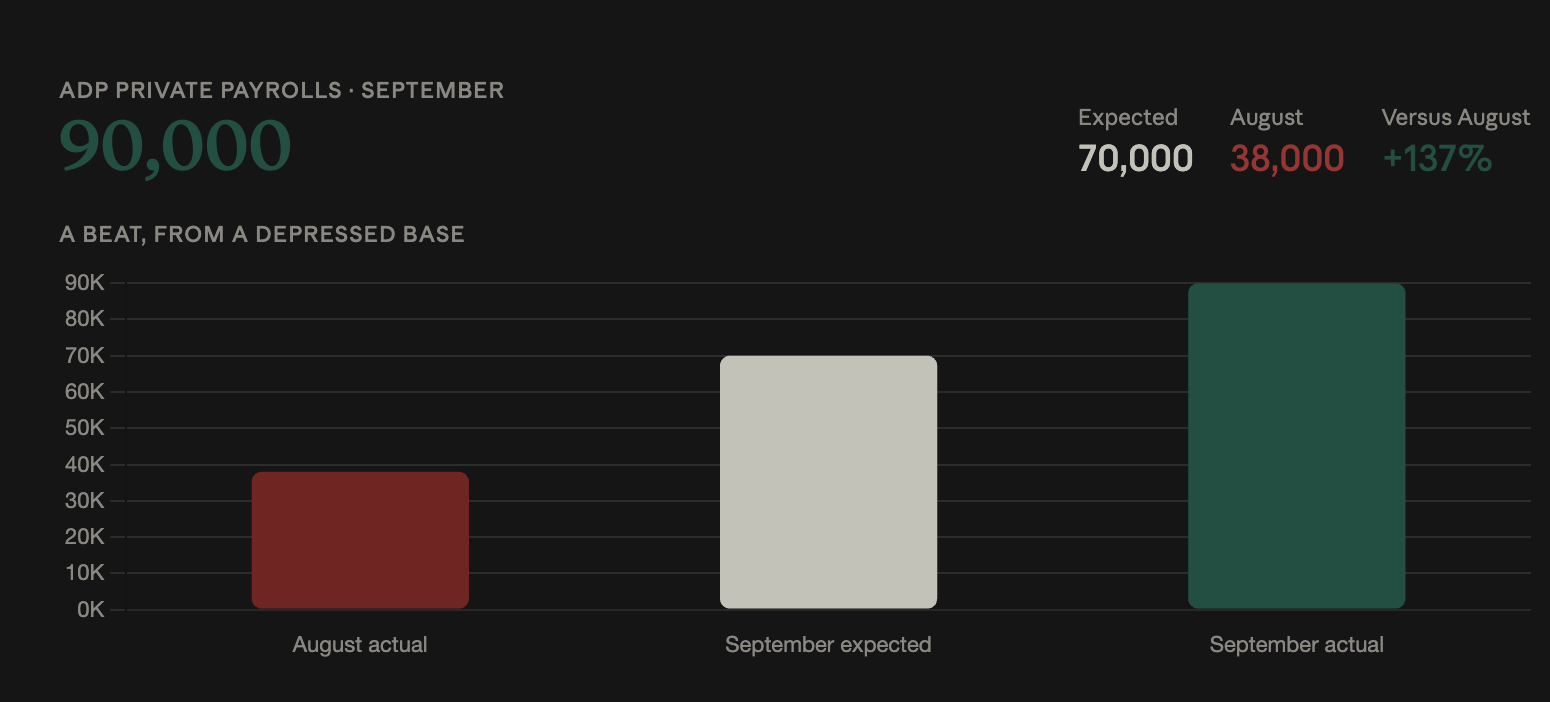
Article
Market News | ADP Shows 90,000 Jobs in September, Beating Forecasts and More Than Doubling AugustUS private employers added 90,000 jobs in September, above expectations of 70,000 and more than double August's 38,000, according to ADP."It was a strong report, with job growth rebounding and wage growth remaining robust after three months of slowdown," said ADP chief economist Nela Richardson.The August Base Is What Makes the Rebound Look LargeAugust's 38,000 was the weakest ADP print since January.A move from 38,000 to 90,000 is a recovery from a depressed base rather than evidence of an accelerating labour market. The figure sits closer to a normal monthly pace than to a strong one.Richardson's reference to wage growth holding firm after three months of slowdown is the second element. Wages that stop decelerating while hiring recovers is a different signal from either alone, and it is the part that bears on inflation.It Lands in the Middle of the Payrolls DisagreementThe print arrives with prediction markets and bank economists split on Friday's non-farm payrolls.Kalshi data put the probability of the official figure exceeding 90,000 at nearly 60%, with about 50% odds of topping 100,000. Goldman Sachs forecast 80,000 and Bank of America just 60,000.ADP at 90,000 sits at the Kalshi threshold and above both bank estimates.The relationship between the two series is loose. ADP covers private payrolls only and uses a different methodology from the Bureau of Labor Statistics, and the monthly correlation between them has been weak in recent years. A strong ADP print raises the odds of a strong official figure without determining it.The Rate Implication Runs Against WilliamsThe timing complicates the Fed pricing.October hike odds fell from about 71% to 50% on Tuesday after New York Fed President John Williams downplayed the urgency of raising rates.A labour market print that beats expectations pushes in the other direction. Firm hiring alongside robust wage growth is the combination that supports further tightening, and it sits awkwardly against Williams's message two days earlier.The Fed raised rates 25 basis points to 3.75%-4.00% on September 16, its first increase since July 2023, with a dot plot median pointing to one more move in 2026.The Bond Market Has Been Pricing Something ElseLong yields have been setting extremes independently of the policy path.The 30-year Treasury yield crossed 5.6% on Tuesday, its highest since June 2002, and the 10-year reached a fresh 2007 high near 5.3%. 10x Research's Markus Thielen forecasts the 10-year reaching 6%, attributing the rise to fiscal concerns and term premium rather than Fed expectations.A strong labour print adds a growth argument to a move that had been driven by deficit and inflation concerns. Whether the long end responds tells you which factor currently dominates.PCE inflation data arrives before the Wall Street open, and Micron reports after the close.
Market News | ADP Shows 90,000 Jobs in September, Beating Forecasts and More Than Doubling August
US private employers added 90,000 jobs in September, above expectations of 70,000 and more than double August's 38,000, according to ADP."It was a strong report, with job growth rebounding and wage growth remaining robust after three months of slowdown," said ADP chief economist Nela Richardson.The August Base Is What Makes the Rebound Look LargeAugust's 38,000 was the weakest ADP print since January.A move from 38,000 to 90,000 is a recovery from a depressed base rather than evidence of an accelerating labour market. The figure sits closer to a normal monthly pace than to a strong one.Richardson's reference to wage growth holding firm after three months of slowdown is the second element. Wages that stop decelerating while hiring recovers is a different signal from either alone, and it is the part that bears on inflation.It Lands in the Middle of the Payrolls DisagreementThe print arrives with prediction markets and bank economists split on Friday's non-farm payrolls.Kalshi data put the probability of the official figure exceeding 90,000 at nearly 60%, with about 50% odds of topping 100,000. Goldman Sachs forecast 80,000 and Bank of America just 60,000.ADP at 90,000 sits at the Kalshi threshold and above both bank estimates.The relationship between the two series is loose. ADP covers private payrolls only and uses a different methodology from the Bureau of Labor Statistics, and the monthly correlation between them has been weak in recent years. A strong ADP print raises the odds of a strong official figure without determining it.The Rate Implication Runs Against WilliamsThe timing complicates the Fed pricing.October hike odds fell from about 71% to 50% on Tuesday after New York Fed President John Williams downplayed the urgency of raising rates.A labour market print that beats expectations pushes in the other direction. Firm hiring alongside robust wage growth is the combination that supports further tightening, and it sits awkwardly against Williams's message two days earlier.The Fed raised rates 25 basis points to 3.75%-4.00% on September 16, its first increase since July 2023, with a dot plot median pointing to one more move in 2026.The Bond Market Has Been Pricing Something ElseLong yields have been setting extremes independently of the policy path.The 30-year Treasury yield crossed 5.6% on Tuesday, its highest since June 2002, and the 10-year reached a fresh 2007 high near 5.3%. 10x Research's Markus Thielen forecasts the 10-year reaching 6%, attributing the rise to fiscal concerns and term premium rather than Fed expectations.A strong labour print adds a growth argument to a move that had been driven by deficit and inflation concerns. Whether the long end responds tells you which factor currently dominates.PCE inflation data arrives before the Wall Street open, and Micron reports after the close.
Voting
ADP beats forecasts — does the Fed hike again in October?
Yes — firm jobs and wages force another hike
No — Williams signaled patience for a reason
One ADP print won't decide it, payrolls will
Fed watching is a full-time job at this point 😮💨
41 votes • Voting
2
1
15
8k
Join global crypto users on Binance Square
⚡️ Get latest and useful information about crypto.
💬 Trusted by the world’s largest crypto exchange.
👍 Discover real insights from verified creators.
Email / Phone number
Trending Topics
US10YearYieldNears5.3%
1,585 views
85 Discussing
#US10YearYieldNears5.3%
📊 BOND YIELDS AT MULTI-YEAR HIGHS!
The US 10-year Treasury yield approaching 5.3% is creating a major talking point across global financial markets. Rising yields reflect changing expectations around inflation, economic growth, and government borrowing.
🌍 What makes this situation particularly interesting is the impact on crypto sentiment. Higher bond yields may reduce demand for riskier assets, while persistent institutional interest could provide some support to crypto markets.
₿ The real question is: Can Bitcoin maintain its strength while traditional financial markets face rising borrowing costs?
💡 Sometimes, the biggest market signals come from outside the crypto market.
#Bitcoin #CryptoMarket #US10YearYield #TreasuryYields #BTC $BTC
PALASH5
·0 Likes
·1.7k views
BitcoinETFsTake$6.34BillionInQ3
234 views
14 Discussing
KoreaProposesTokenizingStocksAndBonds
23,842 views
354 Discussing