


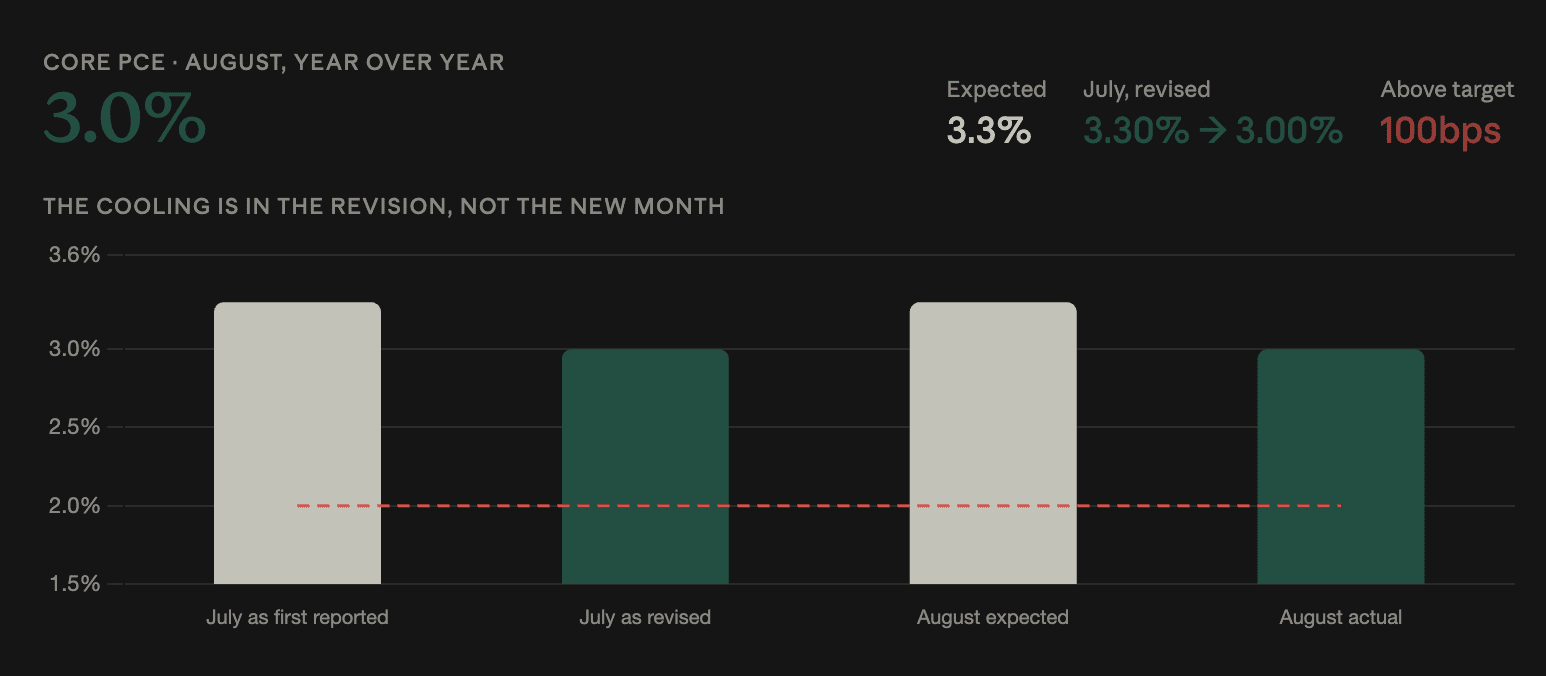
The US core personal consumption expenditures price index rose 3% year over year in August, below expectations of 3.3% and a six-month low.
The July figure was revised down from 3.30% to 3%.
That revision changes how the print reads. August is flat against a restated July rather than a decline from 3.3%, so the cooling shows up in the historical data rather than in the new month.
The Revision Is the Larger Event
A 30 basis point downward revision to the prior month is substantial for a series that moves in tenths.
It means inflation was running cooler in July than the data showed at the time — including on September 16, when the Fed raised rates 25 basis points to 3.75%-4.00% partly on the strength of price pressures.
Chair Kevin Warsh built his Jackson Hole case around PCE rather than CPI, citing a 12-month rate of 3.7% against a hotter six-month reading and arguing the recent trend was the operative measure. A downward revision to that recent trend weakens the specific argument he made.
It Cuts Against Wednesday's Labour Data
The print arrives hours after ADP showed private payrolls rising 90,000 in September, above the 70,000 expected and more than double August's 38,000.
ADP chief economist Nela Richardson described wage growth as remaining robust after three months of slowdown.
The two releases point in opposite directions for policy. Firm hiring with solid wages supports further tightening; cooler inflation than expected does not.
That combination is the one the Fed finds hardest to read, because it separates the labour market from the price data the tightening was meant to address.
October Odds Were Already at a Coin Flip
Rate pricing was finely balanced going in.
Federal funds futures showed October hike odds falling from about 71% to 50% on Tuesday after New York Fed President John Williams downplayed the urgency of raising rates.
A softer inflation print supports Williams's position. The ADP beat runs against it. Which dominates depends on whether the market treats the PCE revision as evidence that price pressures were overstated or as a single data point in a series that remains well above the 2% target.
At 3%, core PCE is still 100 basis points above target.
The Long End Has Been Pricing Something Else
Treasury yields have set extremes independently of inflation expectations.
The 30-year crossed 5.6% on Tuesday, its highest since June 2002, and the 10-year reached a fresh 2007 high near 5.3%. 10x Research's Markus Thielen forecasts the 10-year reaching 6%, attributing the move to fiscal concerns and term premium rather than the policy path.
If that framing is correct, a softer inflation print does less for long yields than it would in a conventional cycle. The test is whether the 30-year responds at all.
For Crypto, the Driver Matters More Than the Level
Thielen's distinction bears directly on how Bitcoin reads this.
"When yields rise because the Fed is tightening, bitcoin suffers. When yields rise on fiscal and term-premium concerns, the picture flips," he said Tuesday.
A cooler inflation print reduces the probability of the first scenario. It does nothing about the second.
Bitcoin traded around $83,700 on Wednesday, consolidating since the failed breakout at $87,300 on September 21, with 30-day implied volatility contained all week.
Gold, which carries roughly twice Bitcoin's sensitivity to the 10-year at −0.41 against −0.17, has more riding on the yield reaction. It fell to $4,144 on September 28 before recovering toward $4,200, the level XS.com identified as the line separating a recovery from a deeper pullback.
Friday's non-farm payrolls report is the next release, with Kalshi pricing nearly 60% odds of a figure above 90,000 against Goldman Sachs at 80,000 and Bank of America at 60,000.