


Original Title: (Interpretation of Polymarket's Major Update Last Night: Expanded Fees, Self-Regulation, New Incentives)
Original Author: Asher, Odaily Planet Daily
Last Saturday, Polymarket official team member Mustafa posted on platform X, stating that a major announcement will be made next Monday.
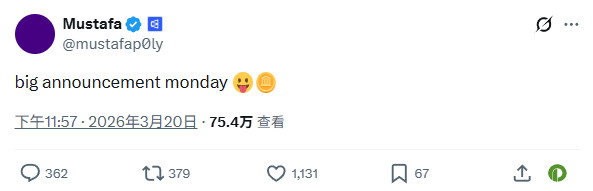
Polymarket official team member updates from last weekend
As expected, Polymarket officials have released multiple significant updates from last night to today. Next, Odaily Planet Daily will provide a detailed analysis one by one.
Update market integrity rules, anti-insider, anti-manipulation
Last night, Polymarket announced updates to its DeFi platform and the integrity rules for its U.S. trading platform regulated by the CFTC, further clarifying the regulatory requirements for insider trading and market manipulation.
Polymarket's Chief Legal Officer Neal Kumar stated: 'Market prosperity relies on transparency. The improvement of these rules clarifies our expectations for all participants on both platforms and highlights the compliance infrastructure we have established. As Polymarket continues to develop, we will continue to consolidate our existing foundation by clearly communicating with users to ensure our market maximizes its advantages—revealing the truth.'
The new regulations specify three types of prohibited behaviors, including:
Trading on undisclosed information: If participants possess confidential information regarding the outcomes or potential outcomes of the subject event, and using that information would violate prior trust or confidentiality obligations owed to others or entities, participants are prohibited from trading any contracts.
Building positions based on illegal information sources: Participants are prohibited from trading using confidential information provided by others if that information is provided by someone who has prior trust or confidentiality obligations to others, and the participant knows or has reason to know that the person providing the information is themselves prohibited from trading on that information;
Entities capable of influencing event outcomes participating in trading: If participants have the authority or influence sufficient to affect the outcomes of the subject event, they are prohibited from trading any contracts.
At the same time, the platform explicitly prohibits false trading, wash trading, and price manipulation, and has launched a dedicated page to explain the rules and provide channels for reporting abnormal behaviors. Additionally, Polymarket stated that its DeFi platform conducts risk identification through on-chain transparency mechanisms and multi-layer monitoring systems, while the US platform collaborates with technical monitoring and industry regulators to investigate and punish violations.
This round of rule updates essentially redefines the market boundaries of Polymarket: what information can be traded and what behaviors are directly excluded. Surrounding insider information, sources of information, and whether there is the ability to influence the outcome of events, the platform clarifies the originally vague gray areas into a 'prohibited' red line, while introducing monitoring and reporting mechanisms to bring trading activities into a more traceable framework.
More importantly, this points to a change in platform positioning. Polymarket will shift from the external impression of a 'high-risk gambling arena' to emphasizing market infrastructure focused on information pricing and transparency, actively strengthening compliance and rule expression, striving for trust from regulators and the public, laying a foundation for broader future expansion.
The 'Era of High Fees' has arrived: fees are charged for all events except geopolitical ones.
According to the latest official documents from Polymarket, the platform will adjust the fee mechanism starting March 30, 2026, adding several market categories such as Finance, Politics, Economics, Culture, and Weather to the taker fee charging range based on the existing Crypto and Sports categories.
The new fee rates are calculated using a dynamic formula and are directly related to the price range. Overall, the new fee collection presents a distribution of 'higher in the middle, lower at both ends': when the price approaches a 50% probability, the actual rate peaks, while at the extreme ranges close to 0% or 100%, fees significantly decrease, and in very small transactions may even be rounded to 0.
Under the current fee rate system, the peak effective rate for the Crypto market is about 1.56%, and for Sports, it is about 0.44%. In the upcoming new fee structure, differences among categories will further widen. For example, Crypto peaks at about 1.80%, Finance and Politics at about 1.00%, and Economics can reach 1.50%. At the same time, the corresponding market-making rebate ratios for each category are also set, such as Finance at as high as 50%, and most other categories around 25%.
The calculation of fees is based on a unified formula, dynamically calculated based on trading volume, price, and various market parameters. Fees are priced in USDC but are charged in 'share form' for buy orders, and deducted in USDC for sell orders.
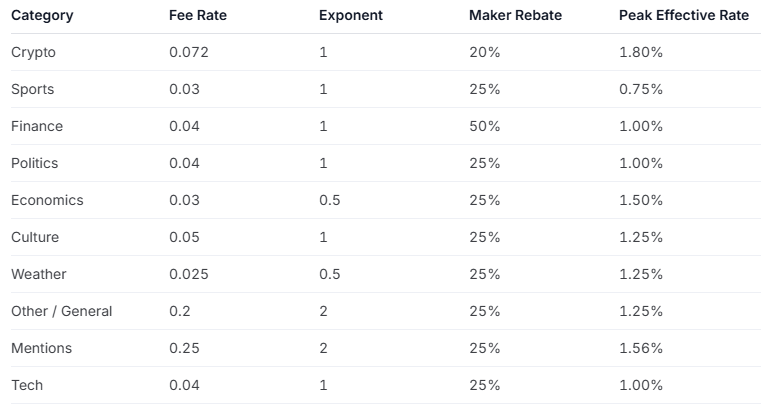
New fee standards for each market
There is no information related to financing or token airdrops; rather, it is about opening the referral program.
This morning, Polymarket announced on platform X that the referral program has expanded from the internal testing phase to all traders with trading volumes exceeding $10,000. Eligible users can receive rewards proportional to the trading volume of the new users they refer. The specific invitation details are as follows:
· 30% of the fee rebates come from direct referrals, and 10% of the fee rebates come from secondary referrals (the rewards will be valid for the first 180 days after the user registers on Polymarket; this period may be subject to change without notice);
· Fee rebate rewards are issued daily (UTC);
· There is no upper limit on rewards; the more users referred trade on the platform, the more rewards they earn.
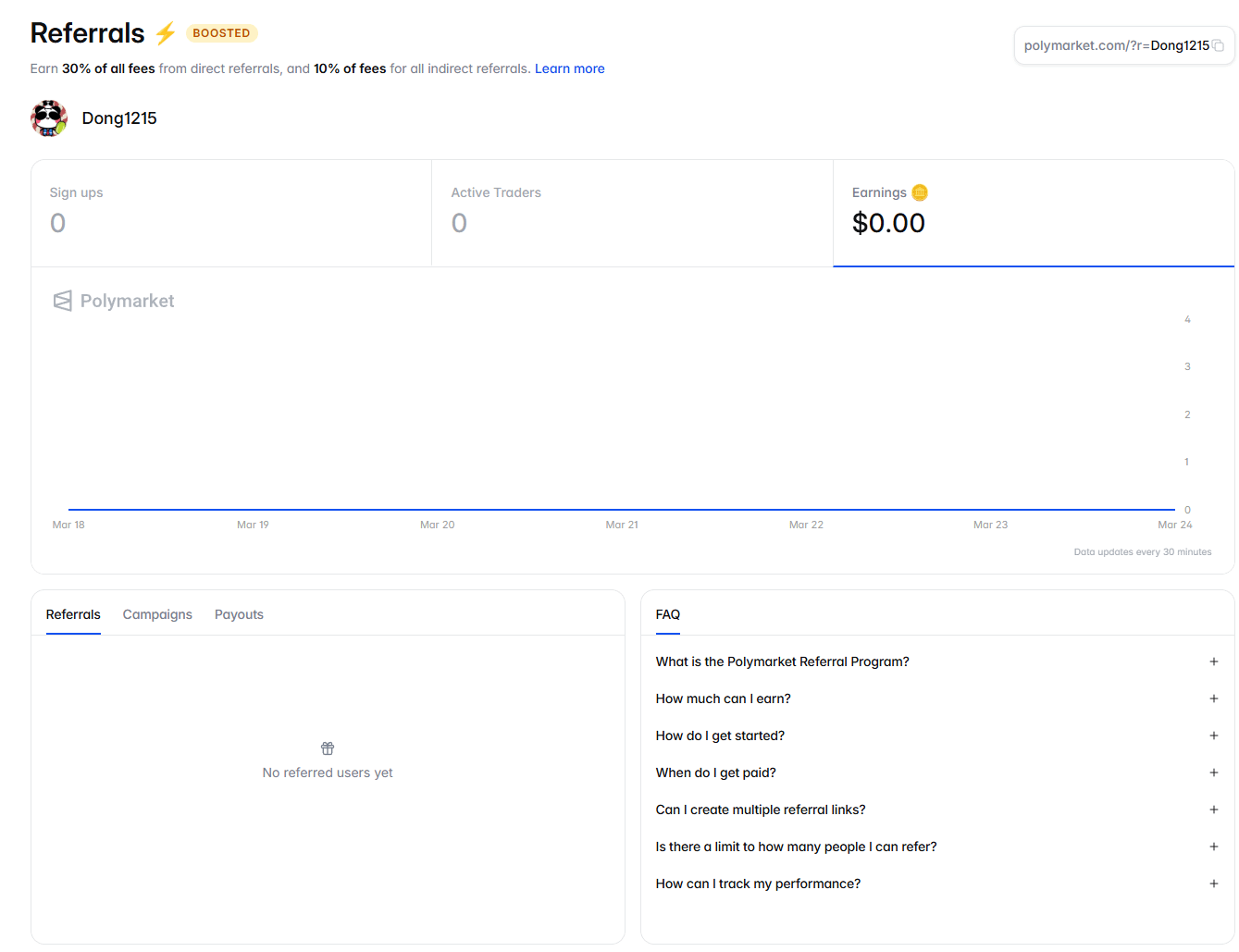
Polymarket invitation interface
Launch of market-making rebate program
In addition to opening the referral program, incentives for continuous and competitive quotes are provided to enhance the trading experience for all traders. Polymarket has launched a market-making rebate program. Specifically, this mechanism will redistribute part of the taker fees to liquidity providers, redistributing trading costs among market participants.
Rebates are settled and issued daily in USDC, and only liquidity that is successfully placed and executed will participate in the distribution. Overall returns are not fixed values but are calculated based on the liquidity contribution ratios in actual transactions; the more transactions and higher contributions lead to more corresponding rebates.
In terms of allocation logic, the system will calculate the 'fee equivalent' for each transaction, considering transaction volume, price, and different market rate parameters, and aggregate within the same market. Ultimately, rebates are distributed based on the contribution ratios of each market maker, meaning competition is reflected not only in whether the quotes are executed but also in the price range of the quotes and their fee contributions. Overall, this portion of rebates comes from the fees paid by takers, with different market rebate ratios existing, such as Crypto at 20%, Finance at up to 50%, and most categories around 25%.
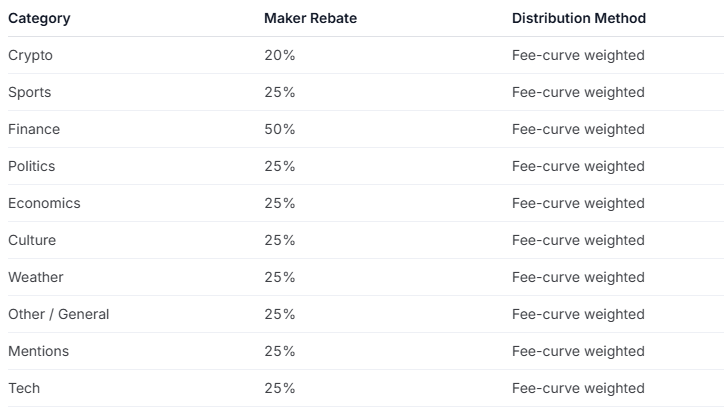
Rebate ratios in each market
There is no information related to token airdrops, but the overall sentiment in the community is optimistic.
Despite the community previously expecting that 'significant news' could point to tokens or airdrops, what eventually materialized was a combination update of fees, rebates, and referral systems. From the outcome, this mechanism leans more towards long-term incentive design rather than a one-time release of expectations. However, sentiment has not cooled as a result; instead, after the paths for participation became clear, the overall feedback from the trading community has been positive.
Many users have already treated the referral program as a 'covert airdrop entry,' especially KOLs who have traffic or community resources, who have clearly begun to increase their sharing efforts. Some even treat it as a long-term revenue stream; after the launch of the market-making rebates, feedback from LP sides has also been direct, with more people reassessing market-making strategies, and willingness to participate has clearly increased.
Relatively speaking, arbitrage trades and tail-end users are calmer. After the new fee rules arrive, some previously viable arbitrage spaces will be compressed, strategies need to be recalibrated, and trading rhythms tend to converge, relying more on meticulous execution and cost control.
However, after Polymarket and Kalshi are under regulatory scrutiny, the valuations in the coming period will be eroded by policy pulls. (Related news: US legislators will introduce a bipartisan bill to prohibit sports predictions on prediction markets like Polymarket)
Original link