


The United States spent three years, implemented four rounds of export controls, involving 24 types of semiconductor equipment and over 140 entities on the list, trying to cut off China's access to advanced AI chips. However, according to a report released by the U.S.-China Economic and Security Review Commission (USCC) on March 24, 80% of American AI startups are using Chinese open-source models.
The wall is built at the hardware level. The door opens at the software level.
This set of contradictions is not an abstract policy discussion. Just last week, the AI programming tool Cursor, valued at $29.3 billion, was found to have its flagship feature Composer 2 based on Kimi K2.5 from the dark side of the moon. A model from a Chinese company is driving the top AI development tools in the United States.
Meanwhile, the Pentagon has labeled "supply chain risk" on Anthropic, an American company.
The direction of regulation is completely opposite to the direction of actual dependencies.
Since the first round of restrictions on A100/H100 level chip exports by the BIS in October 2022, US chip regulations have continued to escalate. In 2023, the H800 loophole was closed, expanding performance density control indicators. In December 2024, another round was added, introducing controls on 24 types of semiconductor equipment and blacklisting 140 Chinese entities, including high-bandwidth memory (HBM) and DRAM. In January 2025, the Department of Commerce even introduced an "AI diffusion framework," attempting to establish a global regulatory system from the model level, but this framework was withdrawn two days before it officially took effect. By December 2025, Trump reversed course again, allowing H200 chips to be exported to approved customers in China.
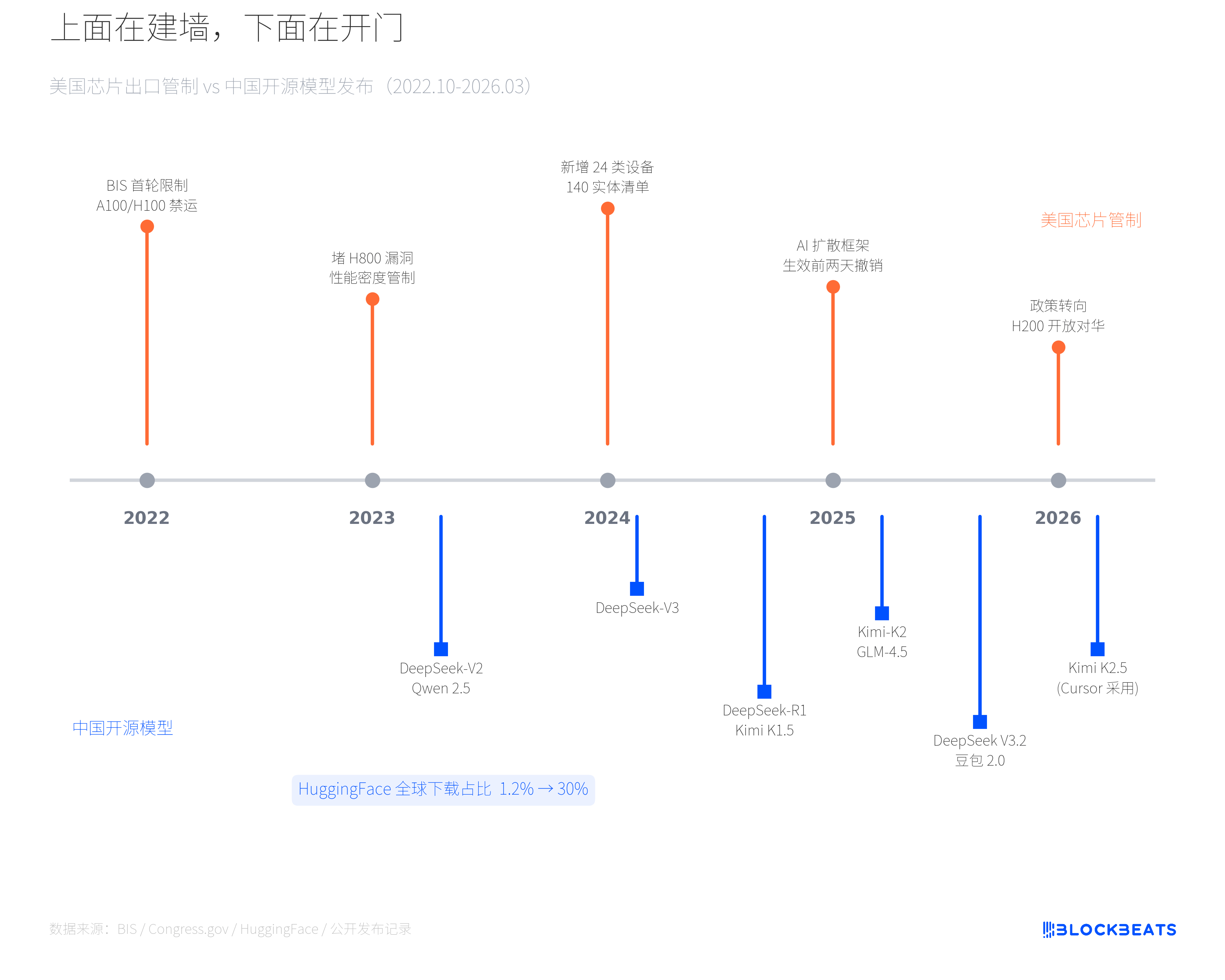
In the latter half of this regulatory timeline, the pace of Chinese open-source model releases has been accelerating. In 2024, DeepSeek-V2 and the Qwen 2.5 series will be open-sourced one after another. On January 20, 2025, DeepSeek-R1 and Kimi K1.5 will be released on the same day, with the former briefly topping the US App Store download chart, surpassing ChatGPT. In the second half of 2025, Kimi-K2 and GLM-4.5 will follow. By early 2026, ByteDance's Doubao 2.0 had 155 million weekly active users, and Kimi K2.5 was directly adopted by Cursor. The tighter the regulations, the more models emerge.
According to HuggingFace's official data, the share of Chinese open-source models in global downloads surged from about 1.2% at the end of 2024 to about 30% by early 2026. The cumulative downloads of Alibaba's Qwen series surpassed 700 million in January 2026, officially surpassing Meta's Llama. Chip regulations have not hindered China's AI software output; rather, they may have accelerated a strategic shift toward open-source routes.
This is not a coincidental data anomaly. The USCC report used a precise framework to describe this phenomenon: "dual circulation." In the hardware cycle, China is constrained by chip supply bottlenecks. In the software cycle, China is penetrating global AI infrastructure through open-source models, forming downstream dependencies. The forces of the two cycles are opposite, but mutually reinforcing. Regulation has limited our ability to access top-tier computing power, but it has also forced a technical route to do more with less computing power. DeepSeek-R1 achieves cutting-edge performance at a reasoning cost far below GPT-4o, which is a product of this route.
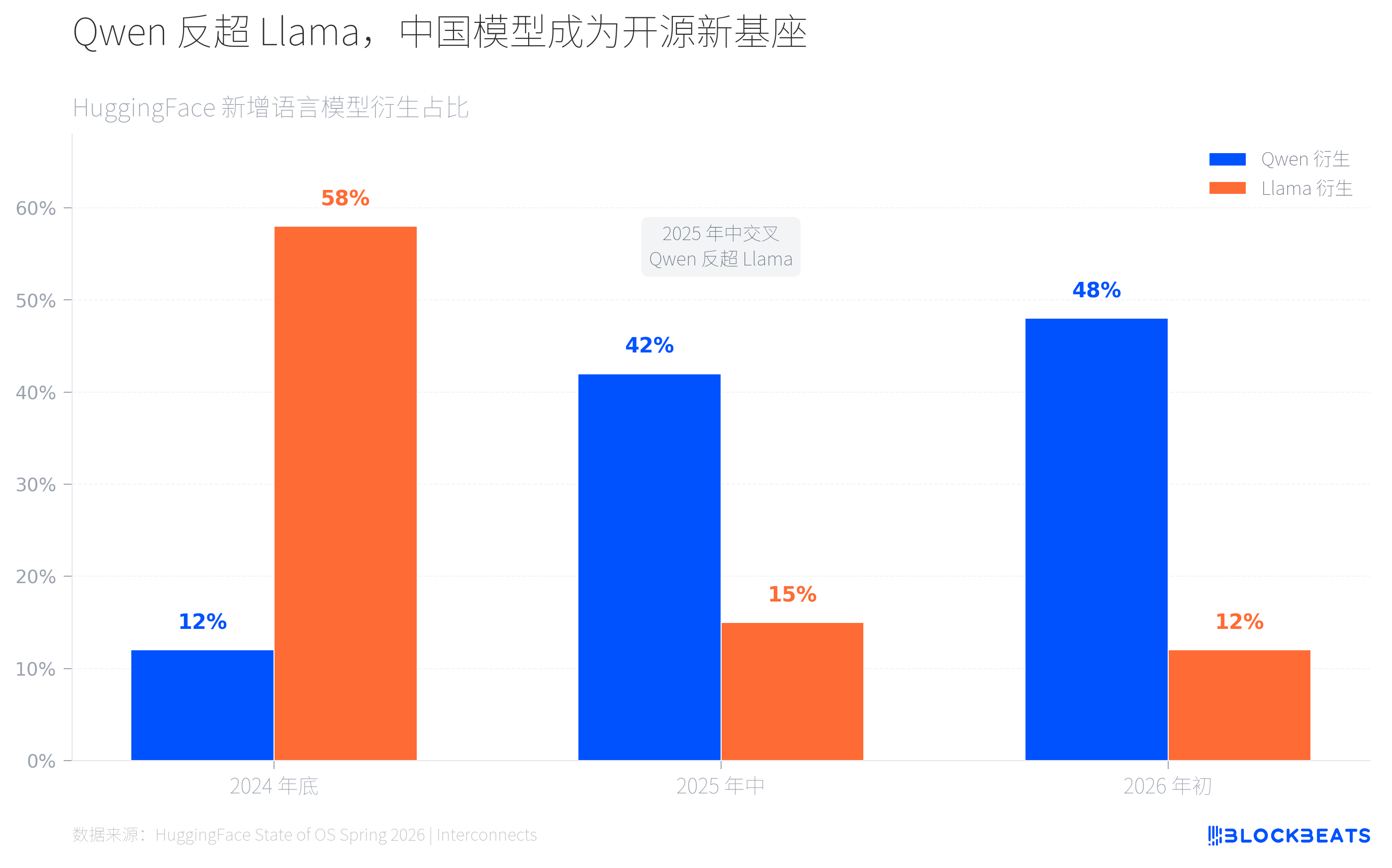
The changes on HuggingFace are visibly notable. According to platform statistics, by the end of 2024, Llama derivative models will account for about 60% of new language models, while Qwen will only account for just over 10%. By mid-2025, a crossover point will appear, with Qwen derivatives skyrocketing to over 40% according to the official HuggingFace blog, and Llama dropping to about 15%. By early 2026, Qwen derivatives will approach half, while Llama continues to shrink to about 12%.
The speed of this crossover has exceeded most people's expectations. Two years ago, open-source AI was almost synonymous with Meta's Llama ecosystem. Global developers fine-tuned, deployed, and built products based on Llama. Now, the same thing is happening with the Qwen ecosystem, only at a faster pace and broader coverage.
This means that global developers are increasingly choosing Chinese models as the underlying foundation when building AI applications. Not because of political stances, but because of performance and openness. The Qwen 2.5 series covers parameter amounts from 0.5B to 72B, allowing developers to fine-tune and deploy on their own hardware without needing to pay OpenAI or Anthropic to call APIs. Open-source eliminates vendor lock-in and transcends national borders.
A noteworthy detail is that, according to a February report by MIT Technology Review, Chinese AI companies are forming differentiated competition strategies in their open-source approaches. DeepSeek takes a route of extreme cost efficiency, Kimi focuses on long context and coding capabilities, while Qwen pursues comprehensive parameter coverage. This multi-route approach enriches the choices available to global developers. Our open-source models are redefining the global AI supply chain with strength.
But what does the end of this supply chain look like?
On March 19, developer @fynnso discovered the model ID accounts/anysphere/models/kimi-k2p5-rl-0317-s515-fast in the Cursor code. Cursor co-founder Aman Sanger subsequently acknowledged that Composer 2 is built on Kimi K2.5. According to Cursor VP Lee Robinson, "the base model only contributes about a quarter of the computational load, the rest comes from our own training." But the base is just the base. The product, valued at $29.3 billion, has its base model sourced from the Dark Side of the Moon, a Chinese company invested by Alibaba and HongShan.
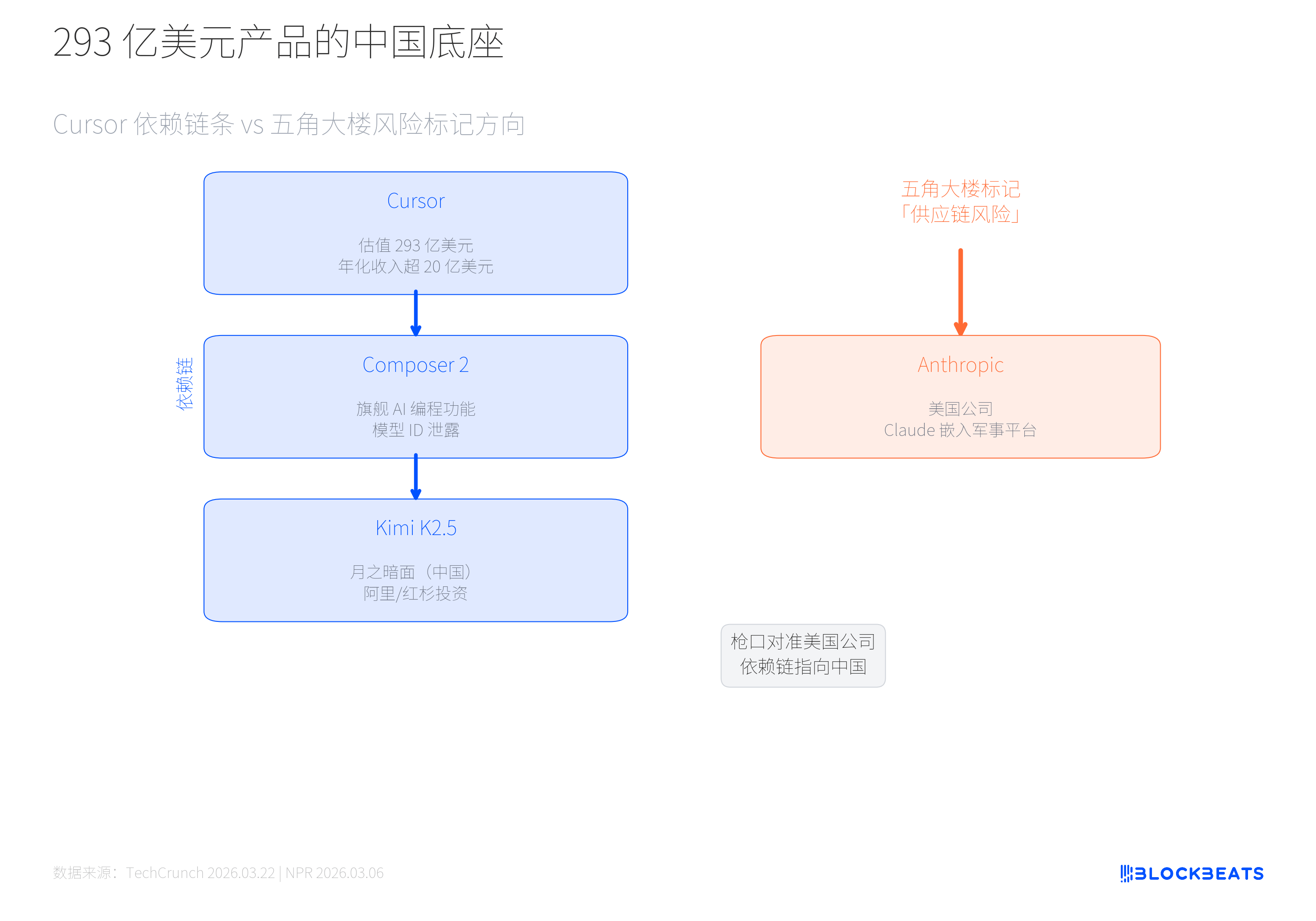
Putting this dependency chain and the Pentagon's actions together makes the absurdity more apparent. On March 5, the Pentagon officially labeled Anthropic as a "supply chain risk." According to NPR, the reason is that Anthropic CEO Dario Amodei refused to compromise on two red lines: the use of AI for autonomous weapons and mass surveillance of US citizens. Trump gave the military six months to phase out Claude, which is deeply embedded in military and national security platforms. Anthropic subsequently sued the Pentagon on March 9.
On one side, the US government labels its own company with a "supply chain risk," while on the other side, 80% of American startups rely on Chinese models. The former is a political game, while the latter is a technical reality. There is no intersection between the two.
80% of American startups rely on Chinese models, while the Pentagon's risk label is placed on an American company. Regulations are layered on hardware, while dependencies quietly grow on software. On the other side of three years of chip walls is a new fact taking shape: Chinese open-source AI is no longer a "follower," but a supplier in the global AI infrastructure.