


In the United States, the story of the crypto industry pouring money to support Trump and reclaim regulatory control has come to an end. In the UK, the same script is being replayed.
Written by: angelilu, Foresight News
Yesterday, the Financial Times in the UK reported that the UK Labour Party government is about to announce a new regulation: companies donating to UK political parties must now declare the true identity of the individuals behind the donations.
The new regulation stems from a series of scandals involving foreign funds infiltrating UK politics. However, when foreign funds are mentioned, one cannot help but pay attention to a 'hidden' crypto tycoon who funds the 'British version of Trump' through dual citizenship.
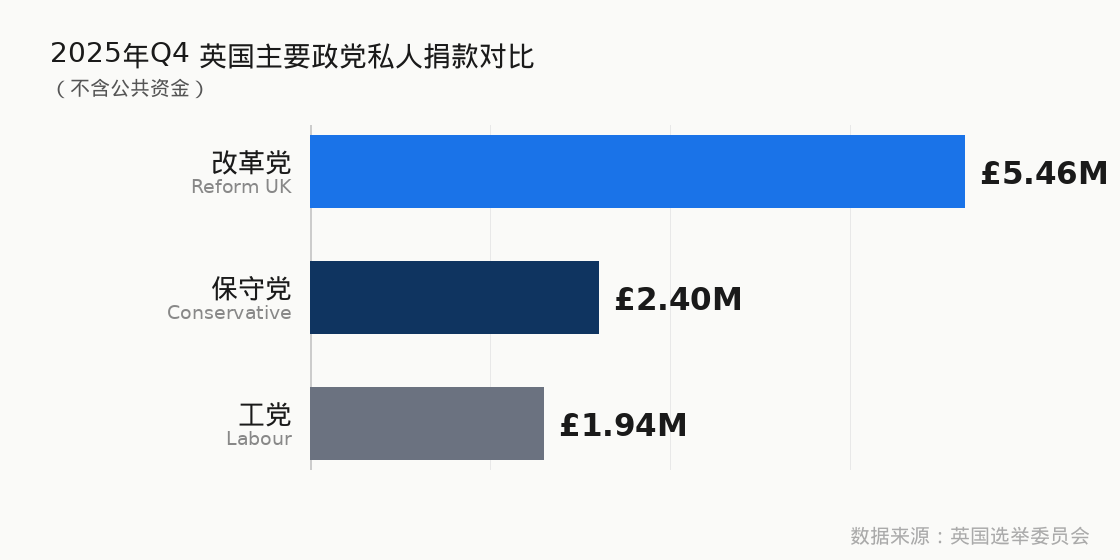
According to the latest quarterly political donation data released by the UK Election Commission on March 5, 2026. The Reform Party (Reform UK) topped the UK party fundraising list again with £5.5 million in the quarter, but one donation of £3 million came from the same person, with the source listed as Thailand.
The donor is called Christopher Harborne. Sometimes, he goes by Chakrit Sakunkrit.
He lives in Thailand, holds Thai citizenship, and owns about 12% of the parent company Tether, the world's largest stablecoin, under his Thai name. He operates one of the largest private aviation fuel networks globally, while funneling political funds to right-wing parties in the UK thousands of miles away. Over the past two years, he has bet on one thing: to elevate Farage and the Reform Party to power in British politics.
Image source: Lesley Martin / AFP via Getty Images
Cambridge engineer & Bangkok recluse
Christopher Charles Sherriff Harborne was born in England in December 1962. He completed his secondary education at Westminster School, which boasts an alumni list that includes prime ministers, judges, and bankers, representing the upper echelon of the empire's elite pipeline.
Next was a dual degree in Engineering and Management from Downing College, Cambridge University. After that, he attended INSEAD in Fontainebleau, France, where he obtained an MBA and graduated in 1988.
His first job was as a management consultant at McKinsey, where he worked for five years. In that era, McKinsey consultants typically moved into investment banking or executive positions in multinational corporations. But Harborne did not. He went to Asia, worked for a research company, and then founded Sherriff Global Group in 2000, a commodity trading company initially focused on high-risk offshore services, named after his paternal family surname.
Around 2005, he moved his family to Thailand. That same year, he registered AML Global Ltd., an aviation fuel brokerage. Today, AML Global operates over 1,200 supply points worldwide, making it one of the largest private jet fuel brokers.
In 2011, he officially became a Thai citizen, taking the name Chakrit Sakunkrit. The British citizenship certificate and Thai nationality certificate now coexist in the same person's pocket.
No one knows his family situation. No spouse, no children, and no verifiable private life records. He never gives media interviews, rarely appears in public, and has no social media accounts. In an attention economy era reliant on exposure, he uses complete invisibility as a shield.
Layout in the crypto field
In 2011, when Bitcoin was still a private code within the geek circle, Harborne bought in. In 2014, he bought Ethereum, ahead of the vast majority of institutional investors.
But what truly changed his status in the crypto world was a hacker attack in August 2016.
That summer, the exchange Bitfinex was attacked, losing approximately $72 million worth of Bitcoin — adjusted for today's prices, this figure is close to $7 billion. Bitfinex could not immediately compensate users in full, so it implemented a controversial plan at the time: issuing a token called BFX to all affected users, representing a claim against the exchange, with a promise for future redemption.
Most users chose to sell off, panic discounting, eager to exit.
Harborne chose to buy in and continued to accumulate shares, eventually amassing about 12% of the equity of Bitfinex and Tether's parent company DigFinex under the name Chakrit Sakunkrit.
This is not a small bet. Tether, under DigFinex, is today the issuer of the world's largest stablecoin USDT, with daily trading volumes consistently ranking among the top in global crypto assets, and a market value exceeding $140 billion. Holding 12% equity in DigFinex means Harborne stands in the core circle of the global crypto dollar system.
But this equity also brought him trouble. In March 2023, The Wall Street Journal published an investigative report on Tether and Bitfinex's banking arrangements, linking Harborne and his aviation fuel company AML Global to the path of Tether/Bitfinex accessing the U.S. banking system, implying he intentionally concealed his identity when opening an account at Signature Bank under his Thai name Chakrit Sakunkrit.
Harborne immediately filed a lawsuit, accusing The Wall Street Journal of publishing false allegations of "fraud, money laundering, and funding terrorism" and formally filing in a Delaware court in February 2024. The Wall Street Journal subsequently removed the paragraphs involving Harborne and AML Global from the report and stated in an editor's note: "The removal of this paragraph was to avoid any possible implication... that Harborne or AML had any concealment or forgery of information in the account opening process."
The lawsuit is allowed to proceed.
The biggest variable in British politics
Beyond aviation fuel and crypto equity, Harborne has a third identity: one of the largest individual donors in British political history.
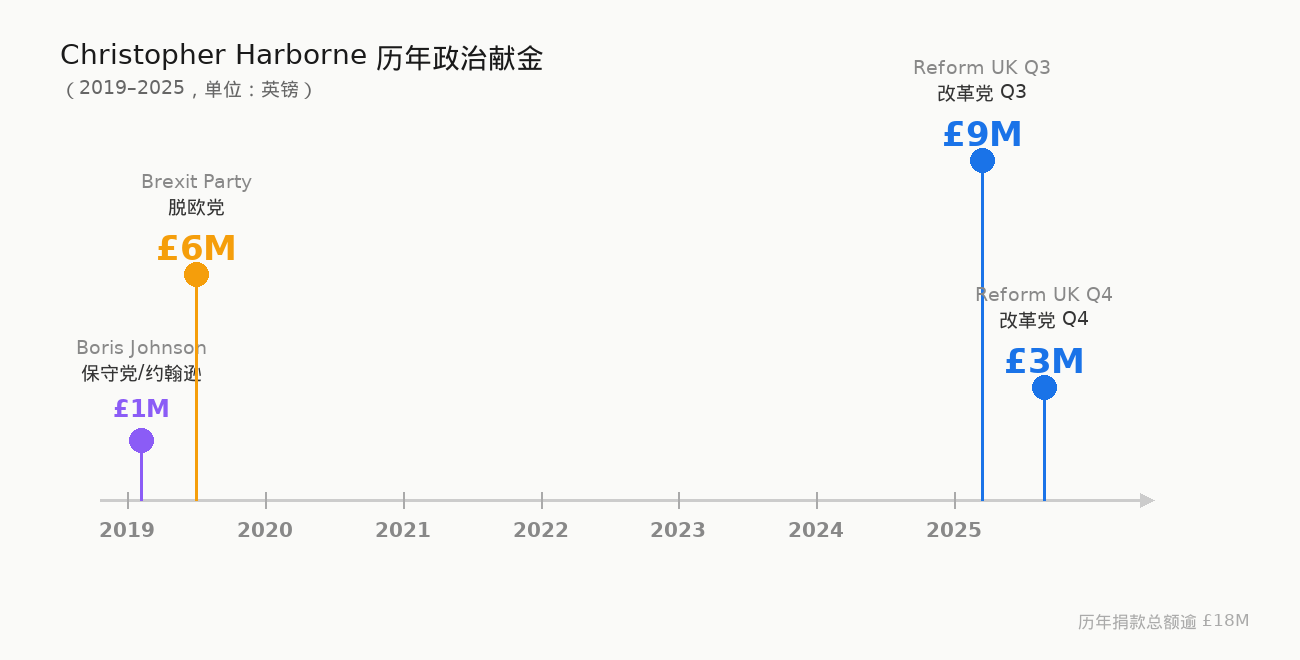
His political path is a traceable trajectory of right-wing betting. Early on, he donated to the Conservative Party and gave Boris Johnson £1 million to support his campaign. But in 2019, when Brexit negotiations bogged down in the Conservative-led parliament, he felt the party's determination to push for Brexit was insufficient, and instead funneled £6 million to Farage's Brexit Party, becoming the largest donor to that party that year. The Brexit Party then achieved a landslide victory in the European Parliament elections.
In September 2023, he traveled to Ukraine with Johnson in his capacity as an "advisor to Boris Johnson's office" to attend the Yalta European Strategy Forum, reportedly meeting with senior Ukrainian officials and President Zelensky. This identity has never been publicly explained.
In 2024, the Conservative Party suffered a crushing defeat in the election, with the Labour Party taking power. Both traditional major parties have lost their utility: the Labour Party holds a clear skeptical stance on cryptocurrencies, with Labour MP Rushanara Ali publicly calling for a ban on political parties accepting cryptocurrency donations, stating it is a "potential channel for foreign interference in democracy"; the Conservative Party has long been slow to act on crypto regulation, remaining at the level of mere statements.
Farage's Reform Party is the only option. Farage is often referred to as the British version of Trump.
In the third quarter of 2025, £9 million. The largest single donation by a living donor to a single political party in British political history, setting a record in one go. In the fourth quarter, another £3 million. For the entirety of 2025, his total donations to the Reform Party exceeded £12 million.
An investment with expected returns
Harborne rarely discusses his motives for donations, with the rare exception being that he briefly stated: "The UK has not made good use of Brexit, and we have not kept up with the pace in the technological field of the 21st century."
But it is difficult for outsiders to ignore another clearer line of logic: he holds about 12% of the equity in the parent company of the world's largest stablecoin Tether. If the UK becomes a crypto-friendly regulatory environment, it has direct commercial value for his core assets. Political donations, in a sense, are also an investment — only the target is policy, not tokens.
The timeline makes this judgment harder to ignore. The public embrace of cryptocurrencies by the Reform Party only happened after receiving large donations from Harborne. Farage announced that if the Reform Party were in power, they would introduce the (Cryptocurrency Assets and Digital Finance Act), promising to cut crypto capital gains tax, allow taxes to be paid in cryptocurrency, and establish a national Bitcoin reserve. In June 2025, the Reform Party became the first major party in the UK to officially accept cryptocurrency political donations. Farage himself subsequently personally invested £215,000 to acquire about 6.3% of the shares in the British Bitcoin treasury company Stack BTC.
The Reform Party denied any direct connection between the two. The Liberal Democrats and the Labour Party called for an investigation.
The hidden logic
In the U.S., the story of the crypto industry pouring money to support Trump and reclaim regulatory dominance has already been told. In the UK, the same script is being replayed — only the main characters have changed, and the money is still flowing.
The impact of this bet is already partially visible. The Reform Party raised £18.6 million throughout 2025, surpassing the Conservative Party's £13.4 million and the Labour Party's £8.2 million, becoming the party with the most fundraising in the UK. Farage's approval ratings continued to rise, with the Reform Party topping several polls.
If this trajectory continues, a party that is clearly friendly to cryptocurrency will have the opportunity to take control of the UK government, and those who bet early will benefit the most.
The story of the U.S. has already provided a reference: In 2024, the crypto industry poured over $200 million into congressional candidates; after Trump's victory, the SEC changed leadership, and the direction of crypto regulation took a sharp turn, bringing the long-awaited policy dividends to the industry.
The story of the UK is not yet finished.