

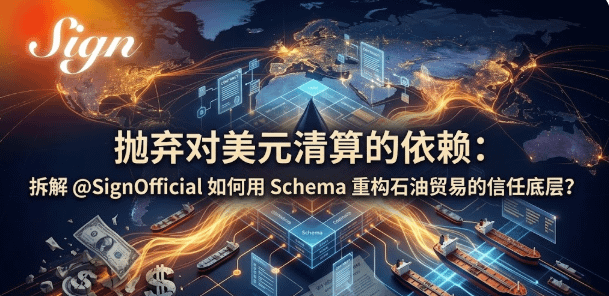
In the context of global macro hedging, Saudi Arabia's 'Vision 2030' and the UAE's digital economy experiment are essentially seeking a form of 'digital sovereignty' independent of the Western centralized clearing system. Especially in the cross-border trade of strategic resources like crude oil, the traditional SWIFT and US dollar settlement systems, while efficient, come with the risk of long-arm jurisdiction, making non-American capital feel like a thorn in the throat.
Yesterday, while reviewing the fluctuations in the crude oil market, I was pondering a highly hardcore technical question: If the oil giants in the Middle East want to establish a non-dollar settlement corridor, what underlying technology do they truly need? It's certainly not just about accepting Bitcoin or stablecoin payments; that only addresses value transfer and does not resolve complex business trust and compliance auditing. Opening the SDK documentation of @SignOfficial , I saw a technological mechanism capable of dimensionally attacking the traditional letter of credit system—a programmable schema (proof model) under the S.I.G.N. architecture.
In traditional oil trading, the completion of a transaction requires dozens of paper documents (bills of lading, certificates of origin, inspection reports, letters of credit) circulating among countless centralized banks and institutions, taking weeks and being extremely prone to tampering or unilateral disconnection. In the all-chain proof network of Sign, all of this is being reconstructed by cryptography. Middle Eastern oil exporters and Asian importers can directly register a customized Schema on the Sign chain. This Schema is not a simple text table; it is a digitally defined trust contract by code.
It can accurately define: the API degree of crude oil (quality parameter), the physical shipping timestamp automatically uploaded by IoT devices, delivery confirmation based on specific geofencing locations, and corresponding payment conditions in non-USD currencies (such as CBDC or stablecoins). The climax comes: at the moment that giant oil tanker loads in the Persian Gulf, the hash data generated by the IoT device will automatically trigger the Hooks on the Sign chain. The Hooks automatically compare the quality and quantity parameters set by the Schema. Once the mathematical verification passes, the smart contract will generate an immutable 'Verifiable Credentials' at the millisecond level.
This credential does not require any third-party bank endorsement; it is the most hardcore credit in itself. In the process of proving trillion-level crude oil production on the chain, $SIGN tokens are no longer a dispensable governance coin. They are the underlying fuel (Gas) and collateral for driving Schema registration, Hooks logic calls, and all-chain proof generation. When a token captures the settlement network transaction fees of the world's core energy trade, its valuation logic has transcended the traditional DeFi bubble, directly anchoring itself to the GDP of the real economy. During the current consolidation period, the big funds that truly understand this hardcore fusion of Schema proof and physical crude oil trade are silently building their strategic bottom positions.