


In the early hours of March 9th, the situation in Iran escalated. The CME and ICE markets were closed, and major global futures exchanges were shut down. The next official price quote for crude oil will not be available until Monday morning, more than ten hours later.
But the Hyperliquid crude oil contract CL-USDC didn't wait. That day, the trading volume of this on-chain perpetual contract surged from a daily $21 million to over $1.2 billion. Traders used an on-chain protocol to instantly price geopolitical risks during the window of time when traditional markets were closed.
This event was touted as another victory for DeFi within the crypto community. However, few people questioned a more fundamental issue: where does the price on this on-chain exchange come from when external markets shut down?
Where do prices come from when there are no external quotes?
Trade.xyz is the largest provider of perpetual contracts for traditional assets on Hyperliquid, operating on the HIP-3 protocol and accounting for 90% of the total HIP-3 open interest. S&P 500, Nasdaq 100, WTI crude oil, gold, silver, and South Korean stocks are all available for trading 24/7. However, the pricing logic of perpetual contracts is completely different from that of spot trading. Spot exchange prices are generated by direct matching between buyers and sellers, while perpetual contracts require an "anchor" to align the contract price with the true price of the underlying asset. This anchor is the oracle.
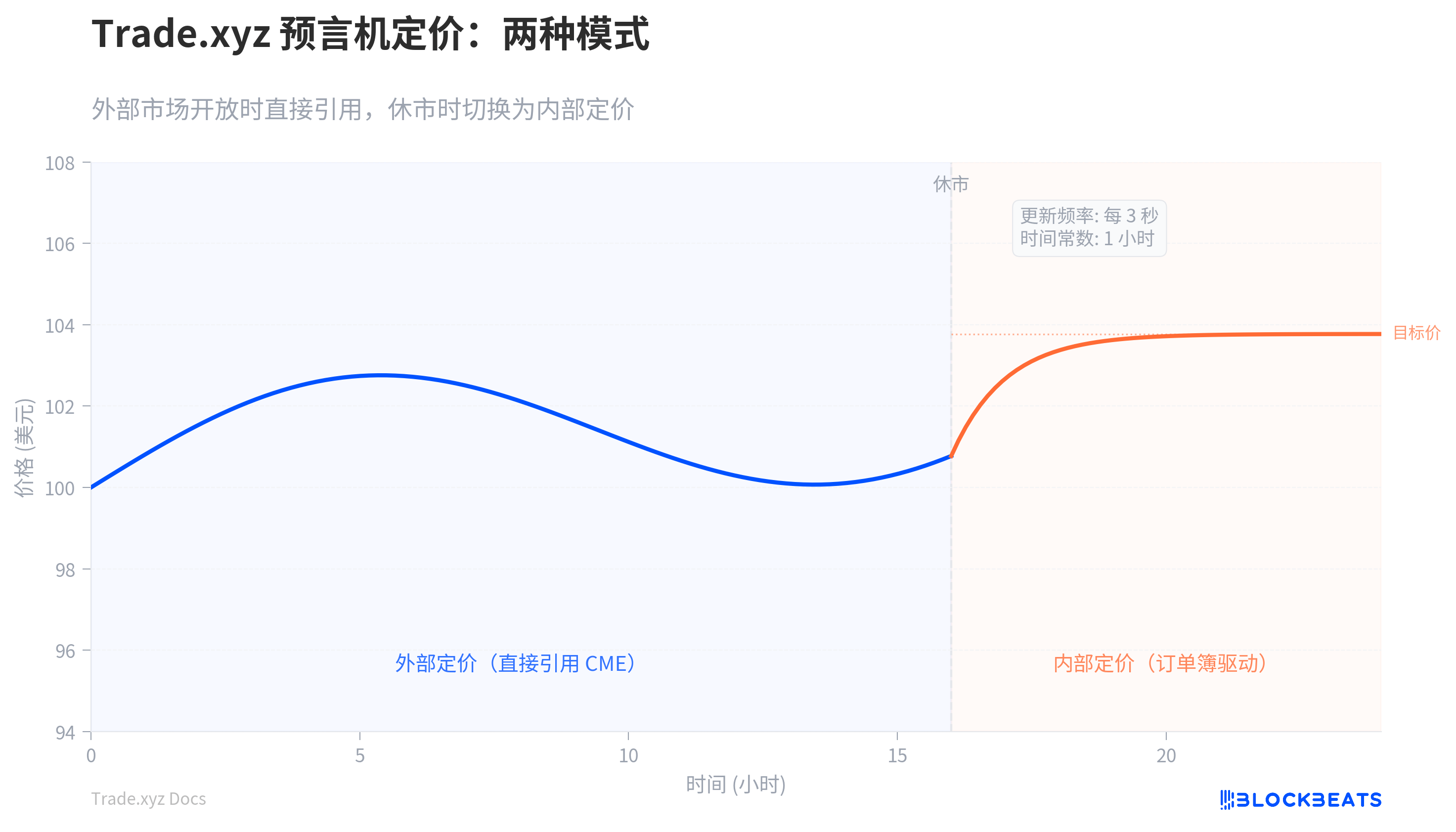
In traditional futures markets, pricing is anchored to the exchange itself. CME's crude oil futures price is simply the price of crude oil, requiring no additional reference point. However, Trade.xyz's contracts run on the Hyperliquid blockchain and have no direct connection to the Chicago Mercantile Exchange's matching engine. When CME is open, Trade.xyz's oracles directly reference CME quotes, which is relatively straightforward. The real problem arises after CME shuts down.
Trade.xyz's approach involves having oracles extract information from their own order books. The system calculates an "impact price difference," which, simply put, is: if someone were to buy a large amount now, how much higher would the average transaction price be compared to the current price? If someone were to sell a large amount now, how much lower would it be? This discrepancy reflects the imbalance between buying and selling forces in the order book. The oracle adds this discrepancy to the current price to obtain a "target price," and then uses a decay function to slowly bring the current price closer to the target price.
The key word is "slow." The oracle updates every 3 seconds, but each time it only moves a small fraction of the gap between the current price and the target price. This movement speed is controlled by a time constant. The larger the time constant, the slower the oracle becomes, the harder it is to manipulate, but the less it reflects true market sentiment.
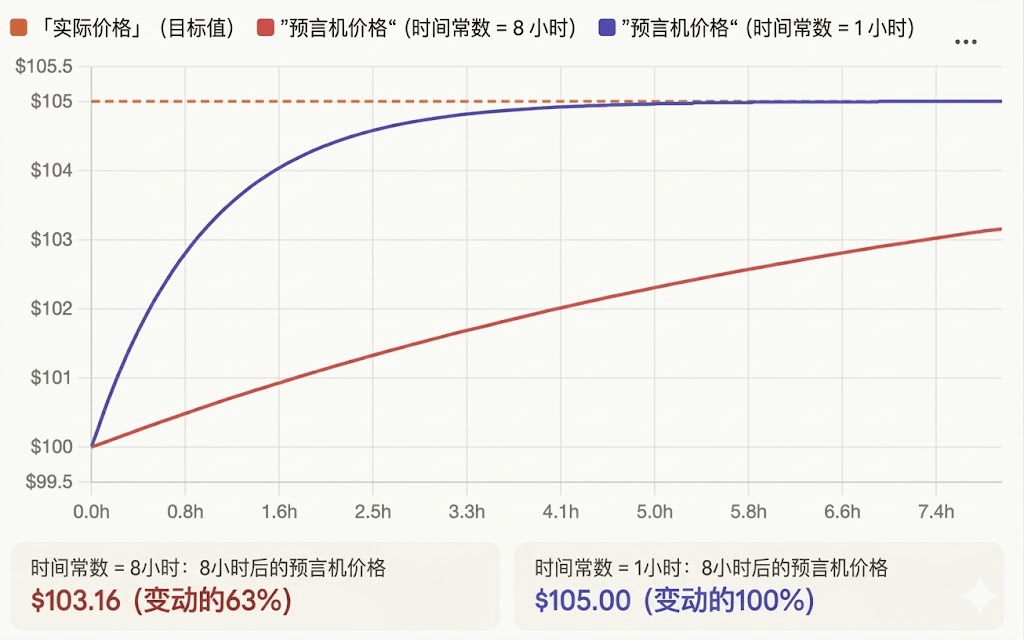
When Trade.xyz first launched, this time constant was set at 8 hours. In November 2025, this parameter was lowered to 1 hour. The reason for the reduction is related to traders' real money: Trade.xyz settles funding rates every hour. If oracles track real prices too slowly, profitable traders will be continuously drained by funding rates.
As shown by the red line in the chart below, it also takes 8 hours. If you went long on crude oil and the direction was correct, but the oracle took 8 hours to catch up with the real price, and the price did not reach your target price (the real price) during those 8 hours, your profits were greatly eroded by the funding rate.
After adjusting the parameters to 1 hour, the price reached the expected position (blue line) in just 5 hours. The price can confirm your judgment more quickly, and you will pay fewer funding fees compared to before.
However, faster oracles also bring new risks. If an oracle malfunctions and stops for 6 hours before suddenly recovering, the formula calculates that it will jump to 99.7% of the target price in one step. This instantaneous price jump can trigger large-scale liquidation. Trade.xyz's solution is to add a safety valve: regardless of the actual time elapsed, the effective time difference for each update is calculated to be at most 6 minutes. Even if the oracle recovers after a malfunction, the price can only catch up step by step.
Cage, heavy anchor, and the gap at Monday's opening.
Oracle pricing solves the problem of "how to bid on weekends". But another problem arises: to what extent can prices move freely?
Trade.xyz has created a "cage" for each contract. The mark price is restricted to a certain percentage above and below the last external closing price. This percentage is equal to the reciprocal of the maximum leverage. For crude oil contracts with a maximum leverage of 20x, the cage is 5% above and below the closing price. If crude oil closes at $100 on Friday, the mark price can only fluctuate between $95 and $105 over the weekend. Touching the boundary results in immediate trading halt.
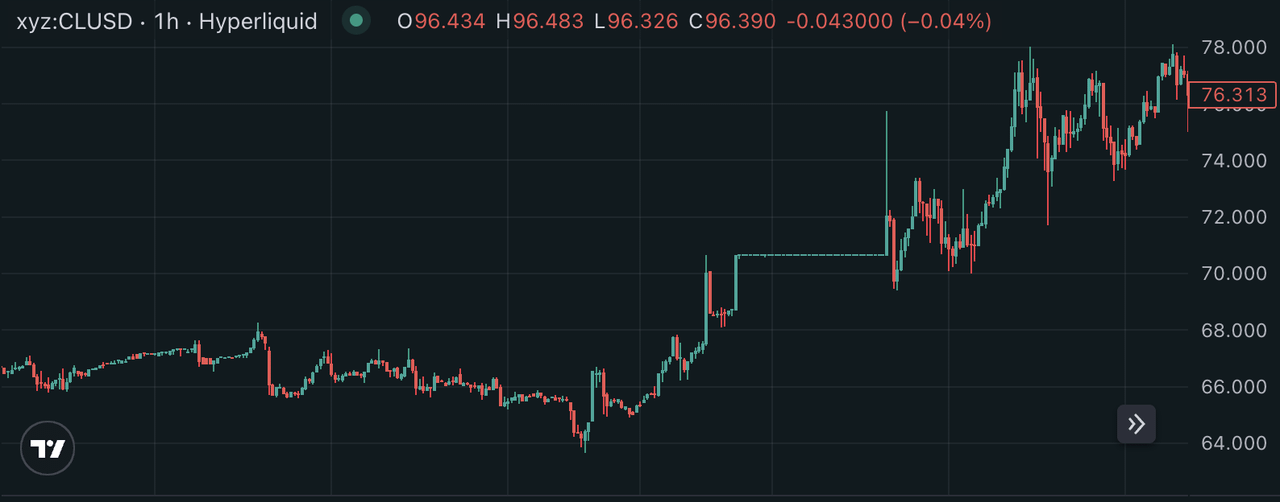 Crude oil contracts were closed over the weekend in early March.
On a normal weekend, this mechanism works well. The 5% margin is sufficient to absorb most overnight fluctuations. However, a geopolitical event of the magnitude of March 9th can push prices directly to the edge of this margin. All market information is piling up, and if the actual price jumps by 8% when the CME opens on Monday, a huge gap will form. Short sellers will be liquidated instantly, and market makers will suffer losses because they cannot hedge gradually.
In March 2026, Trade.xyz deployed "Price Discovery Boundary v2" on crude oil contracts. The core change: the cage size remains the same, but the cage can be moved. When the oracle price reaches 90% of the current boundary, the system re-anchors the cage's center to the boundary value, drawing a new cage of the same size around the new anchor point. This re-anchoring can be performed a maximum of two times in each direction.
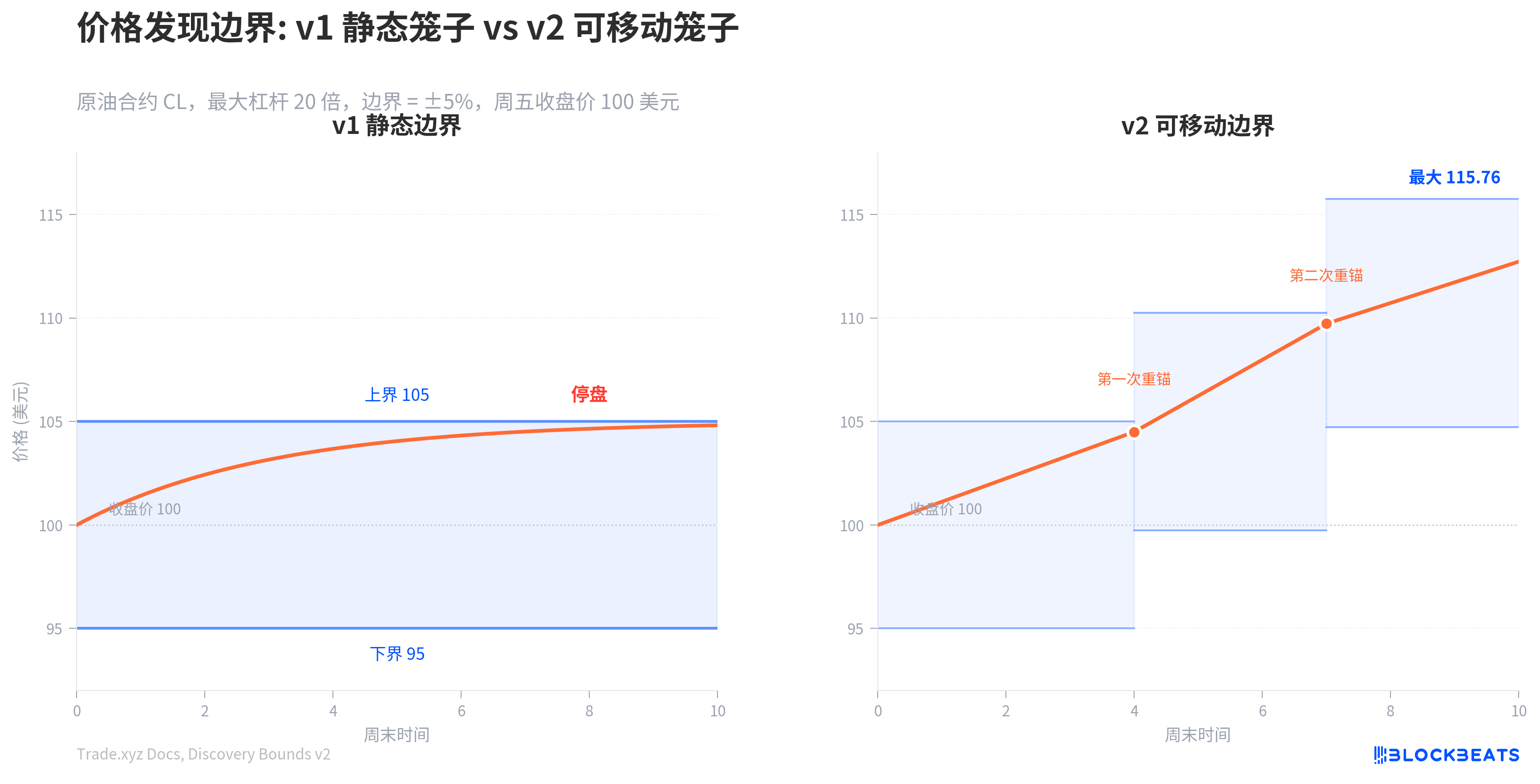
To put it in concrete terms: the initial cage is $95 to $105. When the oracle reaches $104.50, a re-anchoring is triggered, and the new cage becomes $99.75 to $110.25. After another trigger, it becomes $104.74 to $115.76, which is the endpoint. Starting from $100, the maximum discoverable range expands to approximately $115.76.
This design keeps the instantaneous volatility range consistently within 5%, eliminating the need to modify market makers' risk models. Simultaneously, the re-anchoring signifies that the system "acknowledges" the price movement that has already occurred, reducing the gap at Monday's opening. However, the cost is also clear: a long position with a liquidation price at -8%, perfectly safe under v1 (because the price won't reach -8%), may enter the liquidation range after a downward re-anchoring under v2. Trade.xyz has chosen to deploy v2 first on two crude oil contracts and stated that it will decide whether to roll it out after observing the effects.
Another key component of the pricing system is the funding rate. The funding rate is the rubber band that ties the perpetual contract price to the oracle price: if the marked price is higher than the oracle price, the long position pays the short position; if it is lower than the oracle price, the short position pays the long position. Trade.xyz's funding rate formula is the same as most crypto exchanges, but it is multiplied by a scaling factor of 0.5.
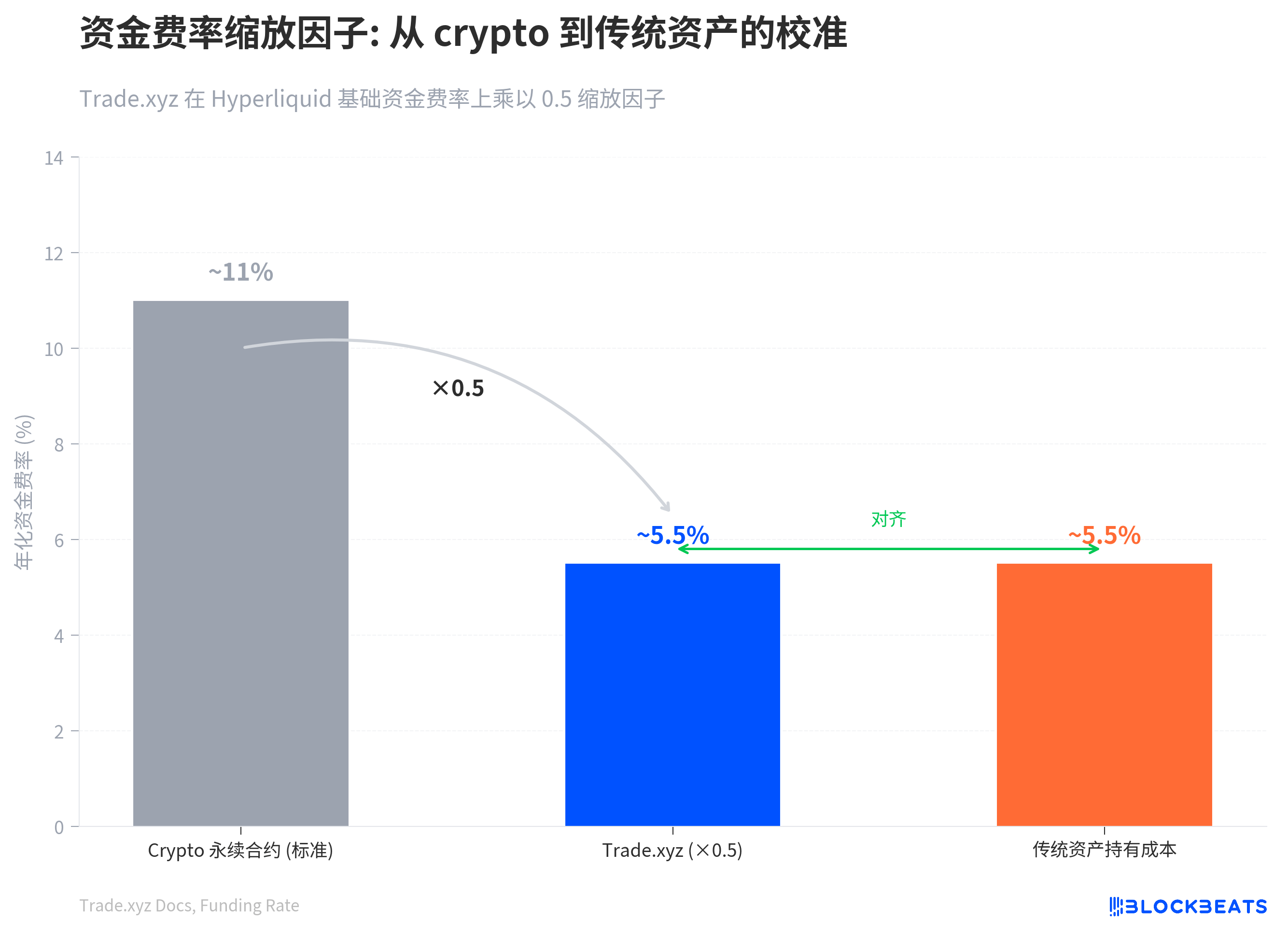
This 0.5 is a calibration against traditional assets. The basic annualized funding rate for crypto perpetual contracts is approximately 11%, reflecting the cost of holding with pure leverage, which is reasonable for assets like Bitcoin that do not pay dividends. However, for stocks and commodities, the true cost of holding is closer to SOFR plus 1 to 2 percentage points, around 5% to 6%. Multiplying by 0.5 reduces the basic annualized rate from 11% to approximately 5.5%, aligning it with traditional assets. This is especially crucial on weekends: the scaling factor directly halves the funding rate on weekends, and combined with oracles that have a 1-hour time constant, allows traders who are on the right track to retain most of their profits.
Different assets, different processing pipelines
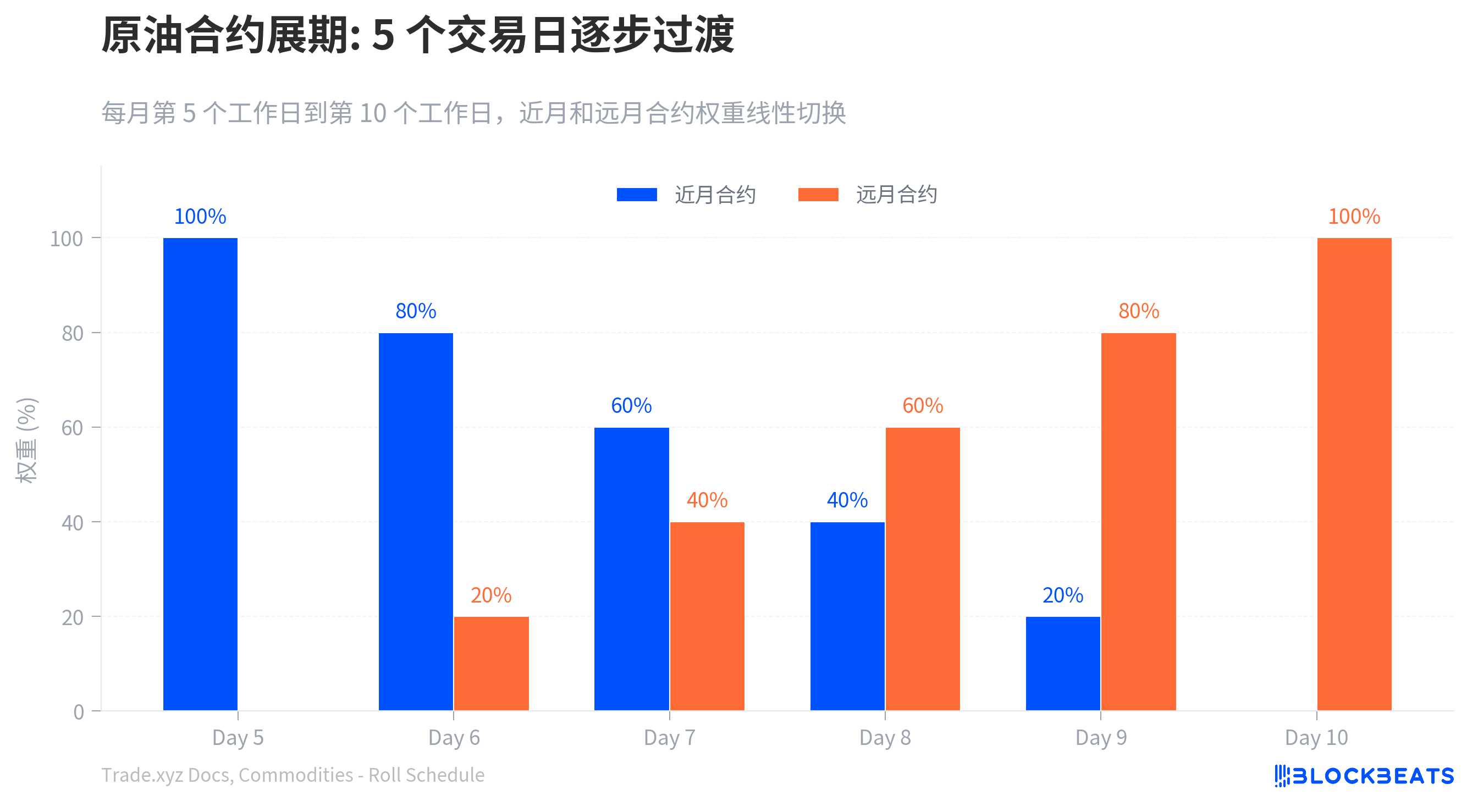
Precious metals have active global spot markets. External prices for gold, silver, platinum, and palladium are directly derived from spot quotes, eliminating the need for futures rollover. However, crude oil and industrial metals lack unified spot quotes, forcing Trade.xyz to use CME futures contracts as the pricing basis. Futures contracts have expiration dates, requiring the system to switch from the current month's contract to the next month's contract monthly. The problem lies in the fact that the prices of the two contracts are often different. Storage costs and supply and demand expectations can cause the price of the more distant contract to be higher than that of the near-month contract. If the price jumps during the switch, positions can experience unrealistic fluctuations in profit and loss, potentially triggering unnecessary liquidations.
Trade.xyz uses a 5-day gradual transition: from the 5th to the 10th business day of each month, the oracle price is a weighted average of near-month and far-month contracts, with the weights changing linearly each day.
The pricing of stock index contracts is more complex. XYZ100 tracks the Nasdaq 100, but CME's Nasdaq futures trade almost 24/7 (5 days x 23 hours), providing a longer-term price reference than the spot market. Trade.xyz initially used futures prices to deduce the spot price, fixing a 4% discount rate to offset holding costs. However, this fixed value deviated from the expected value when the Federal Reserve raised interest rates. The v2 solution, launched in February 2026, changed to dynamic calculation: at the opening of the US stock market, the spot index value is used directly, while the implied discount rate is calculated from the spread between futures and spot prices; during the after-hours session, this discount rate is used to deduce the spot price.
There's another special case: South Korean stocks. Trade.xyz has listed Samsung Electronics, SK Hynix, and Hyundai Motor, whose stocks are quoted in Korean Won on the Korean Exchange. The oracle needs to overlay a USD/KRW exchange rate conversion layer on top of the original quote. The profit or loss of holders reflects both stock price fluctuations and exchange rate fluctuations.
Who will be held responsible for the consequences of parameter selection?
All these pricing mechanisms are based on the premise that there are enough market makers willing to continuously provide liquidity. Hyperliquid's HLP market-making vault provides liquidity for native BTC and ETH perpetual contracts, but does not cover third-party contracts deployed on HIP-3. Trade.xyz's liquidity relies entirely on the spontaneous participation of external market makers. In extreme market conditions, if a liquidated position cannot find a counterparty, the system will not bail it out like on the main Hyperliquid site, but will directly trigger ADL (automatic liquidation), forcibly closing the most profitable counterparty's position based on profit ranking.
The brilliance of this pricing system lies in its use of a set of mutually restraining parameters—oracle tracking speed, price discovery boundaries, and a scaling factor for funding rates—to construct a self-sufficient pricing environment even without external quotes. S&P's decision to license this system to Trade.xyz on March 18th likely reflects their interest in this infrastructure, which has proven effective in real geopolitical crises.
However, this system also comes at a cost. Oracles draw information from the order book, meaning that during periods of low liquidity (such as late-night Korean stock contracts), even a small number of orders can cause the oracle to move significantly. Price Discovery Boundaries v2 has expanded the liquidation range over the weekend, requiring leveraged traders to reassess their safety margins. ADL means that even if your judgment is correct, you may still be forced to liquidate in extreme market conditions.
Trade.xyz chose a completely different path from traditional exchanges: shifting pricing power from a centralized matching engine to an on-chain parameter system. Traditional exchanges close because clearing, risk control, and market making all require human intervention. Trade.xyz cannot close because on-chain contracts do not have a "closing time." It must be able to provide a price at any time. The crude oil event on March 9th proved that this system can operate under pressure. However, it also exposed a deeper problem: when on-chain protocols assume the pricing function of traditional financial infrastructure, who is responsible for the consequences of parameter selection?
Adjusting the time constant from 8 hours to 1 hour was a parameter decision made by the Trade.xyz team. The same applies to upgrading the price discovery boundary from v1 to v2. These decisions affect the liquidation line and funding rates for every position holder. In traditional exchanges, such rule changes require regulatory approval and a public comment period. On-chain, a single parameter update is sufficient.
In a system without HLP backing, without regulatory arbitration, and relying entirely on parameter design to maintain order, understanding how these parameters affect your positions is understanding the true risks you bear.