


Promoting is the best advertisement.
In just a week, the Aster platform has surpassed 710,000 new users, with a perpetual contract trading volume reaching $21.112 billion in the past 24 hours, directly exceeding that of the old DeFi derivative platform Hyperliquid by more than double. The platform's TVL has reached $1.744 billion, with 24-hour revenue of $7.12 million, ranking just behind the stablecoin giants Tether and Circle in the overall revenue leaderboard.
Besides 'Can ASTER still be bought?', 'Can Aster still be brushed?' is also a frequently asked question.
There are still 11 days left for Aster's second season airdrop, with an airdrop pool accounting for 4% of the supply, approximately 320 million ASTER tokens, which also means that as of the time of writing, based on a price of $ASTER$2.3, the S2 airdrop is worth over $700 million. Against this backdrop, Rhythm BlockBeats has organized the most essential airdrop strategies for Aster.
1. Aster × Backpack hedging arbitrage strategy
This is currently the main strategy for grinding points, where the core steps involve placing opposite orders for the same asset on two trading platforms (like Backpack, Aster) to achieve 'points grinding + fee difference capture'.
The only point to note is: Aster uses 'market orders' because Aster takes orders to earn double points.
The detailed steps involve shorting $ASTER with a 'limit order' under Backpack to earn limit order points; while in Aster, using a 'market order' for quick execution. Additionally, market orders must be executed quickly; otherwise, if one side is not executed, it may create an unbalanced position.
Additionally, the weight of holding time and opening frequency needs to be managed. The longer the holding time, the higher the points, but the points cap is twice the weekly trading volume.
Additionally, to prevent being witch-hunted, you can try modifying various parameters, such as opening amount, opening multiplier, opening direction, etc., and avoid using the same parameters repeatedly; otherwise, high-frequency hedging may trigger risk control and witch-hunt. Beginners should start with small amounts and gradually increase the multiplier and amount after getting the hang of it.
2. Capture funding rates
This strategy is based on the operations of arbitraging between two trading platforms, further capturing funding rates.
Here, we mainly utilize the funding rate mechanism of perpetual contracts. When the funding rate is positive, shorting the perpetual earns the funding rate; when the funding rate is negative, going long earns the funding rate. Generally, there will be discrepancies in funding rates between two trading platforms. For example, the tool shown in the image can illustrate the differences in funding rates between various trading platforms and the suitable opening directions.
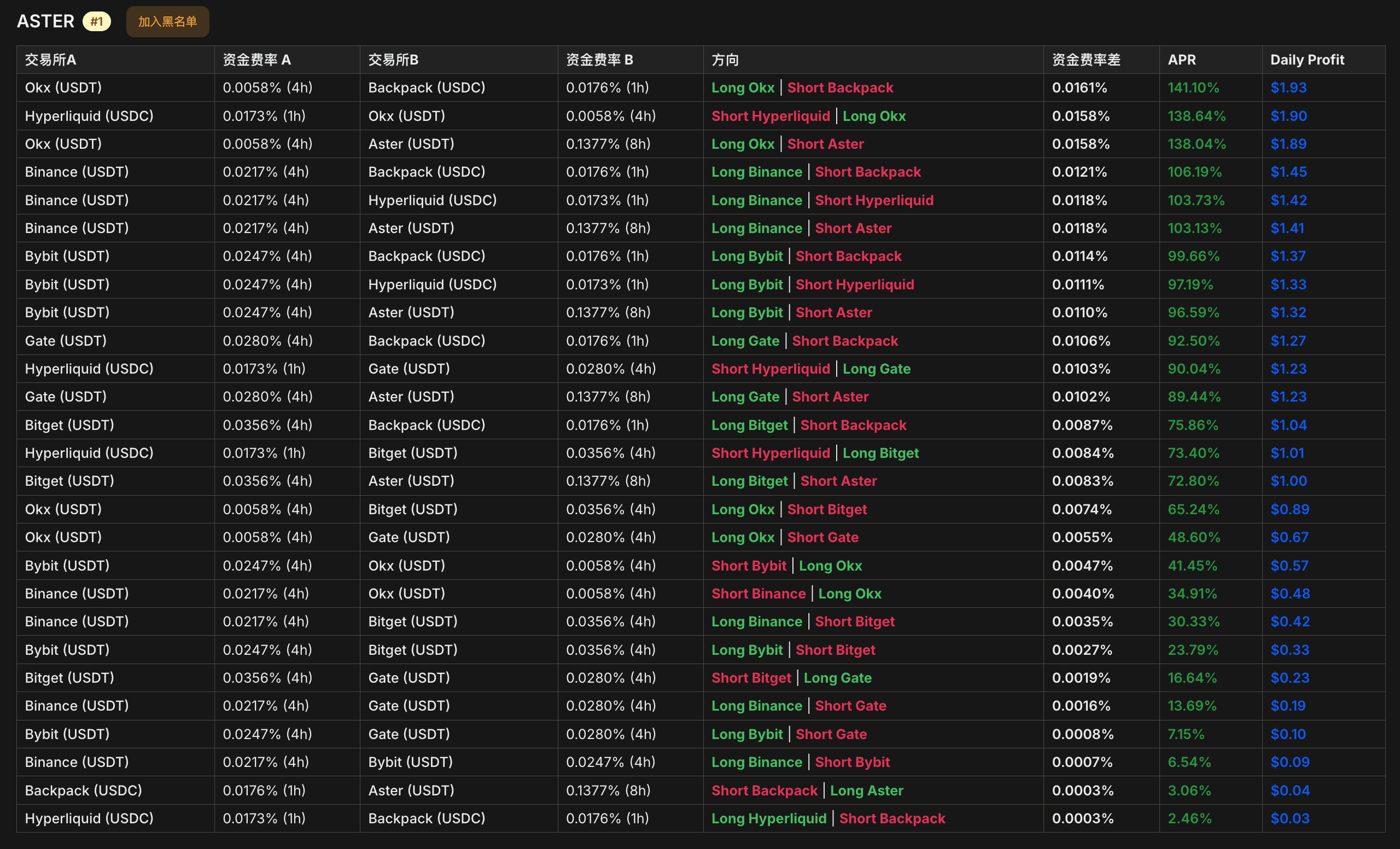
Data source: hibot
Continue to do spot hedging using the previous Backpack (limit orders) + Aster (market orders) approach to earn points. Net profit = points value + funding rate income - transaction costs - slippage loss.
Be sure to consider the fee structure of the trading platform. Transaction fees are usually divided into two types: Taker (market order): refers to orders that are executed immediately, which have higher fees; Maker (limit order): refers to orders that are placed on the order book and wait to be executed, which have lower fees.
Due to the need for real-time monitoring, this is suitable for experienced traders or using funding rate bots. Pay attention to the delays and reconciliations between multiple accounts and trading platforms. Funding rate arbitrage usually has a longer time span than points arbitrage, and position management should not be overlooked.
3. Convert deposits to USDF
In addition to the hedging and funding rate strategies mentioned earlier, Aster also offers a relatively 'low-risk, passive income' gameplay based on the 'Trade & Earn' system of USDF and asBNB. This product continues the experience of Aster's predecessor in the liquidity of staked assets, essentially combining 'trading' and 'investment' so that users can maintain trading activity while enjoying stable annualized returns.
Currently, USDF offers approximately 16.7% annualized yield (APY), with two ways to participate: one is deposit rewards, where as long as your account holds more than 1 USDF, interest will automatically accrue; the other is trading rewards, which have slightly higher requirements, requiring users to be active at least 2 days a week and accumulate a trading volume of over 2000 USDT. Upon meeting the conditions, the system will distribute rewards uniformly in the following week, directly credited to the trading account and automatically reinvested.
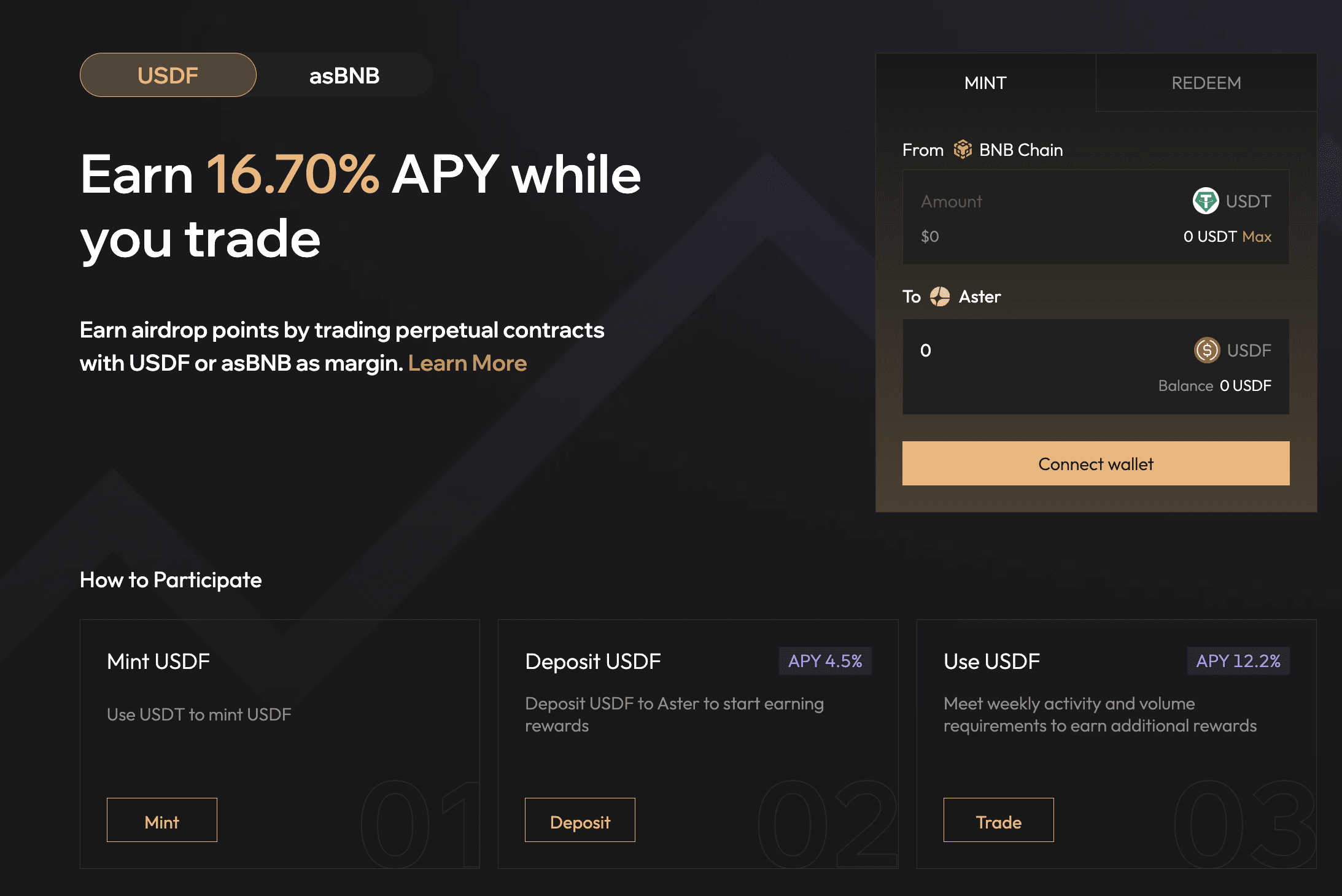
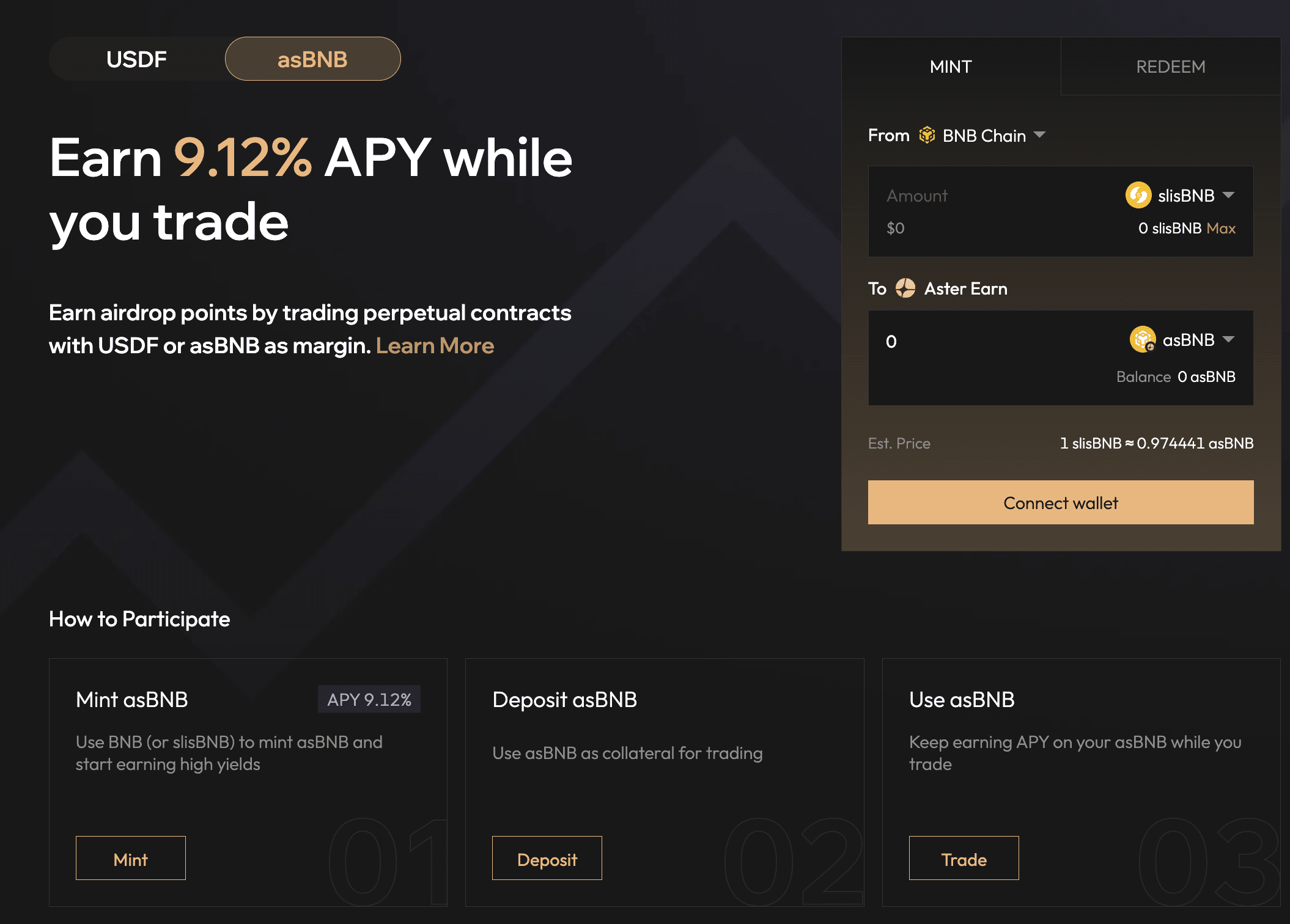
In addition to USDF, Aster also provides asBNB, which serves a similar role and logic as USDF. Users can exchange BNB or slisBNB for asBNB to use as collateral while enjoying about 9.1% annualized returns.
Furthermore, Aster has introduced a 'double points' mechanism in its incentive design. If you choose to use USDF or asBNB as collateral, your trading points will receive a doubling effect, and the weekly trading volume points cap will be raised to double. This makes using these two assets almost a must for players seeking airdrop points or commission rewards, effectively combining interest income and points advantages during trading.
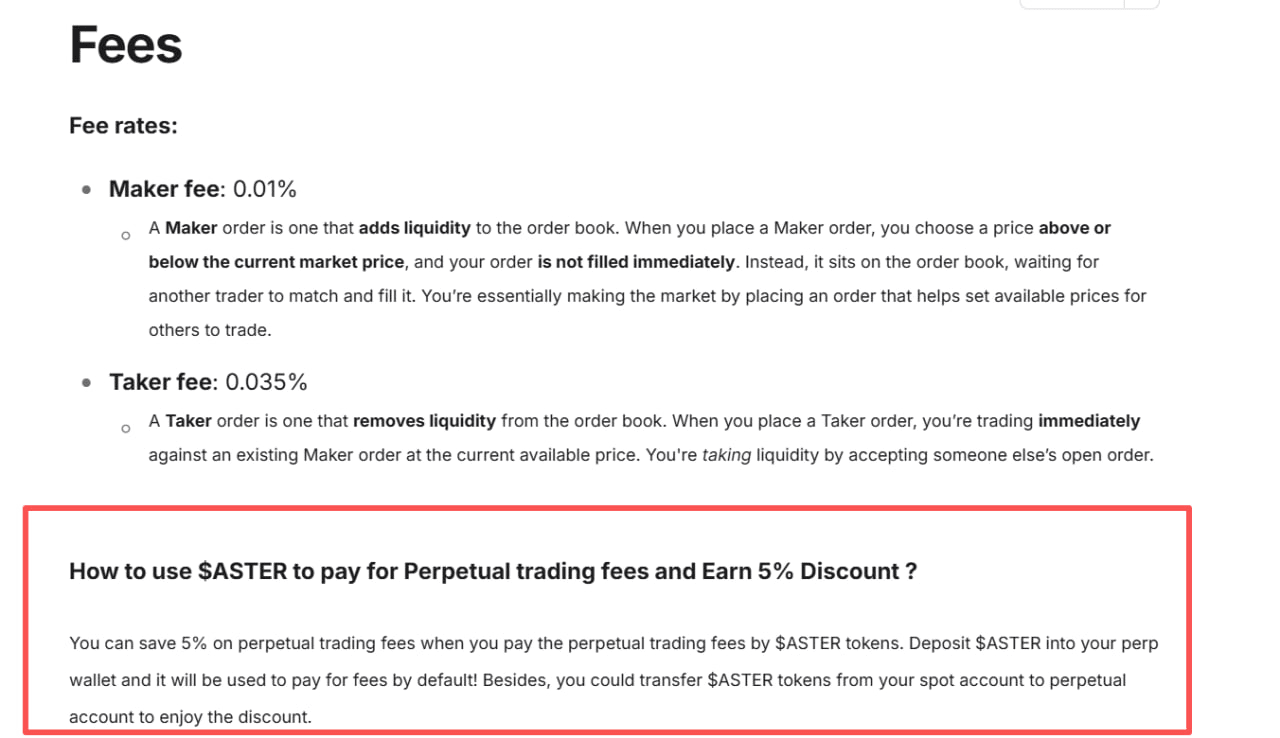
In addition, holding $ASTER gives a 5% discount on transaction fees, so it is best for each wallet to hold a certain amount of $ASTER.
4. Team bonus
Individual players can only achieve limited gains by grinding points, but if you can form a 'team', by inviting others to expand your network, you can leverage the points generated by others' trading and further improve your overall share through team rankings. In the long run, the points earned by a single account trading alone may be far less than the total contribution of an active team, thus 'invitation + team' will become a key factor in widening the gap between players in the later stages.
The core logic is to integrate the power around us into a team through the two-layer mechanism of 'referral' and 'team contribution' to enhance our points acquisition.
Specifically, the invitation rewards are divided into two tiers: If you invite a tier 1 user, you can earn 10% of the Rh points they generate; if it is a tier 2 user (i.e., someone invited by your invitee), you can earn a 5% points share. However, it is important to note that this share only applies to their transaction points earnings, excluding referral points and team points themselves, to avoid the situation of 'infinite nesting'.
Aster has also introduced the concept of team points (Team Points). It can be understood as a team, where each team's points will be settled on T+1, comparing horizontally with other teams. Before the final points are distributed, the system will also make some 'fairness adjustments', including limiting large account monopolies and smoothing out abnormal fluctuations. In other words, team rewards are not just about 'the more people I invite, the better', but rather a comprehensive evaluation of 'team activity' + 'overall contribution proportion'.
In the end, these points will be converted weekly into your share in the overall platform points pool, directly determining how much reward you can receive in the upcoming $ASTER airdrop distribution. Simply put: the invitation relationship gives you a stable 10% / 5% share; team points determine whether you can squeeze into the leaderboard and receive higher additional rewards.
There are 11 days left until the second season airdrop of Aster, with an airdrop pool accounting for 4% of the supply, approximately 320 million ASTER. As of the time of writing, the S2 airdrop is valued at over 700 million USD.
Faced with such a large user growth and complex points ecosystem, the Aster team has also made it clear: professional market makers will be excluded from the Rh points system and will not be able to qualify for the $ASTER token airdrop. Currently, in the second phase of the Rh points calculation, pure spot holding and trading are not included in the points system. However, this does not mean that spot trading is without value—based on the official statements, it is not difficult to infer that the airdrop rules in the third quarter will likely reinclude spot trading in the points calculation scope.
Therefore, at present, there are still many opportunities for retail investors. However, it is important to note that the market is currently overheated, with FOMO sentiment adding to the mix, and scripts are rampant in the market. The timing of the second season airdrop distribution is also uncertain, so competition is relatively fierce, and users need to manage risks.