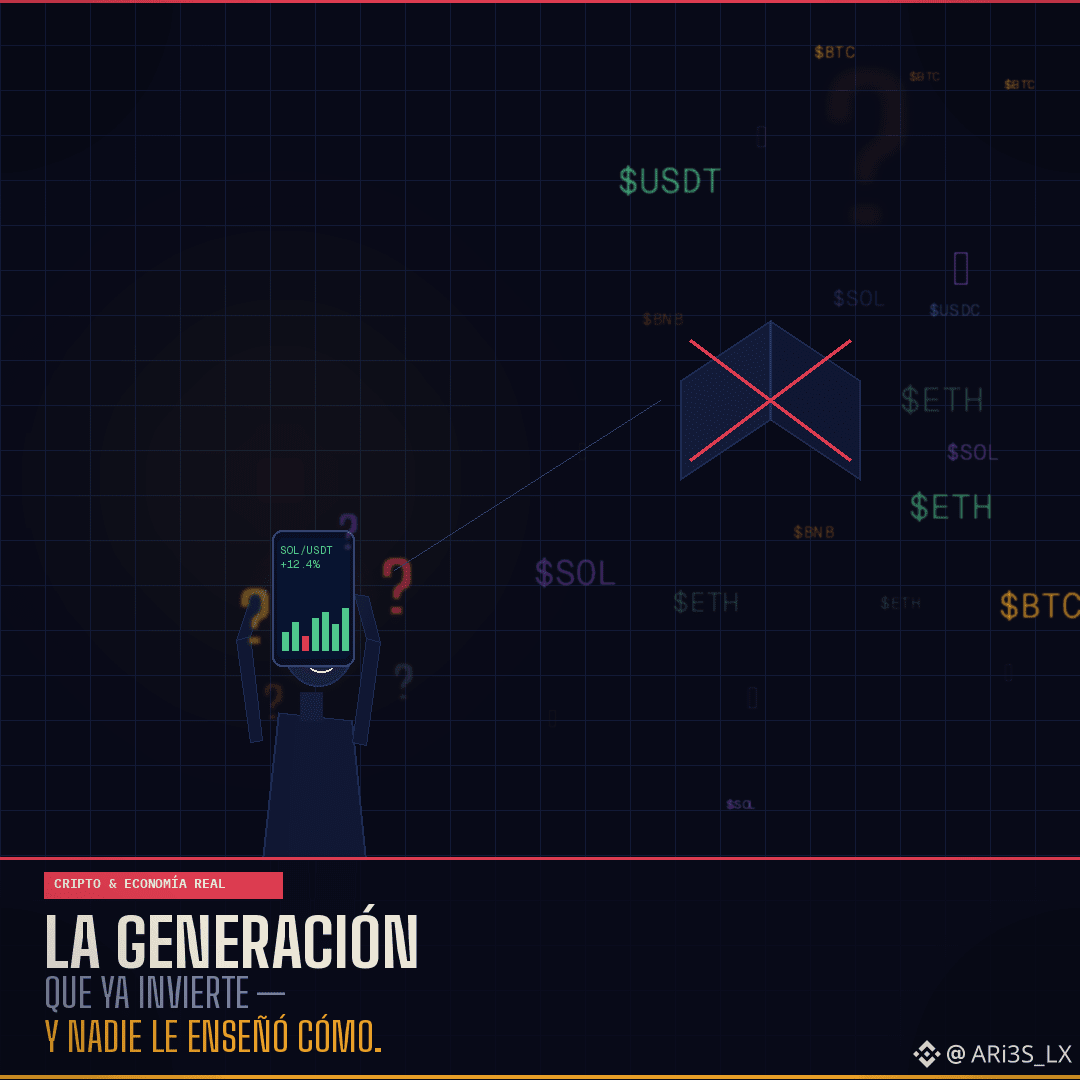
The generation that nobody is educating — and that is already investing in crypto
In Colombia, nearly 60% of crypto investors are between 20 and 40 years old. In Mexico, young people are leading the adoption. In Venezuela and Argentina, teenagers are handling $USDT before they have even opened a bank account. They are not doing it as a trend. They are doing it because the traditional system arrived late — or simply did not arrive at all.
And here lies the problem that nobody wants to name: those same young people are buying BTC, $ETH, or $BNB without understanding what an asset is, what risk is, or what the difference is between storing value and speculating. They operate the pair $SOL/USDT without being able to read a chart. They exchange $USDC for $SOL in seconds, attracted by the speed of the network, without understanding what they are really buying. They know how to use Binance. They do not know why the price goes up or down.
School teaches them to divide fractions. It does not teach them to read a market. And while educational systems debate whether to include digital finance in the curriculum, reality has already taken the lead: the next generation is building their wealth — or losing it — with tools that nobody explained to them.
21st-century financial education must talk about wallets, the difference between USDT and $USDC, why $BTC behaves differently from $SOL in moments of panic, and that trading the pair $BNB/USDT is not the same as understanding the market. It must teach that crypto is neither paradise nor hell — it is a tool. And like any tool, in untrained hands, it can cut.
The question is not whether young people will invest in crypto. They already do. The question is whether anyone will take it seriously to teach them how.
In Colombia, nearly 60% of crypto investors are between 20 and 40 years old. In Mexico, young people are leading the adoption. In Venezuela and Argentina, teenagers are handling $USDT before they have even opened a bank account. They are not doing it as a trend. They are doing it because the traditional system arrived late — or simply did not arrive at all.
And here lies the problem that nobody wants to name: those same young people are buying BTC, $ETH, or $BNB without understanding what an asset is, what risk is, or what the difference is between storing value and speculating. They operate the pair $SOL/USDT without being able to read a chart. They exchange $USDC for $SOL in seconds, attracted by the speed of the network, without understanding what they are really buying. They know how to use Binance. They do not know why the price goes up or down.
School teaches them to divide fractions. It does not teach them to read a market. And while educational systems debate whether to include digital finance in the curriculum, reality has already taken the lead: the next generation is building their wealth — or losing it — with tools that nobody explained to them.
21st-century financial education must talk about wallets, the difference between USDT and $USDC, why $BTC behaves differently from $SOL in moments of panic, and that trading the pair $BNB/USDT is not the same as understanding the market. It must teach that crypto is neither paradise nor hell — it is a tool. And like any tool, in untrained hands, it can cut.
The question is not whether young people will invest in crypto. They already do. The question is whether anyone will take it seriously to teach them how.