

原文标题:《The Decentralized Science Ecosystem: Building a Better Research Economy》
By Stephanie Dunbar, Stephen Basile, Messari
Compiled by: BlockTurbo
Scientific knowledge is a public good that supports technological development and economic growth. However, the current scientific system is rife with inefficiencies, rent-seeking activities, and low transparency that hinder innovation.
To this end, the decentralized science (DeSci) movement is launching new systems to sustain, implement, and spread open science. Nearly 50 DeSci projects were launched last year alone, and early-stage capital is starting to take notice. Pfizer is supporting longevity research by participating in VitaDAO’s latest funding round, and Balaji is an early supporter of Scholar and DBDAO, among others. These projects provide builders, investors, researchers, and community members with opportunities to participate in the development economy and further public goods.
Why DeSci? Breaking down the scientific life cycle
The current scientific research economy incentivizes prestige acquisition at the expense of transparency and innovation. Researchers must negotiate rent-seeking hegemons (institutions), misaligned reviewers, and double gatekeepers (publishers).
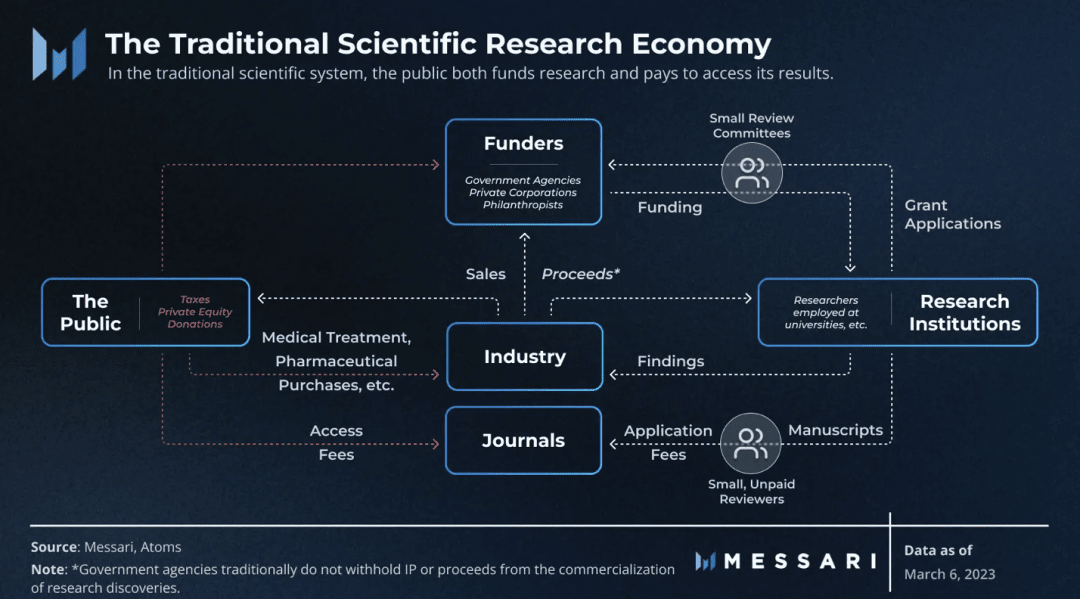
The system suffers from different problems which can be roughly divided into three main categories:
1. Centralize decision-making and funding
Research is often funded by government grants or by small corporate-driven groups of decision-makers. Both display built-in biases about who gets funded. It’s a negative feedback loop where researchers tailor laborious funding applications to the hypotheses they think are most likely to be selected, at the expense of the hypotheses they may be most passionate about. As a result, research variance is greatly reduced. For example, billions of dollars are spent to fund a single theory in Alzheimer’s disease research, while promising new ideas continue to be denied funding.
2. Poor transparency in methodology and data
Bad science can be perpetuated as researchers “publish or perish” to secure employment and funding. In addition, a lack of transparency in data and methods makes it difficult, if not impossible, for others to verify or build upon existing results. This has led to a “replication crisis,” with estimates that more than 50% of research papers cannot be reproduced and 85% of biomedical research spending is wasted on poorly designed and redundant studies.
3. Unincentivized censorship and tightly controlled publication
Manuscripts must pass review by a small group of unpaid peers before they can be considered for publication. This can lead to significant publication delays, bias against competing ideas, and poor attention to detail. Numerous scandals involving false reports, doctored and reused images, and manipulation of impact factor scores have led to a tenfold increase in the number of retracted articles over the past decade.
Traditional scientific publishers then proceed to rip scientists off with thousands of dollars in article processing fees and high reader subscription fees. What’s most disturbing about this system is that the public must pay for scientific research twice: first through taxes to fund the research, and then through subscriptions to publishers to get the results. Ultimately, publishers make a profit margin of between 20% and 50%.
Call for open science
In response to these issues, with the rise of the Internet, the Open Science movement emerged. It is a commitment to open and fair data, manuscripts, and collaboration. Pioneers like the Open Science Foundation award badges to researchers who publish manuscripts with open data and methods. The movement uses Web2 coordination tools and relies primarily on volunteers and donations. While many open science organizations still exist today, many have struggled to stay afloat or keep costs low for end users (researchers and readers):
Sci-Hub: An open access website whose founders publish research from various journals. The platform is considered illegal and is often threatened with being shut down;
Experiment: A crowdfunding site for projects by independent researchers. The platform relies on one staff member per project to review submissions and charges an 8% platform fee and about 3% payment processing fees;
PLOS: An open access publisher that inevitably passes on the costs of staffing and website maintenance to applicants. The cost of publishing in PLOS is similar to that of traditional journals.
Additionally, the field has difficulty with verifiability, as open-access journals accept bogus papers at an alarming rate for well-known reasons. Open science is certainly a step in the right direction, but more than two decades later, many of its builders have realized that additional coordination, incentives, and verification tools are needed to usher in the next wave of open research.
The Rise of DeSci
The DeSci ecosystem has a variety of projects that address some or all of the problems in the research economy.
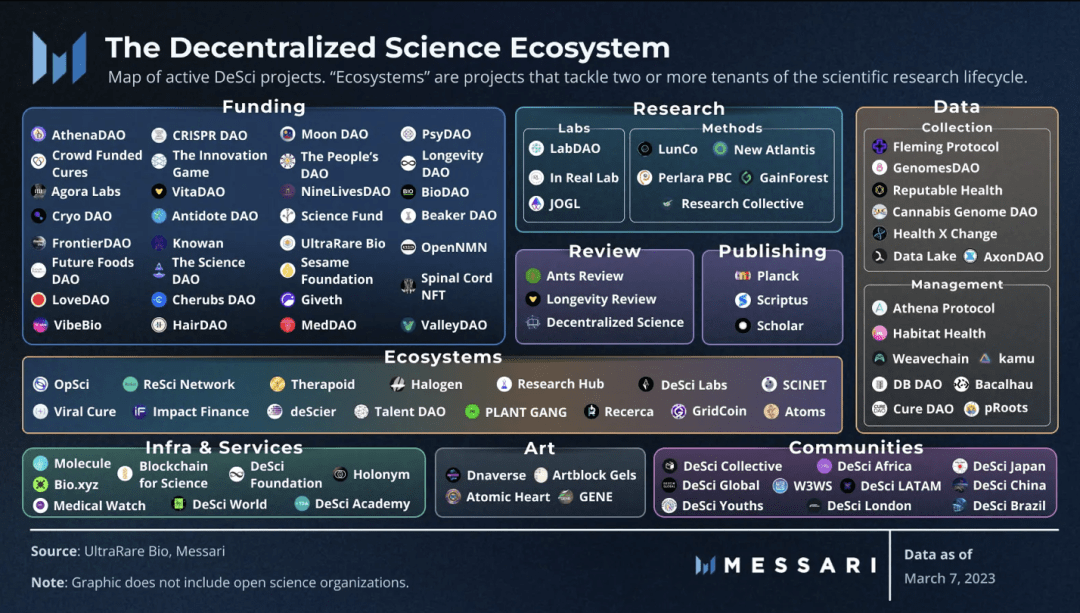
Token-incentivized research ecosystems, such as Brian Armstrong’s research center, address multiple mitigations of the scientific lifecycle. Other DeSci projects are building a core focus area and can be modularly integrated with other projects in the stack.
Whether modular or single, each DeSci project seeks to contribute to scientific progress by democratizing funding, increasing methodological and data transparency, incentivizing review, and promoting open access to scientific knowledge.
funds
DeSci funds research primarily through DAOs that facilitate community-based decision-making. Many DAOs have specific focus areas, such as VitaDAO funding longevity research and FrontierDAO focusing on space exploration. Others, like LoveDAO and VibeBio, plan to fund a range of medical solutions identified by their communities. Putting funding decisions in the hands of the community can promote the development of tailored and targeted solutions that are often overlooked in traditional, profit-driven environments.
Coordination Mechanism and Value Accumulation
Funding DAOs usually revolve around governance tokens or NFTs to raise funds and vote on research initiatives. They can also receive funding and donations from outside sources, such as Gitcoin, which held the latest DeSci funding round from July to September 2022.
To sustain their operations, DAOs could monetize the intellectual property (IP) generated by the research they fund.
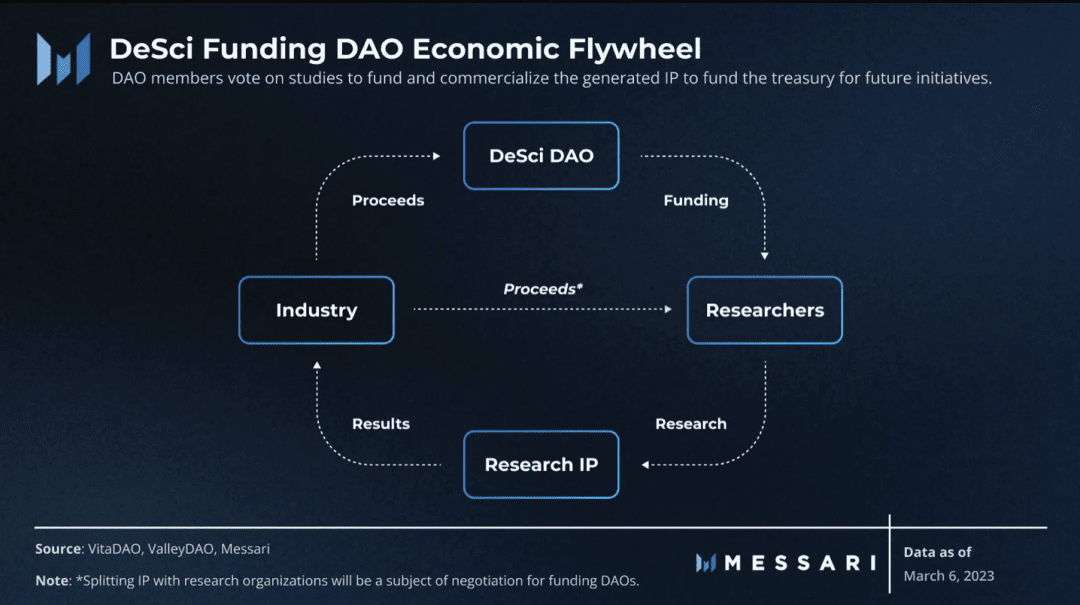
IP-NFTs were first proposed by Molecule in August 2021 to legally protect the IP generated by research. They are a unique alternative to traditional patents, which are used to hoard and restrict data and limit the rate of scientific discovery. IP-NFTs allow DAOs to monetize their work in a variety of ways:
Licensing IP for commercialization by other entities
Split ownership with a partner
Trade data on an open market and maintain royalties for creators
Held as collateral for borrowing
IP-NFTs also allow for new research coordination mechanisms, such as access controls for verified participants to contribute to research and receive compensation. Over time, the boundaries of many funding DAOs may blur, and their communities may fully evolve to address other parts of the research economy.
Transparent research methods and datasets
DeSci can shed light on how research is structured and conducted. To this point, many funding DAOs utilize external entities such as contract research organizations (CROs) to fulfill research queries, although there are a number of emerging DeSci-focused research organizations. For example, members of LabDAO can start and join research projects and share services and tools, while In Real Lab (IRL) is a molecular biology collaboration space focused on DeSci.
Coordination Mechanism and Value Accumulation
IP-NFTs are an example of how contributors can discover and participate in research projects funded by DAOs. The Molecule marketplace matches projects with potential investors, and the results can be added as IP-NFT metadata.
OpSci is taking a different approach by tokenizing the identities, credentials, and projects of independent researchers or groups as Impact Certificate NFTs.
Impact Certificates will be paired with other protocols such as Holonym for decentralized identity and credential verification, and primitives such as Hypercerts for tracking research methods and progress. Hypercerts are ERC-1155 tokens that represent research methods, datasets, and achievements. Researchers can attract funding on an open platform by transparently showing details of their work over time. Ownership of transparent datasets is verified on a public ledger and therefore protected.
Incentivizing peer review and open publishing
By now, it’s probably obvious how researchers and project groups, as well as their datasets, methods, and results, can be tokenized. The same is true for manuscripts. In DeSci, the current journal publishing system, where users must pay to upload or access scientific reports, is replaced with a permissionless data layer and marketplace platform fees. Fees are extracted to those who wish to buy or sell ownership of research; thus, researchers can freely display their manuscripts in the same way that NFTs can be freely viewed on marketplaces like OpenSea. The review process is also more flexible, as researchers can take advantage of independent peer review protocols.
Coordination Mechanism and Value Accumulation
Projects like Ants-Review propose an incentivized peer review protocol on Ethereum where community members put a professional paid review board in charge. Researchers pay the protocol to review their research, but payment is only released to reviewers once the community has determined, by vote, that the requirements for a thorough review have been met.
On the publishing side, DeSci Labs’ DeSci Nodes application allows researchers to create and publish FAIR-enabled research artifacts such as manuscripts, code, datasets, videos, etc. on open, decentralized repositories that are interconnected for reproducibility and replicability.
All components of research are citable and credit is accumulated to a point through linked persistent identifiers and a decentralized resolver system. Developers can build applications on top of this open data layer to implement custom coordination and value accumulation mechanisms. These applications can be modularly integrated with other parts of the DeSci stack; for example, using peer review results from Ants-Review and OpSci Impact Certificates to verify identity and work history.
Data, tools and infrastructure
DeSci relies on data, and lots of it. Protocols like Data Lake, CureDAO, and Fleming Protocol allow individuals to monetize their personal health data and medical records for researchers to purchase. Using DB DAO, DAOs can curate the datasets they collect by tokenizing each row in the database as an NFT, and contributors receive query fees when their data is accessed.
Further down the research lifecycle, DeSci NFTs (IP-NFTs, Impact Certificates, Hypercerts, Research Objects, etc.) are stored in decentralized solutions including IPFS and Arweave. Projects like Bacalhau allow users to execute computational jobs directly where datasets are stored (Compute Over Data). Each job outputs a unique content identifier (CID) on IPFS, which creates provable links between datasets, supporting reproducibility. Bacalhau also helps streamline the workflow for researchers, as it is often impractical to download large datasets locally.
Finally, DAO tooling services, such as those provided by bio.xyz, a launchpad spun out of Molecule, helped DeSci DAO get off the ground. The launchpad has provided initial support and grant funding to various biotech-funded DAOs, including VitaDAO, PsyDAO, HairDAO, and ValleyDAO, among others.
Challenges and risks
DeSci is a nascent ecosystem that is not yet battle-tested. Most DeSci projects (78%) were started in the past year and a half, starting at the peak of the last bull run in Q4 2021. The surge in project launches coincided with the first DeSci track held at the Ethereum conference during LisCon in October 2021.
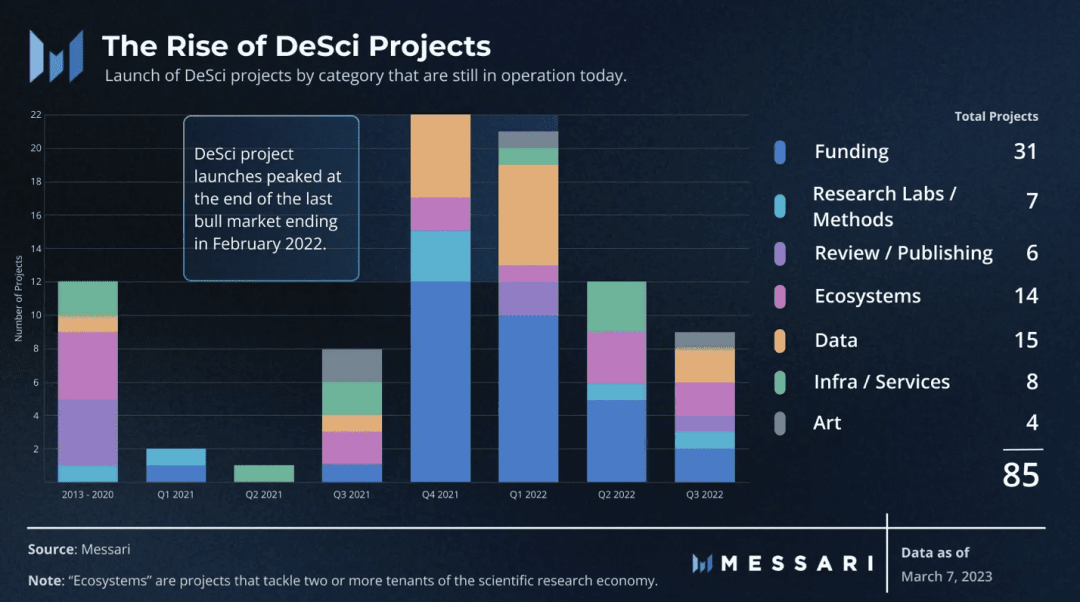
Most protocols have not yet been fully launched on mainnet. There are various emerging DeSci ecosystem designs, and it remains to be seen which projects will successfully capture value and sustain operations. Future challenges include:
Intellectual Property: Conducting research does not necessarily guarantee useful results. IP-NFT communities may not be able to monetize IP, impacting their bottom line. Additionally, if working with a research institution, negotiating IP may require a significant effort through funding DAOs, as traditional institutions are accustomed to receiving the majority of IP produced by researchers at their organization.
Verifiability: Decentralized identity and data verification protocols are in their infancy. Until they mature, there is a risk that researchers will misrepresent their credentials to attract funding and potentially promote illicit results.
Reproducibility: Open and verifiable methods and datasets may lead to better reproducibility, but replication studies are not yet incentivized. Projects such as Scholar and DeSci Labs are in the early stages of building protocols to incentivize replication studies.
Regulatory Compliance: Storing data on decentralized networks like IPFS or Arweave may not be considered compliant with GDPR or HIPAA. Projects will need to work with regulators to establish the legality around DeSci practices.
Addressing these challenges will be important to bring legitimacy to the DeSci economy and further attract funding, application development, and research participation.
Summarize
DeSci is a massive undertaking, and most projects are still in their early stages. However, there are many untapped opportunities for individuals to benefit from contributing to public goods. Communities can fund the research that matters most to them, scientists can more easily monetize their workflows, and the entire system can become more powerful by adopting open and verifiable data practices by default. Transparent datasets and methods improve reproducibility. In turn, scientific discoveries could become more frequent and fruitful, benefiting all participants in the DeSci economy.