


A week-long simulation competition involving four trading bots on Polymarket, each with a capital of $500, revealed the brutal survival rules of prediction markets. The 'reverse strategy' bot (which bets against the market consensus after it reaches over 80%) won with $1,740, while the theoretically smartest 'arbitrage strategy' bot only perished with $82.
The experimental conclusion points directly to the essence of the market: "The smartest strategies die the fastest because the market adapts to them; the most boring strategies live the longest because they only act when certain."
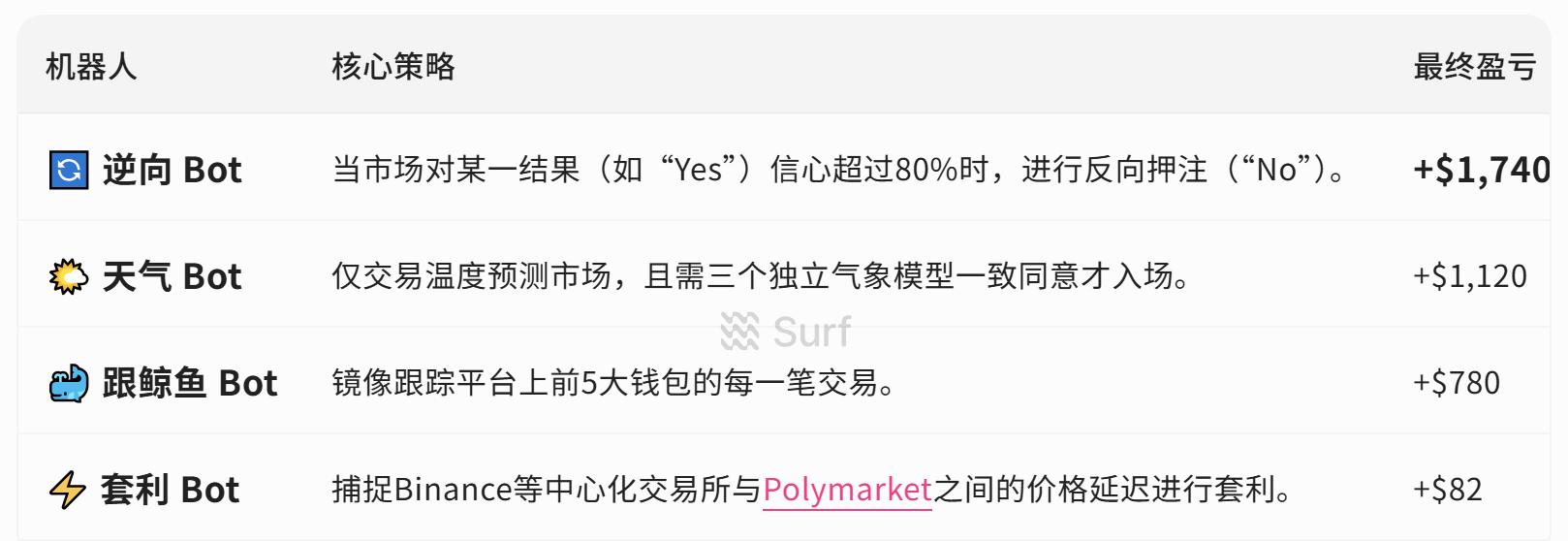
Although this experiment is a strategic simulation story, the three major rules it reveals—'Yes Bias' (the market overestimates positive outcomes), the rapid degradation of arbitrage margins, and the long-term advantages of deterministic games—are fully corroborated by real on-chain data from Polymarket. Currently, about 37% of the trading volume on the platform is generated by Bot addresses, which account for only 3.7%, while the arbitrage opportunity window has shrunk from 12.3 seconds in 2024 to 2.7 seconds, with 73% of profits being seized by high-frequency scripts. For ordinary participants, understanding and leveraging the structural biases of the market is far more important than chasing instantaneous technical advantages.
Key event timeline:
Day 1: The arbitrage Bot quickly profited $180 due to its technical advantage, while other Bots broke even.
Day 3: The reverse Bot discovered a huge pricing deviation in the sports market, making a single profit of $740 and jumping to first place.
Day 4: The arbitrage Bot's profit 'edge' begins to vanish, with capital retracting from $500 to $310.
Day 5: The weather Bot, which had been silent for four days, made its first move, with two trades yielding a total profit of $420.
Day 7: The arbitrage Bot strategy completely failed, ending with $82.
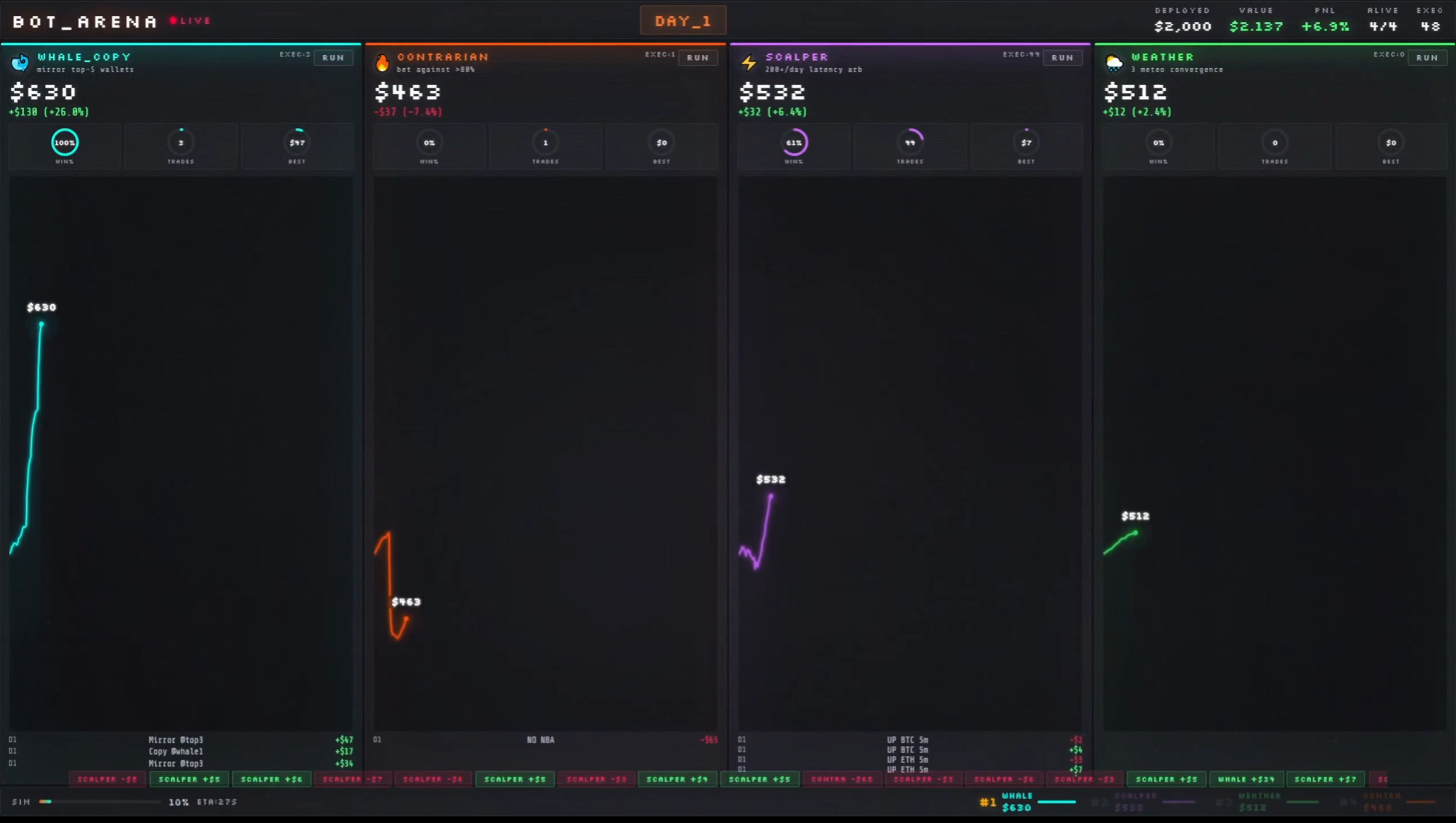
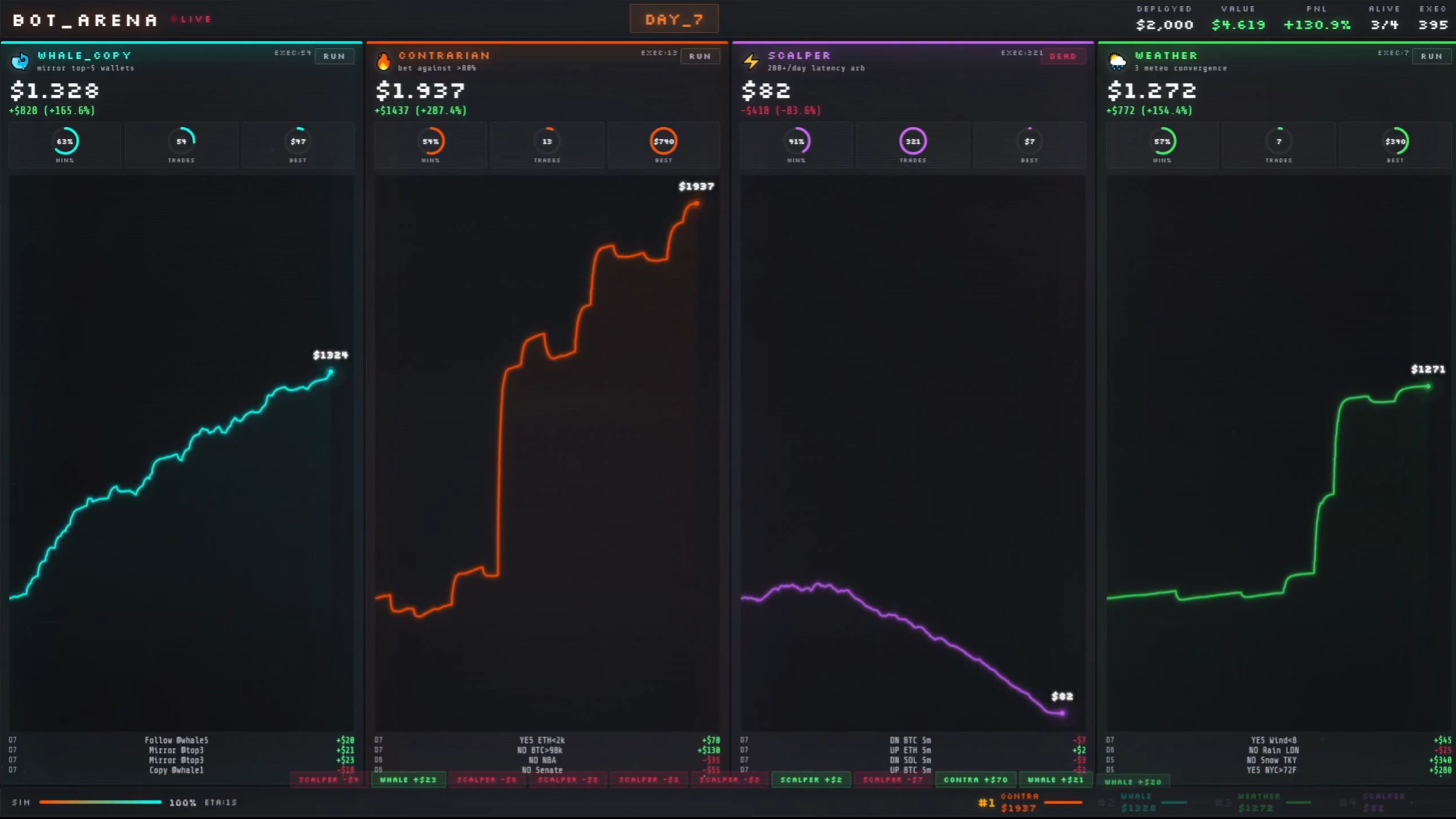
The initiator of the experiment: 'The dumbest robot won. It just waits for everyone to make mistakes, and then enters once.' Meanwhile, 'the smartest (arbitrage robot) dies first because its advantage is temporary.'
2. Strategic Deep Deconstruction: Profit Logic and Fatal Flaws
1. Reverse strategy: leveraging the market's 'optimistic bias' (Yes Bias)
Core idea: do not predict the event itself, but rather predict the errors in 'market consensus.' When the vast majority is extremely optimistic about a particular outcome, its price often already includes an unreasonable optimistic premium.
Research shows that prediction markets (especially for sports and political events) generally have a tendency to overestimate the probability of positive outcomes ('Yes'). Many events on Polymarket exhibit time decay characteristics— as the deadline approaches, the occurrence of 'No' greatly increases in probability, but market sentiment still lags behind.
Reverse Bots discovered pricing deviations in the sports market and achieved great success by capturing this mismatch between sentiment and reality.
2. Weather Strategies: Extreme Certainty and High Barriers
Core idea: Narrow the circle of competence to a domain that can be objectively and quantifiably verified (temperature), and set extremely strict entry conditions (all three models must agree).
Advantages: completely avoid subjective judgment, rely on scientific models, and have a high win rate. The high profits in the experiment confirmed the power of the 'high certainty + high odds' combination.
Limitations: opportunity windows are extremely rare (the experiment was silent for 4 days), which is a significant test of patience for strategy executors.
3. Follow the whale strategy: hitchhiking and signal decay
Core idea: Acknowledge your own information disadvantages and instead track those 'smart money' addresses that may have information or analytical advantages.
A large number of addresses on Polymarket are Bots, and simply tracking trading volume or frequency can easily fall into the 'algorithm meat grinder.' What is truly worth tracking are those human traders who focus on specific fields, have long-term stable records, and holding times exceeding 1 hour.
Experiment limitations: the experiment simplified the setting of 'top 5 wallets,' while in reality, complex filtering is needed to find the true Alpha.
4. Arbitrage strategy: the transience of technical advantages
Core idea: utilize transient price inconsistencies between different markets for risk-free arbitrage.
According to the latest analysis of Polymarket in 2026, simple price gap arbitrage opportunities average only 2.7 seconds (12.3 seconds in 2024), and 73% of such profits are captured by sub-second high-frequency trading scripts.
The root cause of failure: the strategy logic is public and transparent, making it easy to replicate. Once more capital adopts the same strategy, the arbitrage space is quickly squeezed to a point where it cannot cover trading costs (Gas fees). This is the fundamental reason why arbitrage Bots in the experiment went from leading to collapsing and eventually disappearing.
3. Real Market Data Validates Experimental Conclusions
1. Bot-dominated liquidity: the macro background of the experiment
Polymarket is not a purely 'person-to-person' gaming arena. Dune data shows that Bots, which account for only 3.7% of the total addresses, contribute nearly 37.44% of the total trading volume on the platform. The behavioral patterns of these Bots are highly specific: some conduct tens of thousands of trades in a very limited number of markets (market makers), while others engage in very few trades across hundreds of markets (snipers), which is markedly different from the behavior of human traders.
The market share of trading Bots on Polymarket is dynamically changing, indicating fierce competition and frequent changes in leadership.
2. Empirical evidence of 'deterministic' strategies: the victory of automated market makers (AMM)
Once simple arbitrage fails, successful Bots turn to more robust strategies. For example, automated market maker (AMM) strategies earn the bid-ask spread by placing orders on both sides of the market's 'Yes' and 'No,' without predicting the final direction.
Profit logic: earning money comes from providing liquidity and volatility, rather than directional bets.
Real performance: although such strategies lack stories of windfall profits, their win rates can reach 78-85%, achieving stable monthly returns of 1-3%. This is precisely the reflection of the 'boring but lasting' strategies advocated in the experiment in reality.
3. The Evolution of Infrastructure Bots: From Trading Tools to Social Gateways
In the experiment, the Bot is a pure strategy executor, while mainstream Bots in reality, such as okbet and polycule, have evolved into comprehensive trading infrastructures on Telegram.
Core function: provide mobile trading, social following, group broadcasting, wallet management, and other features.
Strategic significance: they lower the barriers to user participation and gamify trading with social elements. This suggests that in prediction markets, community and user experience may have a stronger moat than a single trading strategy.
4. Practical insights for participants in prediction markets
Based on cross-validation of experiments and real data, we draw the following actionable insights:
Beware of the temptation of 'Yes', and make good use of 'time' friends: for events with a clear deadline, if there are still no signs of occurrence as the deadline approaches, the value of 'No' will naturally increase over time. Market sentiment often lags behind the clock.
Give up on chasing 'second-level' arbitrage: unless you have top-notch technical infrastructure and capital scale, simple cross-market price gap arbitrage has become a red ocean, even a 'dead sea.'
Find and stick to your own 'weather market': that is, find the extremely niche area where you have an information advantage or analytical advantage. It could be a niche sport, the dynamics of a specific technology company, or objective events that can be verified by quantifiable models. Depth is superior to breadth.
Following requires penetrating the 'Bot fog': if choosing to follow a strategy, advanced filtering tools must be used. Core indicators should include: focused fields, long-term win rates (not single-instance windfalls), holding times (greater than 1 hour is preferable), and moderate trading frequency. Avoid those 'all-rounder' addresses that frequently trade in hundreds of markets, as they are likely Bots.
Understand platform risks: The 'off-chain matching + on-chain settlement' architecture of Polymarket has theoretical attack vectors (such as 'ghost transaction' attacks) that could lead to sudden price discrepancies. While this is a risk, it could also provide unconventional opportunities for alert participants.

The battle experiment of four Bots is a clever thought experiment in strategy. With an extremely simple narrative, it reveals the ancient truth in financial markets, especially in prediction markets where information games are intense: overly optimized complex strategies, due to their advantages, are easily identified and replicated, resulting in short lifespans; while 'simple' strategies based on a deep understanding of structural market biases (such as Yes Bias), focusing on high certainty domains, and having strong discipline, possess greater anti-fragility and long-term viability.
The real data from Polymarket provides a solid footnote to this story. Here, the survivors are not the fastest hunters but the most patient predators, as well as strategists who are adept at treating market sentiment itself as prey. For participants, what matters is not becoming the smartest Bot but understanding how Bots think and finding that 'deterministic edge' that the market can never fully adapt to.