

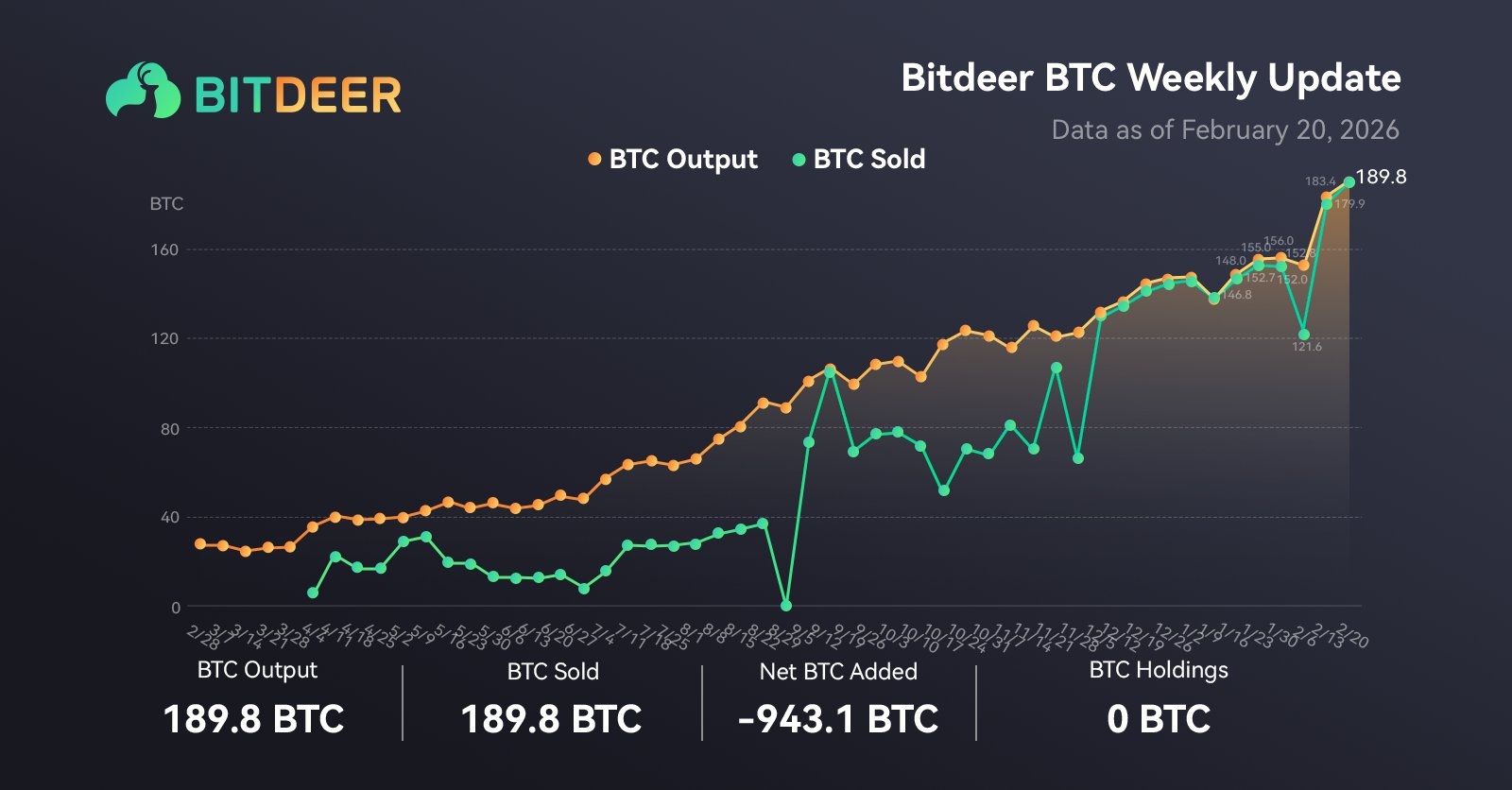
On February 23, 2026, explosive news ❤️ Wu Jihan's US-listed mining company Bit Deer announced it has completely cleared all Bitcoin, reducing its Bitcoin balance to 0 and fully entering a mining and selling mode. Generally, it is understandable for miners to sell some Bitcoin to pay electricity bills, but a complete liquidation is quite rare. Moreover, Bit Deer, as a listed company, is not short on cash, with a current market value of $1.8 billion. This complete liquidation behavior is somewhat undesirable.
A review of Wu Jihan's history of clearing Bitcoin:
2017: Individuals + companies sold all BTC (estimated tens of thousands to over 100,000 coins, price ≈ $3,800-$4,000), all in on BCH, betting on faith to replace BTC with BCH.
Result: BCH failed, forked and internal strife occurred, the company faced a crisis, and he faded out of Bitmain.
February 2026 (Bitdeer): Cleared all BTC holdings to 0 (sold 943.1 reserves + 189.8 mined this week, all sold, BTC ≈ $68,000). Jihan Wu X responded: "Currently holding 0 ≠ will always be like this. Thank you for your attention."
——————

### A Historical Review of Wu Jihan and BCH
Jihan Wu is the co-founder of Bitmain, a Chinese Bitcoin mining machine giant. He is a key figure in the cryptocurrency industry, particularly in the Bitcoin scalability debate. The following is a historical overview, focusing on his relationship with Bitcoin Cash (BCH), and the background and reasons for the failure of the BCH fork. I will organize it chronologically for easier understanding.
#### 1. **Early Background: Bitcoin Scalability Debate and the Birth of BCH (2013-2017)**
**Jihan Wu's Rise:** In 2013, Jihan Wu co-founded Bitmain with Micree Zhan. The company quickly became the world's largest manufacturer of Bitcoin mining machines, controlling a significant portion of the Bitcoin network's hashrate (mining power). Wu is a proponent of the "large block" approach to Bitcoin, arguing that the 1MB block size limit causes transaction congestion and high fees, necessitating larger blocks to increase capacity and realize Bitcoin's vision as "peer-to-peer electronic cash" (as described in Satoshi Nakamoto's white paper).
- **Bitcoin Community Split:** From 2015 to 2017, the Bitcoin community engaged in heated debates surrounding the issue of "scaling." The "small block" faction (such as Bitcoin Core developers) worried that larger blocks would increase the risk of centralization, while the "large block" faction (such as Jihan Wu and Roger Ver) promoted solutions such as Bitcoin Unlimited (BU) or Bitcoin XT.
**The Birth of the BCH Fork:** On August 1, 2017, following the failure of the New York Consensus (SegWit2x), Jihan Wu's faction forked Bitcoin Cash (BCH) from the Bitcoin mainnet. BCH increased the block size from 1MB to 8MB (and later further), aiming to reduce fees and improve transaction speed. Jihan Wu and Bitmain personally sold off a large amount of BTC (estimated to be tens of thousands to 100,000 coins, at a price of approximately $3,800-$4,000 at the time), going all-in on BCH. He publicly stated that BCH was the "real Bitcoin," with the goal of replacing BTC.
**Initial Success**: BCH quickly gained support after its launch, with its price surging to over 20% of BTC's, attracting some miners and users. Bitmain provided significant hash power support through its mining pools, such as Antpool.
#### 2. **BCH Internal Conflicts and the 2018 Fork (2017-2018)**
- **Internal Community Disagreements:** Disagreements quickly emerged within the BCH community. Major factions included:
- **BCH ABC Faction**: Led by Jihan Wu, Roger Ver, and developer Amaury Séchet, it supports incremental upgrades, including the introduction of technologies such as Canonical Transaction Ordering (CTOR) and Avalanche consensus, while keeping the block size at 32MB.
- **BCH SV Faction** (Satoshi's Vision): Led by Craig Wright (CSW), who claims to be Satoshi Nakamoto, and billionaire Calvin Ayre, it promotes extremely large blocks (above 128MB), emphasizes a return to the "original Bitcoin white paper," and opposes the "complex" changes of ABC.
**Fork Event:** On November 15, 2018, BCH underwent a hard fork upgrade, but due to the inability of the two factions to compromise, the chain split into BCH ABC and BCH SV. This was known as the "Hash War," in which both sides mobilized computing power through mining pools to "attack" each other's chains in an attempt to render the other chain invalid.
- Jihan Wu mobilized Bitmain's computing power to support ABC and temporarily borrowed miners from the BTC network, causing a brief drop in the BTC hash rate.
- Result: The ABC faction won the majority of computing power and exchange support, becoming the mainstream BCH (later simply called BCH). SV existed independently, but its market capitalization and influence were far lower than BCH.
#### 3. **Why did the fork fail? (Analysis of main reasons)**
**Community Splits and Internal Strife:** The fork stemmed from ideological conflicts among developers, miners, and investors. Jihan Wu's ABC faction emphasized practicality, while CSW's SV faction was more radical, leading to fragmentation of the BCH community. The internal strife consumed vast resources, with miners suffering huge losses (estimated at hundreds of millions of dollars) in the hash war, and community trust collapsing.
**Market Impact and Price Crash:** Before the fork, BCH was priced at around $500. Following the fork, market panic ensued, and both BCH and BSV prices plummeted (BCH briefly fell to $75). Exchanges suspended BCH trading, leading to a liquidity crunch and dragging down the entire crypto market (exacerbating the 2018 bear market). BCH failed to replace BTC; instead, its market capitalization dropped from over 10% of BTC's to less than 1%.
**Technical and Adoption Issues:** While larger blocks increased capacity, they also increased node operating costs, leading to greater centralization (mining pool dominance). BCH failed to attract mainstream adoption, with users and developers still preferring BTC's network effects and security. Subsequent forks (such as BCH Node vs. BCH ABC in 2020) further fragmented the community.
**Jihan Wu's Personal Impact:** Following the fork, internal conflicts within Bitmain intensified (a power struggle between Jihan Wu and Micree Zhan), leading to a decline in the company's market capitalization. He subsequently left Bitmain in 2021. Wu's all-in strategy was considered a high-risk gamble; while it boosted BCH in the short term, it failed to deliver on its long-term vision. After 2021, he founded Matrixport and Bitdeer, continuing his involvement in mining. However, as the post states, Bitdeer emptied its BTC reserves in 2026, sparking controversy.
#### 4. **Subsequent Developments and Lessons Learned (2019-2026)**
**Current Status of BCH:** BCH still exists, but its market capitalization is far lower than BTC (approximately 0.5% of BTC's in 2026). It focuses on low-fee payments (such as for use in some developing countries) but has not achieved its goal of replacing BTC. Subsequent minor forks have occurred, but their impact has been limited.
- **Jihan Wu's Role**: From "King of Bitcoin" to fading from the core, his influence has diminished. The Blocksize Wars are considered a turning point in his career, the lesson being the importance of community consensus.
**Overall Lesson:** The BCH fork highlights the challenges of cryptocurrency governance—hard forks tend to lead to division rather than unity. In contrast, BTC has maintained stability through soft forks (such as SegWit).
From the candlestick chart, BCH is on the eve of a surge! You should buy more! BTC, on the other hand, is currently stagnant!