



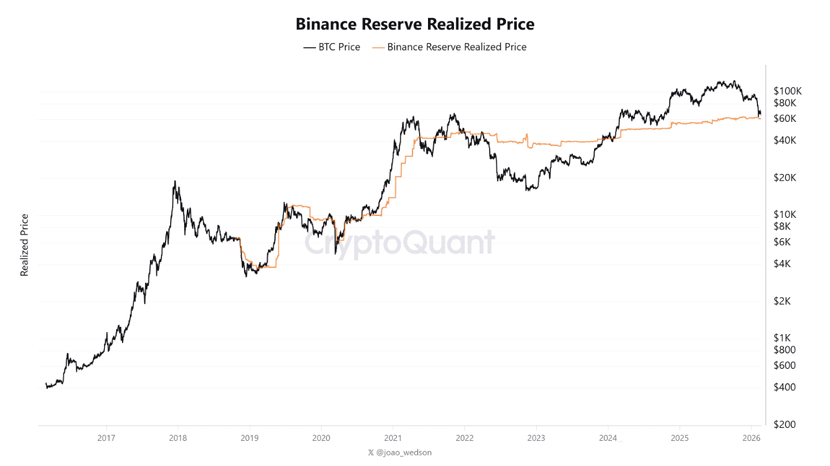
Bitcoin is currently trading near $67,000, while the Binance Reserve Realized Price sits around $61,006.
That places spot price roughly 11% above the average cost basis of the coins held in Binance reserves.
This spread matters.
What the Binance Reserve Realized Price Represents
This metric reflects the average realized acquisition cost of BTC held within Binance’s exchange reserves.
In practical terms:
• If price trades above this level → reserves are in aggregate unrealized profit
• If price trades below it → reserves enter unrealized loss territory
It acts as a structural profitability line for exchange-held supply.
Why Staying Above It Is Constructive
When price remains above the realized reserve cost:
• Forced selling pressure decreases
• Panic-driven distribution is less likely
• Holders are not structurally underwater
• Market psychology remains more stable
Historically, prolonged trading above realized cost bases tends to align with:
• Stable consolidation phases
• Gradual accumulation
• Early recovery environments
Breakdowns below cost basis, on the other hand, often trigger fragility — because losses compress confidence.
The Structural Evolution of the Metric
Over time, the realized reserve price trends upward.
That reflects:
• Coins changing hands at higher prices
• Old low-cost supply being redistributed
• Market cost basis structurally rising
This gradual elevation is typical of expansionary cycles.
It signals capital rotation at higher valuation levels.
The Current Buffer Zone
With BTC trading about $6,900 above the reserve realized price:
• There is a margin of safety
• Structural support remains intact
• Supply-side stress is limited
As long as price holds above ~$61K, the broader exchange-level structure remains constructive.
The Risk Trigger
If price decisively breaks below that cost basis:
• A portion of exchange reserves would enter loss
• Sell-side pressure could increase
• Sentiment may deteriorate quickly
• Demand must step in to prevent acceleration
That level becomes critical.
Bottom Line
Right now, the market is not in structural distress.
Exchange-held supply remains in profit.
Cost basis is rising gradually.
Supportive conditions persist.
The key line isn’t just a price level — it’s the profitability threshold around $61,000.
Above it, structure holds.
Below it, pressure builds.
