

The story of dollar hegemony used to be found in SWIFT messages, oil contracts, and the tracks of warships. Today, it has gained an additional track: a string of code that flows on the blockchain 24/7.
The U.S. dollar, as the global reserve currency, has always relied on existing settlement networks, oil pricing, and military political deterrence. Stablecoins have not invented a new currency; they have merely transformed dollar-denominated debt into digital certificates that flow on-chain 24 hours a day. Cash and the numbers in bank accounts have become on-chain assets that anyone can hold and transfer—thus, for the first time, the dollar has achieved nearly borderless circulation without going through traditional commercial banks or adhering to sovereign boundaries. Rather than saying that hegemony has been weakened, it is more accurate to say that an additional track has been created for the dollar, completing a digital upgrade.

The pre-stablecoin era: liquidity islands and 'patchwork' innovation
Stablecoins are not the result of top-down design, but rather a product forced out by early exchanges under pressure from both banks and regulators.
Around 2014, exchanges faced structural dilemmas: users needed stable pricing and hedging against volatility, but banks generally refused to handle crypto business, and fiat channels could be cut off at any time. Corporate accounts were hard to open, and funds had to rely on gray third parties or offshore channels. Bitfinex and its affiliate iFinex were under pressure from both regulators and banks. After Wells Fargo and other agents cut ties with Bitfinex and its Taiwanese partner bank in 2017, the market fell into a fiat liquidity crisis—this was also the year when stablecoins transformed from 'optional' to 'essential', with USDT's market cap surpassing $1 billion and expanding to nearly $100 billion thereafter.
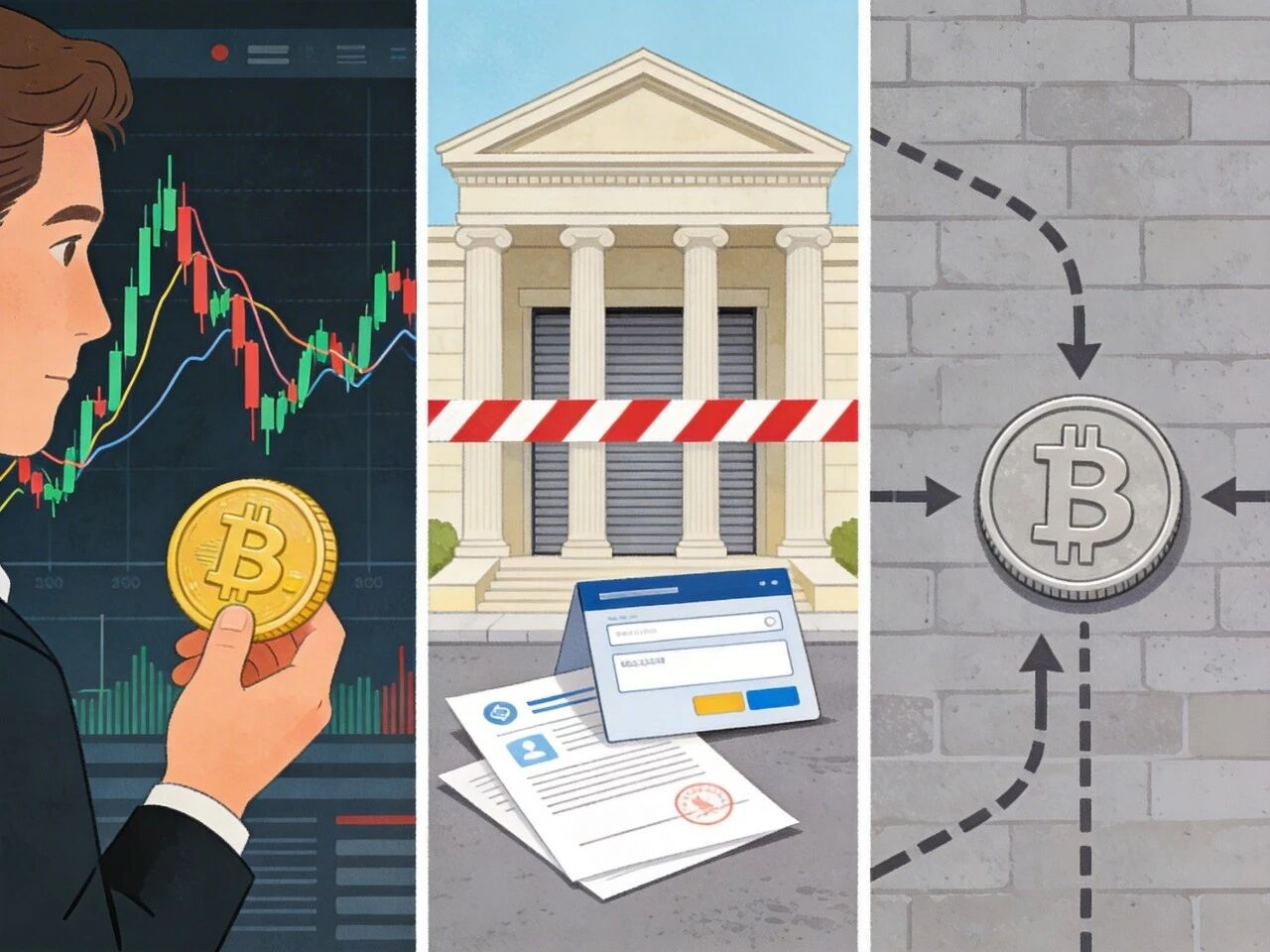
The technological groundwork was laid earlier. In 2012, J.R. Willett's Mastercoin white paper first proposed building a secondary protocol on top of the Bitcoin protocol to issue new assets; in 2014, Brock Pierce, Reeve Collins, and Craig Sellars released Realcoin on the Omni Layer (a second-layer protocol based on the Bitcoin network), which was later renamed Tether (USDT). In 2015, Bitfinex launched USDT, solving the platform's dependency on fiat channels; by 2017, BTC/USDT had replaced BTC/USD as the mainstream trading pair, with exchanges like Binance and OKEx following suit.
The design of USDT is straightforward: an institution issues it, backed 1:1 by dollars, and freely circulates on-chain. Trust entirely depends on whether users believe Tether holds an equivalent amount of dollars in the bank and has redemption capability. In the early days, there was neither transparent reporting nor independent audits, but the market voted with its feet, establishing USDT as the settlement unit in the crypto world. Essentially, it combines a centralized institution with decentralized technology: on-chain responsible for verifiable issuance and circulation, while trust still rests with the issuer; reserves and transparency have long been contentious, and there are arbitrage opportunities in regulation, but the market values usability and liquidity over perfect compliance. Technologically, stablecoins bypass the delays of 'each transaction being cleared by commercial banks', shortening settlements that require several days across banks and countries to just a few minutes of block confirmation.
The evolution of underlying credit: from company promises to U.S. Treasury bonds
After scaling from millions to hundreds of billions, relying solely on 'corporate promises' can no longer withstand scrutiny from regulators and the market. Reserves gradually shifted from high-risk commercial paper and bank deposits to high-quality liquid assets (HQLA) like U.S. Treasury bonds; the risk profile of stablecoins consequently changed, becoming deeply tied to the U.S. sovereign debt market.
Tether and Circle chose two different paths. By the third quarter of 2025, short-term U.S. Treasury bonds accounted for 65.7% of Tether's reserves, with total exposures around $112.4 billion; reverse repos about 12%, money market funds about 4.5%, gold and bitcoin about 9%, with the rest in secured loans—these last two are market watchpoints. Circle's USDC is more conservative: most reserves are placed in the Circle Reserve Fund (USDXX), a SEC-regulated 2a-7 money market fund; directly holding bonds about 30.8%, with approximately 69.2% being reverse repos and similar through that fund.
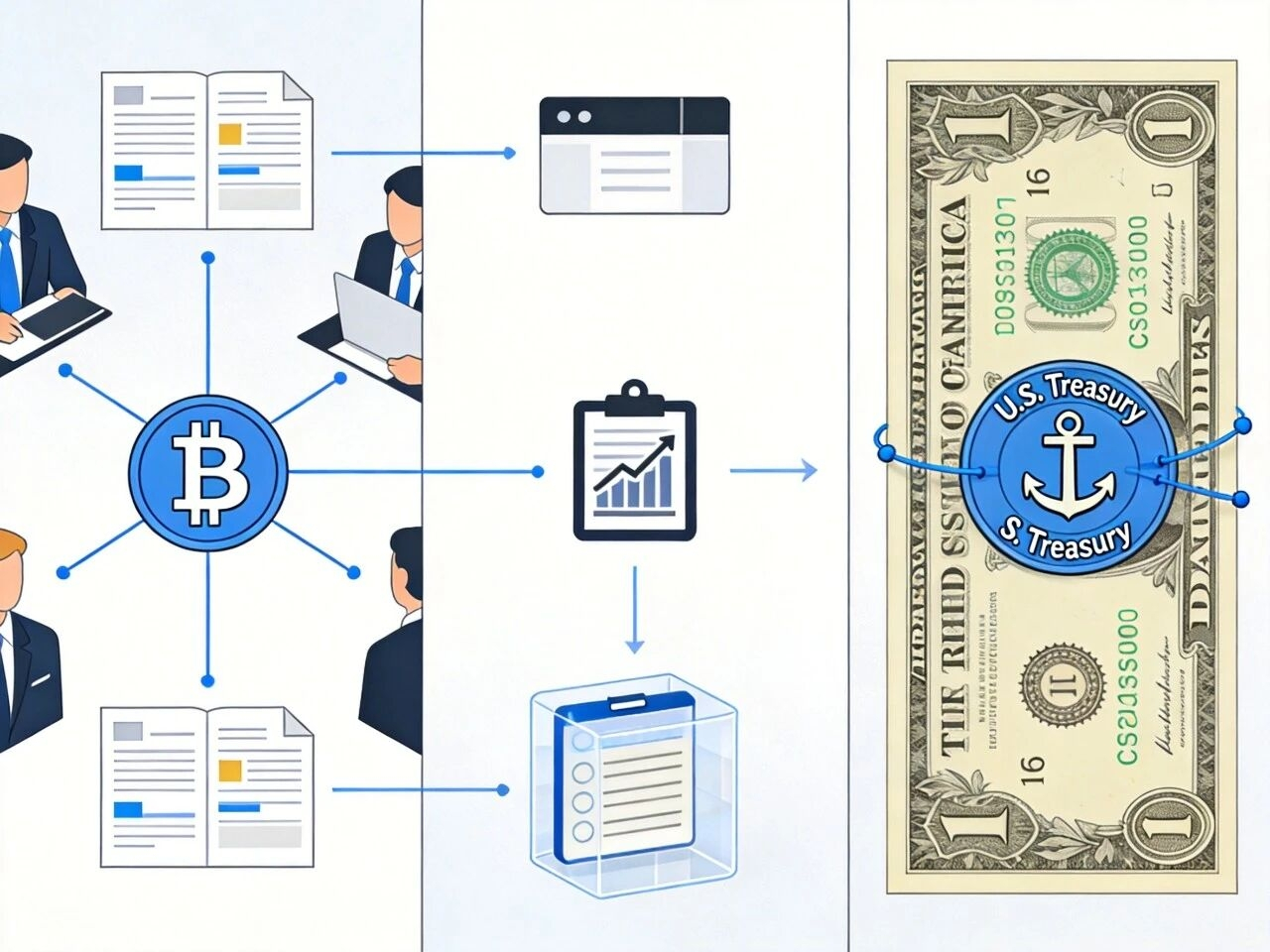
Macroeconomically manifested as two effects. First, crowdfunding-style debt buying: both the BIS and the Brookings Institution have pointed out that the top ten stablecoin issuers hold more U.S. Treasury bonds than sovereign holdings from Germany, the UAE, and others; retail investors' USDT/USDC are converted into Treasury bonds by issuers, which means the U.S. government indirectly obtains retail funds that are otherwise hard to reach through the digital channel of stablecoins to support the deficit. Second, suppression of short-term interest rates: to meet the demand for instant redemption, issuers hold a large amount of T-Bills with maturities of 93 days or less, and concentrated buying at certain times can lower short-term interest rates; the BIS estimates that for every additional $3.5 billion of stablecoins entering the system, the yield on 3-month Treasury bonds will drop by about 2.5–3.5 basis points, and during tight supply periods, such as the debt ceiling, the effect can be amplified to 5–8 basis points. Thus, the 'credit' of stablecoins has shifted from a company's promise to U.S. Treasury bonds and the U.S. dollar clearing system.
Defining the legal frontier: 2025 GENIUS and MiCA
2025 marks the year when stablecoins transition from 'wilderness' to 'legality'. The U.S. and EU have successively passed legislation to bring the digital dollar track under long-arm jurisdiction.
On July 18, 2025, the U.S. signed (to guide and establish the National Innovation American Stablecoin Act) (GENIUS Act). The tone is to legalize and dollarize it, rather than eliminate it. Only 'licensed payment stablecoin issuers' (PPSIs) are allowed to operate in the U.S., and issuers must be a subsidiary of a deposit institution, a federally qualified issuer, or a state-regulated qualified issuer; reserves must be 100% cash or high-liquid assets, and algorithmic stablecoins cannot be used as payment instruments. Bankruptcy isolation is written into law: holders have priority over underlying assets in case of issuer bankruptcy, and assets do not count as bankruptcy property. Payment stablecoins are explicitly defined as neither securities nor commodities, removing compliance barriers for bank access.
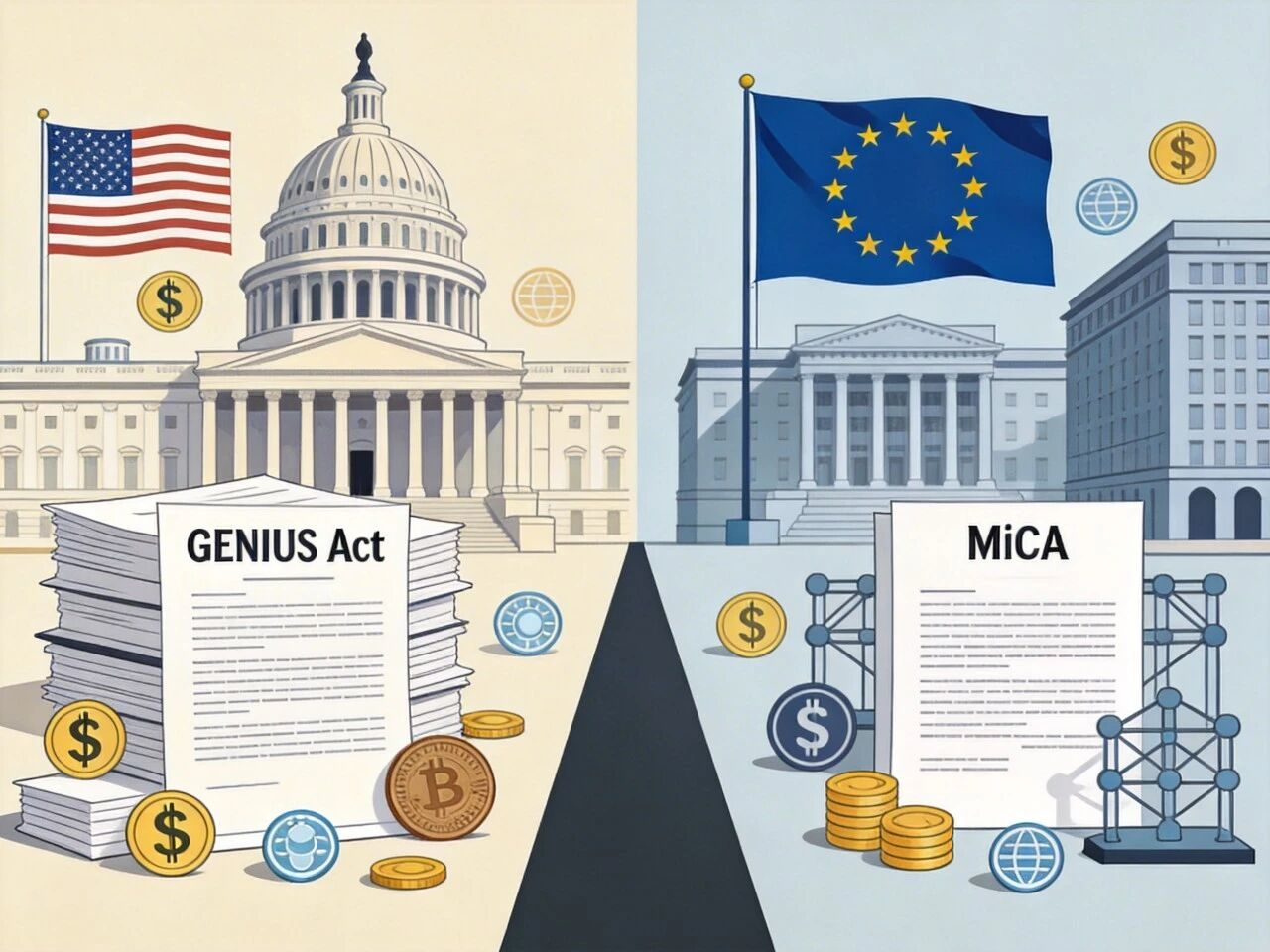
The EU's MiCA is more protective of local interests: selling stablecoins in the EU requires an EU electronic money institution license, with at least 1/3 of reserves needing to be bank deposits, which differs from the broad definition in the U.S. that includes cash, Treasury bonds, and repos. In early 2025, as Tether had not yet obtained MiCA approval, Coinbase, Crypto.com, and others were forced to limit USDT transactions for European users; Circle quickly seized the European market with its French EMI license, making its euro stablecoin EURC the compliant choice. MiCA also stipulates that non-euro stablecoins cannot exceed a daily trading volume of 200 million euros, resulting in a regulatory race where U.S. dollar stablecoins are 'incorporated' in the U.S. but 'restricted' in Europe, redrawing geopolitical boundaries atop the code.
Revolution of payment tracks: stablecoins vs SWIFT
Traditionally, SWIFT only transmits information on 'who pays whom, how much', with actual cash clearing through CHIPS, Fedwire, and central banks, taking hours or even days. Stablecoins combine information and settlement into one step, enabling 'instant settlement' on-chain: once transferred, it is considered settled without waiting for the bank to reconcile.
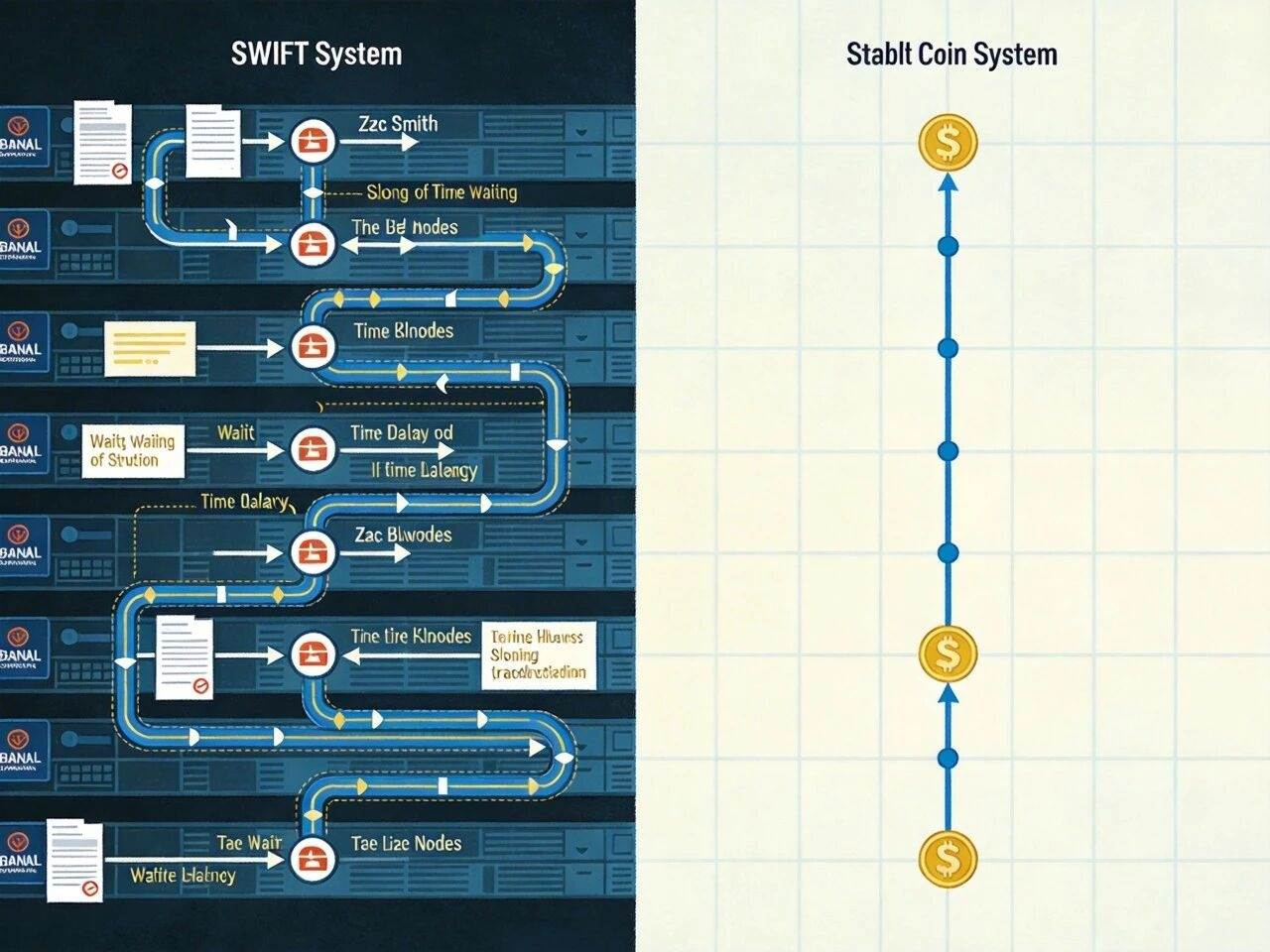
In 2025, Visa integrated USDC into core settlement flows in the U.S., allowing merchants to accept payments via Solana or Ethereum L2 without waiting for banks overnight. By the end of the year, its annual stablecoin settlement volume had exceeded $3.5 billion. The benefits extend beyond speed: operating 24 hours a day, unrestricted by bank hours; minute-level settlements mean that institutions do not need to maintain large pre-funding positions to cope with settlement delays, thus freeing up operating capital. Compared to SWIFT GPI, which averages 30 minutes to 24 hours with fees of $20–100 (including transit) and exchange rate spreads of 0.5%–5%; stablecoins on this path (Solana/L2) can achieve settlements in 15 seconds to 5 minutes, with network fees mostly under $0.1 and near real-time exchange rates, while also supporting smart contract escrow and conditional payments. This is akin to laying down a high-speed clearing layer under U.S. law, operating by private companies beside SWIFT. Once this track is laid out, the volume also increases: between 2024 and 2025, the total market value of global stablecoins is projected to be around $150–160 billion, surpassing that of many countries' M2, with USDT, USDC, and other dollar stablecoins accounting for the vast majority, making on-chain dollars comparable in scale to sovereign currency supply.
Geopolitical effects: Who is using this track?
The most concentrated usage occurs in regions where local currencies fail and capital controls are strict—there, stablecoins become the de facto 'shadow dollar'.
Argentina: Stablecoins have transformed from speculative tools to daily infrastructure. The local 'crypto dollar' exchange rate has become a 24/7 economic sentiment barometer; the gap between the official and black market exchange rates allows households to convert pesos into USDT or USDC through platforms like Binance and Belo to hedge against over 100% annual inflation. In Venezuela, under the dual pressures of sanctions and hyperinflation, bank cross-border remittances are nearly paralyzed; a 2025 report from TRM Labs states that stablecoin usage in Venezuela has grown by about 63% over the past two years, with relatives abroad sending survival funds back home via mobile and P2P, forming a closed loop. Turkey has moved from using stablecoins as payment tools to trade settlement: the lira dropped about 10% within hours in 2024–2025, leading many small and medium enterprises to use stablecoins for international trade; one case showed that local software outsourcing paid global contractors in USDT via TransFi, saving about 5 working days compared to traditional SWIFT, with single transaction losses reduced by about 3%; by mid-2025, Turkey's cryptocurrency receipt volume ranked first in the region, with annual transaction volume approaching $200 billion.
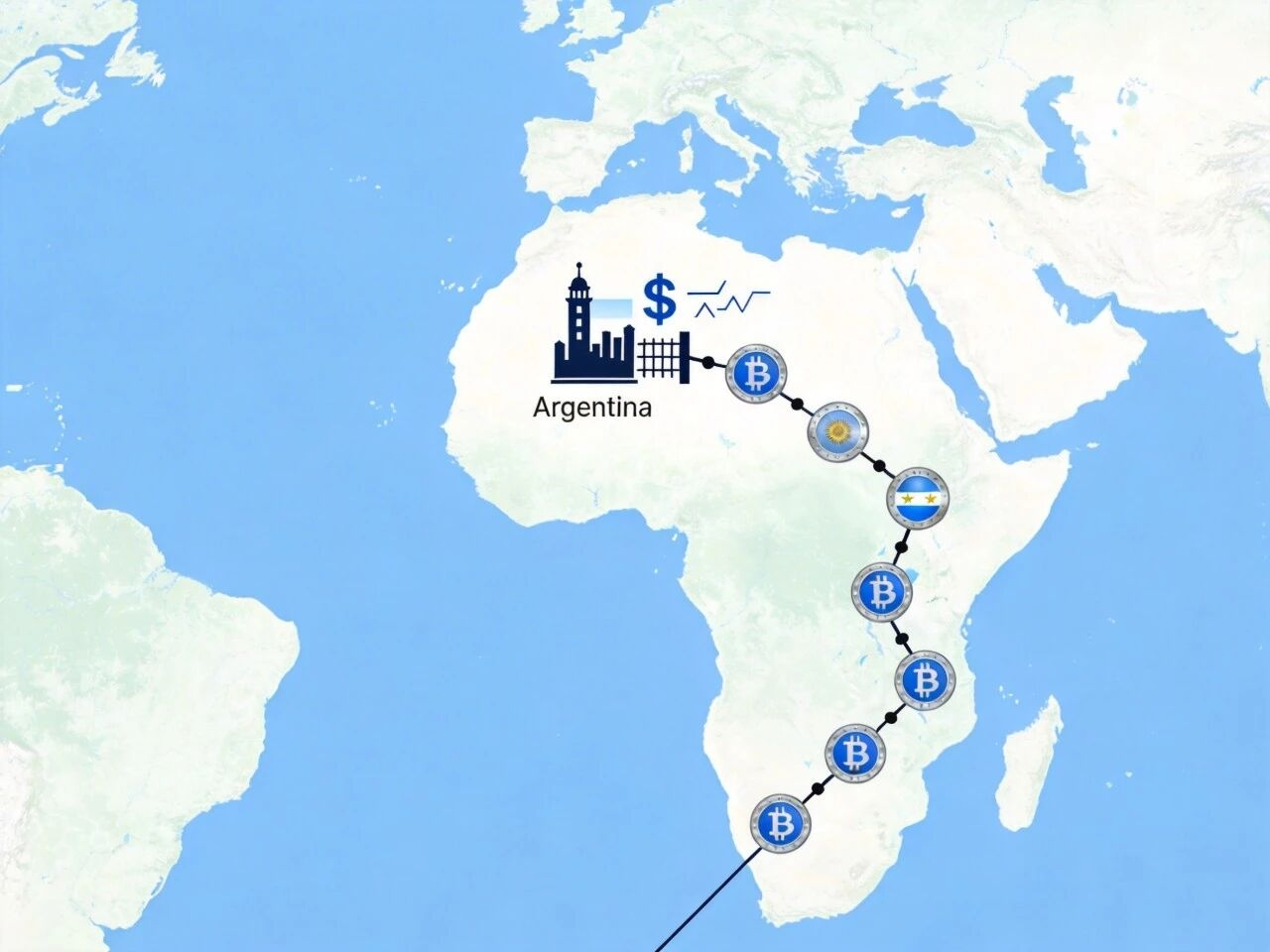
The threshold is lower than opening an offshore account (just a mobile phone and a wallet are enough), and regulatory loopholes are larger than traditional currency exchange, enabling cross-border transactions in minutes. For local central banks, the local currency is being replaced, monetary policy is discounted, capital outflows are digitalized, making regulation more difficult—Chainalysis and TRM Labs' tracking in Latin America and the Middle East are confirming this. For the dollar, both the application scenarios and penetration depth are increasing, reinforcing rather than undermining its hegemony.
Systemic risks: bank runs, offshore issues, and algorithmic stablecoins
Stablecoins push the dollar further while also bringing in new vulnerabilities.
A bank run is the first layer of risk. Although GENIUS requires 1:1 reserves, large-scale redemptions still resemble shadow banking: issuers are forced to sell hundreds of billions of short-term Treasury bonds in the secondary market, creating a fire sale effect—selling pressure drives up short-term yields, thereby increasing the cost of dollar borrowing. The Brookings Institution has pointed out that if the decoupling exceeds 3% in a single day, it could trigger a chain reaction. The second layer is regulatory arbitrage brought about by borders: issuers can register in jurisdictions with lax regulations, with Tether long registered in the British Virgin Islands and not undergoing a full audit; if offshore, non-PPSI stablecoins continue to dominate, their circulation could completely bypass compliance gateways, diminishing the effectiveness of U.S. Treasury sanctions. The third layer is algorithmic stablecoins: following the collapse of Terra/Luna in 2022, they could no longer serve as legal payment instruments under GENIUS, but Ethena's USDe and others relying on basis strategies still reached over $13 billion in scale by 2025, unconstrained by traditional reserve frameworks, potentially becoming new sources of risk under systemic pressure.

This digital dollar track enhances efficiency while prompting all parties to reassess regulation and financial stability.
Conclusion: From patchwork to behemoth, the digital reorganization of dollar hegemony
The growth of stablecoins was initially due to exchanges lacking a 'stable pricing unit', and later because the market collectively chose 'on-chain dollars'. In 2014, it was merely a stopgap measure in response to disruptions in banking channels, but by 2026, it had become a financial infrastructure with an annual trading volume of $33 trillion, comparable to sovereign nations in terms of debt holdings. This is not a deviation from the dollar system, but rather a gradual incorporation into the existing system due to efficiency and accessibility.
Bringing the dollar onto the chain, the U.S. effectively adds a new layer beyond the existing clearing networks, oil pricing, and military deterrents: credit sinking (retail investors indirectly hold Treasury bonds through stablecoins, making the dollar a de facto base currency in high-inflation regions), track conversion (forming a high-speed clearing network regulated by U.S. law and operated by private entities beyond SWIFT), and programming power (the flow of dollars can be written into code and smart contracts, allowing for more granular regulation and anti-money laundering). This history of stablecoins marks the transformation of the dollar from 'a number on a bank's ledger' to 'code in an agreement'—the underlying credit remains unchanged, but the medium has changed, making it easier to spread and harder for a single sovereignty to completely sever.
Therefore, understanding stablecoins cannot be seen merely as adding another type of asset. It is an upgraded version of dollar hegemony: the dominant player remains unchanged, just with an additional track. After the beginning of digitization, code and law, algorithms and reserves, sovereignty and markets will become increasingly intertwined, leading to a global financial order that is flatter, more efficient, and also more complex.