AI will abandon Earth: Elon Musk plans to take data centers into space
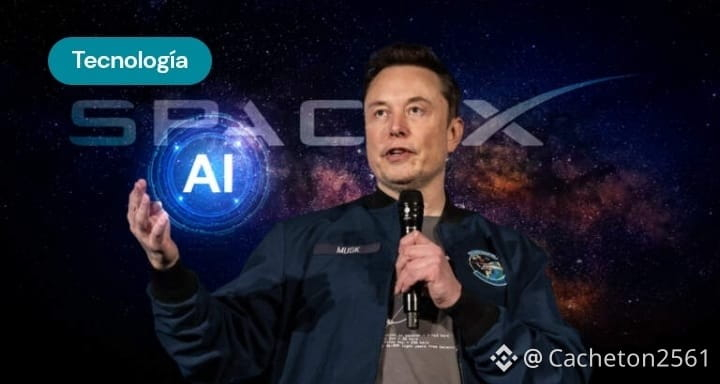
Elon Musk has set a new challenge for artificial intelligence (AI): to take it into space. To achieve this, the world's richest entrepreneur aims to move data centers out of Earth's orbit.
This was expressed by the tycoon on the podcast Cheeky Pint, hosted by Dwarkesh Patel, where he stated that he aims to send at least one terawatt of GPU (Graphics Processing Unit) into space within a period of less than three years.
The reason behind this, the tycoon claimed, lies in energy availability, as the conditions of space create a perfect environment for uninterrupted solar energy due to the absence of the day-night cycle and other earthly limitations like the atmosphere.
"The atmosphere alone produces an energy loss of approximately 30%,"
commented Musk on the podcast.
These advantages, combined with the fact that batteries would not be necessary, could make data centers more profitable and efficient than any existing on the planet. Additionally, according to the owner of xAI, it would also be an alternative to meet the growing demand for processing power in the sector.
The attractive solution has already begun to face some challenges and questions, such as the difficulty of maintaining data centers in case of a failure, although the entrepreneur has assured that this would not represent a real problem if next-generation chips are installed.
Under this science fiction scenario, he has already begun the procedures to materialize his idea by requesting permission from the Federal Communications Commission (FCC) and consolidating the acquisition of xAI by SpaceX, merging two of the tycoon's most ambitious projects.
$XRP
$DOGE
$SOL
Elon Musk has set a new challenge for artificial intelligence (AI): to take it into space. To achieve this, the world's richest entrepreneur aims to move data centers out of Earth's orbit.
This was expressed by the tycoon on the podcast Cheeky Pint, hosted by Dwarkesh Patel, where he stated that he aims to send at least one terawatt of GPU (Graphics Processing Unit) into space within a period of less than three years.
The reason behind this, the tycoon claimed, lies in energy availability, as the conditions of space create a perfect environment for uninterrupted solar energy due to the absence of the day-night cycle and other earthly limitations like the atmosphere.
"The atmosphere alone produces an energy loss of approximately 30%,"
commented Musk on the podcast.
These advantages, combined with the fact that batteries would not be necessary, could make data centers more profitable and efficient than any existing on the planet. Additionally, according to the owner of xAI, it would also be an alternative to meet the growing demand for processing power in the sector.
The attractive solution has already begun to face some challenges and questions, such as the difficulty of maintaining data centers in case of a failure, although the entrepreneur has assured that this would not represent a real problem if next-generation chips are installed.
Under this science fiction scenario, he has already begun the procedures to materialize his idea by requesting permission from the Federal Communications Commission (FCC) and consolidating the acquisition of xAI by SpaceX, merging two of the tycoon's most ambitious projects.
$XRP
$DOGE
$SOL