


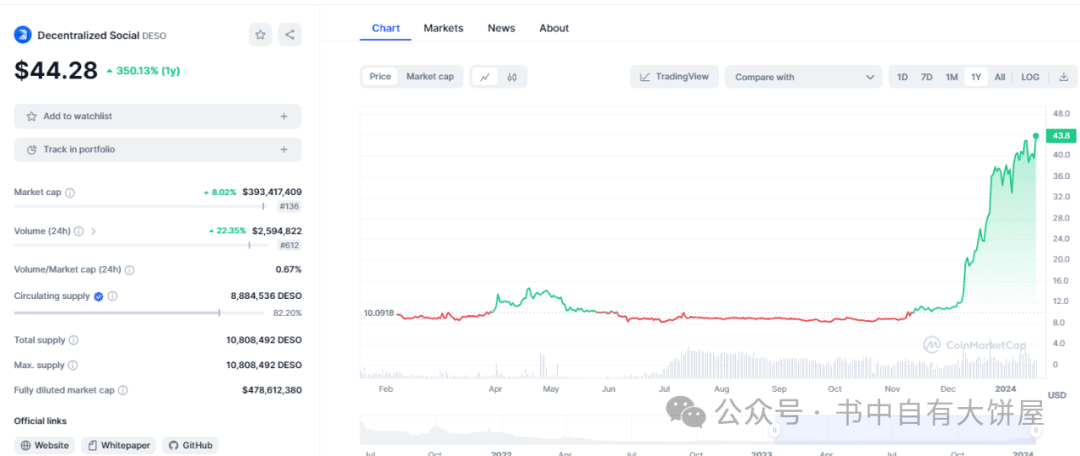
Today we continue to talk about projects. Today we are talking about the socialFi project. This project has been started since 21 years. The currency price has performed well recently, and it has increased fivefold in the past two months. It is Decentralized Social, and the token name is Deso. SocialFi has also talked about cyber, friendtech, etc. before. This project has built a public chain dedicated to web3 social networking, specifically to solve some problems in the blockchain in social scenarios. The current market value has reached 390 million US dollars, and the ranking has entered 130+. Let’s analyze it.
Introduction
DeSo is a new type of social network that has built a custom blockchain from scratch where users can leverage their influence and content monetization mechanisms. Its architecture is similar to Bitcoin, but with a larger scale and throughput, and can better support complex social media data, such as posts, user profiles, fans, speculative predictions, and other functions. And like Bitcoin, DeSo is a completely open source project, with no company behind it, only tokens and code.
Launched in March 2021 as BitClout and renamed Deso, DeSo continues to advance its unique layer 1 chain designed specifically for social applications. The chain was previously a hybrid proof-of-work chain based on the Bitcoin algorithm. In the first half of 2023, DeSo will undergo a hard fork to migrate the network to a proof-of-stake design.
In order to customize the chain for social applications, DeSo abandons the general chain and instead defines core transaction patterns specific to social applications. Standard social activities such as posts and profile updates and NFT transaction types are defined at the network level. In addition, DeSo defines financial transactions that support standard token exchanges, as well as DeSo's creator tokens and a social tipping feature called Diamonds.
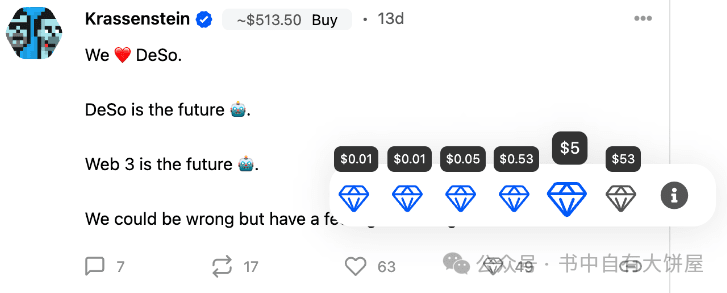
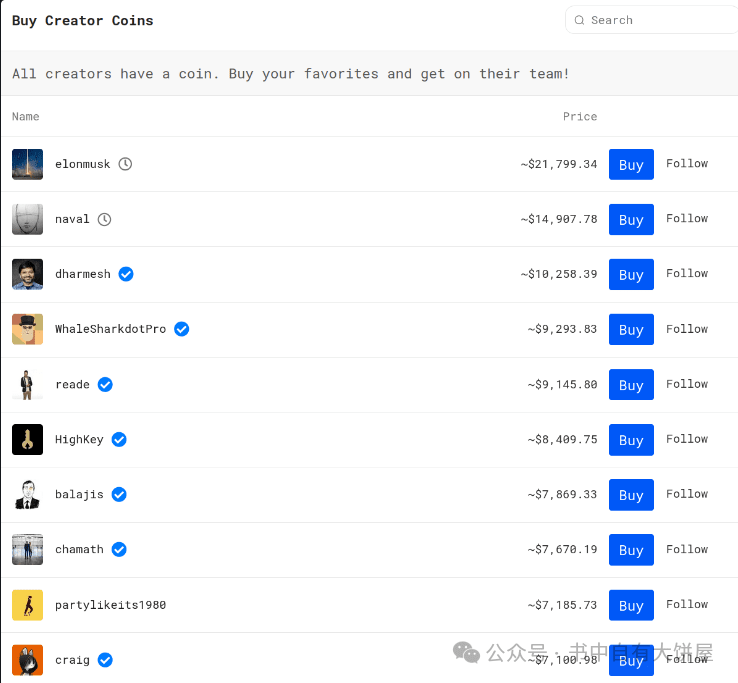
Diamonds act as a tipping mechanism for content creators. For every diamond tip (similar to a like) a user receives, the more DeSo tokens they earn. Creator coins are automatically assigned to accounts and can be purchased in exchange for DESO tokens. Hypothetically, as an account becomes popular, people will want to hold (buy) this creator's coins, causing the price to increase for existing holders.
Each profile on DeSo has its own token that anyone can buy and sell. These tokens are called “creator coins” and just by creating a profile you can own your own token. When people buy, the price of each token goes up, and when people sell, the price goes down. It’s a bit similar to the model of Friend.tech.
All content in DeSo is stored on-chain, with the exception of raw images and videos, which are stored on centralized providers like Google Cloud or decentralized providers like IPFS. By this design, the state of the chain is constantly growing, limiting its long-term decentralization potential.
Ultimate Vision
Today, a post submitted to Instagram, TikTok, or Twitter belongs to those companies, not the creator who posted it. Therefore, the profits mainly go to these companies.
Instead, DeSo stores all its data on a public blockchain, which means anyone in the world can run a node that exposes their own curated feed. So DeSo wants to develop a social app with the data to build a billion users.
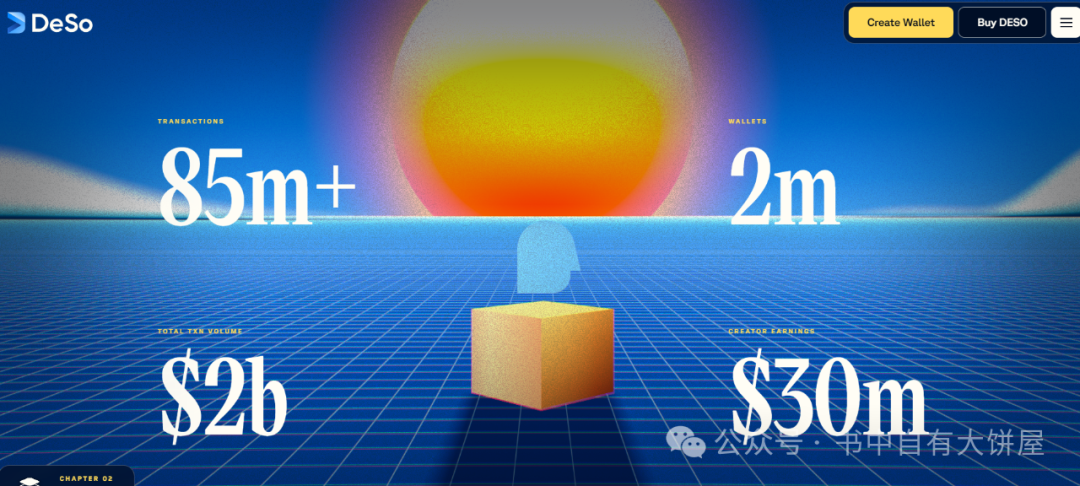
Today, there are also over 100 projects running nodes and building applications on DeSo.
Imagine if ESPN ran a node to curate the best sports content. Or if Politico ran a node to curate the best political content.
Furthermore, since DeSo is completely open source, these players can even customize their UI and build custom algorithms to rank and post influencers in a way that serves specific target audiences.
This will quickly move us from a world where a few giants control the dominant feed, to a world where consumers have thousands of feeds to choose from, each with their own specific focus. Anyone running a node to curate their own feed can contribute data back to the public pool, including profiles, posts, followings, and more.
Existing publishers can easily integrate social apps and experiences into their core businesses, allowing new entrants to innovate on a relatively equal footing with larger companies for the first time.
Current web3 Social applications need to face the following problems:
1. Performance bottleneck: As we know, the concurrency of social applications is very large, with millions of people commenting or posting every second. Although traditional general blockchains (Ethereum, Solana, Polygon, etc.) can scale to tens of thousands of "transactions per second", scaling "posts per second" is a very different problem. Moreover, even for a million-level user query, it is an impossible task on the chain.
2. Storage problem: Social apps have a large number of pictures, texts, and videos, which require a lot of storage, and the capacity of each block is very limited. The current blockchain size is generally several megabytes, while BTC is only 1M in size. At current prices, even if a link to Arweave or Filecoin is stored on any of the above chains, the cost is between $0.10 and $1.00, which is too expensive.
3. The problem of too high gas: If all content is on the chain, then if users need gas even to leave comments, users will definitely be lost.
4. Content review and audit: Because the content is published on the chain, there is no centralized review agency in a decentralized manner, so some content must comply with the laws and regulations of certain countries.
Then let's see how Deso solves these problems:
Advantages of Deso
1. A blockchain network specially customized for social networking:
Because general-purpose blockchains usually do not support ordered lists, this is not possible without building an off-chain index.
In contrast, DeSo natively supports indexes such as posts sorted by timestamp, profiles sorted by token value, NFT bids organized by associated NFTs, and many more, all of which can scale as the user base grows.
This significantly reduces the complexity of running a node, which in turn significantly increases the decentralization of the ecosystem and the number of applications that can be built on top of DeSo.
The DeSo node’s memory pool was also written from scratch to support queries of social data without requiring users to wait for block mining.
This increases the “instantaneity” of DeSo applications, which can make DeSo competitive with traditional centralized social applications.
2. Upgrade route: In order to support 1 billion users, Deso also has the following route planning, the first stage: proof of stake, stage 2: larger blocks, the average post size of the DeSo blockchain is 218 bytes, DESO will increase the block size to 16MB every five minutes, this stage will support 4 million users; the third stage: Warp sync, this stage can make the block size up to 16M, support 30 million users; stage 4: sharding, this stage can support 1 billion users.
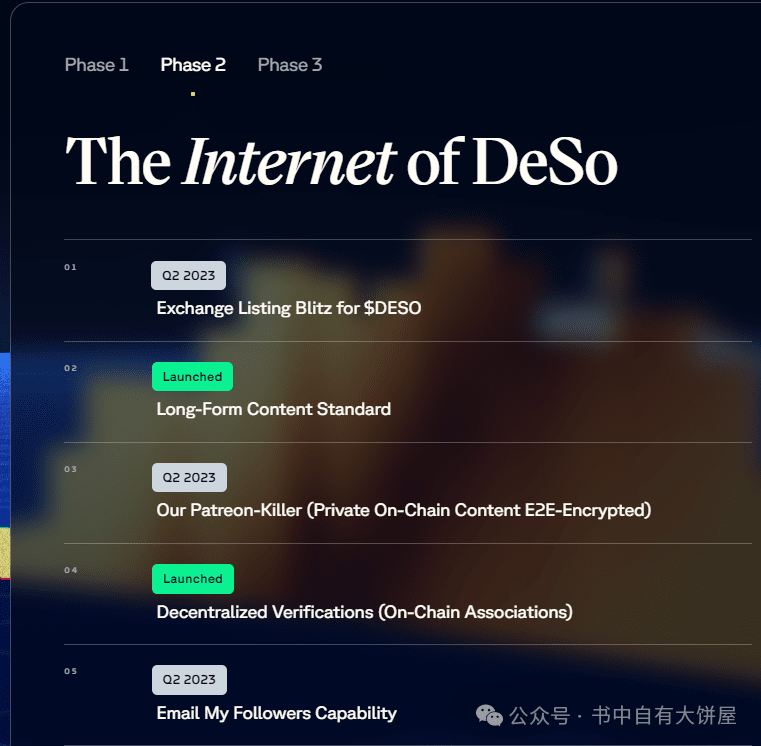
3. Decentralized review: Since the data is open, the best machine learning researchers in the world's best academic institutions can build APIs to distinguish illegal content through data analysis and hide them. Of course, Deso also has its own review procedures.
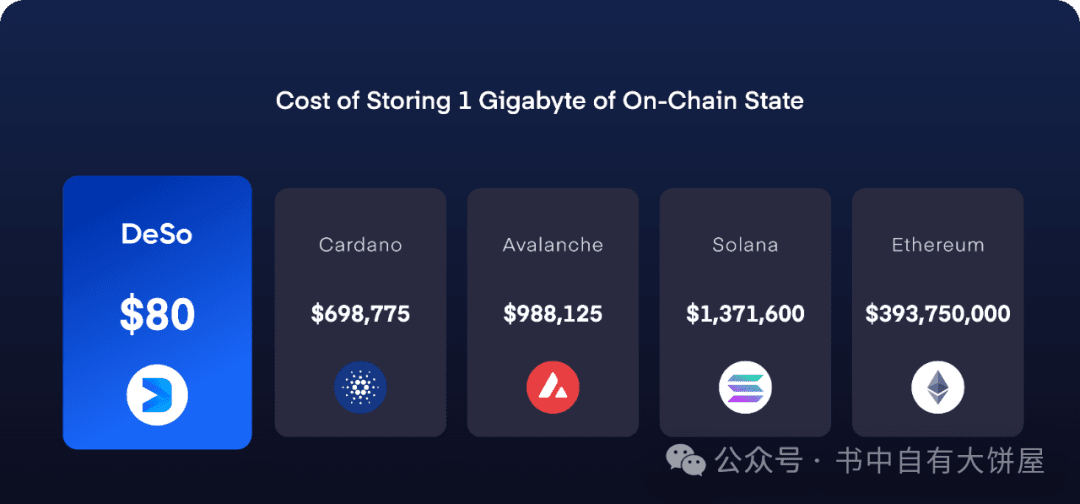
4. Infinite State Storage: DeSo is custom built from the ground up, and all the data it stores and indexes follows a known schema. Different from storing and indexing profiles, different from posts, different from follows, and so on...
This level of customization not only makes storage 10,000 times cheaper than Avalanche or Solana, but also allows all DeSo nodes to instantly query all relevant data.
5. User Security: DeSo desktop applications are all secure sandbox environments that are not easily hacked by third-party attackers. DeSo Identity is located at identity.deso.org and stores your sensitive account information securely in your browser's local storage. To protect private key materials, the identity service has minimal dependencies, strict attribute security policies, and is audited by multiple security companies.
6. Low gas fees: On DeSo, you will never expect to pay more than a fraction of a penny for thousands of on-chain transactions. The average fee per post is < $0.000017, compared to the average fee per post on Ethereum which can be over $50 depending on gas fees.
DeSo Application
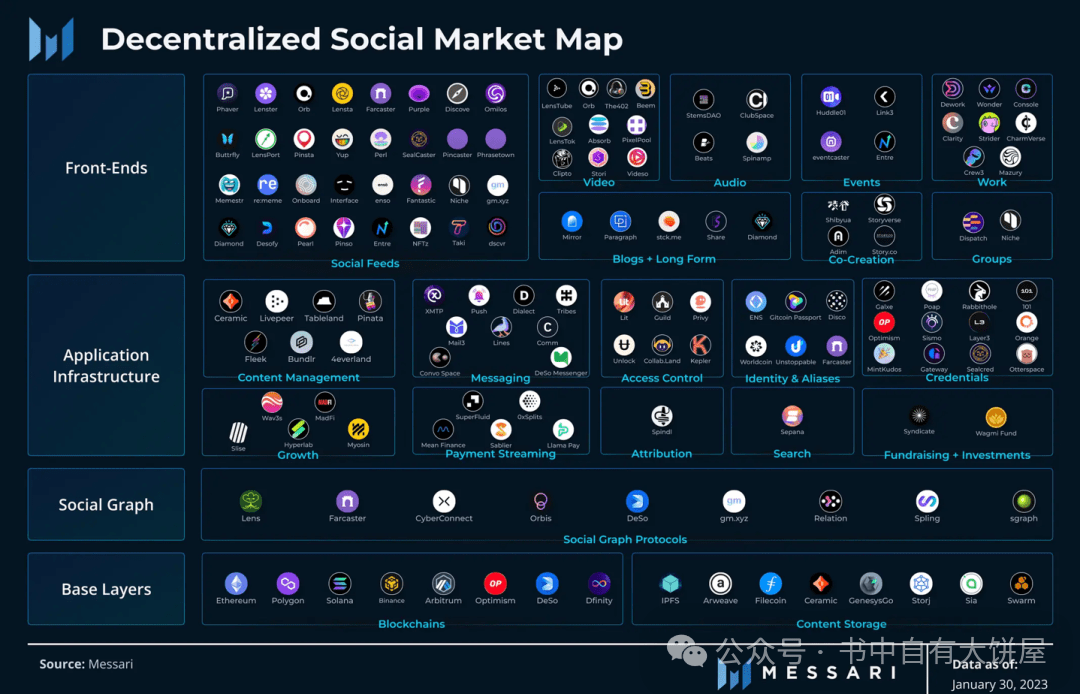
While DeSo has a range of apps, from blogging to fundraising, more than 75% of its web posts come from three social apps:
Desofy – A mobile social media app and the most popular DeSo app in terms of posts. The app is backed by the DeSo Foundation and allows users to earn money through diamond tipping and selling NFTs.
Diamond - A web-based social feed product backed by the DeSo team. Its functionality includes all the monetization aspects of DeSo, enabling users to post short-form and long-form content on the site in addition to images and videos.
DeSocialWorld – A multilingual social feed designed to cater to a global audience. It also showcases most of DeSo’s features, including content and monetization.
Currently, given DeSo’s deterministic design, the feature sets of applications are very similar. However, with the upcoming hard fork, DeSo will introduce access groups to build more customized features.
Financing
DeSo received US$200 million in financing in 2021, with investments from top institutions such as a16z, Sequoia, Coinbase Ventures, and Social Capital, as well as private investment from Alexis Ohanian, co-founder of the famous American social platform Reddit. It can be said that the lineup is luxurious.
project team
The founder of Bitclout announced his true identity to the world - Nader AL-Nail. This computer science genius who graduated from Princeton has worked at quantitative hedge fund DE Shaw and Google. In 2019, he also created the Basis stablecoin company and raised $133 million from investors such as Bain Capital and Andreessen Horowitz, making it onto the 2019 Forbes 30 Under 30 list of crypto entrepreneurs. At the same time, he is also a good friend of Coinlist founder Brian Tubergen.
Token Economy
The total number of tokens is 10,808,492, and the current circulation is 8,884,536, which is 82%. The current token price is around $44. The peak was $800 (2021-12-14). The token distribution has not been found, but it has basically been unlocked. Compared with the peak, it has actually fallen by 95% and has entered a value point.
Finally, let me summarize this project. This project is actually still building a socialFI infrastructure. It has built a public chain, and there are many tools on this chain that can facilitate your development of socialfi applications. It is a different route from the Cyber mentioned earlier. Cyber is more like a protocol or a tool set. You can create applications on different chains. From a fundamental point of view, there is nothing wrong with this project. First, the team has been working hard to solve problems. Second, the investment institutions behind it are quite powerful. There are also many ecological applications, but the homogeneity is quite serious. At present, star-level applications are urgently needed. The SocialFI track may not be able to run out in the next bull market, but the next bull market should be about the same.