



Contents
Introduction
What are support and resistance?
How Traders Can Use Support and Resistance Levels
Psychological support and resistance
Trendline Support and Resistance
Support and resistance of moving averages
Fibonacci support and resistance
What is confluence in technical analysis?
To conclude
Introduction
The concepts of support and resistance are among the most fundamental topics related to technical analysis of financial markets. They can be applied to any financial market, whether stocks, forex, gold or cryptocurrencies.
Although these are simple concepts to understand, they are actually quite difficult to master. Identifying them can be completely subjective, they will perform differently in changing market conditions, and you will need to understand their different types. But first, you'll need to study a lot of charts, and this guide will help you get started.
What are support and resistance?
At the most fundamental level, support and resistance are simple concepts. The price finds a level that it is unable to cross, this level acting as a sort of barrier. In the case of support, the price finds a “floor”, while in the case of resistance, it finds a “ceiling”. Basically, you can think of support as a demand zone and resistance as a supply zone.
While, more traditionally, support and resistance are indicated by lines, real cases are generally not as precise. Keep in mind that markets are not driven by a physical law that prevents them from violating a specific level. This is why it may be more beneficial to view support and resistance as areas. You can think of these areas as ranges on a price chart, likely to spark increased activity from traders.
Let's look at a support level example. Note that the price has continually entered a zone where the asset has been repurchased. A support range has been formed as the area has been tested several times. And as the bears were unable to push the price down, it eventually rebounded, potentially starting a new trend.
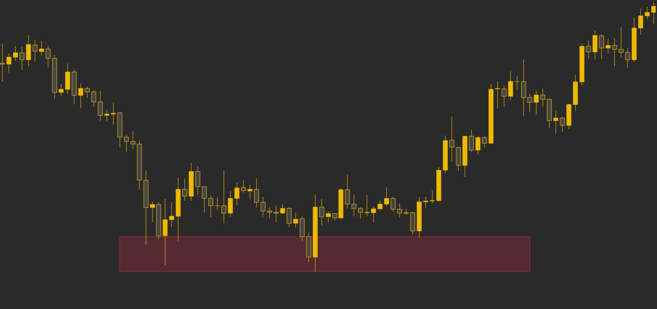
Price rebound in a support area before a breakout.
Now let's look at a resistance level. As we can see, the price was in a downtrend. But after each bounce, he failed to clear the same area multiple times. The resistance level is formed because the bulls (buyers) were unable to take control of the market and increase the price, causing the downtrend to continue.

The price fails to break through a resistance zone.
How Traders Can Use Support and Resistance Levels
Technical analysts use support and resistance levels to identify areas of interest on a price chart. These are levels where the likelihood of a reversal or break in the underlying trend may be higher.
Market psychology plays an important role in the formation of support and resistance levels. Traders and investors will remember price levels that sparked increased interest and trading activity. Since many traders may be looking at the same levels, these zones can bring increased liquidity. This often makes support and resistance areas ideal for large traders (or whales) to enter or exit positions.
Support and resistance are key concepts when it comes to exercising good risk management. The ability to systematically identify these areas may present favorable opportunities. In general, two things can happen when price reaches a support or resistance level. It either bounces out of the zone or crosses it and continues in the direction of the trend, potentially towards the next support or resistance zone.
Entering a position near a support level or resistance zone can be a beneficial strategy. Mainly because of the relatively close invalidation point, usually the level where we set our stop-loss. If the zone is crossed and the trade is invalidated, traders can cut their loss and exit with a small loss. In this sense, the further the entry is from the supply or demand zone, the further the point of invalidation.
It is also necessary to consider how these levels may react to a change in context. Typically, a broken support area can turn into a resistance area. Conversely, if a resistance area is broken, it may turn into a support level later when retested. These patterns are sometimes called support-resistance reversals.

The support area is broken and turns into resistance when retested.
The fact that the previous support area is now acting as resistance (or vice versa) confirms the pattern. As such, retesting the zone may be a favorable place to take a position.
Another thing to consider is the strength of a support or resistance area. In general, the more the price declines and retests a support zone, the more likely it is to be broken to the downside. Likewise, the more price rises and retests a resistance zone, the more likely it is to be broken to the upside.
We have seen how support and resistance work when it comes to price movements. But what are the other types of support and resistance? Let's review a few of them.
Psychological support and resistance
The first type we'll cover is called psychological support and resistance. These areas do not necessarily correspond to any technical model but exist because of the way the human mind attempts to make sense of the world.
If you haven't noticed, we live in an extremely complex world. That's why we inadvertently try to simplify the world around us in order to make it more meaningful, and that includes rounding numbers up to the nearest whole unit. Have you ever thought to yourself that you want 0.7648 of an apple? Or asked a merchant for 13,678,254 grains of rice?
A similar effect is at work in financial markets. This is especially true for cryptocurrency trading, which involves easily divisible digital units. Buying an asset at $8.0674 and selling it at $9.9765 is not treated the same as buying it at $8 and selling it at $10. This is why round numbers can also act as support or resistance on a price chart.
If only it were that simple! This phenomenon has become well known over the years. Thus, some traders may try to “get ahead of” obvious psychological support or resistance areas. Frontrunning, in this case, means placing orders just above or below a predicted support or resistance area.
Take a look at the example below. When the DXY approaches 100, some traders place sell orders just below this level to ensure that these orders are executed. Since many traders expect a reversal to 100 and many of them place orders just below it, the market never reaches it and reverses before.

The US Dollar Index (DXY) reverses before reaching 100.
Trendline Support and Resistance
If you have read our article on classic chart patterns, you will know that patterns will also pose obstacles to price. In the example below, an ascending triangle contains the price until the pattern is broken upwards.

Trendlines serving as support and resistance for the S&P 500.
You can use these patterns to your advantage and identify areas of support and resistance that coincide with trend lines. They can be particularly useful if you can spot them early, before the model is fully developed.
Support and resistance of moving averages
Many indicators can also provide support or resistance when interacting with price.
Among the simplest examples we can name moving averages. A moving average serving as support or resistance to price, many traders use it as a barometer for the overall health of the market. Moving averages can also be useful when trying to spot trend breakouts or pivot points.

200-week moving average based on Bitcoin price.
Do you want to get started with cryptocurrencies? Buy Bitcoin on Binance!
Fibonacci support and resistance
Levels from the Fibonacci retracement tool can also act as support and resistance.
In our example below, the 61.8% Fibonacci level serves as support multiple times, while the 23.6% level serves as resistance.
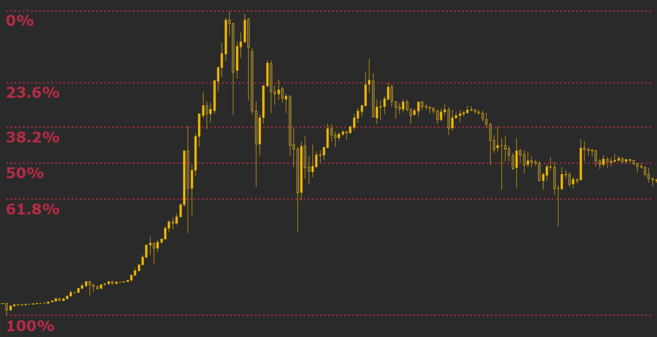
Fibonacci levels serving as both support and resistance for the price of bitcoin.
What is confluence in technical analysis?
So far we have discussed what support and resistance are, and the different types. But what is the most effective way to build trading strategies around them?
A key thing to understand is a concept called confluence. Confluence is when a combination of several strategies is used to create a single strategy. Support and resistance levels tend to be strongest when they fall into more than one of the categories we've discussed.
Let's look at this with two examples. Which potential support zone do you think is most likely to act as support?
Support 1 coincides with:
a previous resistance zone
a significant moving average
a Fibonacci level at 61.8%
a round price
Support 2 coincides with:
a previous resistance zone
a round price
If you have been paying attention, you will have guessed correctly that support 1 is more likely to hold the price. While this may be true, the price could also pass through without difficulty. The point here is that the probability of it acting as support is higher than for support 2. That said, there are no guarantees when it comes to trading. Although trading patterns can be useful, past performance is no guarantee of future performance. So you need to prepare for all possible outcomes.
Historically, setups confirmed by multiple strategies and indicators tend to offer the best opportunities. Some successful confluence traders can be very picky about the setups they choose, and this often involves a lot of waiting. However, when they make trades, their setups tend to work with high probability.
Despite this, it is still essential to manage risk and protect your capital against adverse price movements. Even the strongest setups with the best entry points have a chance of reversing. It is important to consider the possibility of several scenarios, in order not to fall into the traps of false breakouts or bullish or bearish traps.
To conclude
Whether you are a swing or day trader, support and resistance are fundamental concepts to understand when it comes to technical analysis. Support serves as the floor for the price, while resistance serves as the ceiling.
There can be different forms of support and resistance, and some are based on the interaction of price with technical indicators. The most reliable support and resistance areas are usually those that are confirmed by multiple strategies.
If you want to learn more about chart analysis, check out 12 popular candlestick patterns used in technical analysis.