



Résumé
Elastic supply tokens have a variable circulating supply. The idea is that instead of prices being volatile, it's supply that changes during events called "rebases."
Imagine that the Bitcoin protocol could adjust the amount of bitcoins in users' wallets to reach a target price. You have 1 BTC today. You wake up tomorrow, and now you have 2 BTC, worth half of yesterday's value. This is how the rebasing mechanism works.
Introduction
Decentralized finance (DeFi) has seen an explosion of new types of financial products on the blockchain. We have already discussed yield farming, tokenized bitcoins on Ethereum, Uniswap and Flash loans. Another segment of the crypto space that has been interesting to watch is elastic supply tokens, or rebase tokens.
The unique mechanism that defines them allows for many experiments. Let's see how it works.
What is an elastic supply token?
An elastic supply (or rebase) token works such that the circulating supply expands or contracts based on changes in the price of the token. This increase or decrease in supply works through a mechanism called “rebasing.” When a rebase occurs, the supply of the token is algorithmically increased or decreased, based on the current price of the token.
In a way, elastic supply tokens can be compared to stablecoins. They seek to achieve a target price, and rebasing mechanisms allow this. However, the main difference is that rebase tokens seek to achieve it with a variable (elastic) supply.
Wait, aren't there a lot of cryptocurrencies that have an ever-changing supply? Yes, it's true. Currently, 6.25 new BTC are issued with each block. After the halving of the year 2024, this will be reduced to 3.125 per block. This is a predictable rate, so we can estimate how much BTC will exist next year or after the next halving.
Elastic supply tokens work differently. As mentioned, the rebasing mechanism periodically adjusts the circulating supply of the token. Let’s say we have an elastic supply token that aims to reach a value of $1. If the price is above $1, the rebasing increases the current supply, thereby reducing the value of each token. Conversely, if the price is below $1, rebasing decreases the supply, increasing the value of each token.
What does this mean from a practical point of view? The number of tokens in users' wallets changes if a rebasing occurs. Let's say we have Rebase USD (rUSD), a hypothetical token that is targeting a price of $1. You have 100 rUSD safe in your hardware wallet. Let's say the price drops below $1. After the rebasing, you will only have 96 rUSD in your wallet, but at the same time, each of them will be proportionally more valuable than before the rebasing.
The idea is that your holdings proportional to total supply have not changed with the rebasing. If you had 1% of the supply before the rebasing, you should still have 1% after, even if the number of coins in your wallet has changed. In essence, you keep your share, regardless of the price.
Examples of jeton rebase
Ampleforth
Ampleforth is one of the first coins to use an elastic supply. Ampleforth aims to be an unsecured synthetic product, where 1 AMPL targets a price of $1. Rebases occur once every 24 hours.
The project had relatively little success until the introduction of a liquidity mining campaign called Geyser. What is particularly interesting about this pattern is its duration. It distributes tokens to participants over a period of 10 years. Geyser is a great example of how liquidity incentives can create significant traction for a DeFi project.
Although it is technically a stablecoin, AMPL's price chart shows how volatile elastic supply tokens are.

AMPL's price is $1, but it can still be quite volatile.
Keep in mind that this price chart only shows the price of individual AMPL tokens and does not account for changes to the supply. Despite this, Ampleforth is very volatile, making it a risky currency to play with.
It might make more sense to chart elastic supply tokens based on their capitalization. Because the price of individual units doesn't matter as much, the market cap can be a more accurate barometer of network growth and traction.
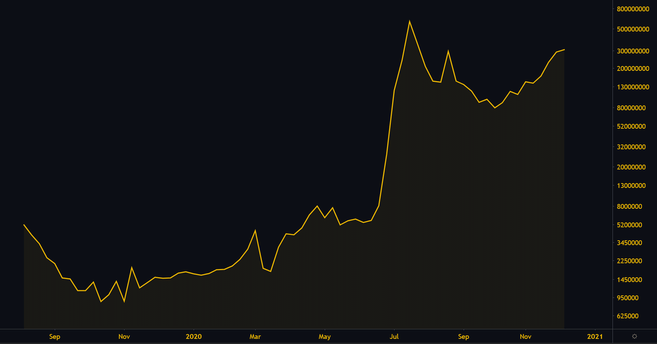
The capitalization of AMPL on a logarithmic scale.
Yam Finance
Yam Finance is one of the other elastic supply token projects that has gained traction. The overall design of Yam is a sort of fusion between the elastic offer of Ampleforth, the staking system of Synthetix and the launch of yearn.finance. YAM also aims to achieve a price target of $1.
YAM is a completely community-based experience, as all tokens were distributed via liquidity mining. There was no pre-mining, no allocation to the founder. The playing field for acquiring these tokens was the same for everyone thanks to a yield farming system.
As a completely new and unknown project, Yam reached $600 million in value locked in its staking pools in less than two days. What may have attracted a lot of liquidity was the way YAM farming specifically targeted holders of some of the most popular DeFi coins. These were COMP, LEND, LINK, MKR, SNX, ETH, YFI and ETH-AMPL Uniswap LP tokens.
However, due to a bug in the rebase mechanism, a much larger quantity than expected was issued. The project was eventually revived and migrated to a new token contract through a community-funded audit and joint efforts. The future of YAM is now entirely in the hands of YAM holders.
The risks of an elastic supply token
Elastic supply tokens are very risky and very dangerous investments. You should only invest if you completely understand what you are doing. Remember that analyzing price charts will not be of much use, as the number of tokens you hold will change after rebasings.
Of course, this can magnify your gains upward, but it can also magnify your losses. If rebasing occurs while token prices are falling, not only do you lose money due to the token price falling, but you also own fewer and fewer tokens after each rebasing!
Since they are quite difficult to understand, investing in rebase tokens will likely result in a loss for most traders. Only invest in elastic supply tokens if you can fully understand the underlying mechanics. Otherwise, you will not be in control of your investment and will not be able to make informed decisions.
➟ Do you want to get started with cryptocurrencies? Buy Bitcoin on Binance!
To conclude
Elastic supply tokens are one of the innovations to watch out for in DeFi. As we have seen, these are coins and tokens that can algorithmically adjust their supply in an attempt to achieve a target price.
Are elastic supply tokens just an interesting experiment, or will they gain popularity and establish themselves? It's hard to say, but there are certainly new DeFi protocol designs in development that attempt to further this idea.