


Résumé
Mining is the process of allowing Bitcoin transactions to be verified and added to the blockchain. The objective of miners is to find a solution to a complex mathematical problem. Miners who manage to find the solution earn the new bitcoins and transaction fees.
When Bitcoin was created, all you needed was a simple laptop to mine BTC. Today, this process requires very specific equipment. Since solo mining is difficult, many miners join pools to increase their chances of getting a block reward and then split it.
Introduction
Bitcoin mining ensures that the legitimacy of transactions occurring on the blockchain is maintained. It was, at the time, a unique solution to create trust in a trustless environment. In this sense, mining is at the heart of the Bitcoin security model.
The idea of mining and receiving BTC in return is an attractive idea. Although it is no longer possible to mine BTC with processors, it is not always necessary to own a machine to mine cryptos. Before you decide if mining is for you, let's briefly explain how it works.
What is bitcoin mining?
When a user creates a new transaction on the bitcoin blockchain, they must wait for other users of the network (the nodes) to verify it. Miners are responsible for collecting new pending transactions and grouping them into a candidate block (a new block that still needs to be validated).
A miner's goal is to find the right hash for their candidate block. A block's hash is a string of numbers and letters that functions as a unique identifier for each block. Here is an example hash:
0000000000000000000b39e10cb246407aa676b43bdc6229a1536bd1d1643679
In order to create a hash, the miner must gather the hash from the previous block, the data from its candidate block (a nonce), and then submit it via a hash function.
However, the miner must find a nonce which, when associated with all the data, will generate a hash starting with a certain amount of zeros. The number of zeros depends on the mining difficulty. The hash of a valid block proves that the miner has done the work necessary to validate his candidate block (this is Proof of Work).
After collecting pending transactions and creating their candidate block, the nonce is the only thing a miner can change, which is what mining rigs are for. In an intensive process of trial and error, the rigs continue to modify the nonce and hash of the data until they find a solution to that block (i.e. a hash that starts with a certain amount of zeros).
Once a miner finds a valid hash, they can validate their candidate block and collect the bitcoins. This is also when blockchain transactions included in this block are confirmed.
How much does a bitcoin miner make?
Each new block provides the miner with a block reward, which consists of newly generated bitcoins (block subscription), plus transaction fees. Since the block reward is almost entirely made up of the block grant, most people refer to it as the block reward (regardless of fees).
As for Bitcoin, the block subsidy started at 50 BTC in 2009 and is halved every 210,000 blocks (around four years). These halvings resulted in a decrease in the block validation reward to 25 BTC in 2012, then to 12.5 BTC in 2016, and finally to 6.25 BTC in 2020. The next halving will take place in 2024. In May 2021, the block reward gives miners around $300,000 per block.
However, there are many factors to consider when calculating profitability. The speed at which a rig can produce random nonces and test them is an important metric to check. This number is known as the hash rate, it is essential to the success of a bitcoin miner. The higher the hash rate, the faster you will be able to test these random inputs.
Another important measurement is the power consumption of the rig. If you spend more money on electricity than the value earned from mining, the profitability is zero.
How to mine Bitcoin
Since Bitcoin is decentralized and is open-source, anyone can join the mining race. In the past, you could use your home computer to mine new blocks. But due to the increase in mining difficulty, you now need more powerful machines (more on this below).
From a theoretical point of view, you can always try to mine bitcoins with your home computer, but the chances of finding a valid hash are almost zero. Computing the hash function is relatively fast, but computing the massive amount of random inputs takes much longer. This is why you now need specialized hardware before you even try to become a profitable miner.
What mining equipment should I use?
In general, you can try mining cryptocurrencies using a CPU, GPU, FPGA, or ASIC machine (we'll cover these). Some altcoins can still be mined with GPUs. FPGA machines may also be an option depending on the mining algorithm, difficulty, and electricity costs. However, when it comes to Bitcoin, the use of ASIC is strongly recommended.
Processor (central processing unit)
Processors work like a chip to distribute instructions to different parts of a computer. Today, processors are no longer efficient enough to mine cryptocurrencies.
GPU (graphics processing unit)
GPUs can serve different purposes, but they are primarily used to process graphics data and transmit it to the screen. They can divide complex tasks into several smaller tasks to improve performance. Some altcoins can be mined with GPUs, but efficiency depends on the mining algorithm and difficulty.
FPGA (field programmable gate array)
FPGAs can be programmed and reprogrammed to serve different functions and applications. They are customizable and more affordable than ASICs but are less efficient for bitcoin mining.
ASIC (Application Specific Integrated Circuit)
ASIC stands for application-specific integrated circuits, meaning these computers are designed for a single purpose. ASICs are entirely dedicated to mining a cryptocurrency. ASICs are less customizable and more expensive than FPGAs, but their hash rates and power consumption levels make them the most efficient option for mining bitcoin.
Mining pools
The chances of mining a block alone are extremely low. By joining a cryptocurrency mining pool instead, you can combine your computing power with other miners. When the pool successfully mines a block, each miner receives a share of the mined bitcoins. Pool rewards are proportional to the mining power you offer.
How to join a mining pool?
If you join a pool using your hardware locally, you will need to configure your software to join with other miners. The process usually involves creating an account and logging into the pool server.
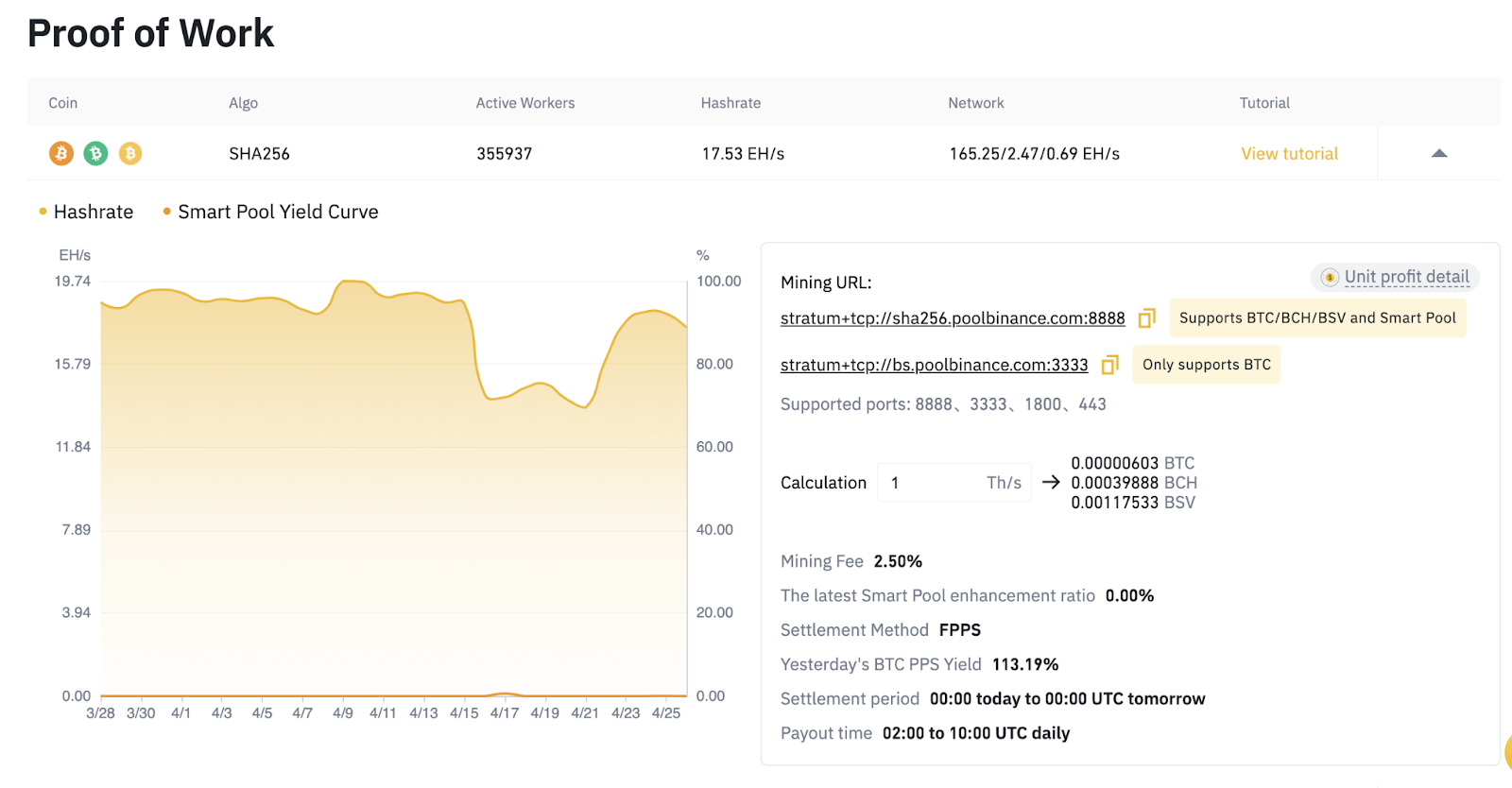
If you have a mining rig, the Binance Pool is a good place to start mining BTC and other coins based on the SHA-256 algorithm. Your ring will automatically switch from BTC to BCH and BSV to maximize your returns, which are paid in BTC.
You can get an idea of how much profit you could get by visiting the Binance Pool page. BTC earnings are paid into your Bitcoin wallet daily.
Cloud Mining
If you want to avoid the more technical aspects, you can also join a cloud mining pool, leaving the hardware and software management to the farm owners. Generally speaking, cloud mining involves paying someone to mine on your behalf. The farm owner will then have to share the winnings with you. However, this option is very risky, as there is no guarantee that you will get a return on your investment. Many cloud mining services turn out to be scams, so be careful.
To conclude
Having a basic understanding of how bitcoin mining works will help you avoid making mistakes. With the right combination of hardware and software, anyone can start mining and contributing to the security of the Bitcoin network. Even if you realize that mining isn't for you, you can still contribute to the network by running a Bitcoin node.
The initial investment to be profitable in mining is very high and many risks are involved. Your returns will also depend on market conditions and external factors such as energy prices and hardware improvements. Be sure to do your research before spending money on your devices.