

TL;DR (RESUME)
In cryptocurrency trading, leverage refers to the use of borrowed capital to make trades. Trading with leverage can expand your buying or selling power, allowing you to trade larger amounts. So, even if your initial capital is small, you can use it as collateral to make leveraged trades. While leveraged trading can multiply your potential profits, it is also subject to high risk, especially in the volatile cryptocurrency market. Be careful when using leverage to trade cryptos. It can cause you significant losses if the market moves against your position.
Introduction
Trading with leverage can be confusing, especially for beginners. But before experimenting with leverage, it's crucial to understand what it is and how it works. This article will focus on leverage trading in the crypto markets, but a lot of the information is valid for traditional markets as well.

What is leverage in cryptocurrency trading?
Leverage refers to the use of borrowed capital to trade cryptocurrencies or other financial assets. Expand your buying or selling power so you can trade with more capital than you currently have in your wallet. Depending on the cryptocurrency exchange you trade on, you could borrow up to 100 times the balance in your account.
The amount of leverage is described as a ratio, for example, 1:5 (5x), 1:10 (10x), or 1:20 (20x). Shows how many times your initial capital is multiplied. For example, imagine you have $100 in your exchange account, but you want to open a position worth $1,000 in Bitcoin (BTC). With 10x leverage, your $100 will have the same purchasing power as $1,000.
You can use leverage to trade different crypto derivatives. Common types of leveraged trading include margin trading, leveraged tokens, and futures contracts.
How does leverage trading work?
Before you can borrow funds and start trading with leverage, you must fund your trading account. The initial capital you provide is what we call collateral. The collateral required depends on the leverage you use and the total value of the position you wish to open (known as margin).
Let's say you want to invest $1,000 in Ethereum (ETH) with 10x leverage. The margin required would be 1/10 of $1,000, meaning you need to have $100 in your account as collateral for the borrowed funds. If you use 20x leverage, your margin requirement would be even lower (1/20 of $1,000 = $50). But keep in mind that the higher the leverage, the greater the risks of your position being liquidated.
In addition to the initial margin deposit, you will also need to maintain a margin threshold for your trades. If the market moves against your position and the margin starts to fall below the maintenance threshold, you will need to deposit more funds into your account to avoid being liquidated. The threshold is also known as the maintenance margin.
Leverage can be applied to both long and short positions. Opening a long position means that you wait for the price of an asset to rise. On the contrary, opening a short position means that you believe that the price of the asset will fall. While this may sound like regular spot trading, using leverage allows you to buy or sell assets based on your collateral alone and not your holdings. Therefore, even if you don't own an asset, you can still borrow it and sell (open a short position) if you think the market will go down.
Example of a leveraged long position
Imagine you want to open a long position of $10,000 in BTC with 10x leverage. This means you will use $1,000 as collateral. If the price of BTC rises by 20%, you will make a net profit of $2,000 (minus fees), which is much more than the $200 you would have earned if you had traded your $1,000 capital without using leverage.
However, if the price of BTC falls by 20%, your position would be down $2,000. Since your initial capital (collateral) is only $1,000, a 20% drop would cause a liquidation (your balance goes to zero). In fact, you could be liquidated even if the market only drops 10%. The exact settlement value will depend on the exchange you are using.
To avoid being liquidated, you must add more funds to your wallet to increase your collateral. In most cases, the exchange will send you a margin call before settlement occurs (for example, an email telling you to add more funds).
Example of a leveraged short position
Now, imagine you want to open a short position of $10,000 in BTC with 10x leverage. In this case, you will borrow BTC from someone else and sell it at the current market price. Your collateral is $1,000, but since you are trading with 10x leverage, you can sell $10,000 worth of BTC.
Assuming the current price of BTC is $40,000, you borrowed 0.25 BTC and sold it. If the BTC price drops 20% (to $32,000), you can buy back 0.25 BTC with just $8,000. This would give you a net profit of $2,000 (minus commissions).
However, if BTC rises 20% to $48,000, you would need an additional $2,000 to buy back the 0.25 BTC. Your position will be liquidated, as the balance in your account is only $1,000. Again, to avoid being liquidated, you must add more funds to your wallet to increase your collateral before the liquidation price is reached.
Why use leverage to trade cryptocurrencies
As mentioned, traders use leverage to increase their position size and potential profits. But as the examples above illustrate, leveraged trading could also lead to much larger losses.
Another reason why traders use leverage is to improve the liquidity of their capital. For example, instead of holding a 2x leveraged position on a single exchange, they could use 4x leverage to hold the same position size with lower collateral. This would allow them to use the other part of their money elsewhere (e.g. trading another asset, staking, providing liquidity on decentralized exchanges (DEX), investing in NFTs, etc.).
How to manage the risks of leveraged trading
Trading with high leverage may require less capital to start, but increases the chances of liquidation. If your leverage is too high, even a 1% price movement could lead to large losses. The higher the leverage, the lower your tolerance for volatility. Using lower leverage gives you more room for error when trading. This is why Binance and other cryptocurrency exchanges have limited the maximum leverage available to new users.
Risk management strategies such as stop-loss and take-profit orders help minimize losses in leveraged trading. You can use stop-loss orders to automatically close your position at a specific price, which is very useful when the market moves against you. Stop-loss orders can protect you from significant losses. Take-profit orders are the opposite: they are automatically closed when your profits reach a certain value. This allows you to lock in your profits before market conditions change.
At this point, it should be clear that leverage trading is a double-edged sword that can multiply both your profits and losses exponentially. It involves a high level of risks, especially in the volatile cryptocurrency market. At Binance, we encourage you to trade responsibly by taking responsibility for your actions. We offer tools such as the anti-addiction warning and the protection period feature to help you exercise control over your trades. You should always be very cautious and don't forget to do your DYOR (do your own research) to understand how to use leverage correctly and plan your trading strategies.
How to use margin trading on Binance
You can use leverage to trade cryptocurrencies on exchanges like Binance. We'll show you how to start margin trading, but the concept of leverage can also be found in other types of trading. Before you begin, you will need a Margin account. Follow this FAQ article to open an account if you haven't already.
1. Go to [Trade] > [Margin] from the top navigation bar.
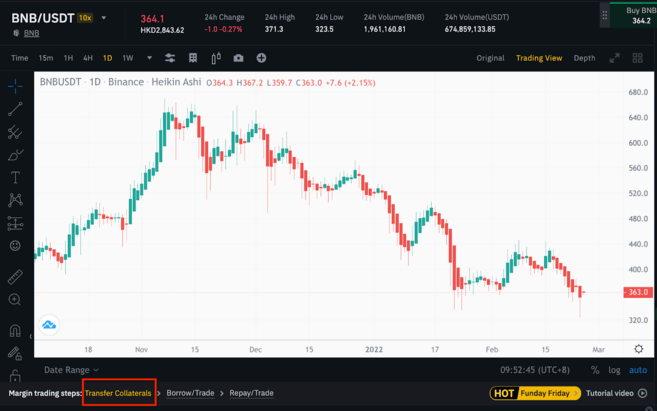
2. Click [BTC/USDT] to find the pair you want to trade. We are going to use the BNB/USDT pair.
3. You will also need to transfer funds to your Margin wallet. Click [Transfer Collateral] below the candlestick chart.
4. Select the wallet to transfer funds, the destination margin account and the currency to transfer. Enter the amount and click [Confirm]. In this example, we are transferring 100 USDT to the Cross Margin account.

5. Now go to the box on the right. Choose [Crossed 3x] or [Isolated 10x]. Margin in Cross Margin mode is shared between your margin accounts, while margin in Isolated Margin mode is independent for each trading pair. You can read more about the difference between the two modes in this FAQ article.
6. Select [Buy] (long) or [Sell] (short) and the order type, such as market order. Click [Borrow] and you will notice that the 100 USDT we transferred to the Cross Margin account is now multiplied by 3, to 300 USDT.

7. You can buy BNB with leverage by entering the amount of USDT for [Total], or the amount of BNB to buy for [Amount]. You can also drag the bar below to select the balance percentage available to use. Next, you will see the amount you are borrowing for this trade. Click [BNB Margin Buy] to open the position.
Please note that you will not be able to use your entire available balance, as you must pay a trading commission. The system will automatically retain the trading commission amount based on your VIP level.


Conclusions
Leverage allows you to easily get started with a lower initial investment and the potential to generate higher profits. Still, leverage combined with market volatility could cause liquidations to occur quickly, especially if you are taking 100x leverage to trade. Always trade with caution and evaluate the risks before making leveraged trades. You should never trade funds you cannot afford to lose, especially when using leverage.