


Today we continue to talk about a relatively promising project with a market value of US$700 million. It can also be regarded as an L2 project. However, it is different from other L2s in that it is a bit like a vertical direction in L2. He specializes in L2 NFTs. -In the gaming field, he is Immutable. As a company that has turned from games to infrastructure, Immutable's vision is to support the development of all Web3 games, and the path is to build an L2 that facilitates the trading of game NFT assets.
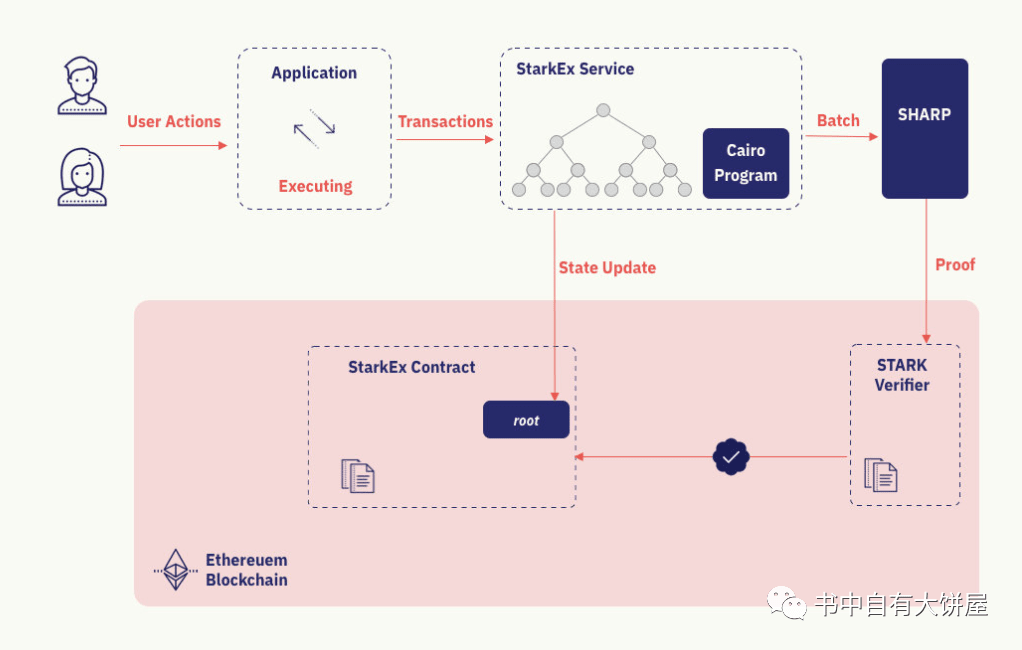
Immutable Immutable X does all this without compromising user ownership. The protocol is built by the Starkware team using StarEx technology. In effect, StarEx allows transactions to be performed outside the blockchain (on a layer 2 network), update them, and then prove them back to the main chain. Currently, Immutable
There are currently a number of games on the platform, including Gods Unchained, Guild of Guardians, Illuvium, and the NFT platform Veve collectibles. Steam, CB, and ftx bosses in chain games have collectively invested in it, which shows his influence in this area. Its token is IMX, which is mainly used for staking, governance and payment of fees.
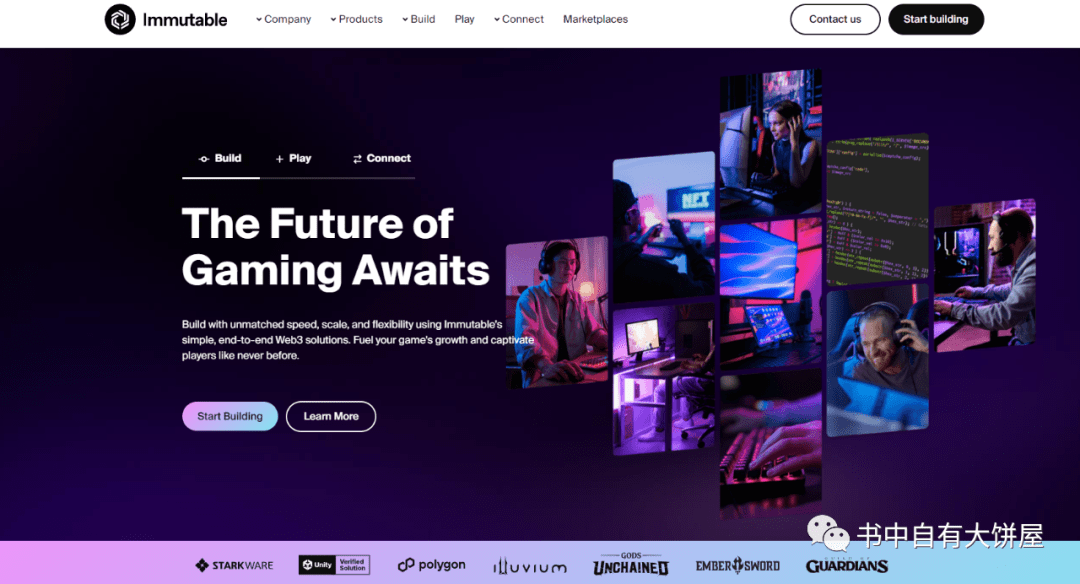
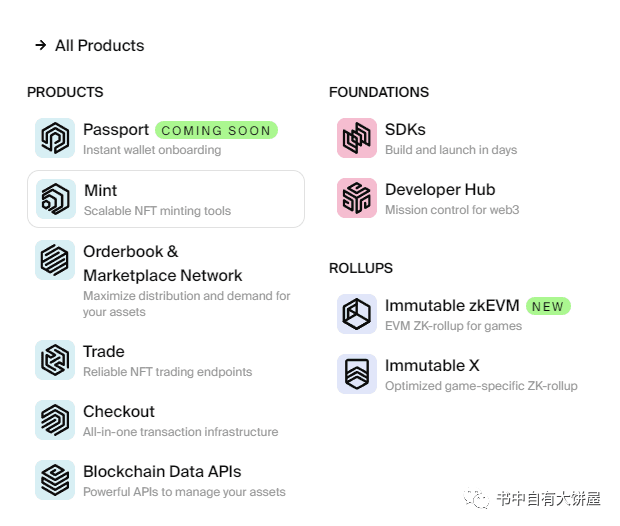
Then I took a look at its official website. Sologan is a game waiting for the future (to improve the next generation of web3 games), so it is mainly a platform for chain games. The main products are as follows, including NFT mint, which provides network services and order book services for the trading market, endpoints for NFT transactions, APIs for blockchain data, etc. And then also provide the underlying infrastructure.
1. Product advantages
IMX has two good advantages. One is that there is no handling fee for casting/transferring NFT. The other is that IMX provides developers with a REST API interface. Developers can deploy it on IMX without writing smart contracts. NFT, and all malls connected to IMX can share NFT liquidity, so this is very convenient.
High-throughput Validium solution
In terms of capacity expansion, IMX chose the Validium data availability solution with lower cost and higher throughput, achieving further improvement in performance. Compared with Rollup's solution, Validium is more suitable for small-amount, high-frequency transactions.
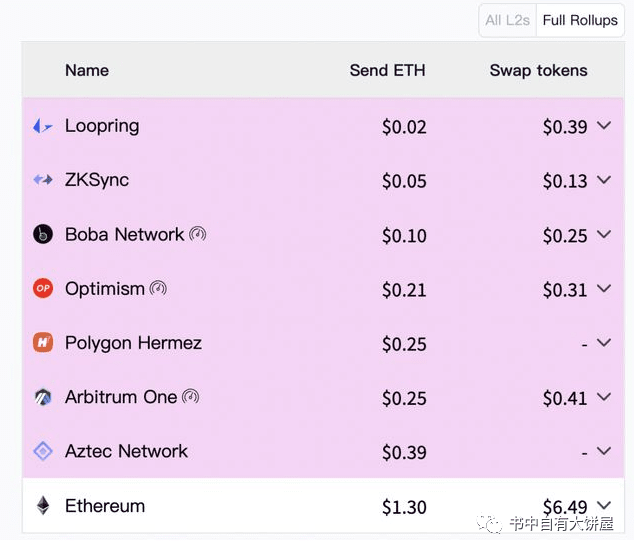
Compared with the liberation scheme of the ZK series, the Validium mode uses the handling fee for IMX to save at least 10 times.
It is worth mentioning that IMX has also integrated StarkNet. Above we saw that there are also ZKEVM products in its product list. This also adds more possibilities and scalability to IMX products.
In this way, IMX will provide its product suite (order book function, NFT casting tools, mall, etc.) on StarkNet, which is a smart contract written in Cairo. Through the IMX suite, basic NFT casting, trading, etc. can be realized on StarkNet. Function.
Interestingly, IMX suggested that project parties can choose to implement different functions on different chains. For example, users can sell land on the L1 main network and sell avatars (Illuvitars) on IMX provided by StarkEx. However, staking and trading The pool will be deployed on StarkNet.
IMX’s integration of StarkNet opens up options for project parties. On StarkEx, IMX provides low-price, standardized NFT minting and trading functions; while on StarkNet, it sacrifices low-price features in exchange for a higher degree of freedom.
Handling fee allocation for value tax
Using Validium’s solution to store complete transaction data under the chain greatly reduces handling fee consumption. Then, IMX wraps up a layer of handling fee allocation plan, providing a policy of “minting/transferring NFT with 0 handling fees”. IMX hopes to collect taxes from the transactions of some valuable NFTs to compensate for the flow of some worthless NFTs. But I think this is not very reasonable, because if it is worthless, then he will definitely not welcome it, and why should we subsidize him for things that cannot be sold? Everything should comply with the value theory in order to maintain the normal operation of the platform.
Shared order book mode
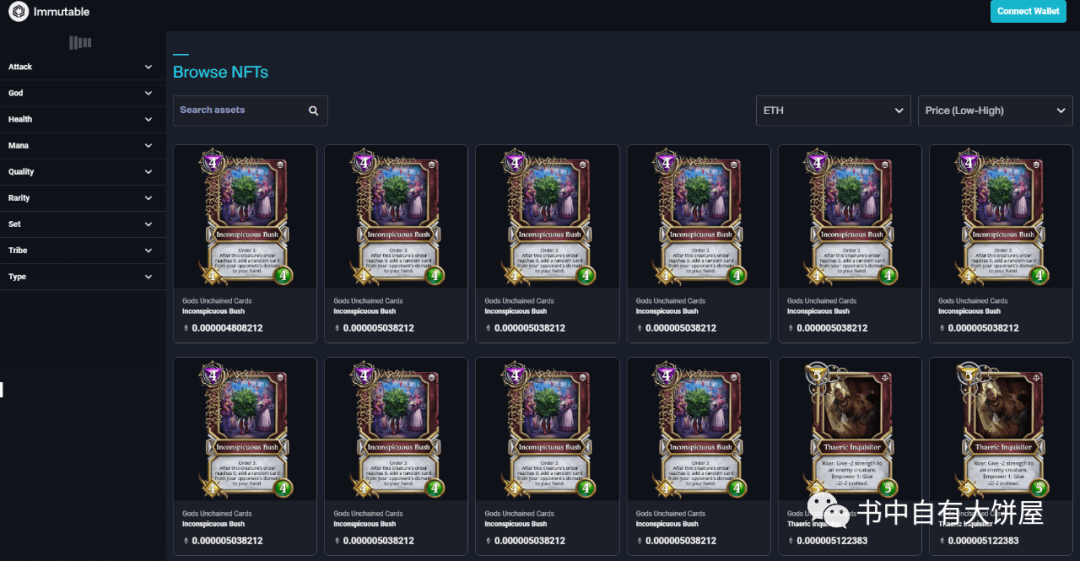
One feature of IMX is its shared order book: all projects that use the underlying technology of IMX, even if they build their own malls, can display and trade all NFTs listed on other malls, which is equivalent to automatically aggregating all NFTs through the IMX protocol. NFT liquidity. At the same time, IMX also provides its own mall, and the game Gods Unchained developed by it is integrated with the IMX Mall.
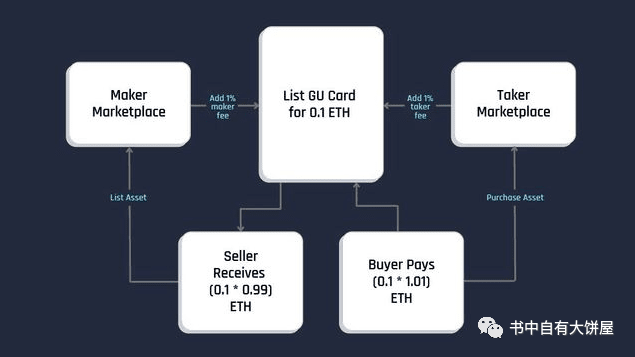
In the IMX ecosystem, shared liquidity allows the seller’s pending orders in any mall to be purchased by the buyer in any mall, and the mall can customize the mall tax rate for the buyer or seller. As shown in the figure below, different malls impose a 1% tax on buyers and sellers respectively. The mall is similar to a free merchant, sharing all goods, but can customize the service model.
2. Operational Ecology
As mentioned earlier, IMX’s original intention was to support the development of Web3 games, but its actual functions can meet the issuance of all NFT projects, and thus it has become a “pan-NFT” platform.
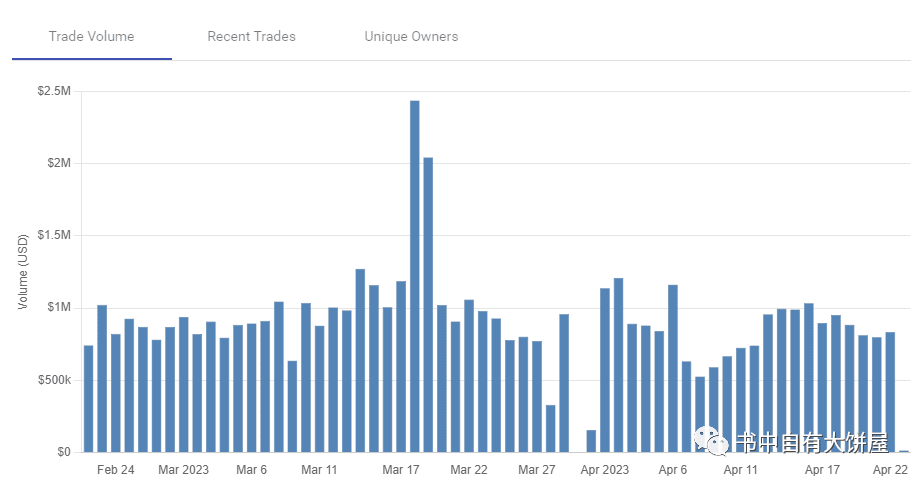
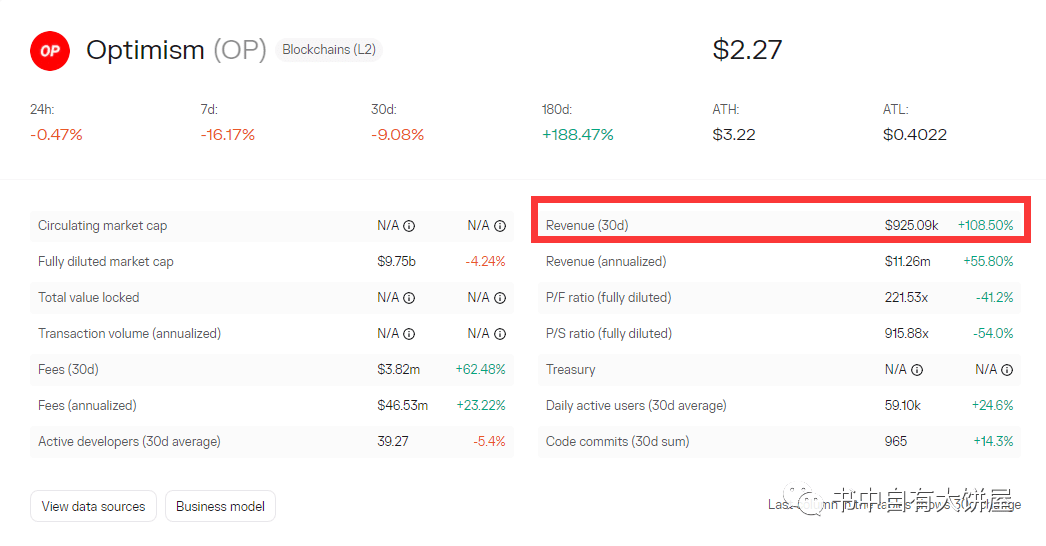
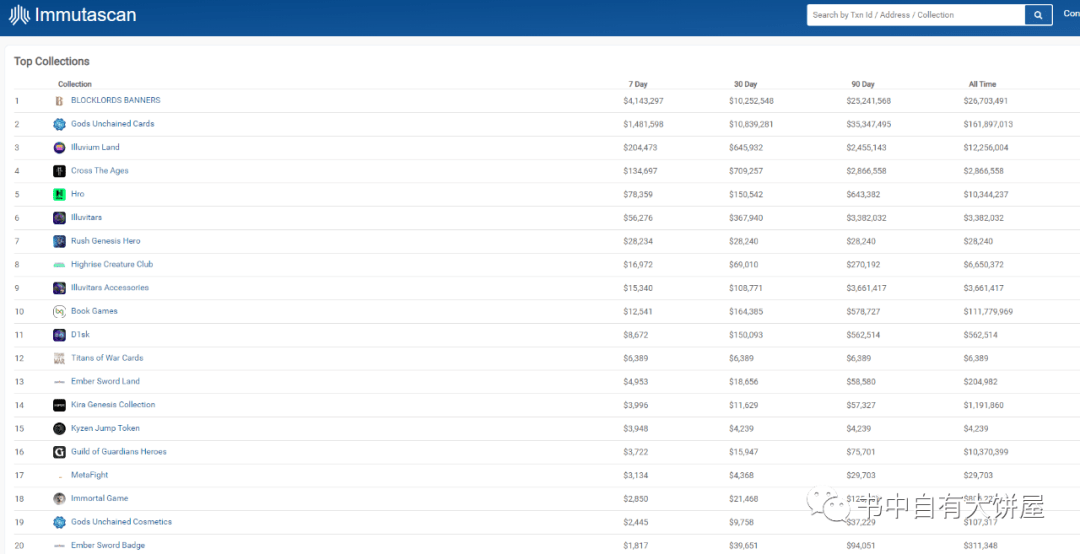
From the overall scale, the IMX ecosystem is quite impressive. From the browser https://immutascan.io/, you can see the average daily transaction volume of 1 million US dollars. If this volume is continued and the 2% protocol tax policy is implemented, the average daily income of the protocol will be 20,000 US dollars, and the average monthly income will be 600,000 US dollars, and the average annual income is US$7.2 million. Then let’s compare it to the OP, which is also L2, and its price is $900,000. From this comparison, they are actually about the same.
Whether it is game assets or pure NFT, the projects on IMX have one thing in common: the individual assets are relatively small. For example, the top 15 projects mentioned above have floor prices between 0.002~1.5 ETH, and many projects have floor prices of 0.1 Below ETH. Combined with the free casting/transfer characteristics of IMX, IMX is actually more suitable for "small-amount, high-frequency" NFT transaction scenarios. The operating fees are cheap, but the security level is not as good as the Ethereum mainnet or Rollups, and games that require a large number of cards such as Gods Unchained is exactly a representative of this type of scene.
3. Team and Financing
Immutable was co-founded by a pair of young brothers in Australia. Brother James Ferguson is the CEO. He studied law at the University of Sydney from 2011 to 2016. After graduation, he founded three companies and started Immutable in 2018. Robbie Ferguson, who is 5 years younger, also studied at the University of Sydney, but dropped out to serve as general manager due to the establishment of Immutable. CTO Alex Connolly is also one of their colleagues. He dropped out of the University of Sydney and founded Immutable with the Ferguson brothers.
So far, Immutable has announced 5 rounds of financing, with a cumulative financing of ~US$280 million. In July 2018, it announced two rounds of financing, both led by Continue Capital and Nirvana Capital, with a single amount of US$2.4 million. In September 2019, it completed a US$15 million Series A financing, led by Galaxy Interactive and Prosus Ventures. Leading the investment; in September 2021, it completed a Series B financing of AUD 82 million, led by BITKRAFT Ventures and King River Capital; in March 2022, it completed a Series C financing of USD 200 million, led by Temasek.
4 Advantages and Challenges
The characteristics of IMX are very obvious. It exchanges certain data security for convenient and low-cost developer and user experience, which also creates its corresponding advantages and disadvantages.
IMX’s free casting/transfer of NFT and API interface are its biggest advantages, which greatly lower the threshold for NFT issuance. At the same time, IMX is also part of the Ethereum ecosystem. By integrating into StarkNet, it can be combined with other smart contracts, making it more flexible than the completely independent Flow.
This also makes IMX more suitable for "small-amount, high-frequency" lightweight assets. This scenario can better leverage the advantages of high throughput in Validium mode, and has lower requirements for data security. In turn, owners of high-value assets may not be willing to take the risk of storing and trading assets on IMX. IMX may not be able to attract high-quality blue-chip NFT projects; moreover, if the NFT project has complex Defi interaction logic, it will be difficult for the current IMX to provide technical support.