

By Arthur Hayes
(Any of the following views are the author’s personal views and should not be used as the basis for investment decisions, nor should they be regarded as advice or opinions on participating in investment transactions).
From a healthcare perspective, the last moments of life are the most expensive. We are willing to spend unlimited amounts of money on any advertised treatment to prevent the inevitable. Likewise, the Pax Americana elites and their henchmen are willing to do whatever it takes to preserve the current world order because they benefit most from it as it exists. But since 2008, shady mortgages issued to destitute Americans have unleashed a global economic crisis as severe as the Great Depression of the 1930s. What is the prescription of the mid-century New Keynesian barbers, led blindly by Ben Bernanke? The same simple prescription for a dying empire…print money.
The Empire and its European, Chinese, and Japanese client, strategic rivals and allies are all printing money to address different symptoms of the same problem. The problem is a deeply unbalanced global economic and political architecture. The United States, led by the Federal Reserve (Fed), prints money and buys U.S. government bonds and mortgages. Europe, led by the European Central Bank (ECB), prints money and buys euro member government bonds to maintain the now flawed monetary union (not fiscal union). China, led by the People's Bank of China, requires the banking system to lend to industrial companies building apartments, steel mills and other large infrastructure projects. Japan, led by the Bank of Japan (BOJ), continues to print money to try to create the phantom inflation that disappeared after the 1989 real estate crash.
The result of the reckless money printing is an accelerating rise in the ratio of global debt to GDP. Global interest rates are at their lowest level in 5,000 years. Nearly $20 trillion of corporate and government bonds have negative yields at their peak. Since interest is compensation for the time value of money, if interest is negative, can we say that time is no longer valuable?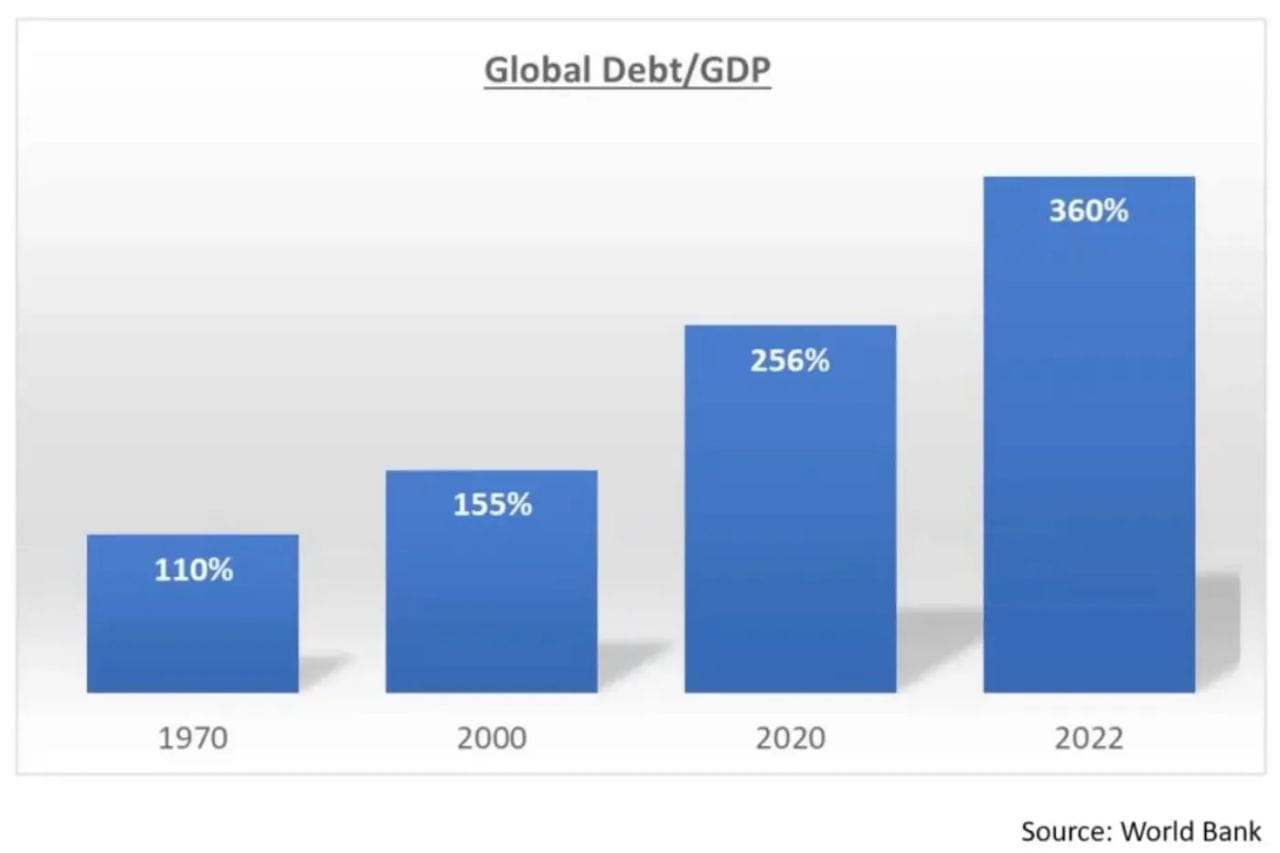
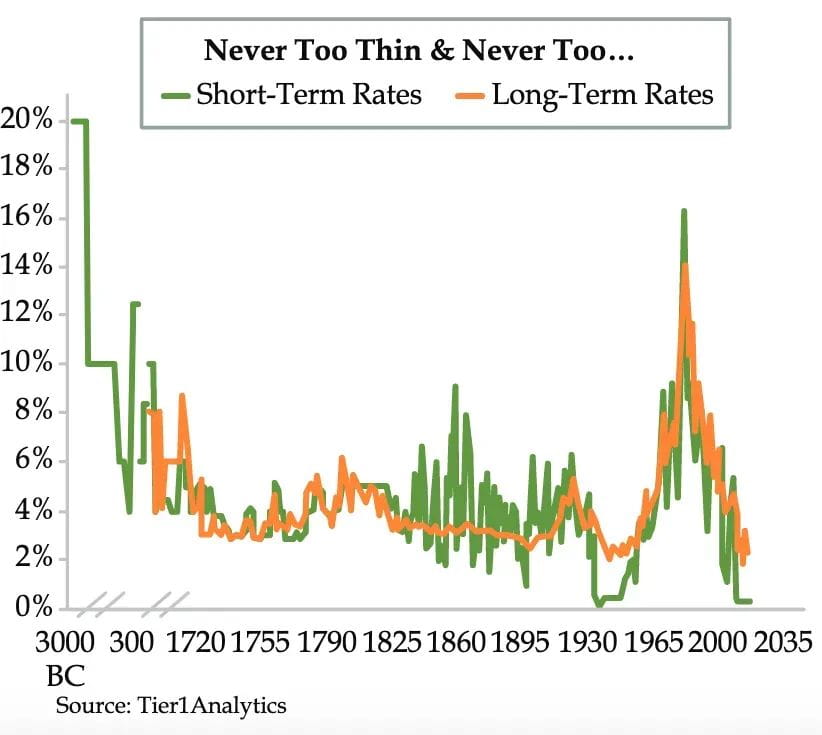
Thanks to Danielle DiMartino Booth of Quill Intelligence for this chart.
As you can see, in 2008, after the global financial crisis (GFC) hit, interest rates fell to their lowest point in 5,000 years.
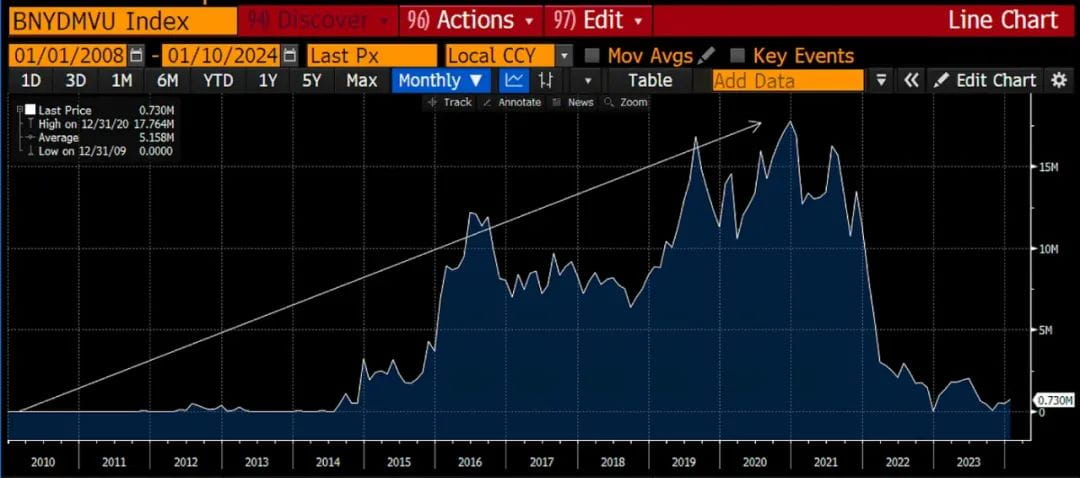
This is a Bloomberg index of the total amount of negative-yielding debt in the world. From nothing before the 2008 global financial crisis, it reached a high of $17.76 trillion in 2020. This is thanks to central banks around the world cutting interest rates to 0% or below.
Most of the world’s population does not have enough financial assets to benefit from the global debasement of fiat currencies. Inflation has sprung up on all kinds of commodities around the world. Remember the Arab Spring in 2011? Remember when a piece of avocado toast cost less than $20 in major financial centers around the world? Remember when a middle-income family could afford a median-priced home without resorting to handouts from their parents’ bank account?
The only way out is to own a little gold. But owning gold is unrealistic. It is heavy and difficult to hide in large quantities from greedy governments. As a result, people can only eat their "humble pie" while the elites continue to party in Davos, Switzerland like it's 2007.
But like a lotus flower blooming in a cesspool, Satoshi Nakamoto published the Bitcoin White Paper as his empire was sinking in moral, political, and economic bankruptcy. The white paper proposed a peer-to-peer system where people could use networked machines and cryptographic proofs to separate money from the state in a globally scalable way for the first time in human history. I say "globally scalable" because Bitcoin is weightless. Whether you hold 1 Satoshi or 1 million Bitcoins, the weight is the same.
In addition, you can protect your Bitcoins by memorizing the mnemonic phrase that unlocks your Bitcoin wallet. Bitcoin provides a complete financial system for everyone, as long as you have a device connected to the Internet, without being attached to an ancient regime.
People have finally found a way to escape the global fiat currency debasement binge. However, Bitcoin is too immature to provide a reliable escape valve for the faithful after the 2008 financial crisis. Bitcoin and the entire cryptocurrency market must increase the number of users and prove that they can withstand the test of a serious crisis.
We the faithful were severely tested in 2022. The Fed and most of the world’s central banks began a journey to tighten financial conditions at the fastest pace since the 1980s. The US banking system and debt markets could not withstand the Fed’s onslaught. In March 2023, three US banks (Silvergate, Silicon Valley Bank, and Signature Bank) failed within two weeks of each other. The US banking system was and is insolvent if its holdings of US Treasuries and mortgage-backed securities were marked to market. Therefore, as a covert way to save the entire US banking system, US Treasury Secretary Bad Gurl Yellen established the Bank Term Funding Program (BTFP).
Cryptocurrencies were not immune to the disruption caused by high and rising interest rates. Centralized lenders such as BlockFi, Celsius, and Genesis collapsed as they extended loans to over-leveraged trading firms such as Three Arrows Capital. Terra Luna, a stablecoin pegged to the US dollar, also collapsed due to a drop in the price of Luna, the governance token that supports the issuance of the UST stablecoin. This event wiped out more than $40 billion in two days. Centralized exchanges then began to collapse, with FTX being the largest. FTX was run by “correct” American peace white boy Sam Bankman-Fried, who stole more than $10 billion worth of customer funds and his scam was revealed as crypto asset prices plummeted.
What happened to Bitcoin, Ethereum, and DeFi projects like Uniswap, Compound, Aave, GMX, dYdX, etc.? Did they falter? Did they call home and get a bailout from the central banks of crypto? Absolutely not. Overleveraged positions were liquidated. Prices fell. People lost a lot of money. Centralized companies ceased to exist. But Bitcoin still produces an average of one block every 10 minutes. The DeFi platforms themselves did not go bankrupt. In short, there was no bailout because crypto cannot be bailed out. We took a hit, but we kept going.
In 2023, emerging from the ashes, Pax Americana and its followers clearly could not continue to tighten monetary policy. Doing so would bankrupt the entire system because leverage and debt piled too high. As long-term U.S. Treasury yields began to step up, a strange thing happened. Bitcoin and cryptocurrencies rebounded, while bond prices fell.
Bitcoin (white) and the U.S. 10-year Treasury yield (yellow)
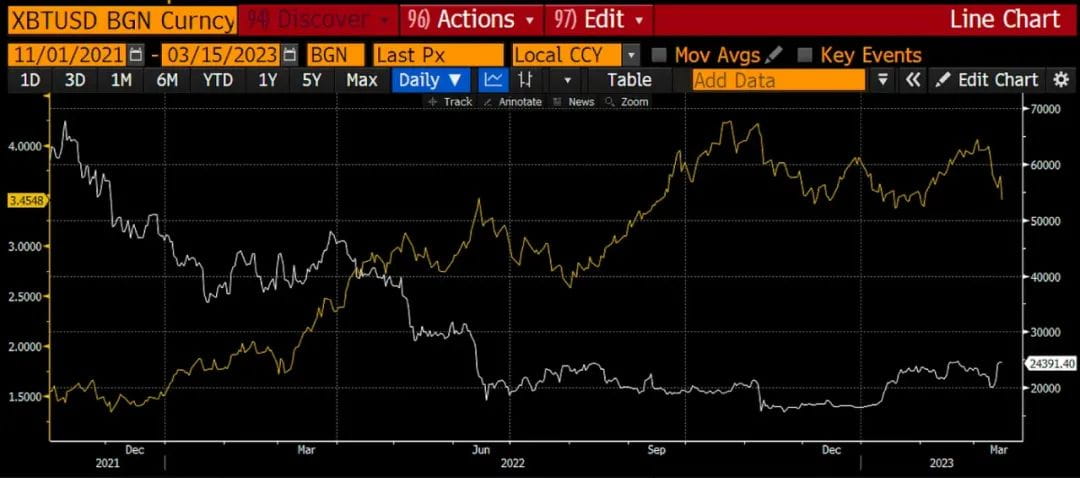 As the chart above shows, when interest rates rise, Bitcoin behaves like all other long-term assets…it falls.
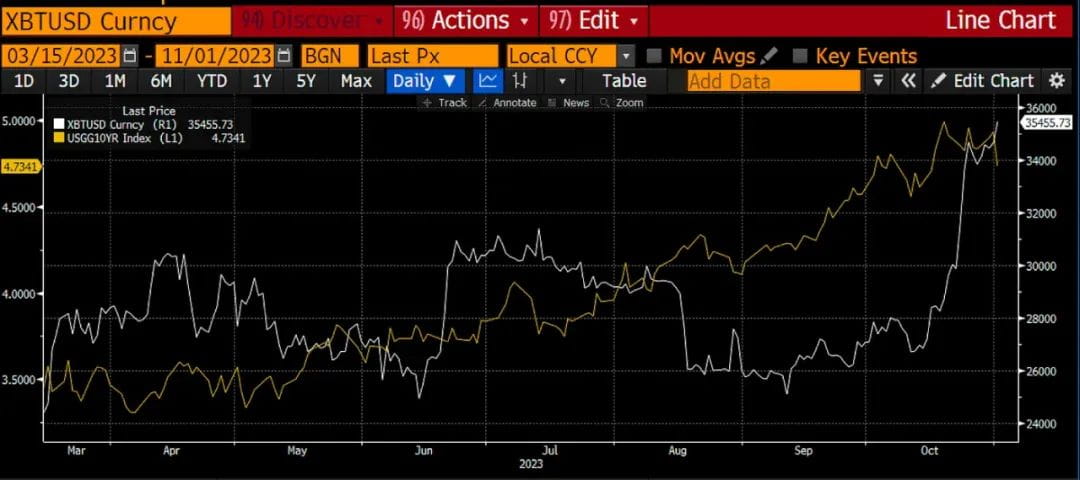 After BTFP, the relationship shifted. Bitcoin and yields rose in tandem. Rising yields, especially those that rose in a bear market stair-step fashion, suggest that investors don’t trust the “financial system.” In response, they are selling the safest government bonds in the empire, U.S. Treasuries. The money has primarily gone to the 7 largest AI tech stocks (Apple, Alphabet, Microsoft, Amazon, Meta, Tesla, Nvidia), and a small amount of cryptocurrencies. After nearly 15 years, Bitcoin is finally showing its true colors as the “people’s currency” rather than just another risky asset derivative of the empire. This poses a very tricky problem for TradFi.
Capital must stay in the system to inflate away the massive amounts of unproductive debt. Bitcoin is outside the system and now has zero or even slightly negative correlation with bonds (remember, when yields go up, bond prices go down). If the bond watchers express their displeasure with government bonds by selling them and buying Bitcoin and other cryptocurrencies, the global financial system will collapse. The reason the financial system collapses is that people finally realize the inherent losses in the financial system, and large financial companies and governments will have to shrink dramatically.
To avoid this liquidation, the elites must financialize Bitcoin by creating highly liquid exchange-traded funds (ETFs). This is the same trick they played on the gold market when the SEC approved ETFs such as SPDR GLD in 2004 that supposedly stored gold bars in vaults around the world. If all the capital looking to escape the collapse of the global government bond market bought a Bitcoin ETF managed by a large TradFi company such as BlackRock, then this capital would still be safely inside the system.
Obviously, in order to protect the global bond market, the Federal Reserve and all other major central banks must turn to printing money again, so BlackRock officially applied for a Bitcoin ETF in June 2023. Blackrock was one of many companies hoping to get a spot Bitcoin ETF approved in the United States. However, in 2023, the SEC finally seemed to accept the application. I present the following to highlight the strangeness of the current events surrounding the ETF approval process. The Winklevoss twins applied for a spot Bitcoin ETF in 2013, and the SEC rejected their application for more than ten years. BlackRock applied and was approved within six months. Things that make you "uh-huh"
As I wrote in my last article, "Expressions", a spot Bitcoin ETF is a trading product. You buy it with fiat and earn more fiat. It is not Bitcoin. It is not a path to financial freedom. It is not outside the TradFi system. If you want to escape, you must buy Bitcoin, withdraw it from the exchange, and self-custody it.
I wrote this lengthy preface to explain “why now?” Why a spot Bitcoin ETF would finally be approved at this critical juncture for the Empire and the financial system? I hope you understand the gravity of this development. The global bond market is estimated at $133 trillion; imagine the inflows to Bitcoin ETFs if bond prices continue to fall, even as the Fed may begin cutting rates in March. If inflation bottoms out and continues to move higher, bond prices may continue to fall. Remember, war causes inflation, and the periphery of the Empire is undoubtedly at war. Also, don’t forget that China will launch the exact same US-listed ETF in the Hong Kong financial market to capture capital flows from China and the Asia-Pacific region. Pax Americana leads, and her friends and foes will follow.
The rest of this article will discuss the market impact of a spot Bitcoin ETF. I will focus only on the BlackRock ETF because BlackRock is the largest asset manager in the world. They have the best ETF distribution platform in the world. They can sell to family offices, retail financial advisory firms, retirement and pension plans, sovereign wealth funds and even central banks. All other companies will try their best, but the BlackRock ETF will be the clear winner in terms of assets under management. Whether this prediction is correct or not, the following strategy will work if there is a large volume of ETFs from any issuer.
This article will discuss the following and how the inner workings of ETFs will create amazing trading opportunities for those who are able to trade in TradFi and the cryptocurrency markets:
- Creation and redemption process
- Spot trading arbitrage and trading time series analysis
- ETF derivatives such as listed options
- Impact of ETF financing transactions
Having said all that, let’s make some money!
Cash rules everything around me
The dust has settled. Inflows (creations) and outflows (redemptions) of funds can only be made using cash. The most concerning aspect of this ETF is that it allows civilians to purchase the ETF with fiat currency and choose to redeem the ETF with Bitcoin. The point of this product is to provide exposure to fiat currency, not to provide an easy way to buy physical Bitcoin with a retirement account.
create
To create shares of an ETF, an Authorized Participant (AP) must send the fund the dollar value of the creation basket, i.e. a certain number of ETF shares, by a certain time each day. Authorized Participants are large TradFi trading firms. The who’s who of the TradFi cephalopod vampires have signed on to be APs for various ETF launches. Companies like Jamie Dimon, CEO of JPMorgan Chase, who has called on governments to ban cryptocurrencies, will be involved. That surprises me ;).
for example:
Each ETF share is worth 0.001 BTC. The creation basket is 10,000 shares; at 4pm EST, these bitcoins are worth $1,000,000. The AP must remit this money to the Fund. The Fund will then instruct its counterparty to purchase 10 bitcoins. Once the bitcoins are purchased, the Fund will credit the AP with the ETF shares.
1 basket = 0.001 BTC * 10,000 shares = 10 BTC
0 BTC * 100,000 BTC/USD = 1,000,000 USD
redemption
To redeem ETF units, the AP must send the ETF shares to the Fund by 4pm EST. The Fund will then instruct its counterparty to sell the 10 Bitcoins. Once the Bitcoins are sold, the Fund will deposit $1,000,000 into the AP account.
1 Basket = 0.001 BTC * 10,000 Shares = 10 BTC
10 BTC * 100,000 BTC/USD = 1,000,000 USD
For us traders, what we want to know is where Bitcoin must be traded. Of course, the counterparties that help the fund buy and sell Bitcoin can do so wherever they like, but in order to reduce slippage, they must match the fund's net asset value (NAV).
The fund's NAV is based on the 4pm EST price of BTC/USD on the CF Benchmark. The CF Benchmark receives prices from Bitstamp, Coinbase, itBit, Kraken, Gemini and LMAX between 3-4pm EST. Any trader who wishes to perfectly match the NAV with minimal execution risk can trade directly on all of these exchanges.
Bitcoin is a global market and price discovery happens primarily on Binance (I guess based in Abu Dhabi). Another large Asian exchange that is excluded from the CF benchmark is OKX. For the first time in a long time, there will be predictable long-term arbitrage opportunities in the Bitcoin market. Hopefully, billions of dollars of flows will be concentrated within an hour on exchanges with poor liquidity and prices following large Eastern competitors. I expect there will be a lot of spot arbitrage opportunities.
Obviously, if ETFs are wildly successful, price discovery will move from East to West. But don’t forget Hong Kong and its copycat ETF products. Hong Kong only allows its listed ETFs to be traded on Hong Kong-regulated exchanges. Binance and OKX may serve this market. But there will be new exchanges serving China’s southbound liquidity.
Whatever the situation in New York and Hong Kong, neither city will allow fund managers to trade Bitcoin at the best price, but they can only trade it on "specific" exchanges. This unnatural state will only create more market inefficiencies, which we, as arbitrageurs, can profit from.
Here is a simple example of arbitrage:
Average Daily Volume (ADV) = (CF Benchmark Weight of Exchange * Daily Close (MOC) USD Notional) / USD ADV of CF Benchmark Exchange
Select the least liquid exchange in the CF (Contract for Difference) benchmark, i.e. the exchange with the highest ADV days. If the pressure is on the buy side, the Bitcoin price on the CF benchmark exchange will be higher than Binance. If the pressure is on the sell side, the Bitcoin price on the CF benchmark exchange will be lower than Binance. Then, you sell Bitcoin on the expensive exchange and buy Bitcoin on the cheap exchange. You can estimate the direction of the creation/redemption process by the premium or discount at which the ETF trades relative to its intraday net asset value (INAV). If the ETF is at a premium, the creation process occurs. AP sells short the ETF at a high price and creates the ETF at a lower NAV. If the ETF is at a discount, the redemption process occurs. AP buys the ETF on the secondary market at a low price and then redeems it at a higher price of the net asset value (NAV).
To do this trade in a price neutral way, you need to trade USD and Bitcoin on CF Benchmark Exchange and Binance. However, as a risk neutral arbitrage trader, your Bitcoin needs to be hedged. To do this, buy Bitcoin with USD and short the BitMEX Bitcoin/USD Bitcoin Margin Inverse Perpetual Swap contract. Deposit some Bitcoin margin on BitMEX and the remaining Bitcoin can be spread across related exchanges.
ETF Options
To truly casinoize ETFs, we need leveraged derivatives. The zero-day option (0DTE) market in the US has exploded. Options that expire in one day are like lottery tickets, especially when purchased out-of-the-money (OTM). 0DTE options are now the most traded option instrument in the US. Uh, Mofos likes to gamble.
After the ETF has been listed for a while, listed options will start to appear on U.S. exchanges. Now the real fun begins.
It is difficult to get 100x leverage at TradFi. They don’t have a solution like BitMEX. However, the premium of OTM options with short expiration dates is very low, which creates a high gearing or leverage ratio. To understand why, learn about theoretical option pricing such as Black-Scholes.
Degen traders who have brokerage accounts that can trade on U.S. options exchanges now have a liquid way to make highly leveraged bets on the price of Bitcoin. The underlying of these options will be ETFs.
Here is a simple example.
ETF = 0.001 BTC per share
BTC/USD = $100,000
ETF stock price = $100
You think the price of Bitcoin will go up 25% by the end of the week, so you buy a call option with a strike price of $125. The option is an OTM option because the current ETF price is 25% below the current strike price. Volatility is high, but not extremely high, so the option premium is relatively low at $1. The most you can lose is $1, and if the option goes into the money quickly (above $125), you will have made much more from the change in the option premium than you would have made from buying or selling the ETF shares themselves at 25%. This is a very crude way to explain gearing.
The perverts in the US capital markets are a serious bunch. With these new highly leveraged ETF options products, they are going to screw up some things with Bitcoin’s implied volatility and forward structure.
Forward Arbitrage
Call-Put = Long Forward
As ETF option prices are bid up by lottery buyers, in-the-money (ATM) forward prices will also rise. This provides an opportunity for arbitrage between Bitcoin/USD options on exchanges such as BitMEX and ATM forward options derived from ETF option prices.
Futures Basis = Futures Price - Spot Price
I expect the ETF ATM forward basis to trade at a premium to the BitMEX futures basis. Here’s how the trade would work.
Sell ATM call options, buy ATM put options, and short ETF ATM forward options.
Long BitMEX Bitcoin/USD fixed expiry futures contract (similar expiry date).
Wait for prices to converge as they get closer to expiration. This won’t be a perfect arbitrage because BitMEX and the ETF use different exchange prices to construct the spot index price of Bitcoin.
Volatility Arbitrage
To a large extent, when you trade options, you are trading volatility. The types of ETF options traders and their preferences for expiration dates and strike prices are different from the traders who currently trade Bitcoin options on crypto-native non-US exchanges. I predict that ETF options volume will dominate the global liquidity of Bitcoin options. Since the two types of traders, US-based and non-US-based, cannot interact on the same exchanges, arbitrage opportunities will emerge.
Direct arbitrage opportunities arise when options with the same expiration date and strike price trade at different prices. More general volatility arbitrage opportunities also arise when some of the volatility surfaces of ETF options differ significantly from the non-U.S. Bitcoin volatility surface. It takes more trading skills to spot and exploit these opportunities, but I know there will be a lot of French people licking their lips trying to make big money from these markets.
MOC Traffic
The 4pm CF benchmark will become very important as ETFs will lead to a surge in trading volume in ETF derivatives listed in the U.S. The value of derivatives is derived from the underlying. Since the notional value of options and futures expiring each day differs by billions of dollars from the closing trading price of the ETF, matching the net asset value is critical.
This will create statistically significant trading activity around 4pm ET versus the rest of the trading day. Those who are good with the dataset and have good trading bots will be able to make huge profits by arbitrage these market inefficiencies.
ETF Financing (Creating Loans)
Centralized lending platforms like Blockfi, Celsius, and Genesis are popular with Bitcoiners who want to borrow money against their Bitcoin. Unfortunately, the dream of an end-to-end Bitcoin economy has yet to be realized. Believers still need to pay for their necessities with dirty fiat money.
All of the centralized lenders I just mentioned and many others are out of business. It is harder and more expensive to borrow against Bitcoin. TradFi is very used to lending against liquid ETFs. Now you can get competitively priced, large fiat loans against Bitcoin ETF shares. The question for those who believe in financial freedom is how to maintain control of your Bitcoin and take advantage of this cheaper capital.
The solution to this problem is to exchange Bitcoin for ETFs. The specific steps are as follows.
APs that can borrow in the interbank market will create ETF shares to hedge the Bitcoin/USD price risk. This is the "create-borrow" business. In Delta-one terms, it is the repurchase value of ETF shares.
The specific process is as follows:
Borrow US dollars in the interbank market and cash out the created ETF shares.
Sell ATM call and buy ATM put on the ETF to create a short synthetic forward.
Since the forward benchmark > interbank USD rate, the act of creating ETF units generates a positive carry.
Lend ETF shares in exchange for Bitcoin collateral.
Let's ask Chad to talk about what he needs to do with his Bitcoin.
Chad is a guy with 10 BTC who needs to pay his AMEX bill in USD. Even the bubbles in the club are so expensive. Chad finds his friend Jerome, a wily French guy working at SocGen, who used to be a puppet in a major financial middle office, went to jail for aggressive futures trading, but got his job back (you can't fire anyone in France) and is now managing a crypto trading desk. Chad asks Jerome about the swap of BTC to the ETF in 30 days. Jerome quotes him -0.1%. This means that Chad will exchange 10 BTC for 10,000 shares of the ETF, assuming each share is worth 0.001 BTC, and after 30 days Chad will get back 9.99 BTC.
During the 30 days that Chad owned 10,000 shares of the ETF instead of 10 BTC, he pledged the ETF shares to borrow USD from TradFi stockbroker at a very low interest rate.
Everyone is happy. Chad can continue to be a star player in the club without having to sell his Bitcoin. Jerome earns the difference in financing.
ETF financing business will become extremely important and affect the interest rate of Bitcoin. As the market develops, I will focus on attractive ETF, physical Bitcoin and Bitcoin derivative financing transactions.
Your size is my size
In order for these trading opportunities to last long and for arbitrageurs to have enough scale to execute, the Bitcoin spot ETF complex must trade billions of dollars worth of shares every day. On Friday, January 12, total daily volume reached $3.1 billion. This is very encouraging, and as fund managers begin to activate their vast global distribution networks, trading volumes will only increase. With a liquid way to trade the financial version of Bitcoin within the TradFi system, fund managers can get rid of the poor returns provided by bonds in a global inflationary environment.
We are in the early stages of a transition to sustained global inflation. While there is a lot of noise now, over time managers managing stock-bond correlations will realize that things have changed. With interest rates at zero, bonds have no role in a portfolio, and even more so when there is sustained inflation. The market will slowly realize this, and a rapid exit from the $100 trillion+ bond market will devastate countries around the world. At that point, these managers must find another asset class that is not correlated to stocks or any TradFi asset class. Bitcoin can do that.