

Think of #L1 as the 'Supreme Court' and #Rollup as the 'Fast Review Court'. Large transactions are first sorted and packed by the Sequencer on L2, then 'evidence + results' are written back to Bitcoin to achieve finality: using L2 for efficiency, using L1 for security. This is the original design intention of Bitlayer.
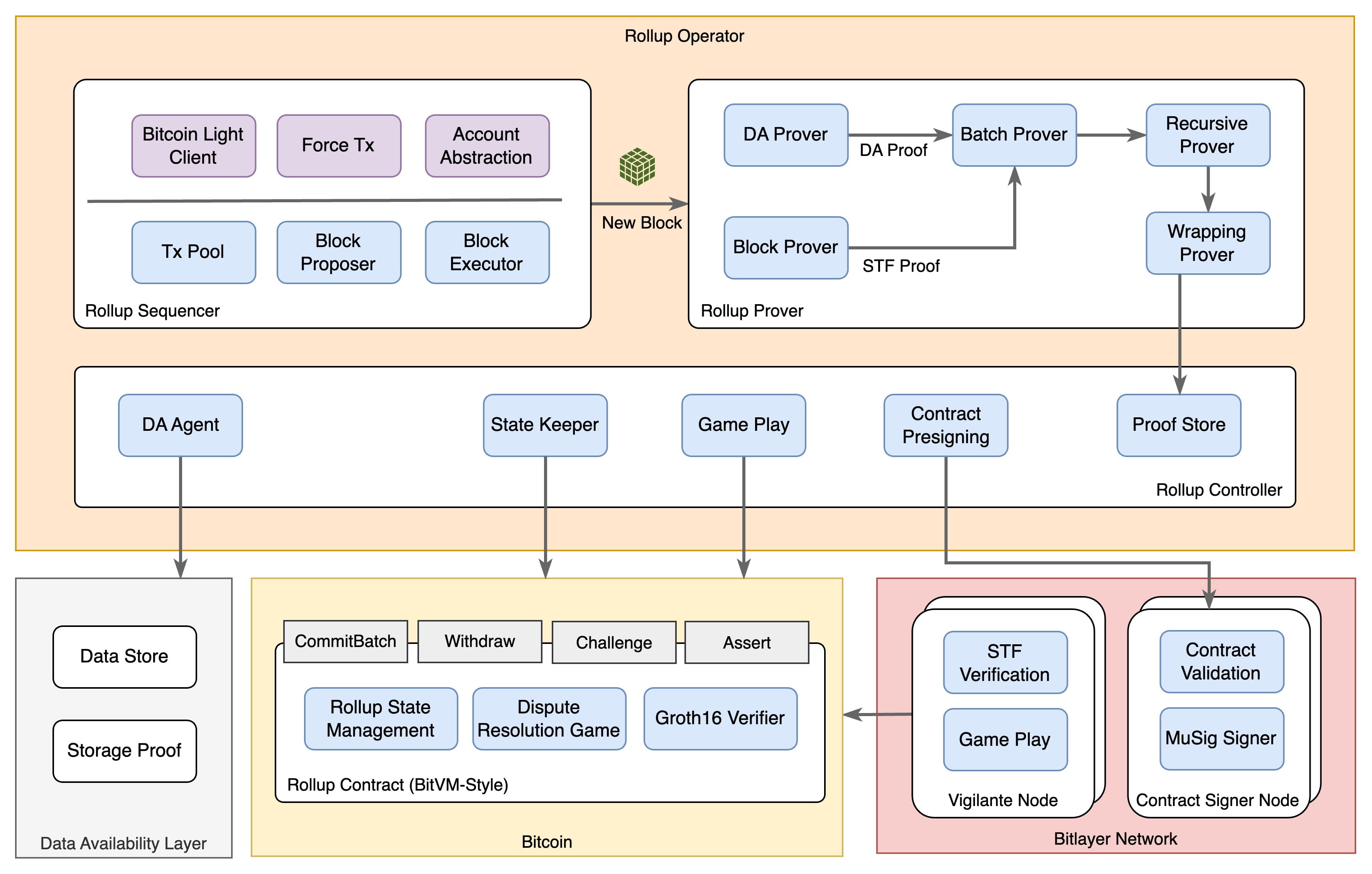
1) Why do costs decrease and speeds increase?
Costs: L2 aggregates multiple transactions into a batch, paying L1's settlement costs once, effectively 'spreading' fixed costs over multiple transactions, thus reducing per capita transaction fees.
Speed: Block creation and execution on L2 are completed at the second layer, TPS and confirmation times benefit from a lighter consensus burden; finality is still provided by L1 verifying batches and proofs.
Bitlayer's Rollup Operator (including Sequencer / Prover / Controller) is responsible for collecting transactions, generating and compressing proofs (to Groth16), then submitting them to Bitcoin for verification; if there are disputes, Watcher and Attester will initiate challenges. (Bitlayer)
2) How is finality ensured?
BitVM-style contracts: Deploy recursive BitVM-style contracts on Bitcoin to verify L2 state transitions; as long as proofs can be verified, finality is anchored to Bitcoin. (Bitlayer, static.bitlayer.org)
Data Availability (DA): Batches will be uploaded to the DA layer; if a review occurs, users can bypass the Operator and force transactions to the DA layer, reducing the risk of single-point monopoly. (Bitlayer)

3) Why does 'composability' make 1+1>2?
On L2, smart contracts can be pieced together like 'blocks':
Market-making × Lending × Derivatives can link into a strategy pipeline;
Assets (like YBTC) circulate among multiple protocols, low fees + fast settlement make composite strategies more viable;
The 'cash flow stacking' formed by multiple protocols can enhance capital efficiency, but also amplify risks like contracts, liquidation, and feedback; risk control measures (limits, hedging, alerts) must be in place. (Bitlayer)
4) The actual impact on general users
Cheaper and faster: Daily interactions (transfers, market-making, lending) have significantly lower costs, faster confirmations, making the experience closer to mainstream public chains.
The use cases for BTC are increasing: Minting BTC into YBTC through BitVM Bridge to participate in L2 DeFi while maintaining BTC price exposure.
Security still reverts to L1: The efficiency you gain on L2 is ultimately backed by Bitcoin's proof mechanism and contract verification.
$BTC is securely protected this way

