


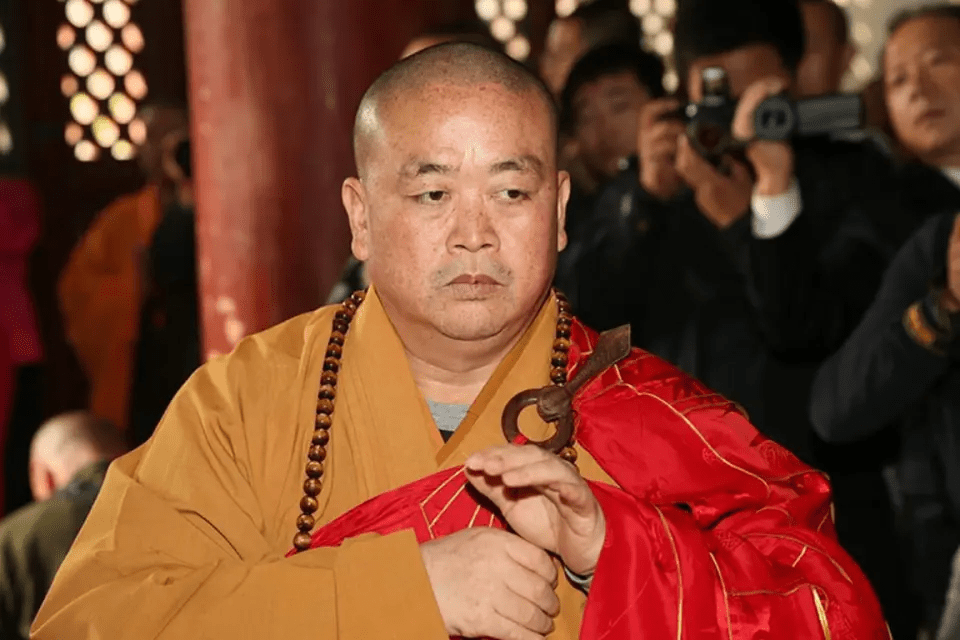
Shanxi Economic Daily reported: A thousand-year-old temple, a pure land of Buddhism, is embroiled in worldly disputes due to the abbot being taken away for investigation.
On July 26, news broke that Shi Yongxin, the abbot of Shaolin Temple, known as the 'world's number one temple,' had been taken away for investigation. According to the official website of Shaolin Temple on July 27, abbot Shi Yongxin is suspected of criminal offenses, misappropriating project funds and temple assets; severely violating Buddhist precepts, maintaining improper relationships with multiple women for a long time and fathering illegitimate children. He is currently under joint investigation by multiple departments. Relevant information will be promptly released to the public.
Phoenix News (Storm Eye) has repeatedly called the business phone of Shaolin Temple-related companies, but the other party has always been either powered off or unanswered. Subsequently, Phoenix News (Storm Eye) also called the Zhengzhou Buddhist Association, which was still on the line.
According to public reports, the last public appearance of Shi Yongxin was 20 days ago when he attended a meeting of all monks at Shaolin Temple. The latest update from Shi Yongxin's verified Sina Weibo account was on July 24, and no new updates have been published since then.
Shi Yongxin involved in investigation storm
During his 26 years of management of Shaolin Temple, this 'CEO' clad in a robe has transformed Shaolin Temple from a secluded Zen temple into a 'commercial empire' spanning cultural tourism, film and television, and food. Now, with the ongoing fallout from Shi Yongxin's 'being taken away for investigation,' the commercialization development of Shaolin Temple is shrouded in mystery.
01 From Incense Money to Capital Game
In 1965, a boy named Liu Yingcheng was born in Yingshang County, Fuyang, Anhui. No one expected that this peasant boy would later become the abbot of Shaolin Temple, famous worldwide.
Time reached the 1980s, when a wave of qigong and martial arts swept across the land of China. In 1981, at the age of only 16, Liu Yingcheng came alone to Shaolin Temple in Dengfeng, Henan, with a yearning for martial arts. At that time, Shaolin Temple was in ruins: weeds were waist-high, mountain paths were difficult to traverse, only a battered mountain gate remained, and there were only a dozen elderly monks over seventy in the temple, completely devoid of the splendor depicted in martial arts novels where 'all martial arts come from Shaolin.'
In this desolation, young Liu Yingcheng became a disciple under the 29th abbot of Shaolin Temple, Master Xingzheng, and received the Dharma name 'Yongxin.' As the youngest disciple in the temple at that time, later disciples had to respectfully call him 'Senior Brother.' From being elected to the democratic management committee of Shaolin Temple at the age of 19 to becoming the director of the management committee at 22, Shi Yongxin became the actual helmsman of Shaolin Temple.
In 1982, the film (Shaolin Temple) set a box office myth of 160 million yuan with a ticket price of 0.1 yuan, allowing this thousand-year-old temple to taste the sweetness of 'traffic economy' for the first time. The appearance of Shi Yongxin rewritten the survival logic of Shaolin Temple.
Before establishing its own industry, fake 'Shaolin monks' and counterfeit 'Shaolin products' flooded the globe. In 1994, Shi Yongxin took the lead in protecting rights through legal means, suing for infringement over 'Shaolin Temple brand ham,' becoming the first case of reputation rights litigation in China's religious community. This victory made him realize the importance of brand protection, leading Shaolin Temple to systematically register trademarks and defend the 'Shaolin' IP.
In 1996, after coming into contact with the internet, Shi Yongxin quickly registered the domain name for Shaolin Temple and established an official website, becoming one of the earliest religious institutions to embrace digitalization. The website not only released temple news but also publicly shared Shaolin classics such as (Yijinjing) and (Xisui Jing), using 'martial arts secrets' as a gimmick to quickly attract global martial arts enthusiasts.
In 1997, Shi Yongxin established Henan Shaolin Temple Industrial Development Co., Ltd., the first company in the Chinese Buddhist community. Since then, the commercial landscape of Shaolin Temple has continuously expanded, involving culture, catering, pharmaceuticals, clothing, and other fields, and gradually building a multi-industrial commercial ecosystem through trademark registration and overseas expansion.
02 'Monks also need to eat'
'All martial arts come from Shaolin,' and Shaolin Temple has always been regarded as the 'origin of martial arts.'
Shi Yongxin once said that monks also need to eat, which was his original intention for promoting the commercialization of Shaolin Temple. To the outside world, Shi Yongxin is both a monk and a successful businessman, regarded as running Shaolin Temple like a CEO. Now, the term 'Shaolin' has become a cultural IP valued at tens of billions, with commercial tentacles extending everywhere from game licensing to co-branded mooncakes.
The commercialization process of Shaolin Temple began with the recognition and protection of its cultural value. Established in 2008, Henan Shaolin Intangible Asset Management Co., Ltd. became the core platform of this process, fully owned by China Songshan Shaolin Temple.
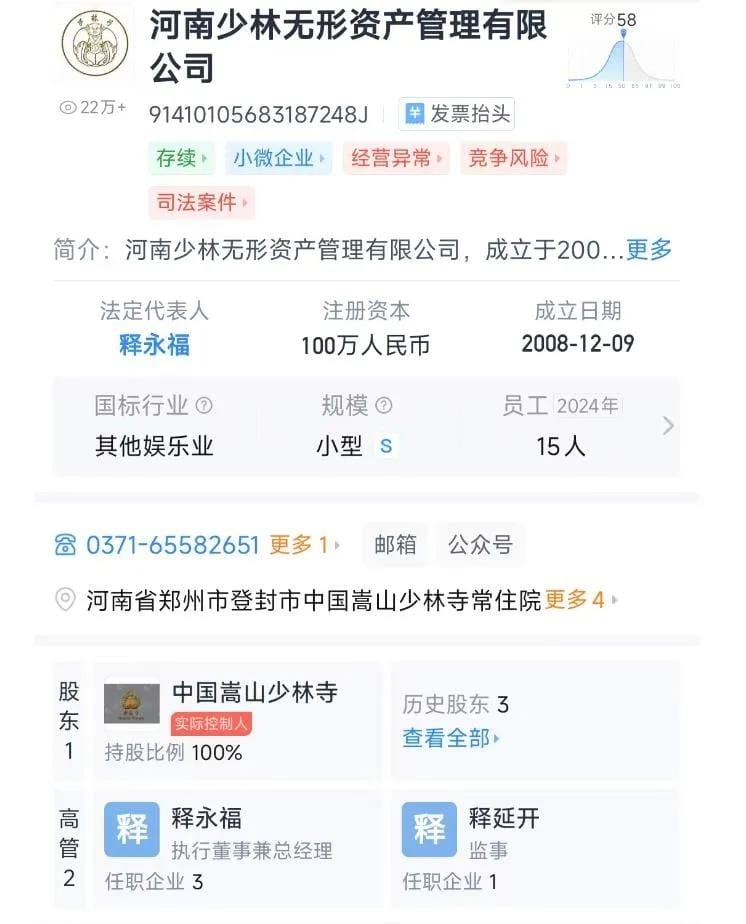
According to Ai Qichao, the legal representative of Henan Shaolin Intangible Asset Management Co., Ltd. is Shi Yongfu, with a registered capital of 1 million yuan. Shaolin Intangible Assets has invested in 14 companies, and its business scope includes cultural and artistic exchanges, martial arts exchanges; cultural performances and brokerage services; conference exhibition services; management of Shaolin and Shaolin Temple's own intangible assets; development of tourism resources and products; and engaging in import and export of goods and technologies.
Shi Yongxin once held 80% of the shares of Henan Shaolin Intangible Asset Management Co., Ltd., which was later succeeded by Shi Yongfu as the actual controller. Shi Yongfu and Shi Yongxin are both monks of Shaolin Temple and share a brotherly relationship, with a hierarchical division of duties. Shi Yongxin is the abbot of Shaolin Temple, while Shi Yongfu has long served as the first seat and participated in the management of the temple's commercial assets.
As one of the most influential Buddhist temples in China, Shaolin Temple, while inheriting Zen and martial arts culture, has also constructed a complete commercialization operation system. Through years of development, its business has covered multiple fields including cultural tourism, intellectual property operations, the big health industry, and emerging technology, forming a unique 'religion + business' model.
Cultural tourism is the core source of income for Shaolin Temple. Shaolin Temple has established Shaolin Kung Fu as a culturally influential brand through live performances such as (Zen Shaolin · Music Ceremony), global tours by martial monk groups, and martial arts training schools both domestically and internationally.
Relevant media data shows that in 2010, tourism revenue from Shaolin Temple accounted for one-third of Dengfeng's financial income, with the tertiary industry developed around Shaolin Temple also accounting for about one-third of local finances. According to data from the Songshan tourism department, ticket revenue from the scenic area reached 350 million yuan in 2017, while related experience project income exceeded 120 million yuan, accounting for nearly one-third. In 2019, the peak number of tourists reached 4.2 million, and based on a per capita consumption of 300 yuan, total tourism-related revenue exceeded 1.2 billion yuan.
Shi Yongxin's commercialization methods are diverse and bold, making him a 'Buddhist CEO.' In addition to direct investments and holdings, according to upstream news reports, Shaolin Temple also develops the 'kung fu' economy through registered companies and trademarks, including buying land, selling medicines, developing online games, opening stores on Taobao to sell meditation supplies and creative items appealing to young people, as well as managing other temples, showcasing a skilled commercialization operation from 'the world's number one temple.'
The big health industry has been a key area of expansion for Shaolin Temple in recent years. According to Li Di Finance, the Shaolin pharmacy, restarted by Shi Yongxin in 2003, has developed products such as joint pain ointment and Shaolin lingzhi tea based on traditional recipes, packaged with 'intangible cultural heritage + modern craftsmanship,' with prices ranging from dozens to thousands of yuan. In 2019, sales exceeded 80 million yuan, making it a 'internet celebrity brand' in the field of traditional Chinese medicine.
After that, Shi Yongxin began to enter e-commerce and new retail. The Taobao store 'Shaolin Happy Land,' launched in 2008, initially sold only Buddhist beads, meditation cushions, and other supplies, but in 2015 transformed into a 'cultural lifestyle brand,' launching Zen fragrances, Shaolin-themed cultural creations (such as 'sweeping monk' dolls), with annual sales rising from millions to 23 million yuan in 2020. In 2021, after Shaolin Temple joined Douyin, its personal account gained over ten million followers in six months, with its first live-streaming sales event generating 5 million yuan in sales. Shi Yongxin has been planning to tap into overseas markets; after leading the martial monk group to Buckingham Palace in the UK in 1999, the Shaolin martial monk troupe now performs over 200 shows worldwide each year, with revenue per show rising from $100,000 initially to nearly $500,000 in recent years.
Shaolin Temple had also expanded its revenue sources by authorizing Shaolin-related online games, collaborating with third-party companies to develop Shaolin music, and auctioning off connected phone numbers, among other avant-garde attempts.
In terms of intellectual property operations, according to data from the National Intellectual Property Trademark Office's China Trademark Network, as of 2022, the number of trademarks applied for by Shaolin Temple has reached 706, covering convenience foods, lighting, catering and accommodation, feed, jewelry, beverages, sanitary ware, and more.
03 The Dilemma of Faith Beneath the Robe
The success of business also brought a dilemma of faith. From Shaolin Temple’s mountain gate to its commercial landscape, Shi Yongxin has spent more than thirty years building a 'Buddhist commercial empire' that spans culture, real estate, and catering. This abbot, who became a monk at the age of 16, is both a guardian of Shaolin culture and a trendsetter in the business world, with controversies surrounding his multiple identities never ceasing.
As ticket prices at Shaolin Temple continue to rise, and its associated companies spend huge sums to bid for commercial land, the public begins to question whether the pure land of Buddhism has become a tool for profit-seeking. The monk's image of 'simplicity and contentment' stands in stark contrast to the identity of a 'commercial empire builder.' Although Shi Yongxin has claimed that commercialization is to better promote Buddhism and protect the temple's cultural relics, the massive profit chain and frequent business activities may provoke new speculations.
In 2015, a person claiming to be Shi Zhengyi, a former disciple of Shaolin, publicly reported online, releasing (Shaolin Temple Abbot Shi Yongxin, this big tiger, who will supervise?), accusing Shi Yongxin of having complex relationships with multiple women and questioning his possession of two ID cards and misappropriation of assets, among seven major issues. Later, after investigations by relevant departments, some allegations were found to be untrue, and some had no evidence.
Shaolin Temple and the Songshan Scenic Area Management Committee once had resentment over uneven revenue distribution, resulting in a huge uproar online. On September 20, 2014, several men in monk robes at Shaolin Temple unfurled a banner demanding an explanation from the Songshan Scenic Area Management Committee regarding ticket revenue. In response, an official from the committee asked, 'What does Shaolin Temple need so much money for?' The interest game between the Buddhist community and local government remains unresolved.
In 2022, a company related to Shaolin Temple, Henan Tiesong Digital Technology Co., Ltd., won commercial land in Zhengzhou for 452 million yuan. Although Shaolin Temple later withdrew from the company’s shareholder list, doubts about 'entering the real estate market' have been constant. These drastic reforms have led to high ticket prices at Shaolin Temple, and the annual incense money is astonishing, raising questions among some about the temple's principle of 'simplicity and contentment.'
In February 2015, news that 'Shaolin Temple will build a four-star hotel and golf course in Australia' sparked explosive reactions on domestic and international online media. Currently, among the companies invested by Shaolin Intangible Asset Management, 7 are still active, 8 have been canceled, and 1 has been revoked. The revoked company was the Shaolin Zhongyao Cultural Industry Development Co., Ltd. established in 2014, whose business scope included cultural industry investment, cultural facility construction and project introduction, and real estate development.
Shi Yongxin once told Phoenix News Finance that Zen promotes seeing through and letting go; everything comes from the heart. A pure heart leads to a pure land; a peaceful heart leads to a peaceful world. Managing one's heart is the greatest contribution to society, humanity, oneself, and family. Now, as the commercial empire beneath the robe grows larger, and the boundaries between faith and money become increasingly blurred, we can't help but ask: how should he truly 'let go'?
Source | Phoenix News (Storm Eye)
