


Around the year 2140, there will no longer be new bitcoins issued in the market. All 21 million bitcoins will have been fully distributed, meaning Bitcoin miners will only be able to earn rewards in the form of transaction fees. Critics argue that relying solely on transaction fees is insufficient to maintain the security of the Bitcoin network.
Key points
After 2140, block subsidies will no longer exist. Bitcoin miners are crucial for processing transactions and securing the network, at which point they will only be compensated through transaction fees paid by users.
The gradual decrease in mining rewards raises questions about Bitcoin's long-term security, as mining rewards serve as the "security budget" for the Bitcoin network.
A reduction in the security budget could expose the Bitcoin network to the risk of a 51% attack and/or lead to increased centralization of the network.
Bulls believe that the increase in Bitcoin asset value and future block demand will make a market solely based on transaction fees economically viable for Bitcoin miners.
Is Bitcoin's future destined to fail?
The most famous characteristic of Bitcoin is its scarcity, which has earned it the title of "digital gold." To ensure scarcity, the rewards paid to Bitcoin miners are gradually reduced every four years through "Bitcoin halving." However, this mechanism presents a long-term, severe challenge.
The main incentive for miners in the Bitcoin network is the reward from newly generated bitcoins, known as the block subsidy, which will completely disappear around 2140 through the aforementioned Bitcoin halving mechanism. The block subsidy effectively serves as the security budget for Bitcoin, paid to miners to ensure the security of the Bitcoin network. This raises a question:
Will the remaining transaction fee incentives be sufficient to secure the network?
Understanding Bitcoin's incentive model
To understand the challenges of the post-subsidy era, one must examine the current incentive mechanisms that secure the Bitcoin network. Every ten minutes, a miner verifies a new transaction block and receives a block reward, which consists of two parts.
Block subsidy: This is the predetermined amount of new bitcoins generated. When Bitcoin was first launched, the subsidy for each block was 50 bitcoins. It is halved every four years, an event known as "Bitcoin halving." This mechanism distributes 21 million bitcoins over several decades and is the primary source of miners' income to date.
Transaction fees: This is the cost included by users in transactions to incentivize miners to add them to blocks. You can think of it as an additional "tip" paid to Bitcoin miners to help those who want to ensure their transactions are completed smoothly, creating a competitive market environment. As of the writing of this article, the average transaction fee for Bitcoin is $1.30.
Bitcoin halving: Reducing issuance rate
Every Bitcoin halving is a cyclical efficiency test for the mining industry, as each halving effectively reduces miners' income by half. This ensures that only the most efficient miners can profit, while less efficient miners may shut down; however, the potential negative effect is that this could temporarily lead to a decrease in the network's hashrate.
The hashrate of the Bitcoin network is the total computational power used to secure the Bitcoin network. When Bitcoin miners stop working, the hashrate decreases. A reduction in network hashrate means the Bitcoin network is more vulnerable to network attacks, such as a 51% attack (where a single entity controls enough hashrate to disrupt the blockchain).
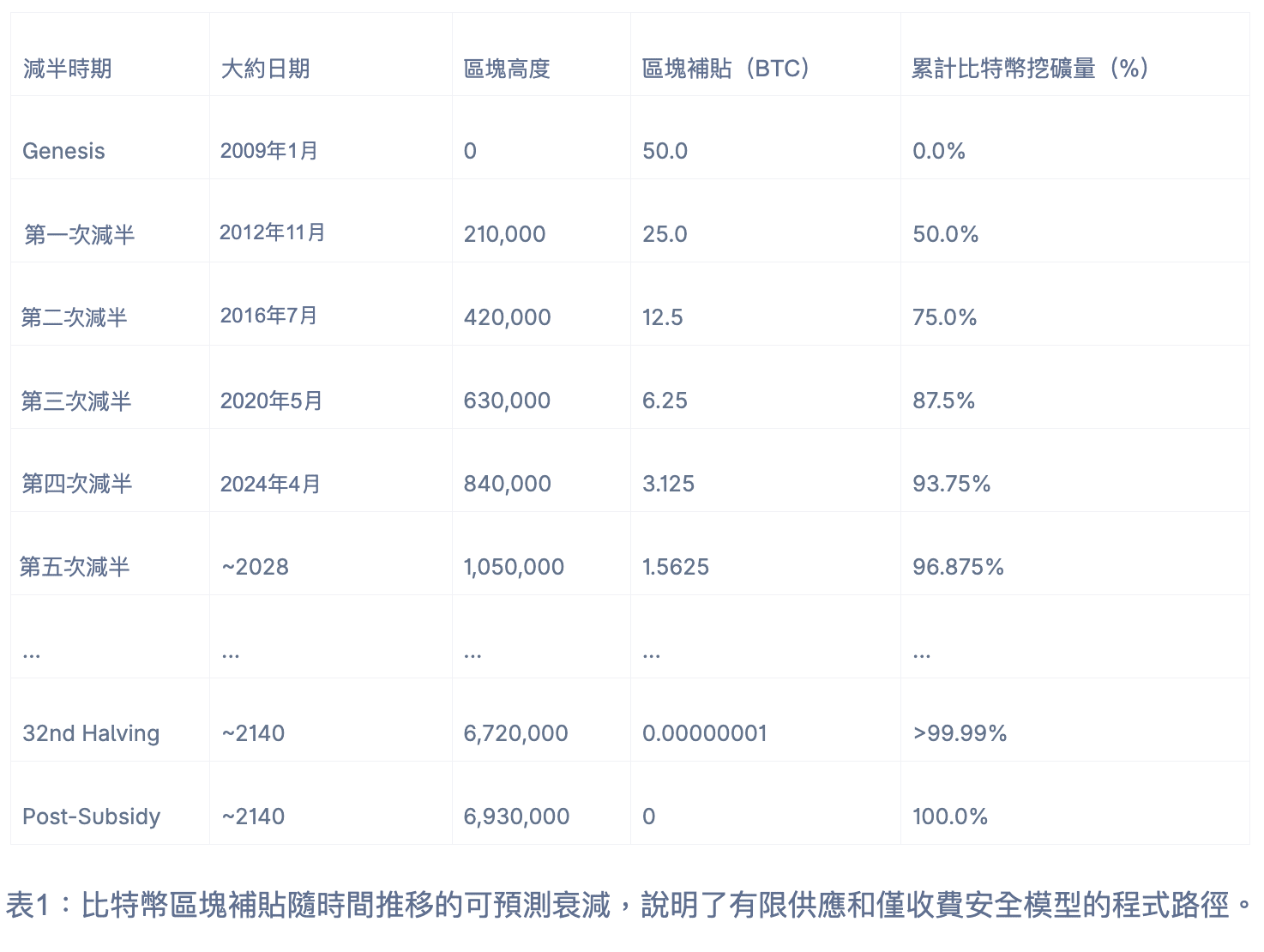 Source: CoinGecko
Bitcoin block reward in 2025
To further illustrate the importance of Bitcoin block subsidies to miners, here are the details of the rewards obtained for successfully mining a Bitcoin block.
According to the transaction fee data from the blockchain, in July 2025, each new Bitcoin block contains about 0.025 bitcoins in transaction fees. As of April 2024, the block subsidy is 3.125 bitcoins.
In summary, the "wage" for Bitcoin miners mining a block is:
Guaranteed reward (newly generated bitcoins): 3.125 bitcoins
Additional "tip" (from transaction fees): approximately 0.025 bitcoins
Total earnings per block: approximately 3.15 bitcoins.
The "tip" in transaction fees only constitutes a tiny fraction of the miner's total income, meaning that in a market relying solely on transaction fees, miners are almost certainly unable to profit.
Discussion on the economic viability of Bitcoin in the post-subsidy era
Relying solely on Bitcoin transaction fees is currently insufficient to secure the Bitcoin network. However, bulls believe that by 2140, demand will drive transaction fees to levels far above the current ones, while bears foresee a crisis. The following will explore the main arguments for each viewpoint.
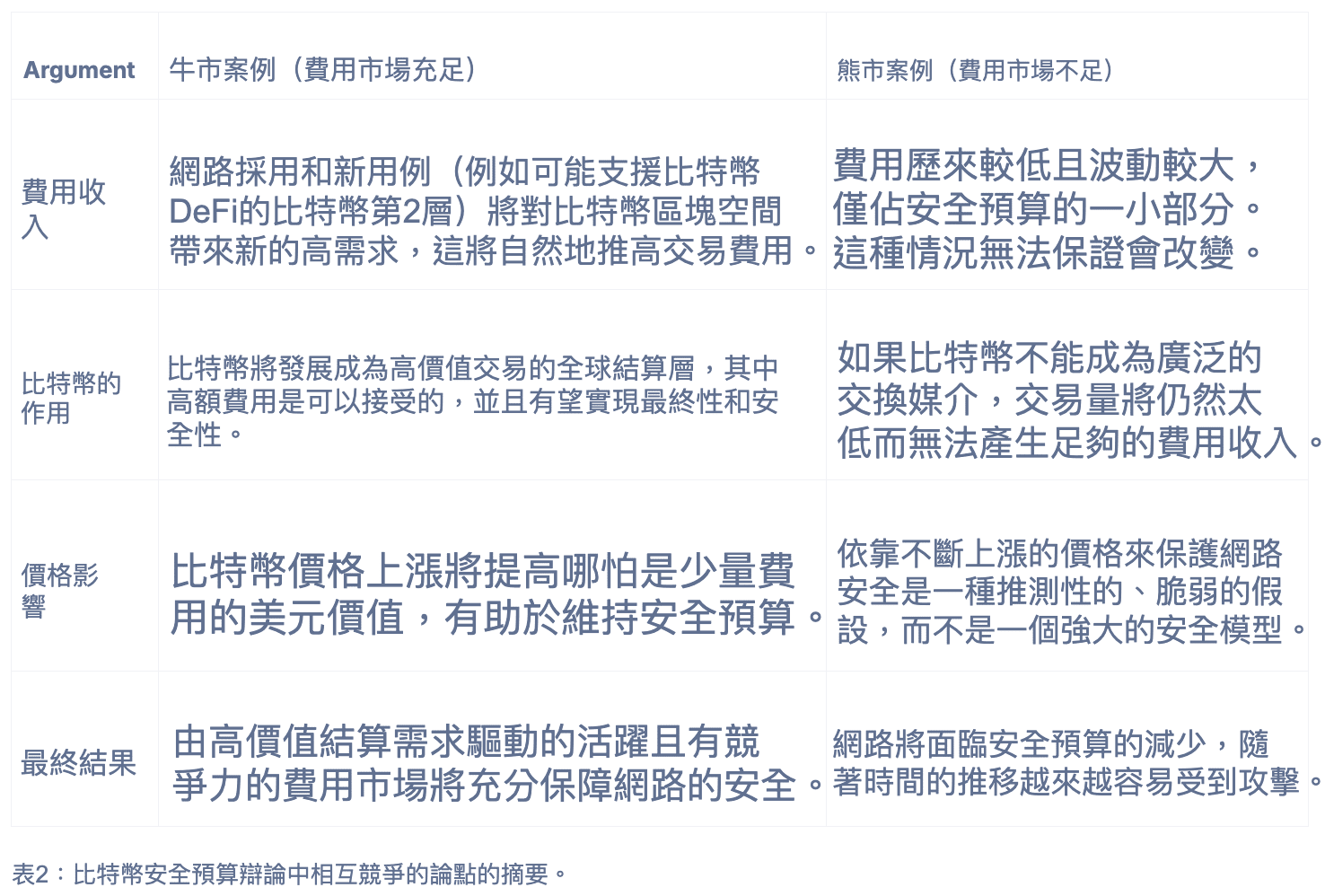 Source: CoinGecko
Pessimistic argument: Reduction of security budget
The basis for the pessimistic view is simple: the historical trend of transaction fees has not shown an increase sufficient to compensate for the reduction in subsidies. Critics worry that each halving will cut the security budget, gradually lowering the network's security.
Optimistic argument: Strong fee market
Optimists believe that Bitcoin will be supported by its ever-increasing asset value and growing block demand. Firstly, with the help of Bitcoin's deflationary design, the network will evolve into an asset class worth trillions of dollars, so even a small proportion of Bitcoin transaction fees in the future will generate considerable income for miners.
Secondly, there will be a fundamental growth in demand for block space itself, which could emerge in the form of large institutional settlements, layer 2 scaling solutions (Layer 2 rollups), or some yet-to-be-discovered innovations. Ultimately, these factors will drive up transaction fees, making them economically viable in the future.
Potential risks of reduced security budget
The decline in the security budget could lead to a large number of Bitcoin miners shutting down, thereby reducing the total hashrate of the Bitcoin network, which could trigger a series of potential risks and put pressure on the network's integrity.
51% attack
The most concerning threat is a 51% attack, where an entity controlling more than half of the network's hashrate can reverse transactions (double spending) or censor the network. The security budget is a primary line of defense; the higher the budget, the more hashrate it supports, and the higher the cost of an attack. Nowadays, for rational economic agents, the cost of launching such an attack is prohibitively high, as it could likely lead to a crash in Bitcoin prices, thus reducing the value of the attacker's own hardware. However, for geopolitical reasons, state-level actors may be willing to incur such losses to disrupt the network. As the security budget decreases, the cost of attacks lowers, and the likelihood of this threat increases in the long term.
Hashrate fluctuations
A more direct risk is miner capitulation, where the reduction in income due to Bitcoin halving forces a large number of miners to shut down their mining rigs, leading to a sharp decline in hashrate. Although difficulty adjustments will correct this, a rapid exit by miners could create a vulnerable window in the short term.
Bitcoin innovation as a solution
The Bitcoin community is actively developing solutions to promote network adoption and mitigate the risks arising from the gradual reduction of Bitcoin's security budget. Here are some of these solutions.
Layer 2 solutions
One solution to the limited on-chain capacity of Bitcoin is L2 blockchain. L2 is a sub-blockchain built within the main blockchain (in this case, Bitcoin) that transfers transactions from the main blockchain to these L2s to increase transaction speed and reduce costs.
L2 solutions like the Lightning Network enable Bitcoin to be used for everyday transactions, which have already seen a degree of adoption in Vietnam. The Vietnamese Bitcoin community "Bitcoin Saigon" frequently collaborates with local businesses, cafes, and markets to promote and support Bitcoin payments powered by the Lightning Network. If L2 solutions succeed, they will propel Bitcoin from niche applications to everyday applications, thereby increasing transaction fees on the main Bitcoin blockchain network.
Bitcoin Runes
The runes that became popular in 2024 are a token standard that leverages Bitcoin's UTXO model (where the wallet's balance is made up of unspent bitcoins from individual blocks, similar to tokens and cash in a wallet) and the OP_RETURN opcode (which allows embedding a small amount of data in Bitcoin transactions, akin to the memo field on a check). Runes made it possible to create meme coins and community tokens on the Bitcoin blockchain. At its peak, runes pushed Bitcoin's average transaction fee to a historic high of $127 per transaction. Although market interest in runes has waned, this innovation demonstrates that new applications could drive up Bitcoin transaction fees, paving the way for a Bitcoin economy sustained solely by transaction fees in the future.
Future user experience
For ordinary users, interacting with Bitcoin may be a multi-layered experience. Sending transactions directly on the first layer is expected to become expensive, suitable only for large transfers. For everyday transactions, users will almost certainly interact with Bitcoin through L2 solutions like the Lightning Network, which can provide instant and low-cost experiences, or through Wrapped Bitcoin. This shift means that the user experience for small payments will still be feasible but will be realized on a different technical layer than the main blockchain.
Long-term outlook for investors
For investors, the end of block subsidies raises a critical conflict between two core attributes of Bitcoin (scarcity and security). Investors are attracted to Bitcoin's fixed supply, but they now must face the reality that the network's security is dynamic and will depend on the future transaction fee market. If the network supporting the scarce asset is perceived to have vulnerabilities, its long-term value becomes questionable. Ultimately, the value of Bitcoin derives not only from its technical features but also from the market's collective confidence in its ability to remain secure.
Conclusion
The day the last new Bitcoin is mined does not signify the end of Bitcoin, but rather the beginning of its ultimate test. The end of block subsidies is the expected final state of the protocol, and the ecosystem has over a century to adapt to this challenge. The long-term security of Bitcoin will be determined by the complex interaction of various forces: technological innovations in L2 solutions, economic evolution of the transaction fee market, and the social consensus around Bitcoin as a global settlement layer.
Note that this article discusses concerns that may arise in the distant future of Bitcoin, given that there is a time gap of up to a century from now until 2140, and its content is highly speculative.
This article is reprinted with permission from: (PANews)
Original title: (What Happens When All 21 Million Bitcoins Are Mined?)
Original author: Loke Choon Khei, CoinGecko
Translation: Felix, PANews
What happens when all bitcoins are mined? Can on-chain transaction fees support the entire ecosystem? This article was first published in "Crypto City".