


NNS has and will continue to develop in a way that increases the decentralization of NNS participants and thereby reduces risk to the Internet Computer Protocol and its stakeholders.
The decentralization of NNS can be measured in a number of ways, including decentralization away from large genesis token holders, voting power distribution, and the ability for future participants to gain a significant share of the vote.
In the first 21 months since the launch of the Internet Computer mainnet (Genesis) in May 2021, most voting power has been transferred to post-Genesis participants, and most ICP has been staked in NNS, effectively eliminating the opportunity for a 51% attack.

1. Background: What is NNS?
The Network Nervous System (NNS) is a permissionless on-chain DAO that allows the management of Internet computer protocols in an open, decentralized and secure manner. NNS has full control over all aspects of the network, enabling it to upgrade and scale efficiently.
ICP is the utility token of the Internet Computer. Token holders from all over the world can stake their tokens in NNS neurons to participate in network governance and vote on whether to adopt or reject network proposals, while receiving voting rewards through participation.
Anyone who stakes tokens in neurons within NNS can also submit proposals to suggest changes, giving the ICP community the power to guide the evolution of the blockchain and optimize it for developers, entrepreneurs, and users.
The decentralization of NNS is important to ensure that one entity or multiple entities do not steer the Internet Computer in a direction that satisfies their own interests at the expense of the interests of other stakeholders in the Internet Computer. This blog post analyzes the current status and trends of NNS decentralization.
2. Decentralization measures
This analysis will explore the progress and direction of NNS towards decentralization through three measures:
Creation Entity — How have voting rights changed since creation?
Nakamoto Coefficient - How much voting power is concentrated today?
Future Participants and 51% Attacks — How likely is it that concentration of voting power will occur in the future?
Liquid Democracy — How decentralized is the NNS liquid democracy system?
Analysis considerations
Similar to Ethereum node operators and wallet addresses, it is impossible to know the entity that owns a neuron and whether an entity owns multiple neurons. Furthermore, public information about the existence of a neuron is only available if the neuron identification number is known.
Identification numbers are generally made public by neuron owners searching for their neuron ID in a public dashboard (referred to as "found neurons"), with the exception of genesis-created neurons, which are all discovered neurons.
Note that “found neurons” are different from “known neurons”, which are neurons that appear in the NNS front-end Dapp as a user option in the liquid democracy system (and are set by NNS proposal to self-identify and name neurons).
Creation Entity – How have voting rights changed since creation?
The Internet Computer was publicly launched on May 10, 2021, and during the Genesis launch, stakeholders in the Internet Computer project were awarded ICPs to be locked in Neurons for different time periods.
Owners of these neurons include the DFINITY Foundation, the ICA Foundation, seed and early contributors, strategic partners, and team members. A full breakdown of the genesis token distribution can be found in Messari’s report: Messari | Introduction to Dfinity and the Internet Computer.
A key measure of decentralization is to transfer voting power away from these early stakeholders, who often hold a large amount of ICP due to their early contributions.
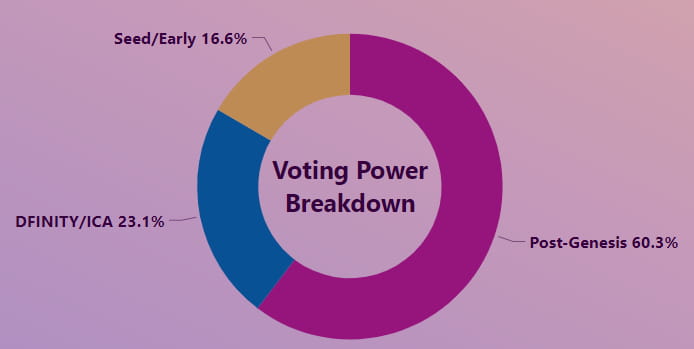
The combination of some Genesis Neuron holders dissolving their Neurons (thus being able to “cancel” Neuron ICP) and new participants on NNS has resulted in the majority of voting power being held by post-Genesis Neurons (those that were created), who currently control 60.1% of voting power on NNS.
The DFINITY and ICA Foundation currently control 22.7% of the voting power, a significant decrease from the 39.5% of voting power they controlled after Creation. You can track DFINITY and ICA’s voting power on the public dashboard.
At this time there are 4,592 Seed and Early Contributor Neurons with voting power, the largest of these Neurons has 1.28 M votes (0.29% of total voting power), Seed round contributors receive initial ICPs in 49 different Neurons and the first 49 Seed round Neurons control 11.1 M votes (2.5% of total voting power).
This means that a top-seeded contributor could control at most 2.5% of total voting power, but a top-seeded contributor may actually control much less.
There are currently 40.1M voting power (9.1% of total voting power) held by seed and early stakeholders in neurons that are being dissolved (a process that reduces the amount of time a neuron has to stake, and, at the same time, reduces voting power).
As the voting power of 40.1M decreases due to the dissolution of neurons, post-genesis neurons are gaining voting power relative to seed and early stakeholders.
Creation Entity - Conclusion
In the first year and a half of the Internet Computer mainnet launch, the voting power held by Genesis Neurons has dropped to 39.9%, and will continue to decline as some of their neurons dissolve and new participants stake on NNS.
This is a clear sign of decentralization, with early stakeholders tending to have large stakes, while new participants in the governance of the internet computer tend to have smaller stakes.
Nakamoto coefficient — How much voting power is concentrated today?
The Nakamoto Coefficient is the minimum number of entities required to obtain 51% of the voting power in a subsystem (an independent control system) of the blockchain. It is calculated by adding up the entities with the largest voting power until 51% of the total voting power is reached.
In the case of NNS, 225M voting rights are currently required to own 51% of the total voting rights. The following analysis is specifically for the NNS voting rights subsystem. Subsequent articles will discuss the Nakamoto coefficients of other Internet computer subsystems (such as nodes and node providers).
This analysis could only be performed on found neurons, which account for 64.6% of the NNS voting power. DFINITY and ICA Foundation together control 22.7% of the voting power, and the remaining 41.9% of the found neuron voting power is made up of 11,264 neurons.
The voting power of these 11,264 Neurons is broken down into 56.5% for Seed Round stakeholders, 23.2% for Early Contributor stakeholders, 19.4% for Post-Genesis participants, and 0.9% for Node Providers.
In terms of the Nakamoto coefficient, the DFINITY/ICA neurons plus the first 1,283 neurons found in the voting power reached 51% of the voting power.
The worst case scenario for the Nakamoto coefficient of a neuron is found to be DFINITY/ICA plus 12 seed stakeholder entities (individuals or organizations that own or control one or more neurons), plus 17 early contributor entities plus 17 node provider entities plus 87 post-genesis participants, resulting in a Nakamoto coefficient of 134, assuming that the largest neurons in the post-genesis participant group are owned by different entities.
For reference, the creator of the Nakamoto Coefficient, Balaji Srinivasan, calculated coefficient values of 5 and 2 for major client code updates for Bitcoin and Ethereum in 2017. More recent benchmarks can be found in the Solana Foundation’s 2022 Mid-Year Report, which calculated Solana’s Nakamoto Coefficient to be 31, the highest among its Proof-of-Stake peers, but also taking into account that the methods for updating mainnet code vary from PoS blockchain to PoS blockchain, this benchmark is not necessarily apples to apples.
As mentioned above, the Nakamoto coefficient is calculated for the subsystem, and there will be other articles that calculate the Nakamoto coefficients for other subsystems (including nodes and node providers).
At the time of writing, the ICA dashboard reports 153,215 neurons, of which 18,279 have been discovered, and the remaining 134,936 undiscovered neurons total 156 M votes, an average of 1,157 votes per neuron.
A counterargument to the above analysis is that if all 134,936 undiscovered neurons belonged to the same entity, then the voting power of these neurons plus the voting power of DFINITY/ICA would be 58%, which would give NNS a Nakamoto coefficient equal to 2.
Nakamoto Coefficient - Conclusion
Using data from discovered neurons, the worst-case NNS Nakamoto coefficient is 134, meaning that at least 134 different people and organizations would need to collude to take actions that go against the best interests of the Internet computer protocol.
This Nakamoto coefficient of the NNS subsystem is relatively strong compared to other blockchain coefficients, especially in the subsystem that updates the main client code.
Future Participants and Sybil Attacks — How likely is it that voting power will be concentrated in the future?
At the time of writing, it is impossible for new participants of NNS to obtain 50% of the voting power regardless of their financial resources. This is because new participants need to stake 220.75M ICP in an 8-year neuron to reach 50% of the voting power, and there are only 178.7M ICP not yet staked on NNS.
Furthermore, with the exception of DFINITY/ICA, current NNS participants cannot acquire enough ICP to obtain 50% of voting power given that the maximum possible voting power of a genesis entity is 11.1 million (from genesis entity analysis).
DFINITY/ICA could get 50% of the voting power, but they would need to stake an additional 120M ICP in an 8 year neuron to achieve this, which is theoretically possible but unlikely given that there are currently 178.7M ICP unstaked, a reference point is that there are only 52.4M ICP on major exchanges.
Since most of the ICP is already staked on NNS, it is highly unlikely that voting power will be concentrated in one entity.

Liquid Democracy — How decentralized is the NNS follower system?
NNS utilizes a liquid democracy system where neurons can choose, but not be obliged to, delegate their voting rights to one or more other neurons by “following”.
This is a very fluid system as neuron holders can remove or change their following status at any time, and NNS also has many categories of proposals (e.g., “governance” or “system container maintenance”) and neurons can configure their followers by proposal topic.
The recent NNS proposal showed that over 99% of voting power is following non-governance subject DFINITY or ICA neurons, and this has remained consistent since Genesis.
Regarding the topic of governance (and a new one called SNS and Community Funds), the following structures are more decentralized and distributed. Since neurons can follow multiple neurons and their subsequent elections can be changed at any time, it is difficult to give an exact number on follower counts, but an analysis of recent governance proposals can provide insights into the integration of voting rights for liquid democracy mechanisms.
This analysis used Proposal 96475, which received 221 million votes. The highest vote share of total NNS voting power for this proposal was:
23% (DFINITY/ICA neurons, indicating that few neurons follow DFINITY)
5.6% (most likely neurons with known conclusions)
5.1% (most likely neurons known to ICDevs)
3.5%
1.3%
1.3%
The remaining vote changes represent less than 1% of the total voting power, and voting changes can be viewed on the Proposal 96745 dashboard page, which received 51% of the total voting power.
A common view of liquid democracy is that the behavior of a neuron following another neuron is similar to a neuron voting based on the reputation and recommendation of another neuron. From this perspective, the accumulation of voting power due to the liquid democracy system on NNS does not lead to centralization, just as neuron participants seek expert opinions on proposals and vote based on that opinion.
Furthermore, since neuron owners can modify or delete their follow status at any time, the risk of centralization in liquid democracy systems is reduced. From this perspective, accumulating voting power through liquid democracy does not conflict with the goal of decentralizing voting power.
Liquid Democracy - Conclusion
DFINITY’s 23% of voting power gained by following is greater than the voting power gained by following the next five known neurons, which may change over time and trends as there has been a trend since genesis to split voting power between more neurons and known neurons.
A key area for improvement in the decentralization of Internet computer governance is greater participation in governance topics, as recent proposals have a participation rate of about 51%.

3. Overall conclusion
The voting power of NNS is currently found to be 134 (64.6% of voting power), which means that at least 134 entities need to collude to take actions that benefit themselves at the expense of other Internet computers.
These 134 entities include DFINITY and ICA Foundation, as well as some seed and early contributor stakeholders that have been discovered and disclosed, but the majority of the 134 entities are unknown.
The Nakamoto coefficient of NNS has been trending upward over time as larger stakeholders dissolve their NEURONS and new, relatively smaller participants hold stake on NNS. Given that the majority of ICP is already staked on NNS, it is difficult to see how one entity could pull off a 51% attack without the strong cooperation of many other entities.
The natural conclusion is that the risks associated with NNS centralization have declined significantly since genesis and appear to continue to decline.

IC content you care about
Technology Progress | Project Information | Global Activities

Collect and follow IC Binance Channel
Get the latest news