

Source: André Beganski, Decrypt
Compiled by: Moni, Odaily Planet Daily
On March 2, Silvergate Capital Corporation, the holding company of crypto-friendly bank Silvergate Bank, announced the postponement of its annual 10-K report to the U.S. Securities and Exchange Commission (SEC), claiming that it may face capital insufficiency and is re-evaluating its business. Silvergate claimed that accounting firms and independent auditors asked it to provide more information to respond to potential U.S. congressional inquiries and subsequent investigations by the Department of Justice and banking regulators.
After the news broke, the entire digital asset industry expressed its desire to distance itself from Silvergate, and Silvergate's stock price fell like a waterfall, closing at $5.72 on Thursday, a drop of 57.69%. Compared with the historical high of $222 created during the last crypto bull market in November 2021, it has shrunk by more than 93%.
The crypto industry is abandoning Silvergate
Silvergate has confirmed that a series of recent events may affect its ability to "continue to operate", which is obviously not what the crypto industry wants to see. As soon as the news came out, many crypto companies and exchanges expressed their opinions and distanced themselves from Silvergate.
1、Coinbase
Coinbase was the first crypto exchange to announce that it would no longer work with Silvergate. On the evening of March 2, Coinbase announced on social media that in light of recent developments and out of caution, it would no longer accept or initiate payments with Silvergate, nor would it use Silvergate as a US dollar banking partner for Prime customers. Coinbase also admitted that its corporate risk exposure to Silvergate was minimal, and that it had switched its US dollar banking business to Signature Bank, a change that did not affect payment instructions for pounds or euros.
2、Crypto.com
Singapore-based cryptocurrency exchange Crypto.com also announced that it would also refuse to transfer funds into and out of the platform through Silvergate, and a spokesperson for the exchange also confirmed that "deposits and withdrawals through Silvergate have been suspended."
3、Bitstamp
On March 3, Bitstamp released a statement on its official blog saying that the Luxembourg-based cryptocurrency exchange has temporarily canceled the Silvergate Exchange Network (SEN) service for all users, as well as all US dollar wire transfer support provided through Silvergate Bank. For instant US dollar payments, Signature Bank's SigNet service is currently required. In addition, Bitstamp clarified that its platform customer funds are safe, Bitstamp has no significant risks to Silvergate Bank, and the exchange has cooperated with 17 banking partners around the world and implemented alternative banking services to ensure that disruption to customers is minimized.
4、Gemini
The cryptocurrency exchange Gemini said on its official Twitter account that it is actively monitoring the situation at Silvergate Bank, but that no GUSD or customer funds are deposited in the bank. In addition, the exchange has stopped customer deposits/withdrawals through ACH, and the fund exchange service initiated by Silvergate Bank to Gemini has also been suspended.
5、Circle
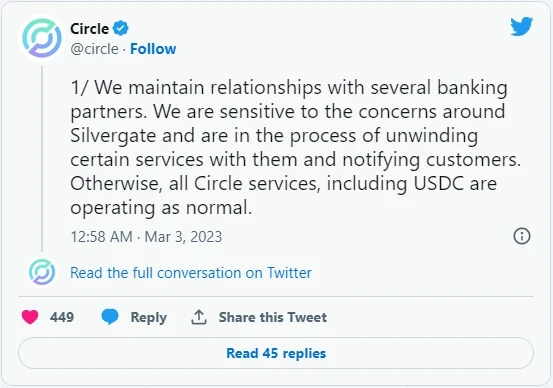
Circle, the issuer of the US dollar stablecoin USDC, posted on social media that Circle is in contact with many bank partners, is currently paying close attention to the market's concerns about Silvergate, and is in the process of unblocking some services with Silvergate. Circle said that it will promptly notify customers of relevant progress, and that all Circle services, including USDC, are currently operating normally. Circle has multiple reserve and settlement bank partners who are responsible for managing USDC's cash reserves and providing strong liquidity management.
6、Paxos
On the evening of March 2, Paxos, the issuer of the U.S. dollar stablecoin BUSD, released a statement to Silvergate Bank on social media, saying that the company had no substantive contact with Silvergate and that Paxos’ top priority has always been to protect its customers’ funds and assets and leverage a diverse network of banking partners.
7、Tether
Paolo Ardoino, chief technology officer (CTO) of Tether, the issuer of the U.S. dollar stablecoin USDT, said on social media that the company has no exposure to Silvergate and has not had any contact with Silvergate.
8、Galaxy Digital
Mike Novogratz's crypto investment company Galaxy Digital said in an official tweet that in light of recent developments, Galaxy has stopped accepting or initiating fund transfers to Silvergate. As a company, Galaxy has no substantial contact with Silvergate, and this action was taken out of an extremely cautious decision and as part of the risk management process to ensure the safety of customer and company assets.
9、Cboe Digital
Cboe Digital also immediately issued a clarification notice to its members and participants, suspending all transactions with Silvergate and using other banking partners to process cash transactions.
10、MicroStrategy
As the listed company with the largest Bitcoin holdings, MicroStrategy confirmed that it has a loan from Silvergate, but it will not mature until the first quarter of 2025. The company said that this loan will not accelerate Silvergate's bankruptcy progress, and confirmed that the Bitcoin collateral is not held by Silvergate and has no other financial relationship with it except this loan.
Another “victim” of the FTX collapse?
Silvergate is actually another "victim" of the FTX collapse. Due to the collapse of FTX, Silvergate's bank deposits have dropped sharply. It previously reported that it processed a large number of withdrawal transactions in the last fiscal quarter of 2022, with 81 million U.S. dollars withdrawn in January alone, accounting for 68% of its deposit balance. In order to meet the large withdrawal demand in the crypto market, Silvergate had to obtain a loan of US$4.3 billion from the Federal Home Loan Bank of the United States and sold debt securities worth about US$5.2 billion.
Silvergate Bank’s poor performance even aroused the anger of U.S. congressmen. Senator Elizabeth Warren took the lead in writing a letter to Silvergate CEO Alan Lane, requesting stricter scrutiny of Silvergate’s transactions with FTX and Alameda. At that time, they were all worried that Silvergate’s transactions with FTX Exchange would "further introduce crypto market risks into the traditional banking system."
In January, the U.S. Department of Justice initiated an investigation into Silvergate’s handling of account funds for FTX, specifically potential criminal conduct that allowed FTX to deposit deposits, including user funds, into the Alameda Research account.
In fact, the market has long sensed the potential risks, and Wall Street investors including billionaire George Soros have recently shorted Silvergate. According to MarketWatch data, at the end of February, Silvergate had become the most shorted stock on Wall Street, with shorted stocks accounting for 73.5% of all Silvergate stocks available for investors to buy and sell, ranking first.
Frankly speaking, Silvergate was once one of the few banks in the United States that handled cryptocurrency-related funds. Circle, Coinbase, Binance US, and several local U.S. crypto institutions all had cooperative relationships with it. However, as the saying goes, when the wall falls, everyone pushes it; when the tree falls, the monkeys scatter. When Silvergate got into trouble and found it difficult to extricate itself, crypto companies left it and looked for other banking solutions.
Although Silvergate has stated that it will submit a 10-K report as soon as possible, the crypto market's confidence in it seems to have been worn down. Whether Silvergate can make a comeback or fall apart, perhaps only time can give us the answer.