


Recently, the 'Gor' token on the Solana chain surged 400 times within 24 hours, with its market value briefly exceeding 40 million dollars. The whole incident actually began with @lex_node, the founder of MetaLeX, expressing concerns about Solana's decentralization, which led to exchanges on social media with Solana co-founder Toly, gradually revealing the ideology behind the token.

Who is Gabriel Shapiro?
Gabriel Shapiro, 'lex_node', before serving as the General Counsel of Delphi Labs, was initially a lawyer at a Wall Street law firm in Silicon Valley, specializing in assisting tech companies like PayPal and Facebook with buy-side acquisitions. The turning point to join cryptocurrency was quite coincidental; during a Valentine's Day dinner date, he received a call from a Facebook shareholder asking him to return to the office to help Mark Zuckerberg complete the acquisition of WhatsApp.

It is said that Mark happened to meet the WhatsApp team at a restaurant and persuaded them to sell the company, with the deal completed in just five days. Gabriel Shapiro, the lawyer responsible for this acquisition, deeply studied WhatsApp's end-to-end encryption technology during the research process, which led him to a deeper understanding of the cryptocurrency industry.
In 2015, he came into contact with Ethereum and attended an Ethereum conference where the speaker was Nick Szabo, who was once thought to be 'Satoshi Nakamoto' himself. He vividly described The DAO on stage, which deeply fascinated him as someone working in the legal field. He believed in a DAO-type economic system that automatically adjusts operations through programs and rules.
He built MetaLeX on the theory of 'New Control Theory Economy DAO,' which connects DAO with the real world by combining autonomous on-chain code with off-chain legal entities through a unique on-chain protocol and off-chain legal arrangements, creating a flexible, efficient, legal, and accountable cybernetic organization for its DAO.
Ethereum Classic = Solana, Ethereum = Gorbagana?
Yesterday, Gabriel Shapiro engaged in a heated debate regarding 'the legitimacy of the chain and trademark control.' He reviewed Ethereum's fork after the 2016 DAO incident, pointing out that the Ethereum Foundation successfully shaped the new chain created by the hard fork into the legitimate version by controlling the trademarks of 'Ethereum' and 'ETH,' while relegating the original chain to Ethereum Classic.
In his view, this fact illustrates that the so-called 'decentralization' is actually constrained by Web2-style legal power at critical moments. He further warned that the Ethereum Foundation might have lost effective control over the 'ETH' trademark, as brands like MegaETH and ETHDenver have been widely used without authorization.
He believes that 'if a company owns a trademark but lacks a credible neutral rule to determine how it should be used, then the project is not truly decentralized/autonomous.' This fact illustrates that the so-called 'decentralization' is actually constrained by Web2-style legal power at critical moments. Solana's founder Toly responded to this by saying, 'No matter where you are, as long as everyone is using the same ledger, the brand name does not matter.'

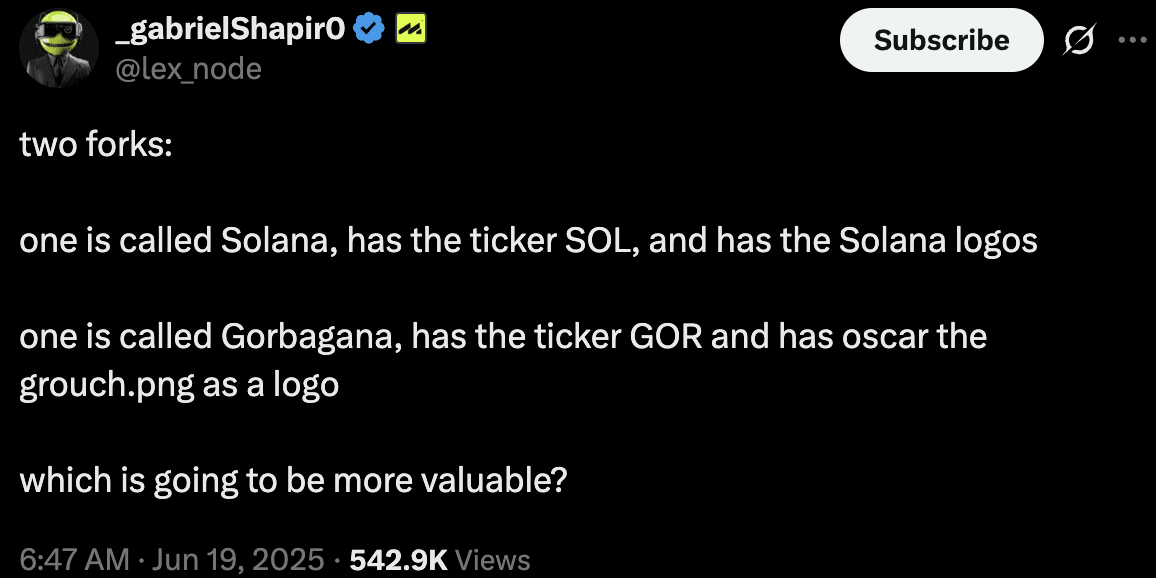
He also proposed the idea that if one day Solana forks, one chain keeps the original name Solana and the $SOL token, while the other chain calls itself 'Gorbagana,' with a logo of oscar the grouch.png; this naming method easily evokes associations with the homophony of garbage, making the narrative more ironic.
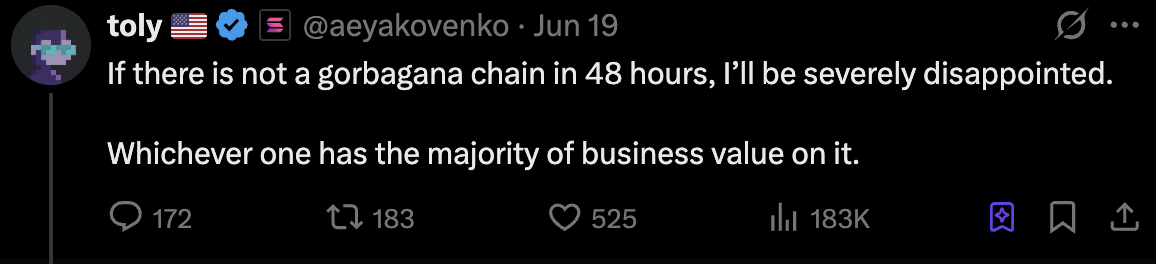
Toly's response was, 'If no one creates Gorbagana chain within 48 hours, I will be very disappointed.'
Meanwhile, the token named 'Gor' meme coin was launched through Pumpfun, whose prototype comes from Oscar the Grouch, a character from Sesame Street. He is a green monster living in a trash can, known for his grumpy attitude, love for garbage, and cynical outlook, while the term 'Gorbagana' itself is clearly a sarcastic variant of 'Garbage.'

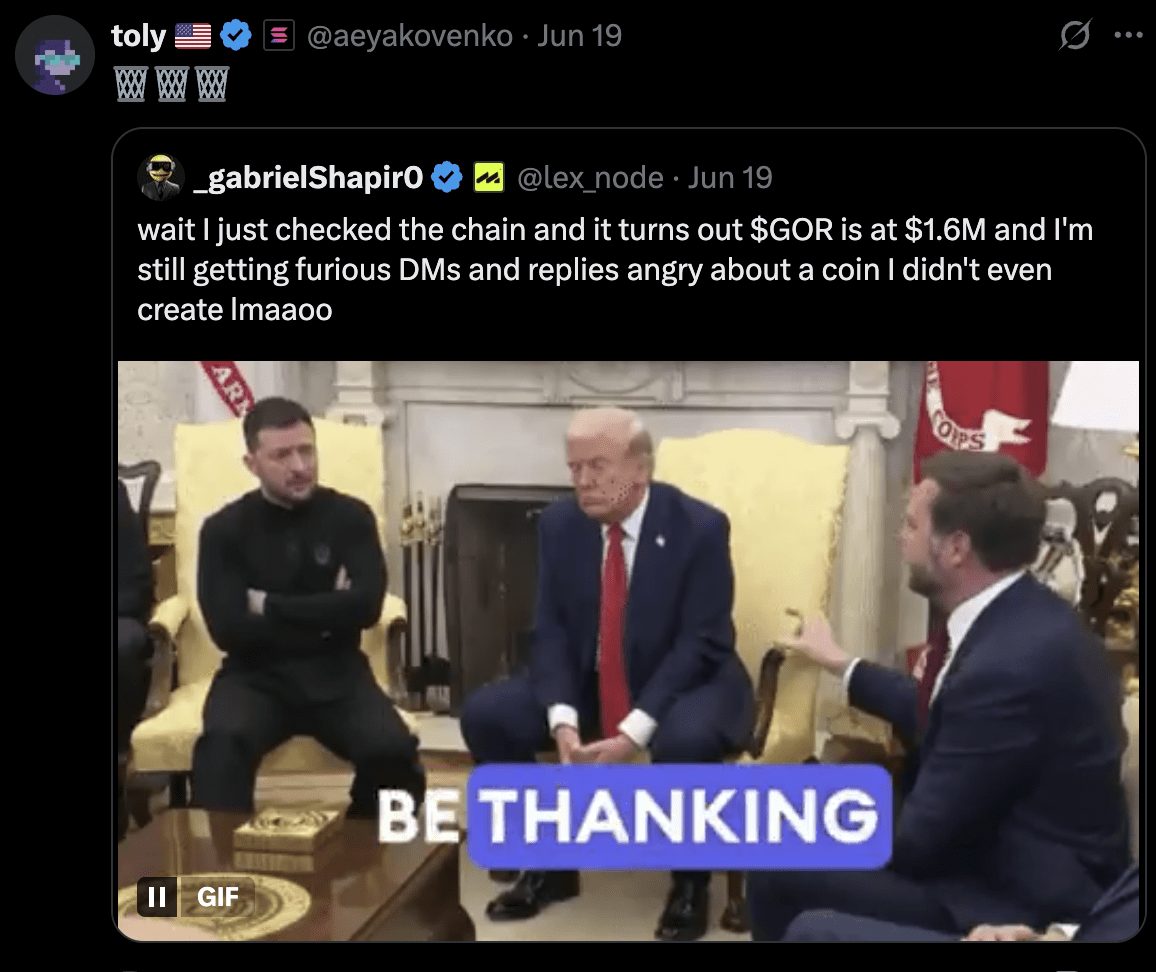
The token's market value quickly climbed to 1.6 million dollars and caught Toly's attention, prompting him to comment on an icon of three garbage bins, sparking a complete Fomo in the community, with $Gor's market value briefly exceeding 10 million dollars.
Ironically, the Gor-chain was indeed developed by @MidTermDev in less than 48 hours, and after Toly responded to it, the token's market value again reached a new high, breaking through 40 million dollars.

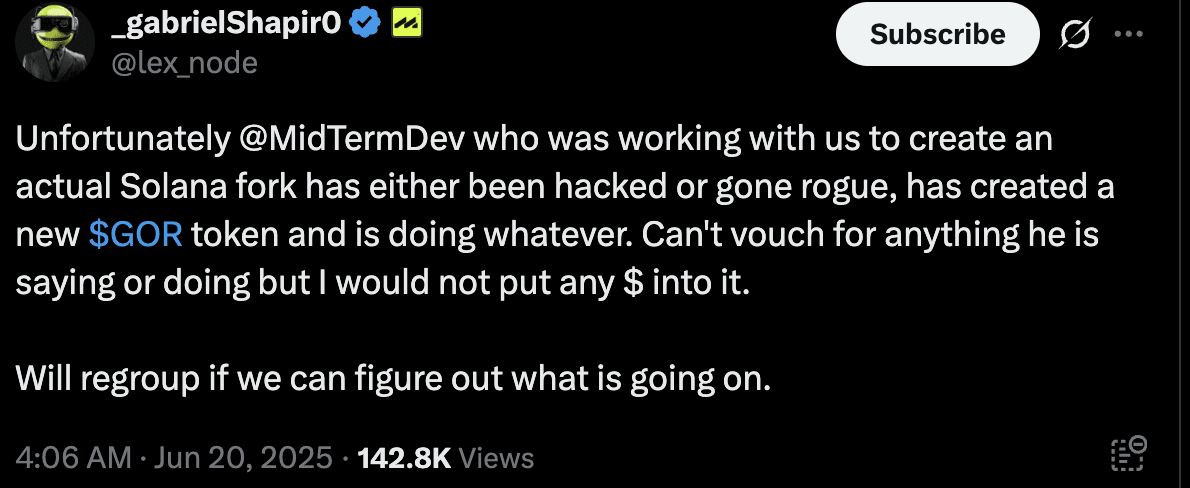
However, @MidTermDev's account may have suffered a 'hacking attack' afterward and launched a new token (which has nearly gone to zero). Currently, @MidTermDev has been banned, and the development team is taken over by the CTO, with core members including @0rdlibrary and @Sarv_shaktiman.
Another feast for conspiracy groups? Who made money on $GOR?
Behind this capital frenzy, it is intriguing that the wallet address starting with A4DC, ranking first on the 'Gor' token profit leaderboard, also earned 861 Sol from the 'IBRL' token, currently ranking 4th in profits. On the on-chain data tracking platform Arkm, this address is circled.sol, which has financial transactions with the verified entity wallet coyote, pointing to the X account @4pfcoyot.
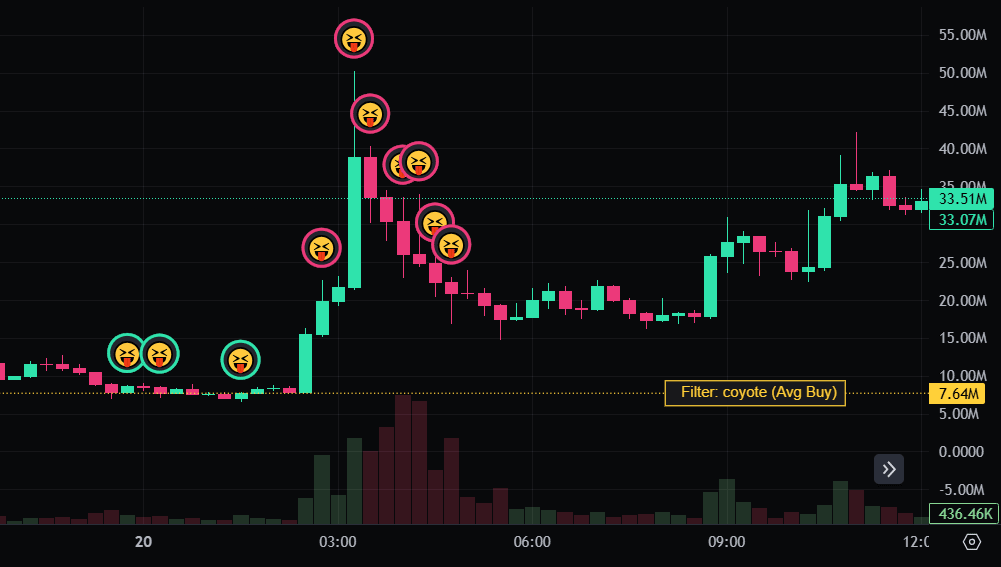
When the market value of $Gor retraced to 7-8 million dollars, coyote bought 350 Sol. Coincidentally, shortly thereafter, Toly responded to the tweet about the development of Gor-chain, causing the market value of 'Gor' to skyrocket to 40 million dollars. Coyote also completed a liquidity exit during this surge, profiting over 1500 Sol. After this counterintuitive operation, coyote made a huge profit, and as of now, coyote has already earned 1780 Sol on $GOR, ranking first in profits.
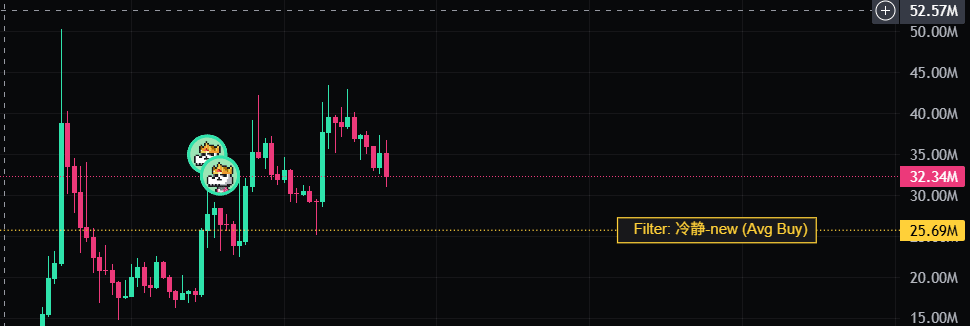
In stark contrast to this is the operation of the well-known Chinese on-chain KOL, Lingjing. Although he bought 200 Sol at an average price of 4 million dollars, when the price rose to a market value of 7 million dollars, he sold a large amount of chips. The narrative further developed, and he chose to sell a large amount of chips when the market value reached 11 million dollars, and then chased high at 25 million dollars, ultimately raising the average price to around 2.6 million dollars, currently only having a floating profit of 370 Sol.
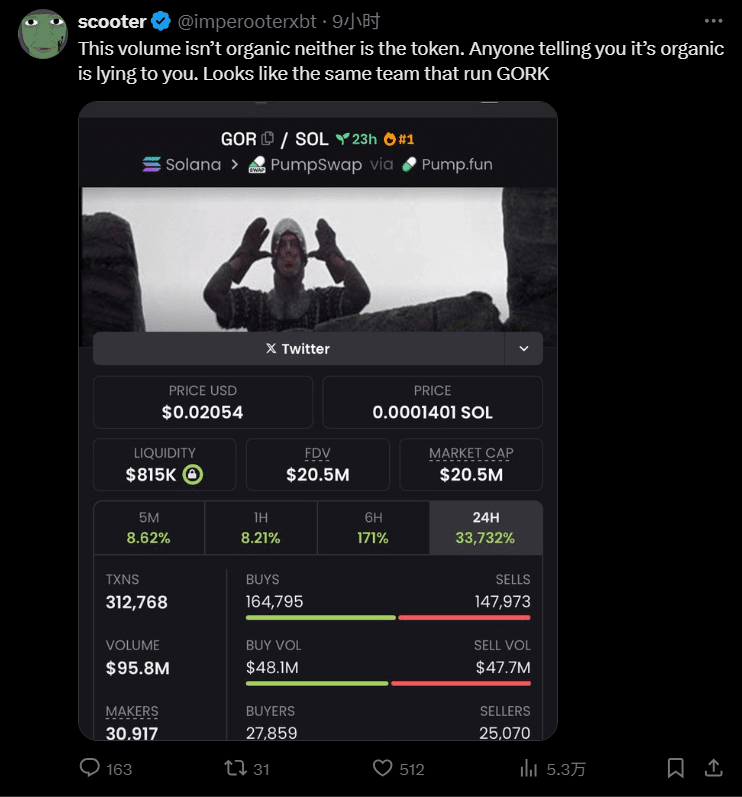
Unlike the Fomo retail investors, some in the community believe that 'Gor' is not as interesting as it appears on the surface. @imperooterxbt bluntly stated that the token was created by the same team behind 'GORK,' but seems to lack reliable evidence.
Although this social experiment may seem like just another 'conspiracy feast' to most in the community, the 'decentralized brand' mentioned by Gabriel Shapiro indeed reflects a long-standing issue. Since Ethereum can 'arbitrarily' become Ethereum Classic, can garbage (Gorbagana) also replace Solana?