


Do you really understand what inflation is?
It’s no exaggeration; one of my brothers makes over ten million annually by relying on inflation indicators during each trading cycle!
Everyone knows that inflation data is an important indicator for the Federal Reserve's interest rate hikes or cuts, and it also affects the liquidity of the stock market and cryptocurrency market in our investments.
In simple terms, the definition of inflation is: there is more money in the market, goods become more expensive, and money becomes less valuable.
This means that our money is 'shrinking', and purchasing power is declining.
So why does money increase? Or rather, why is money becoming less valuable? This brings us to the reasons for currency depreciation.
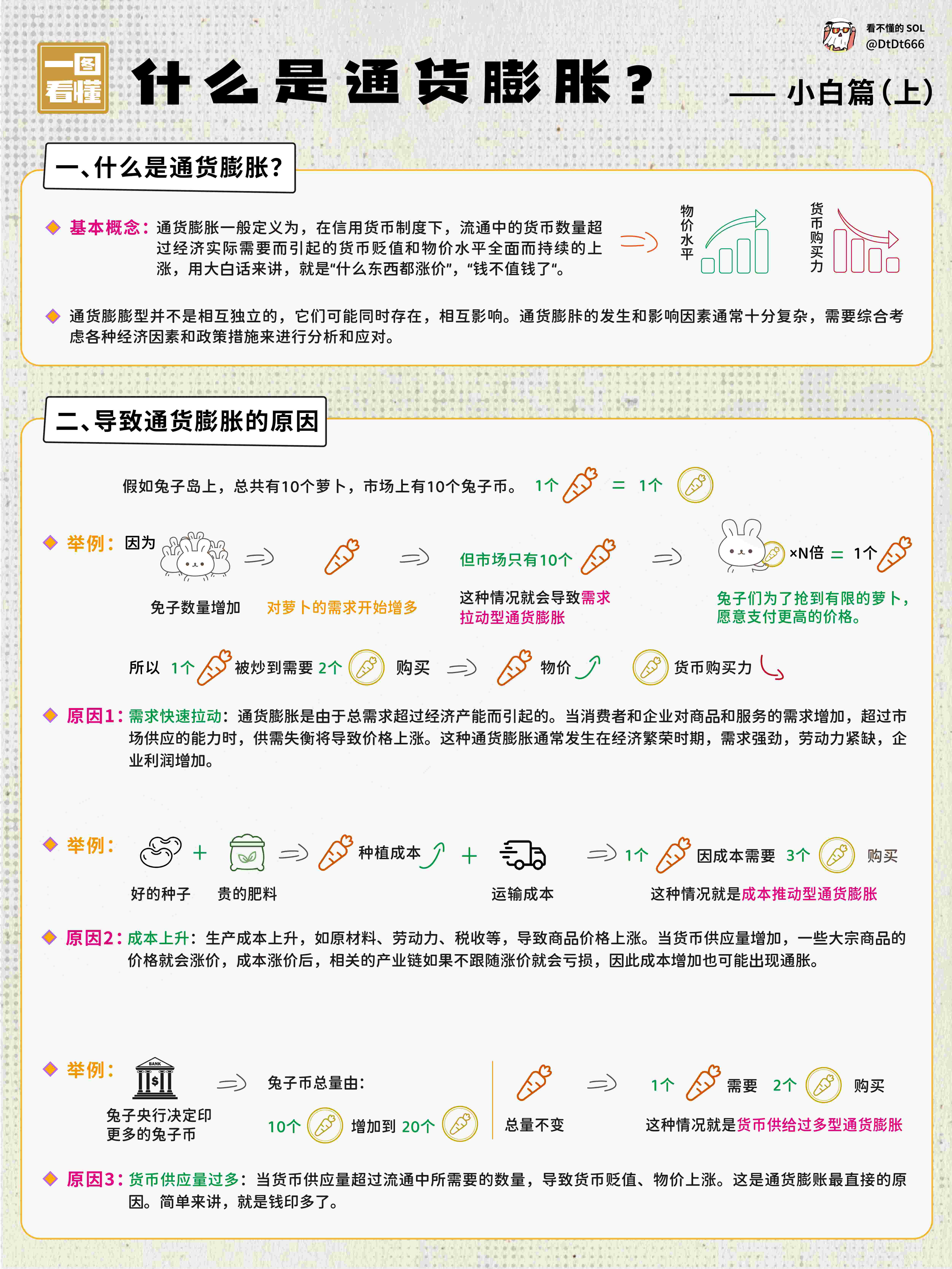
01. Causes of Inflation
■ First reason: Too much money printed, excessive money supply
Imagine you are on a small island with only 10 golden apples, and there is a total of 100 dollars in circulation, meaning each apple costs 10 dollars. Suddenly, the island's 'central bank' decides to print another 100 dollars, so everyone now has 200 dollars, but there are still only 10 apples. What happens? The price of apples doubles, now each costs 20 dollars! With more money, prices naturally rise; this is a typical case of inflation caused by excessive money supply.
In the real world, after the 2008 financial crisis, the Federal Reserve printed money like crazy to 'rescue the market', which led to a flood of dollars in the market and ultimately increased the global inflation rate. In recent years, to cope with the impact of the pandemic, governments around the world have also injected large amounts of money, resulting in a new wave of global inflation.
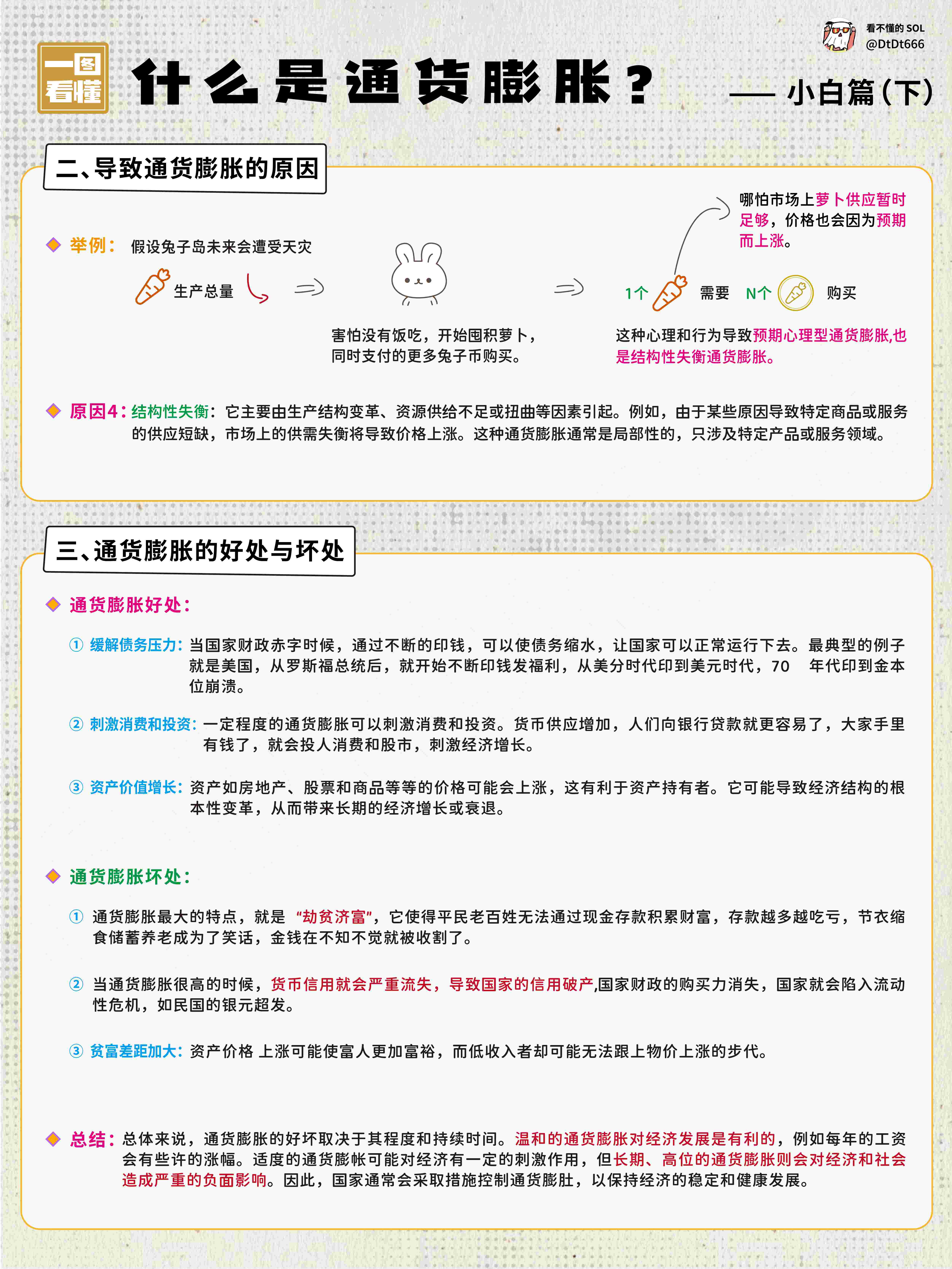
■ Second reason: Scarcity of goods, imbalance between supply and demand
What if the amount of money in the market doesn't change, but the goods decrease? The answer is the same—price increases still apply!
For example, after the Russia-Ukraine conflict in 2022, the supply of natural gas from Russia decreased, causing heating costs in Europe to skyrocket, leading to fluctuations in energy prices, with oil, gas, and electricity prices all soaring. Additionally, during the pandemic, the global supply chain faced immense pressure, preventing many goods from being shipped, which naturally led to rising prices.
■ Third reason: Rising costs, wages, materials, and logistics all increase
If your company wants to give you a raise, would you be happy? Don’t get too excited; if the company raises wages for all employees, the operating costs will increase, and they will have to raise the prices of goods and services, passing the costs onto consumers. Thus, wage increases also become one of the triggers for rising prices, which shows the relationship between wage adjustments and inflation.
Similarly, if the raw materials produced by the company become more expensive, such as chips, oil, or grain, their price increases will also be transferred to consumer products, causing everyone to pay more.
02. Case Analysis: Federal Reserve Interest Rate Hikes
When talking about inflation, we must mention the Federal Reserve. In 2021, the U.S. inflation rate soared to a 40-year high, with the CPI index (Consumer Price Index) at one point exceeding 9%. To curb inflation, the Federal Reserve had to implement an interest rate hike policy.
How does raising interest rates suppress inflation? There are two core logics:
■ After the rate hike, loans become more expensive, and borrowing costs rise, making businesses and individuals less willing to borrow money for investment or consumption;
■ With less money in the market, demand decreases, and prices naturally stabilize.
But the problem is that the impact of interest rate hikes is not just to reduce inflation; it may also bring risks of economic recession. In 2023, the collapse of Silicon Valley Bank (SVB) in the U.S. was due to rising bond yields caused by the Federal Reserve's rate hikes, leading to a depreciation of bonds held by the bank, ultimately resulting in a crisis. This indicates that if interest rates are raised too aggressively, the financial system cannot withstand it.
This game of inflation and interest rate hikes affects not just the U.S., but the economies of the entire world.
03. Classification of Inflation
If we classify inflation by its severity, it can be divided into three types: mild or creeping inflation, galloping or runaway inflation, and vicious or hyperinflation.
1. Mild or Creeping Inflation
This is an inflation that keeps the inflation rate basically between 2%-3%, remaining relatively stable. Some economists believe that if the annual price increase rate is below 2.5%, it cannot be considered inflation. When the price increase rate reaches 2.5%, it is called insidious inflation.
Some economists believe that during economic development, having a bit of mild inflation can stimulate economic growth. Because rising prices can allow manufacturers to gain a bit more profit, encouraging their investment enthusiasm. At the same time, mild inflation will not cause significant social unrest. Keeping the price increase under 1%-2%, at most 5%, can act like lubricant to stimulate economic development, which is known as 'lubricant policy.'
2. Galloping or Runaway Inflation
Galloping or runaway inflation is also known as rampant inflation or acute inflation. It is an unstable, rapidly deteriorating, accelerating inflation. When this type of inflation occurs, the inflation rate is high (generally reaching double digits), causing people's confidence in currency to waver, leading to social unrest; thus, it is a relatively dangerous form of inflation.
3. Vicious or Hyperinflation
Vicious or hyperinflation is also known as extreme inflation or runaway inflation. Once this type of inflation occurs, the inflation rate is extremely high (generally exceeding three digits) and completely out of control, resulting in social prices continuously skyrocketing and significant currency depreciation, leading people to completely lose confidence in money.
At this time, the entire social financial system is in chaos, normal social and economic relations are disrupted, and it can easily lead to social collapse and government failure. This type of inflation is rare in the history of economic development, usually occurring after wars or major social upheavals.
Currently, it is recognized that hyperinflation has only occurred three times globally.
The first occurred in Germany in 1923, just after World War I ended, where prices rose by 2500% in one month, and the value of one mark dropped to one trillionth of its pre-war value. During the most severe crisis, workers’ wages had to be paid in two installments a day, and by evening, the price of a loaf of bread equaled the value of a house in the morning.
The second occurred in Hungary in 1946, after World War II, where the value of one pengő was only equivalent to 8 raised to the 28th power times 10 to the 27th power of its pre-war value.
The third occurred in China, from June 1937 to May 1949, where the issuance of counterfeit currency increased by 144.5 billion times, and during the same period, the price index rose by 36,807 billion times.
For example, in February 1948, the market price of one dan of rice in China was 3 million yuan in currency, and just four months later, in June, the price became 10 million yuan, meaning the rice price in June was more than three times that of February, and the situation was further deteriorating. One can imagine how severe this hyperinflation was at that time.
▲ Paying salaries and selling goods had to be done with bundles of cash.
If we classify inflation by its triggering causes, it can also be divided into four types: covert inflation, demand-pull inflation, cost-push inflation, and structural inflation.
1. Covert Inflation
Covert inflation, also known as suppressed inflation, refers to the existence of inflationary pressure or potential price rise crises in the social economy. However, due to strict price control policies implemented by the government, inflation has not actually occurred. But once the government lifts or relaxes price control measures, inflation will occur in the economy, so this type of inflation is not nonexistent but is a covert inflation.
2. Demand-Pull Inflation
Demand-pull inflation refers to a general increase in average prices of goods caused by an increase in total demand. An extreme example is that holiday flight and train tickets are more expensive than usual.
3. Cost-Push Inflation
Cost-push inflation refers to a general increase in average prices of goods caused by producers of goods and services actively raising prices. For example, when chicken prices rise, the prices of chicken burgers and chicken sandwiches will also increase; when oil prices rise, the world will feel the pressure of cost-push inflation.
4. Structural Inflation
Structural inflation refers to the phenomenon where price increases occur under conditions of not excessive total demand, but rather excessive demand for certain sectors' products, causing prices of certain products to rise. During inflation, demand, cost, and structure all play a role simultaneously.
In summary, the seven types of inflation can be categorized into the following four classifications:
Benign: Mild or creeping inflation, demand-pull inflation
Cautious: Covert inflation, structural inflation
Dangerous: Cost-push inflation, galloping or runaway inflation
Deadly: Vicious or hyperinflation
04. Impacts of Inflation
■ Rising cost of living, ordinary people are getting poorer
Inflation leads to an increase in the cost of living; rent, food, transportation, and medical care all become more expensive, but wages may not necessarily keep up. Ordinary workers' savings depreciate, making life increasingly difficult.
■ Investment shrinkage, savings increasingly losing value
Many people believe that keeping money in the bank is safe, but the reality is that if the inflation rate is 5%, but your bank savings interest rate is only 2%, your money is actually 'shrinking'. This is why many people prefer to invest in real estate, stocks, or gold rather than leaving money idle in the bank.
■ Stagflation crisis: Economic stagnation + skyrocketing inflation
The scariest thing is 'stagflation'—economic growth stagnates, but inflation remains high. In the 1970s, the U.S. experienced such a stagflation crisis, where the economy did not grow, but the unemployment rate soared, leading to social unrest.
Pay attention to the CPI and PPI indices to make decisions in advance
The CPI index (Consumer Price Index) and PPI index (Producer Price Index) are important indicators for measuring inflation.
If the CPI rises quickly, it indicates that prices are soaring; if the PPI rises quickly, it indicates that production costs are increasing, and future prices may continue to rise.
Learning to pay attention to these data can help everyone make economic decisions in advance.