

Original title: What Crypto Founders Can Learn from Blur’s Token Airdrop
Authors: Li Jin, Mason Nystrom, Tina Dai
Compiled by: Block unicorn
Since its public launch 5 months ago, Blur has become the industry’s top NFT marketplace and trading platform, with over 40% market share by trading volume prior to its airdrop in February 2023. Beating incumbents in a competitive landscape requires more than just product and UX improvements — it requires sophisticated incentives to guide and increase user adoption.
Over the past few years, there have been many creative ways to apply tokens to building networks, including incentivizing growth or loyalty of participants, capturing value, or providing core utility for various types of products. Common token play focuses on one-time retroactive airdrops to incentivize participation and reward early users (such as Uniswap, ENS); to continuous liquidity mining projects that reward users for performing certain actions (such as LooksRare, Compound).
Studying Blur reveals a more complex token distribution design that provides phased rewards to sequence the growth of the network. This analysis will consist of two parts: The first post will explain Blur’s token approach and provide advice for founders seeking to grow their networks with tokens. A future blog post will share data analysis quantifying the impact of the airdrop on the market and usage.
Background on Blur Airdrop
BLUR has a total supply of 3 billion tokens, of which 360 million, or 12%, were airdropped and available for claiming on February 14. As of February 20, 112K unique wallets have claimed the airdropped tokens, with 93% of tokens claimed. With a token price of $1.21 as of February 20, the total value of the airdrops is over $435 million, with a median airdrop of 298 tokens (worth $360).
Prior to the airdrop, Blur’s token incentives had several phases, collectively referred to as “Season 1,” similar to the sequential way the network grew. Importantly, during these phases, users did not receive airdrops of tokens, but instead received off-chain “care packages” that could be viewed on Blur’s website as credits for future airdrops of BLUR tokens or mystery boxes.
There are four stages of rewards in the first season.
0 Airdrop: Rewarding social referrals to attract traders to its platform (announced on May 4, 2022).
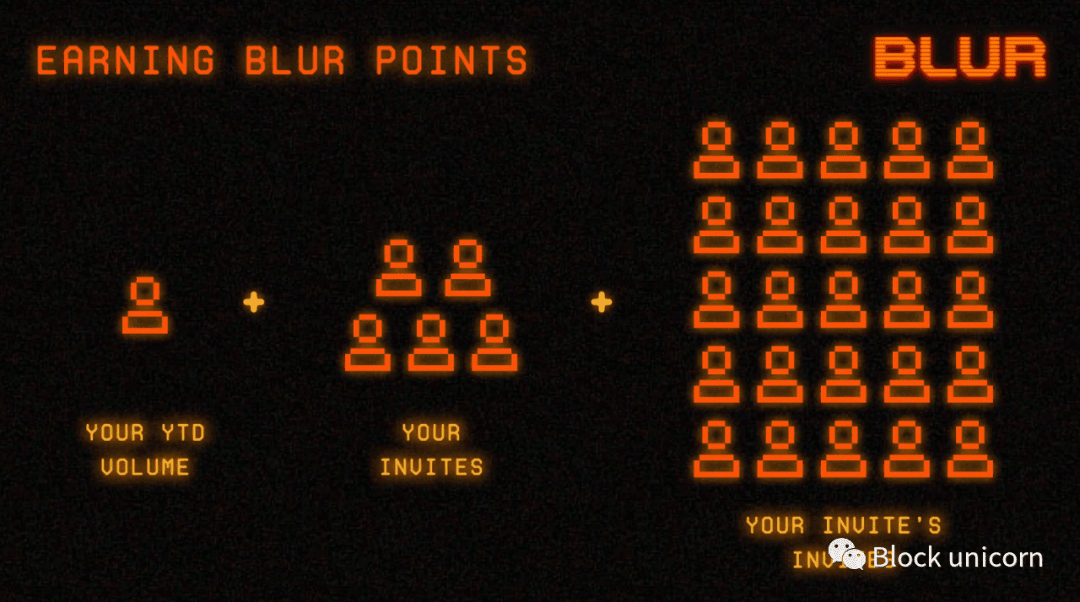
You get points when you join, when you use your invitations, and when people you invite use their invitations.
Blur’s first phase of airdrops was announced in May 2022, when the platform was still waiting list, and rewards users who actively refer others to the platform. Notably, these rewards are calculated in a way that incentivizes not only invitations but also high volume traders.
Airdrop Phase 1: Rewarding Ecosystem Trading Activity (Announced October 19, 2022)
Blur’s first airdrop coincides with the public launch of its NFT aggregator and marketplace. The airdrop rewards users who have been active in Ethereum NFT trading over the past 6 months. To claim the airdrop, users need to list an NFT on Blur within 14 days.
“Our goal is to make Blur a marketplace owned and benefited by the entire NFT community. Our first step is to airdrop a care package to everyone who has consistently traded NFTs over the past 6 months.”
Airdrop Phase 2: Rewarding addresses that build supply in the market (Announced on October 19, 2022)
At the same time as announcing Airdrop 1, Blur also announced Airdrop 2 to reward individuals who listed NFTs on Blur before November. The second airdrop also rewarded traders who used Blur’s new features, including their professional order placing tools (e.g., placing orders by NFT feature floor price, sweeping floor price NFTs, etc.). Airdrop 2 further rewards traders who frequently list, lists actively traded collectibles, and incentivizes blue chip NFT orders.
Notably, Blur also encourages users to stay loyal to Blur, rather than other NFT marketplaces:
“Loyalty does not affect how many Care Packages you get in Airdrop 2, but it does affect your luck in revealing them. When you list on other marketplaces, it will not affect your loyalty score as long as you list it on Blur for the same price or lower. You can use Blur’s advanced order tool to list NFTs on all NFT exchanges at once!”
Airdrop Phase 3: Reward Bidding to Stimulate Demand (Announced December 14, 2022)
With a lower-priced supply base than other markets, Blur announced the third airdrop with a focus on building demand. In conjunction with the third airdrop, Blur launched their bidding contract, allowing traders to bid on collections more efficiently (e.g. no gas bidding).
Blur also encourages traders to create the best bid-ask spread possible, with traders who offer better bids receiving more rewards.
“In a pool, the bids that carry the most ‘risk’ earn the vast majority of points. If the reserve price is 1.01 and there are 100 bids at 1, and you bid at 0.99, your bid will not earn many points because there are 100 buyers ahead of you, but if you bid at 1.01, you will earn more points because now you are carrying the most ‘risk’.”
Crucially, while listings are no longer incentivized during this period, Blur maintains the same loyalty promise: users who list on Blur at the same or lower price will receive more luck (meaning more airdrops) when opening their care packages, which helps keep Blur’s price the lowest relative to other markets.
Care Package
Care Packages come in four different levels of rarity: Common, Rare, Legendary, Mythic. The rarity of a Care Package is tied to a user’s loyalty score with Blur, which differentiates actions like listing a common NFT or a blue chip NFT, with rarer packages receiving more tokens.
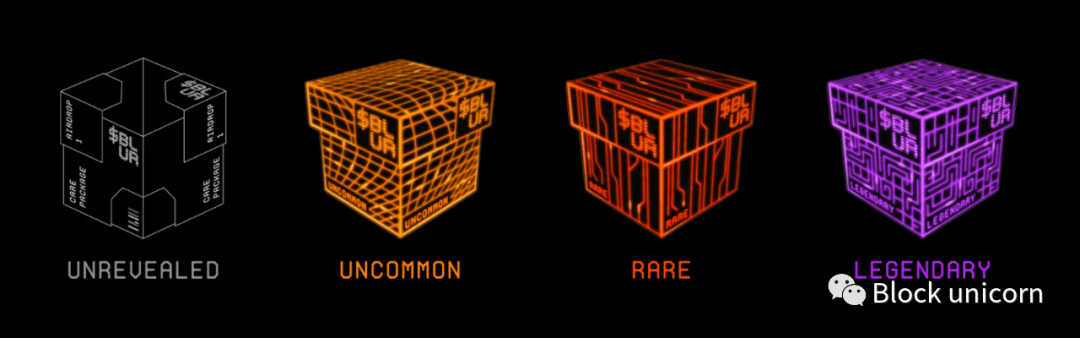
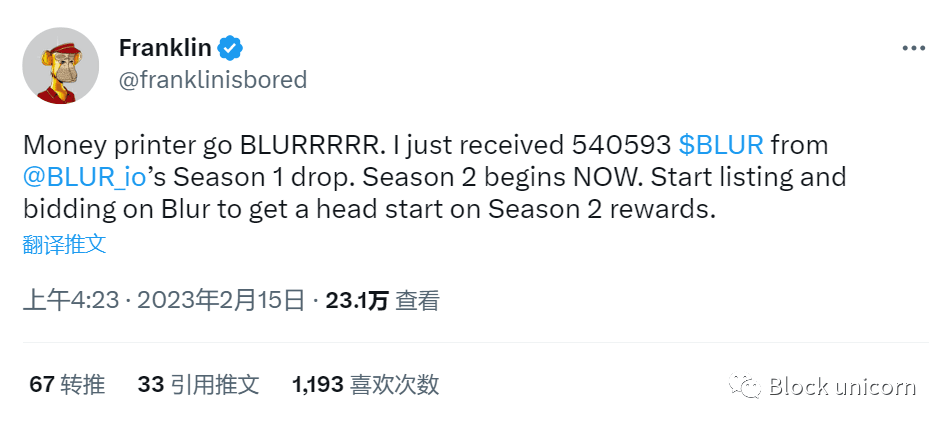
February 14, 2023 — Nearly a year after the initial airdrop was announced, Blur users can open their care packages to reveal the BLUR tokens inside. The top five wallets have each claimed over 2 million BLUR tokens, with the median Blur airdrop being 298 BLUR (worth $360 as of February 20) and the average being 2,995 tokens (worth $3,623).
To claim their airdrop, Blur users need to tweet about the airdrop. Blur pre-populates the tweet with the requested amount of tokens (users can edit the tweet and claim the airdrop).
Key Lessons Learned from the Blur Airdrop
Blur's innovative airdrop design has some important lessons
1. Market growth of sequential airdrops
Blur’s innovation lies in its use of a sequential airdrop model, building the network in phases and matching it with new product releases.
This sequential token airdrop has two key effects:
The network is built in stages, corresponding to the way in which supply is built up first, followed by demand in the market.
Keep Blur users engaged and onboard them to newly launched product features like bidding contracts.
2. Uncertain rewards create greater motivation
Like most crypto projects, Blur decided to keep the specifics of the airdrops (care packages) secret until launch, but crucially, they abstracted the details behind gamified and quantifiable care packages, providing short-term rewards to users in the interim. Each subsequent airdrop is “more valuable than the next,” creating an incentive to continue participating because users don’t know the true nominal value they will receive.
Contrast this approach with LooksRare’s original token distribution strategy, which functioned more like DeFi liquidity mining, with rewards being a function of specific market activity. LooksRare rewards traders based on volume, meaning that traders can reliably calculate how many tokens (and USD value) they will receive based on their volume on a given day. This has led to wash trading by traders in order to earn LooksRare token rewards, and has resulted in almost no sustained organic activity (94% of LooksRare’s historical volume is allegedly wash trading).
In studies comparing the effort people put in to win a reward of some kind versus an uncertain reward, researchers found that uncertainty creates greater motivation and effort. Blur’s model closely mirrors the four-step habit formation process proposed by author Nir Eyal: a trigger to start using the product, an action to satisfy the trigger, a variable reward for the action, and some type of investment that ultimately makes the product more valuable to the user.
Another related strategy is to use care packages of varying rarities to reward loyalty, with the promise of more Blur tokens for rarer care packages. This gamifies uncertainty, creating an incentive for users to get rarer care packages.
3. Incentivize virality and social sharing
To get off the waiting list and join the early beta, users needed to earn as many Blur points as possible. Blur gamified and rewarded users for their viral coefficient (the number of new users generated by existing users), with more points earned for referrals. Influencers posted on Twitter, users shared referral links in group chats, and Blur created a wave of invitations. Importantly, users who got the beta version earned points for the first airdrop, and participants on the waiting list and beta users could get one additional airdrop from Blur.
Blur also specifically encouraged sharing on Twitter, including the promise of providing care packages to random users who retweeted the announcement. Finally, opening the "care package" and claiming Blur's airdrop requires tweeting, which will be pre-filled with Blur's airdrop information. Although users can circumvent this and still receive the airdrop (for example, through tweets and deletions), this mechanism still caused a huge response on the day of the airdrop, with thousands of tweets about the airdrop.
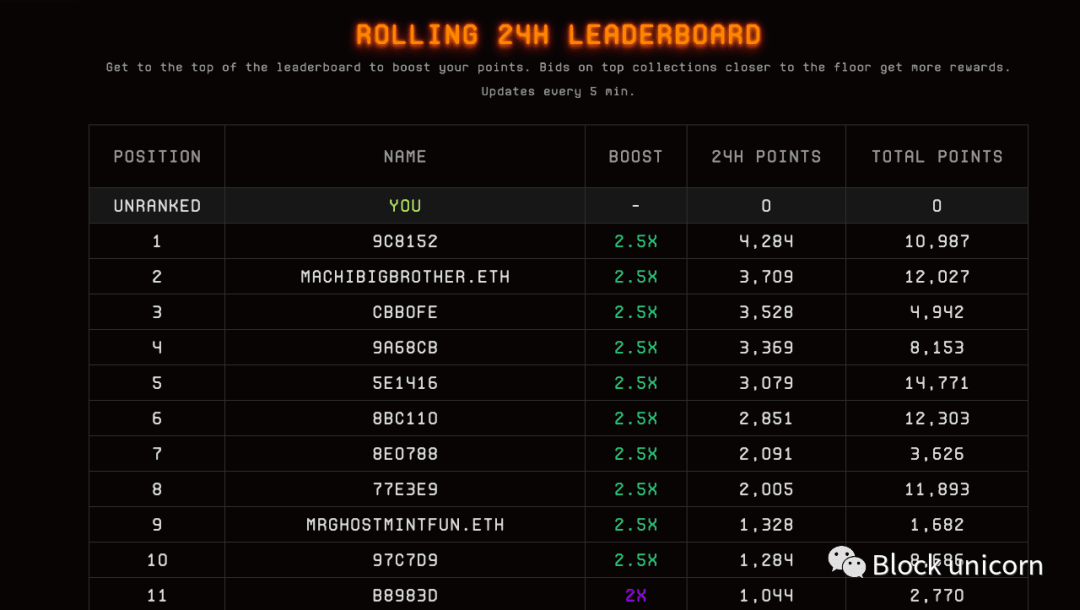
Finally, throughout the process, Blur maintains a leaderboard for users, ranked by points. This creates gamified competition and social proof, showing other users’ activity.
4. Transferring Liquidity to Blur
Blur's Loyalty Score - which determines the scarcity of Care Package airdrops - is determined by how well traders maintain competitive exclusivity within Blur. Traders maximize their Blur Loyalty Score by listing NFTs on Blur at a lower price than on other marketplaces. Conversely, listing NFTs on other marketplaces at a lower price lowers a user's Loyalty Score.
This incentive causes traders to list NFTs at lower prices on Blur, creating a supply moat for Blur and increasing its attractiveness to NFT buyers. During the bidding incentive period, bids closest to the reserve price are rewarded the most, further creating a tight bid-ask spread that keeps Blur's reserve price lower than other markets.
It’s worth noting that Blur’s loyalty program will continue into Season 2, serving as an incentive to keep traders loyal to the platform.
5. Continuous incentives for new users
Unlike many airdrop projects that target early adopters, Blur announced that it will continue to airdrop tokens to new users in Season 2, with additional incentives for traders who list and bid on NFTs within thirty days of the airdrop.
On the day of the airdrop, Blur also announced a care package for new users. Applying for the care package requires browsing an animated slideshow of Blur features, purchasing NFTs through the marketplace, and listing them on Blur. This is strategic timing because on the day of the airdrop, Blur's website may have a large amount of potential user traffic. Meeting these new users on the day of the airdrop and incentivizing them to use Blur can be an effective customer acquisition strategy.
6. Continuous iteration of airdrop plan
On the day of the airdrop, Blur announced an Incentive Committee that will have the power to deploy 10% of the community token supply to further incentivize adoption of Blur. The committee will also be able to request more tokens through governance once the budget is exhausted.
This committee allows Blur’s airdrop schedule to continually iterate — avoiding manipulation by users to maximize the airdrop — without requiring ongoing DAO approval. This is similar to web2’s strategy of continually updating incentives to optimize network dynamics.
Improvement suggestions and open issues
In reflecting on the airdrop, we identified several areas of opportunity for the future:
Focus on user retention
To further decentralize and retain users, one suggestion from Marc Boiron’s Sufficient Decentralization Playbook is to incentivize the committee to evolve into a child DAO, similar to the Uniswap Foundation, which could be a sustainable way to keep incentives alive as the market evolves.
Future airdrops could benefit from using a time-locked airdrop vesting schedule, where users who sell are not eligible to receive the remainder of their allocated airdrop. Additionally, airdrops could be contingent on continued use of the platform (e.g. a certain number of bids or listings per month) or actions such as governance participation.
Build moats around demand and supply
Blur creates an element of buyer lock-in through the use of a bidding contract, where users are required to deposit money into the Blur bidding contract in order to bid. As of February 20, the bidding contract had $128 million in deposits, which represented potential bids.
Blur could further strengthen its demand-side maintainability by allowing users to earn yield on deposited capital; offering additional financial products to professional traders; or using other incentives to help lock in liquidity. As the NFT market war continues, creating a supply moat for the market will also be critical to future defensibility.
Token Creation Tools
Creating greater utility for the token, making it a core part of the product experience, and building demand for the token can be the next area of focus. This can take inspiration from tokens like Binance’s BNB, which offers discounted trading fees on the exchange, or SuperRare’s RARE, which entails curating independent storefronts on a platform called Spaces.
Finally, there is the existential question of whether the token will accrue value. Since the token’s launch, users on Twitter have questioned how value accrues to Blur token holders given the existence of an equity company building and maintaining the front end. Since Blur is the dominant (and only) application built on its protocol, this could lead to distorted incentives in driving value for the DAO versus the equity business, and leaves open the question of whether or how the company can make a credible commitment to the DAO.
Looking forward to the next iteration of the user incentive token mechanism
Given the recent airdrop, the long-term effects of Blur’s airdrop strategy will only become apparent over time. To date, over 75% of airdrop recipients have sold a portion of their airdrop. Early data is promising regarding the effectiveness of the airdrop, however, with Blur’s volume market share (according to bid sources) rising from the mid-40% to over 80% in the days following the airdrop. As of February 20th — a week after the airdrop — the 1st, 3rd, and 5th largest airdrop recipients still hold their entire airdrop, over 2 million tokens each (worth over $2.4 million).
There is no doubt that Blur’s airdrop has broken new ground in token applications for network growth. Ultimately, the goal of token incentives should be to improve core KPIs: long-term retention and stickiness. The ideal outcome of a token is that user ownership makes the product more successful than it would be without token ownership. To do this still requires building products that people want, incremental decentralization, and a customized evolving roadmap for each product and protocol.