


This article is a continuation of the use case introduction of the previous DAG architecture popularization. The Avalanche Protocol AVAX is also a relatively familiar project in the encryption field. If you have not understood it before, you can use this as a more detailed introduction. Disclaimer: This article does not constitute investment advice, please take the funds in your hands seriously~
1. Project Introduction📁
01丨Introduction
Avalanche is an open source platform for creating decentralized financial applications, distributed applications, and interoperable blockchain platforms. Using a breakthrough consensus protocol architecture, the smart contract platform can confirm transactions within one second, supports all the contents of the Ethereum development toolkit, and can complete developer migration between the two networks.
At the same time, the Avalanche Protocol has the characteristics of high throughput, low cost, high security and green environmental protection. It is one of the fastest blockchains to complete transactions on the current chain, while also ensuring the security of all POS protocol activities.
02丨Project Vision
As a high-performance, scalable, customizable and secure blockchain platform, Avalanche has three goals:
A platform for building enterprise-grade custom applications that will allow applications to be deployed publicly or privately;
Build highly decentralized and scalable applications (DAPPs);
Build any smart digital assets using customized contract rules and other ancillary terms;
The main goal of Avalanche is to provide an integrated platform for the creation, trading and transfer of digital assets. Because of its massively scalable and efficient global network, it provides a powerful decentralized system for the realization of the goal.
03丨Development trends
In February 2019, Ava Labs completed a $6 million seed round of financing;
On May 17, 2019, Ava Labs officially released a test network based on the Avalanche protocol;
On June 25, 2020, Ava Labs completed US$12 million in private financing;
In July 2020, Avalanche announced the completion of US$42 million in public financing;
In September 2020, the Avalanche Protocol mainnet was launched, and the decentralized service platform Avalanche was officially launched on the mainnet;
04丨Project Team
Avalanche Protocol was co-founded by Cornell University professor and IC3 co-founder Emin Gün Sirer, computer scholar Kevin Sekniqi, and Ted Yin, the first author of the Facebook Libra protocol HotStuff consensus; the consultants are Professor Maureen O'Hara from Cornell University and Bank of America executive Adam Kravetz;
2. Token Economy💰
01丨Basic market information
Market code: AVAX
Token type: Coin
Industry total market capitalization share: 0.53%
Initial issuance method: ICO
Current supply of tokens: 421/720 million
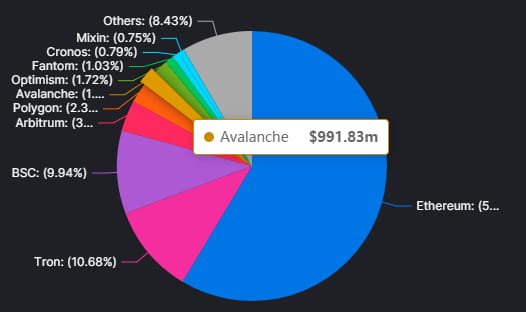
On-chain lockup: $991 million
02丨Token Economic Model
Deflation/Inflation Mechanism: Deflation (transaction fees will be destroyed)
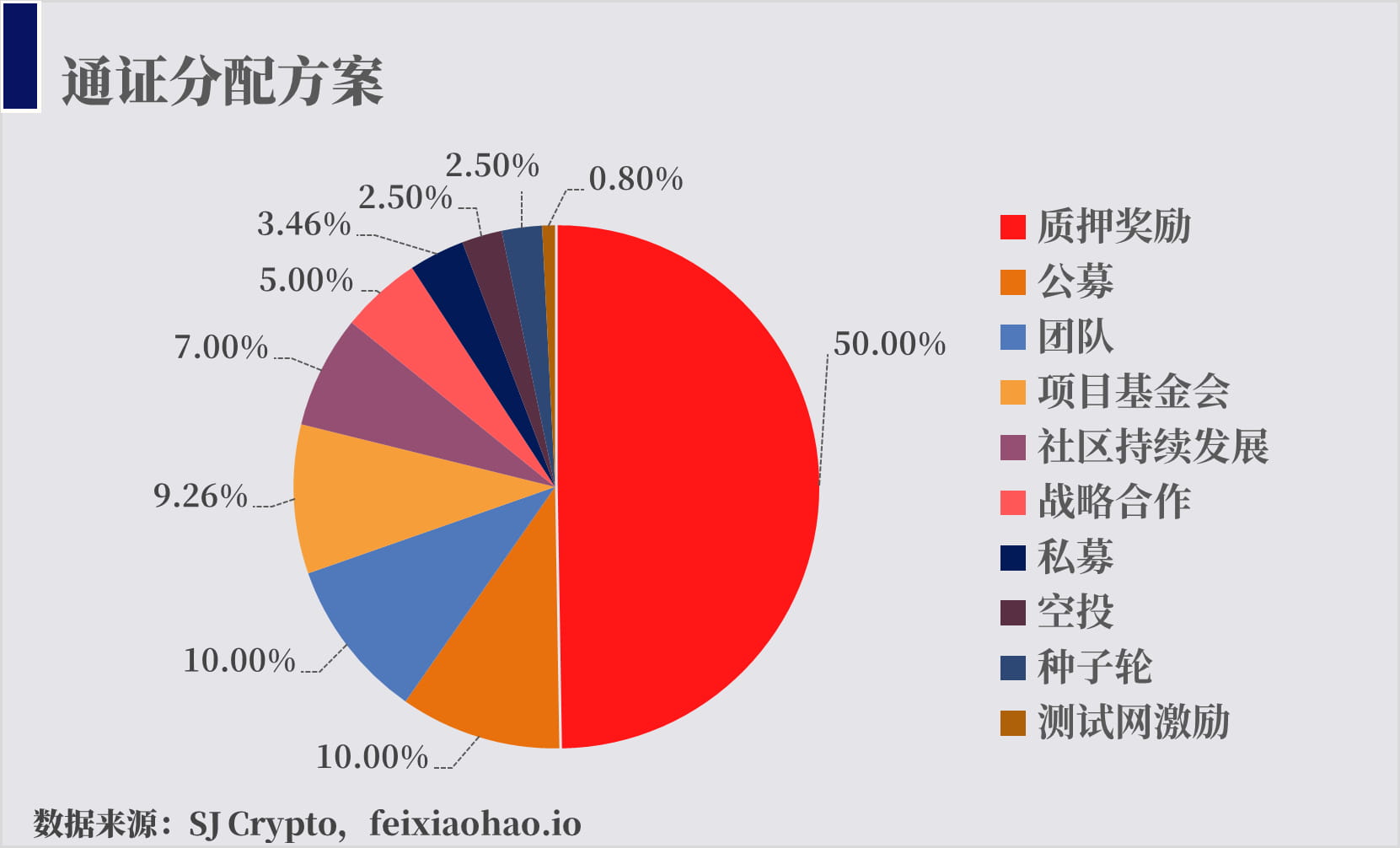
The supply of AVAX is limited to 720 million, 50% of which is pre-mined by the AVA Labs team and foundation, occupying 20% and 19% of the entire token system, being the largest share, of which the portion belonging to the team is locked for four years and will be released in 2024 Unlocked in December. The remaining 50% is used as a sustainable node staking reward to encourage staking.
03丨Token usage scenarios:
Users pledge AVAX to become a verifier or entrust it to other verifiers to enjoy annual returns;
Pay transaction fees and subnet subscription fees;
As the basic exchange unit for network native tokens;
Sector: Defi/a16z investment/basic chain
*Section introduction
Basic chain, as the underlying infrastructure of the blockchain industry, is usually the collective name for platform-based public chains, providing a development and operating environment for applications in various sectors of the entire industry.
Defi's full name is Decentralized Finance, which is "decentralized finance" or "distributed finance". It is a financial field application built on an open decentralized network.
a16z Investment’s full name is Andreessen Horowitz, one of the most well-known VCs in Silicon Valley. The earliest investment institution to enter the crypto world among traditional institutions. Known as the capital beacon of the crypto world, it has high attention and strong appeal.
04丨Architecture introduction
1) Avalanche Consensus Protocol
The Avalanche consensus mechanism claims to be able to break the limitations of the impossible triangle of blockchain—high performance, security, and decentralization. Here we officially compare the Avalanche consensus protocol with the two main types of consensus protocols obtained in the past. Here we explain that the past consensus protocols are mainly divided into two categories:
Classical Consensus Protocols;
Nakamoto Consensus;
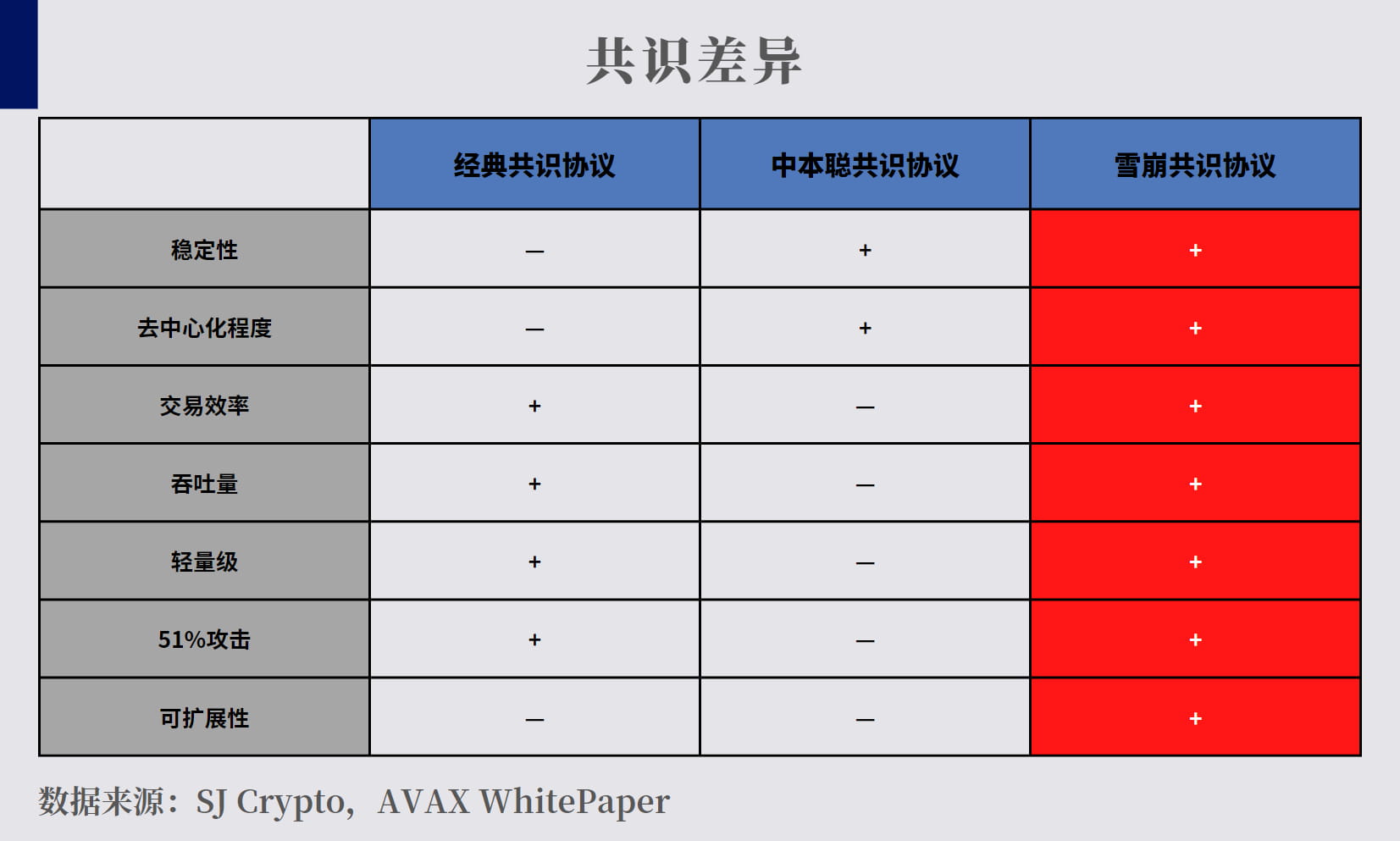
In the AVAX network, there are two main consensus mechanisms that support the operation of the network, namely: Avalanche Consensus and Snowman Consensus.
These two consensus protocols are very easy to understand. AVAX is a heterogeneous chain. Avalanche consensus adopts the DAG architecture. This architecture allows nodes to work at the same time and has the characteristics of high concurrency and high efficiency (if you don’t understand DAG , the previous article has a more detailed introduction). Supported by this consensus mechanism, AVAX is a blockchain with great advantages in transaction performance.
The Snowman consensus follows the linear verification method, which is what we usually understand as the blockchain packaging method. Because AVAX has a multi-layer network architecture, its two consensuses are distinguished.
Compared with Avalanche consensus, Snowman consensus will have more advantages in the creation of contracts. It is used on its contract chain and platform chain. Due to its performance advantages, the heterogeneous consensus is specially used for processing on the transaction chain. Matters related to certificates.
2) Three-layer link of the main network architecture-X/P/C chain
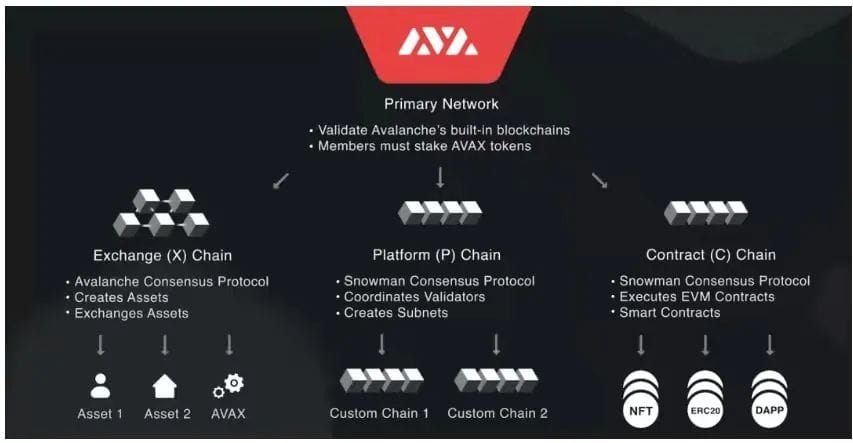
Aalanche has constructed three blockchain links based on the main network. According to different functions, they are:
Platform chain (P chain): carries the data layer of the Avalanche protocol network and is used to coordinate verification nodes and create subnets;
Transaction chain (X chain): mainly used to create and trade assets;
Contract chain (C chain): will be used to deploy smart contracts, and can be functionally compatible with the Ethereum Virtual Machine (EVM) very quickly, and can be used to create EVM-related contracts, etc.;
Among them, only the transaction link (X chain) uses the Avalanche consensus protocol, the network’s native consensus protocol. The current main application scenario is the use and interaction of transaction scenarios, but this does not mean that the function is limited to this. The platform chain and contract chain use a customized linear consensus protocol - Snowman (Snowman Consensus)
3) Structural characteristics of subnets
Avalanche's subnet is created based on the platform chain. The subnet is a network composed of a series of validator nodes. It is basically initiated by Avalanche's on-chain ecology. It can be simply understood as the Avalanche mainnet verification node outsourcing network. The core of a subnet is that you can customize the requirements of network validators to make the performance of the chain closer to the business ecology it serves.
At the same time, Avalanche can also cooperate with enterprises in building subnets. The developed subnets will have greater organizational characteristics, and the permissions can be divided into open and private chains (customized blockchains).
3. Project advantages👍
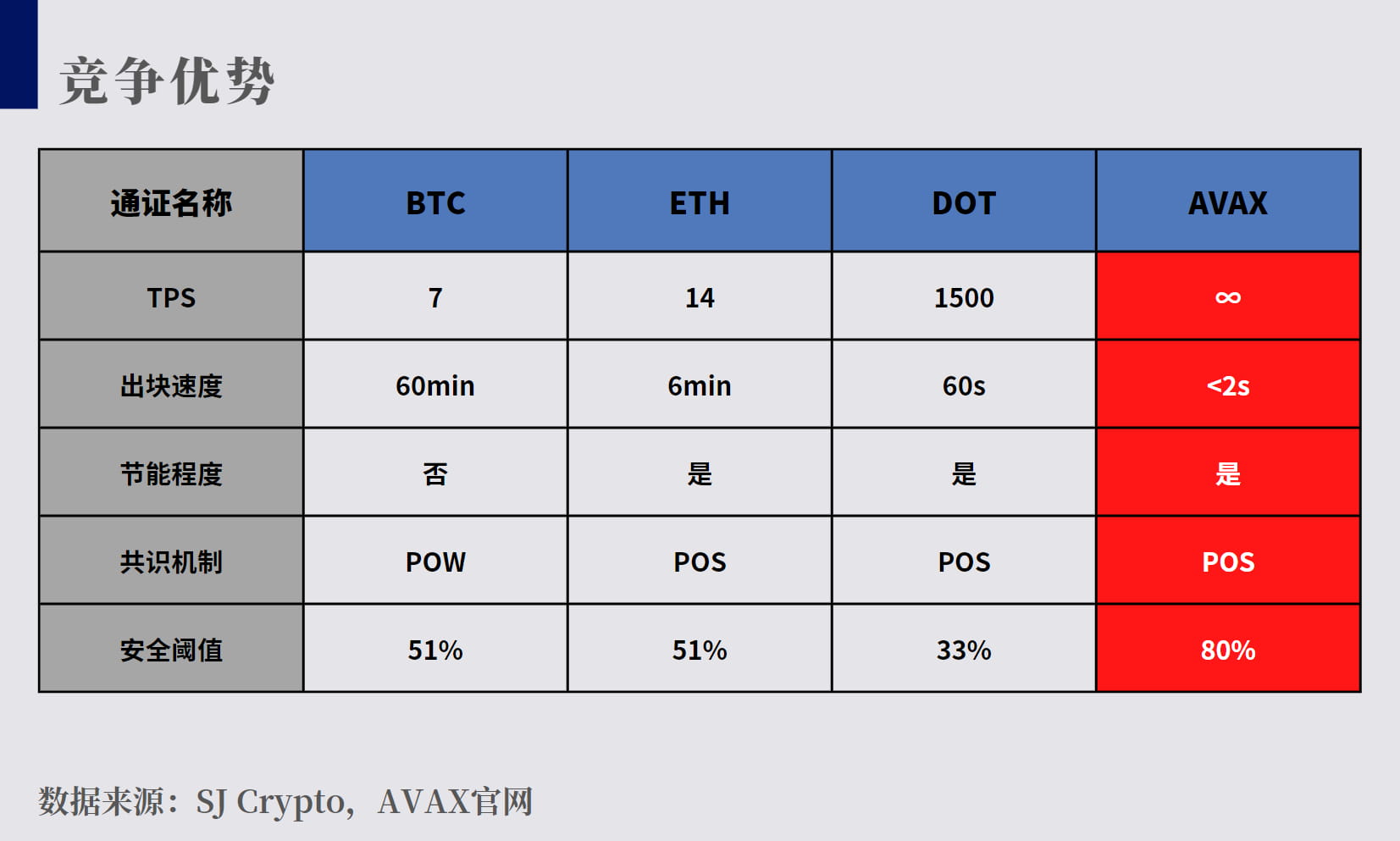
-Improvement of consensus mechanism
Different from other public chains, Avalanche positions itself as "Consensus 3.0". Its improvement in the consensus mechanism takes into account the advantages of [Classic Consensus Protocol] and [Nakamoto Consensus], compared with the shortcomings of the two. It has also been solved in a targeted manner. It can be said that in terms of consensus mechanism, it has laid an extremely solid foundation for Avalanche’s platform foundation.
-Using experience
At the same time, compared with other special-shaped structure blockchains, Avalanche's performance advantages also have its own advantages. The three-chain structure is used in the architecture to maximize the performance of the network. The performance advantage means a better user experience. For For a user, experience is paramount. At this point, compared to the established public chain Ethereum, Avalanche will undoubtedly become a better choice for users in the future.
-Ecological scale
Compared with other new public chains, Avalanche has undoubtedly invested a lot in ecological incentives, and the results of its efforts are also very effective on the chain. It has quickly seized the market share in the ecological and locked positions, and it is still continuing. expansion.
After conducting multiple rounds of financing, Avalanche is undoubtedly strong in terms of financial strength. It also appears to be very willing to provide incentives to the market and style. Those who win users will win the world. This has been confirmed countless times in this industry. of.
- Degree of decentralization
Since AVAX and its nodes do not have high operational requirements (the basic POS mechanism is not high), its network has always retained a large number of validators for a long time. Of course, this has a certain relationship with its linear growth of staking rewards. The verification principle of DAG adopted between validators has no direct affiliation, and there is no possibility of local centralization doing evil.
4. Summary of opinions 📈
AVAX operates around the Impossible Triangle and has certain advantages in three aspects (scalability, performance, decentralization). Moreover, the multi-layer network architecture improves the utilization of assets, and chains can cross-chain each other, which is better than most Layer 1 platforms in terms of network resource allocation;
It is compatible with EVM and has the possibility of ecological secondary development, giving a good living space for ecological development. Existing projects on the Ethereum chain can be directly transplanted;
The current Defi pledge amount on the chain is better than that of projects of the same period, such as SOL, LUNA, etc. Having survived the last round of bull market, AVAX still maintains a high Defi holding amount in the Defi field;
Finally, to briefly summarize, in the entire development process of the industry, especially the clichéd "public chain dispute", countless public chains known as "Ether killers" have been ignored by everyone in the past. However, with the development of the industry, the performance of Ethernet has declined. As well as scalability and even user experience, it has been criticized by countless industry participants. From a platform perspective, Avalanche is not only compatible with the Ethereum Virtual Machine but also has low cost, which is obviously very attractive.
Since Avalanche was launched, attention has been high. Compared with other competitors at the same time, Avalanche's comprehensive strength in all aspects is at the forefront. In the future, whether it can stand out from its competitors is worthy of our attention~
References:
1.AVA Blockchain Platform White Paper
2.Galaxy Digital Research analyzes AVALANCHE