


Real-world assets exist off-chain, and asset owners can obtain expected benefits from them. Related ownership benefits are regulated by the legal system and rooted in our social contract. For "Code is Law"'s on-chain DeFi, how to adapt the off-chain governance system and legal structure to help crypto capital capture off-chain assets safely and compliantly is a problem that currently needs to be explored and solved.
After previously sorting out the path of off-chain assets to the chain through Centrifuge, this article will sort out the governance system, legal structure and practical path of decentralized on-chain protocols to capture off-chain assets through the DeFi perspective of MakerDAO. I hope it will be helpful to project parties and builders who are engaged in RWA, and you are welcome to communicate with us at any time.
The content of this article will cover the more mature RWA projects in MakerDAO, such as New Silver Restructuring, BlockTower Credit, BlockTower Andremeda, Montalis Clydesdale, and the transaction structure provided by Centrifuge for Aave.
1. Why DeFi needs to capture off-chain real-world assets
The narrative of RWA can also be said to be the narrative of MakerDAO’s DeFi. It is very necessary to look at the significance of RWA to the DeFi world from the perspective of MakerDAO.
MakerDAO is a decentralized autonomous organization (DAO) designed to manage the Maker protocol running on Ethereum. The protocol provides the first decentralized basic stable currency $DAI (which can be simply understood as the US dollar on Ethereum) and a series of derivative financial systems. Since its launch in 2017, $DAI has always remained anchored to the US dollar.
In the DeFi Summer of 2021, many unsustainable DeFi yield products have appeared, which has brought about a collapse of the crypto market and credit default contagion spreading to every corner of the ecosystem. Although crypto-native assets are a key component and long-term value differentiator of DeFi, current real needs cannot match long-term development value.
Due to the high volatility of the cryptocurrency market, relying on a single collateral asset can lead to massive liquidations. For giant lending protocols like MakerDAO, the key consideration is: the value of the collateral is stable. We have seen that MakerDAO’s previous collateral included cryptocurrencies with unstable values. This unstable and volatile factor created risks for lending and severely limited the development space of MakerDAO.
Therefore, MakerDAO or DeFi urgently needs a more stable base layer level of collateral to support the large-scale adoption of the stable currency $DAI in the crypto world and build a sustainable and scalable path.
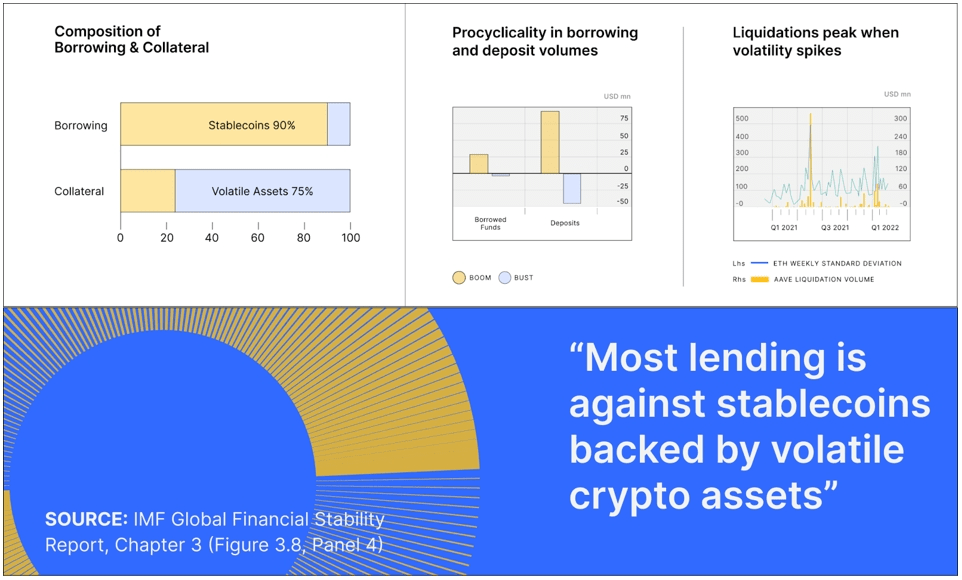 Image source: Web3 Xiaolu Centrifuge & Maker: A Partner's View of Real-World Assets
As one of the most important issues in MakerDAO, RWA is constantly discussed and verified by the community and is regarded as an important solution. In the Endgame plan released by MakerDAO in May 2022, it was also emphasized that one of the key parts of MakerDAO building a decentralized stable currency is to use RWA as collateral.
Benefits of RWA include:
Increase transparency about market risks and asset use;
Provide DeFi composability;
Improve accessibility to underbanked and underbanked populations;
Capture value from larger and more stable traditional financial markets.
For MakerDAO, RWA has two important characteristics-stability and scale. Furthermore, $DAI can expand its scope of use by anchoring assets that are free from crypto-fluctuation risks, stable interest-earning, and scalable, especially in today's market environment of low crypto-asset yields and high U.S. bond yields. Through the value capture of RWA, MakerDAO can continue to expand and grow in the bear market and be fully prepared for the next bull market cycle.
Most importantly, RWA can help MakerDAO realize its grand vision: allowing a credit-neutral, decentralized channel to add utility to people's daily lives and the development needs of enterprises. Through an open chain, community-driven, programmable, and decentralized protocols, a new open DeFi financial market will be realized.
However, it is not easy to put real-world assets on the chain. It will involve new product architecture design challenges, financial, legal compliance and technical risks, as well as unknown unknowns.
2. How DeFi captures off-chain real-world assets
After clarifying the need for DeFi to capture real-world assets, it is necessary to build a governance system and legal structure suitable for on-chain protocols or DAO organizations. Of course, some people will say that this operation is not necessary. It is enough to directly purchase tokenized U.S. bonds issued by a third party, saving time and effort.
For example, we have seen that Solv Protocol, a very successful on-chain fund project on the market, has launched two RWA funds in its V3 version. Solv RWA is the fund manager and currently manages a total of US$2 million in TVL assets. Through KYC Qualified users of /AML can deposit stablecoins and enjoy the benefits of U.S. debt. According to its press release, the underlying assets of the RWA fund are tokenized U.S. bonds provided by Red Cedar Digital. Ltd.
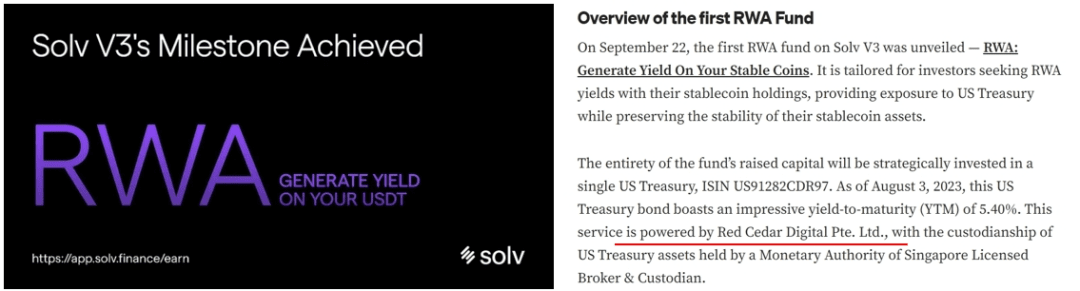 Image source: Web3 Xiaolu Solv V3’s Milestone Achieved: The First Ever RWA Fund Launch
For projects with a small amount of capital, and on the premise that the risks are controllable and affordable, tokenized U.S. bonds provided by third parties can be directly purchased without any problem. But we still need to think about a few questions:
How to ensure that the counterparty (Red Cedar Digital. Ltd.) that provides the underlying assets will not go bankrupt and run away? Think about FTX when it was at its peak;
Furthermore, after the counterparty goes bankrupt, how can such an on-chain agreement without legal entity go to court as a creditor to participate in asset liquidation/reorganization?
Although it may be costly for DeFi projects to build their own governance systems and legal structures, this is a hedge against risks. In any case, this does not prevent us from exploring and studying successful RWA cases on the market to make a choice that suits us.
2.1 The necessity of DeFi legal packaging
As a multi-billion-dollar RWA fund, MakerDAO has taken into account the currently identifiable risks, both from the perspective of fund security and from the level of legal entity qualifications. These risks come from:
Counterparty risk: Imagine the case where the counterparty goes bankrupt or runs away. What MakerDAO needs to ensure is that no third party (including fund management companies/investment consultants) has the ability to directly control, dominate, or transfer its huge funds;
Subject qualification certification: The on-chain protocol or DAO organization cannot complete the customer identification verification (KYC/AML) required to legally hold assets, resulting in the inability to legally purchase and hold off-chain assets. In the same way, you cannot hold your own IP assets;
Qualification for bankruptcy and liquidation: Once there is a breach of contract, bankruptcy, or liquidation of off-chain assets, since the on-chain agreement or DAO is not a legal subject, it cannot immediately interact with courts and liquidation agencies in the real world. Then it is necessary to ensure that MakerDAO has the ability to exercise the right to dispose of off-chain assets in a timely manner through the governance system and legal structure.
Therefore, it is very necessary to build a governance system and legal structure for on-chain protocols or DAO organizations through legal wrapper, and through the connection of DAO governance and legal entity governance systems, DeFi can control off-chain assets governance control.
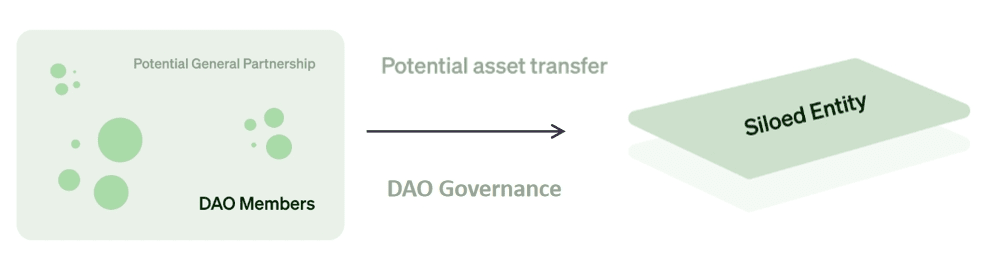 圖源:Web3 小律 The DAO Legal Wrappers and why you need them
2.2 How DeFi carries out legal packaging
Legal Wrapper is a series of legal structures or legal entities specifically targeted at on-chain protocols or DAO organizations, providing on-chain protocols or DAO organizations with a recognized legal status in relevant jurisdictions. Its essence is to "package" the on-chain agreement or DAO organization within a legal structure, or "subordinate" a legal structure, thereby connecting the real-world interaction so that the on-chain agreement or DAO organization can interact with the traditional legal system. connect.
Legal packaging is not absorbed or replaced. The on-chain agreement or DAO organization continues to operate on the chain. It only transfers some of its functions and responsibilities to the legal entity of the DAO, thereby being able to obtain legal protection from relevant jurisdictions, manage tax and regulatory obligations, Sign contracts, own assets, make legal payments, and participate in real-world interactions. DAOs and multi-signature wallets retain direct control over smart contracts, vaults, and any on-chain assets, and only fund their legally wrapped entities when needed.
From this, from the perspective of RWA, we can "set up" corresponding legal entities specifically for the special purposes of on-chain protocols or DAO organizations to capture the value of off-chain assets.
2.3 How DeFi governs off-chain legal entities
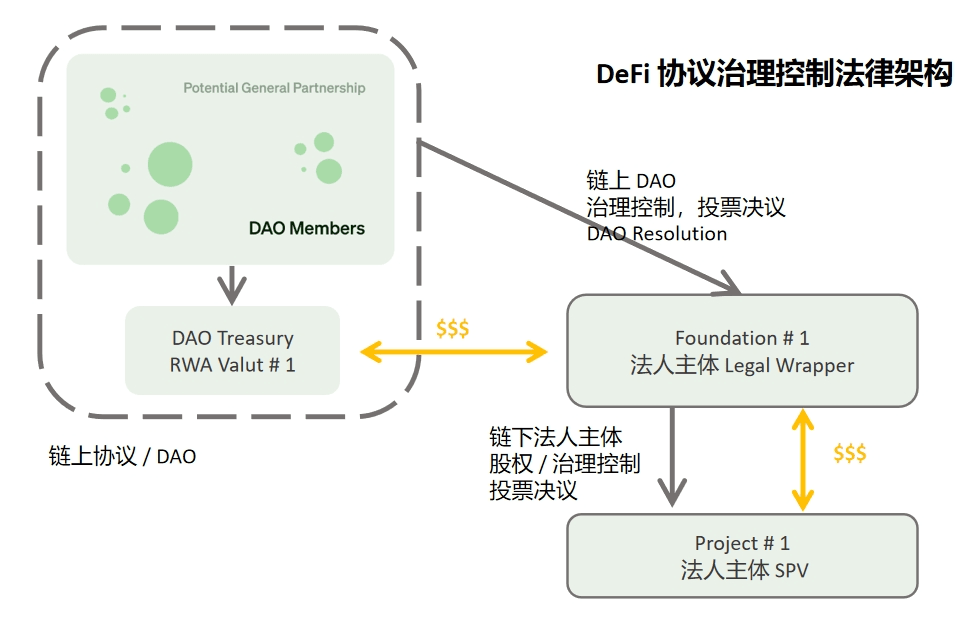 Image source: Web3 Xiaolu
We will further explain using the practice of MakerDAO, which currently has the largest RWA asset volume.
The picture above shows the structure of the Foundation + SPV established specifically for the RWA project based on the MakerDAO MIP-58 proposal. It aims to realize the value capture of the underlying RWA assets through the governance control of the foundation's legal entities.
First of all, MakerDAO established the RWA Foundation#1foundation under the Cayman legal framework (the Foundation Company Law of the Cayman Islands 2017). The foundation can provide a flexible governance structure for on-chain protocols or DAO organizations.
As a legal entity, the foundation does not require any registered capital or shareholder/member roles internally, making the foundation a single-purpose independent orphan legal entity; the foundation can also be similar to a trust, designating MakerDAO or its members as beneficiaries (Beneficiary ); at the same time, the foundation can also achieve bankruptcy isolation (Bankruptcy-Remote), even if MakerDAO or the foundation "Go Dark" will not affect each other.
As a legal entity, the foundation can achieve the following externally:
Interact with off-chain entities, such as signing contracts, providing services, etc.;
Legally hold off-chain assets and IP through KYC/AML;
Protect the limited liability of DAO members;
According to the resolution of DAO, a series of off-chain operations are performed on behalf of DAO.
Secondly, the foundation legal entity can tailor a governance system for MakerDAO based on organizational documents such as Articles of Association and Company Registration Certificate (Memorandum of Association). For example, it stipulates in the Articles of Association that it will only implement the resolutions made by MakerDAO and will not make any decisions on its own. Any resolution and execution; Supervisors and Directors appointed by MakerDAO to have fiduciary duties (Fiduciary Duties) are governed according to the foundation’s organizational documents and the authority granted (Power of Attorney) to ensure that MakerDAO can achieve full control at the legal entity governance level.
Finally, according to the resolution of MakerDAO, Foundation #1, as an independent orphan holding company, holds the equity interests of the subordinate SPV#1legal entity. SPV#1is established in the local jurisdiction based on the attributes of off-chain assets, and captures off-chain assets with the foundation’s investment. For example, if the off-chain assets are located in the United States, you can set up Delaware LLC as an SPV to hold off-chain assets, and the funds come from the loan agreement signed between Foundation # 1 and MakerDAO.
Although we can also see the governance system and legal structure of SPV + trust in some other projects, the overall principle is:
Ensure the governance control of on-chain protocols or DAO organizations;
DAO organization and Tokenholder are the beneficiaries;
The packaging legal entity is able to dispose of assets legally, efficiently and promptly.
3. MakerDAO’s RWA practical cases
Since MakerDAO participated in the Solar Capture, the transaction structure remains unchanged.
The following are several of MakerDAO's more successful RWA projects for reference, including New Silver Restructuring, BlockTower Credit, BlockTower Andremeda, Montalis Clydesdale, and the transaction structure provided by Centrifuge for Aave.
3.1 MakerDAO——New Silver Restructuring (Credit Asset RWA)
New Silver should be MakerDAO's first official RWA project. It was established in 2021 with a debt limit of US$20 million. The underlying assets are mortgage assets (Mortgage Loan) sponsored by New Sliver, which are issued through New Sliver. Business SPV raises funds on Centrifuge tokenization platform.
The community proposed an upgrade and reorganization of the 2021 New Silver project in November 2022. This upgrade and reorganization fully adopted the above-mentioned Foundation + SPV transaction structure, which can be described as a textbook practice.
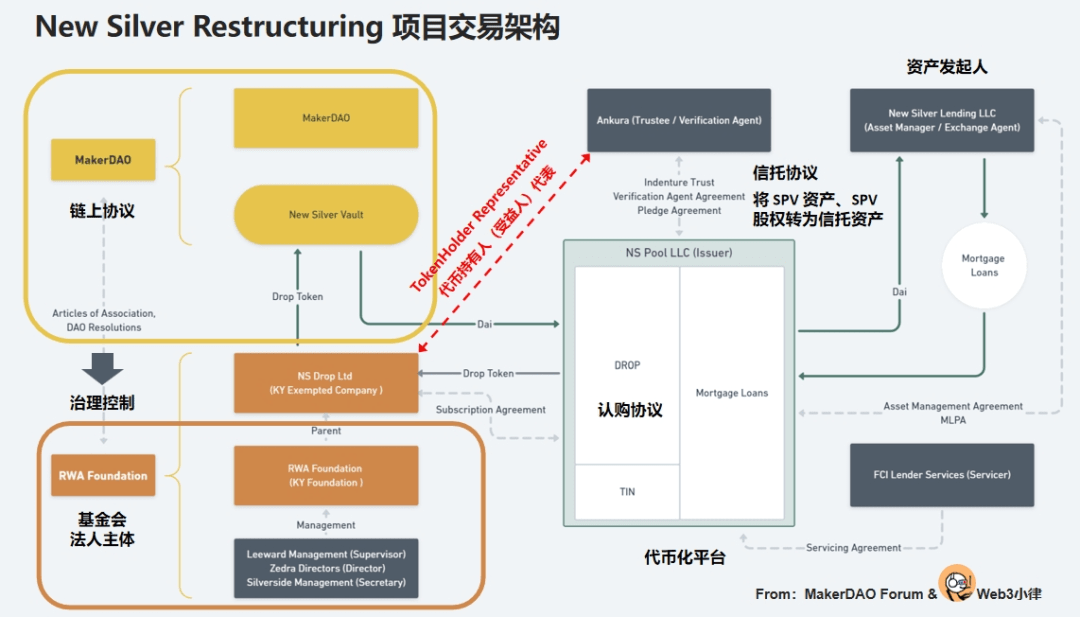 Image source: Web3 Xiaolu
In the transaction structure of New Silver Restructuring upgrade and reorganization, the main participants include:
RWA Foundation, which was established in 2021 and operated the previous HunTINgdon Valley Bank (HVB) project, is controlled by MakerDAO governance - it is agreed in the governance document that the Foundation Director needs to make any resolution or exercise any rights in accordance with MakerDAO Resolutions . Therefore, through the system of MakerDAO on-chain governance + foundation off-chain governance, it is guaranteed that MakerDAO can achieve full control at the level of legal entity governance.
As a wholly-owned subsidiary of the RWA Foundation, NS DROP Ltd is the execution subject of this transaction, participating in the subscription of DROP tokens initiated by Centtifuge as the financier and providing funds; as a representative of token holders (DROP/TIN), exercise MakerDAO Resolutions entrusts the relevant rights; instructs the trustee Ankura Trust to conduct a series of asset operations according to the trust agreement, etc.
Ankura Trust is to ensure the asset independence of the issuer SPV and the safety of MakerDAO funds. According to the trust agreement between the issuer SPV and the trust company, it is agreed on the mortgage of SPV credit assets and the pledge of SPV equity to ensure the integrity of MakerDAO's assets and the timely and adequate settlement of defaults. The amount of disposal provides a guarantee for the security of MakerDAO funds.
3.2 MakerDAO——BlockTower Credit (Credit Asset RWA)
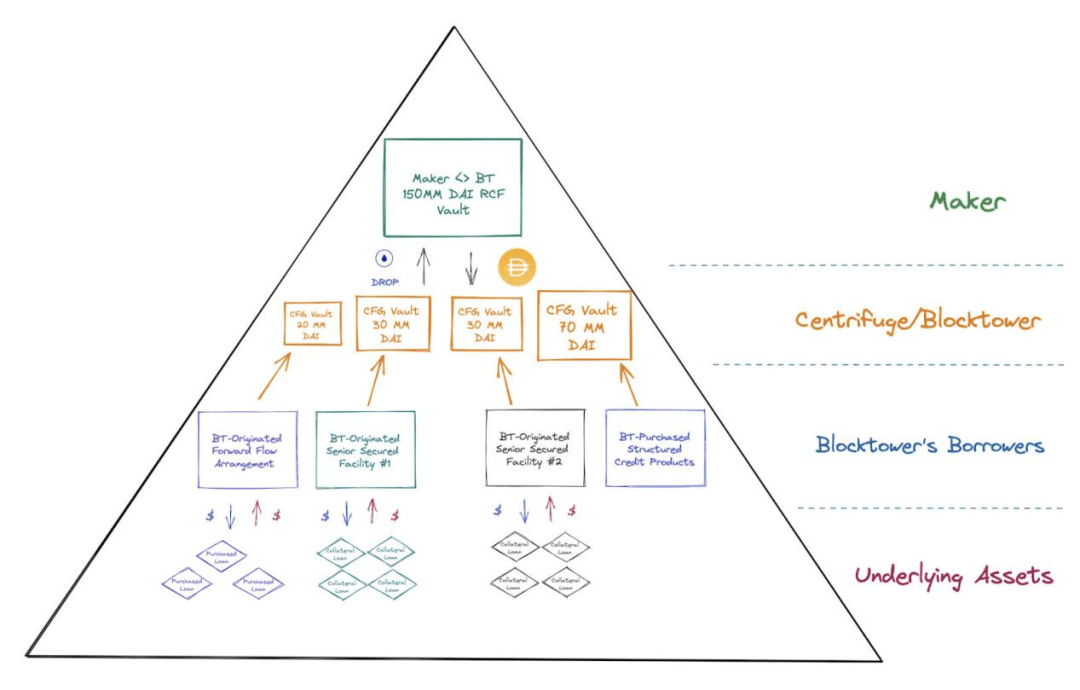
BlockTower Credit is a credit asset tokenization project initiated by BlockTower Capital and will be implemented in November 2022. The entire project has a debt ceiling of US$150 million and is divided into 4 asset pools. BlockTower Credit, as the asset initiator, raises funds on the Centrifuge tokenization platform through its affiliated issuer SPV.
 Source: Web3 Xiaolu BlockTower Credit - Commercial and Legal Risk Assessment - Part I
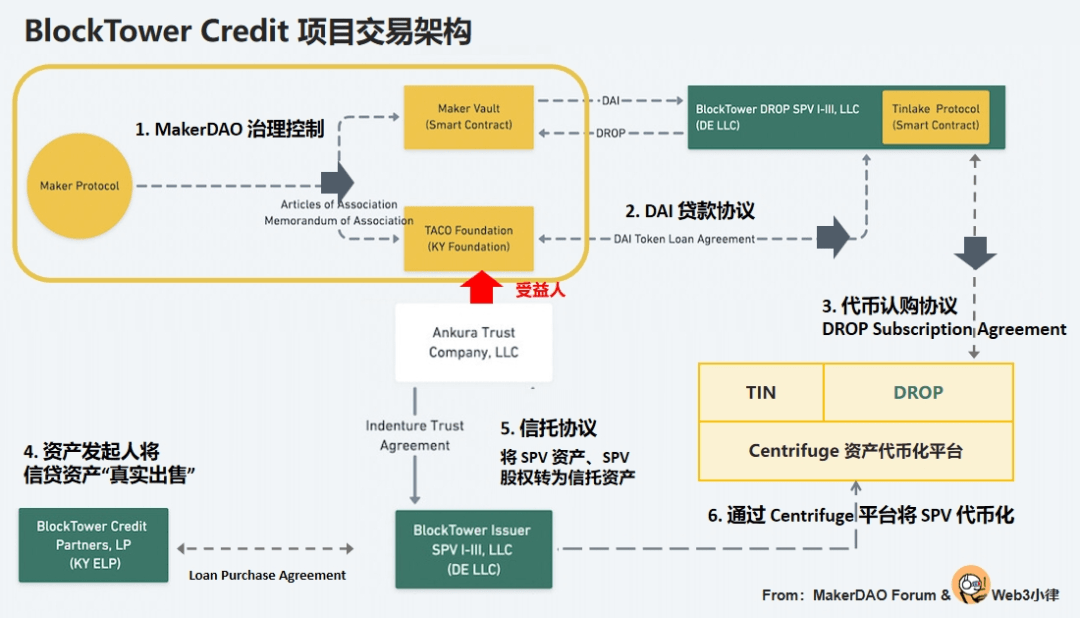 Image source: Web3 Xiaolu
The transaction structure of BlockTower Credit is similar to New Silver Restructuring. We further split it. One part is the operation of the capital side, that is, how to convert the assets on the chain to the off-chain safely and compliantly, and still control it in the hands of MakerDAO; the other part is the asset side. Operation, that is, how to tokenize off-chain assets and obtain funds from MakerDAO.
From MakerDAO’s DeFi perspective:
MakerDAO first achieves control over the TACO Foundation through governance (the TACO Foundation, like the RWA Foundation, is controlled by MakerDAO governance);
Through the loan agreement signed between the TACO Foundation and Blocktower DROP SPV, MakerDAO’s $DAI funds are provided, using DROP tokens as collateral;
This part of the funds is used to subscribe for the $DROP token on the Centrifuge platform, which is issued by the issuer SPV that holds the underlying assets of Blocktower.
From an asset financing perspective:
BlockTower Credit Partners, as the asset originator, loads credit assets into the issuer's SPV through "real sales";
In order to ensure the asset independence of the issuer SPV and the security of MakerDAO funds, the issuer SPV will sign a trust agreement with the Ankura Trust trust company, stipulating the mortgage of the SPV credit assets and the pledge of the equity of the SPV. The beneficiaries are the holders of $DROP and $TIN tokens. The owner (that is, the TACO Foundation) ensures the integrity of MakerDAO’s assets and the timely and full disposal of defaults, providing a guarantee for the safety of MakerDAO funds;
The issuer SPV issues two tokens, $DROP and $TIN, through the Centrifuge asset tokenization platform. $DROP is the priority token, subscribed by TACO through the above channels; $TIN token is the inferior token. Tokens, subscribed by BlockTower Credit Partners.
3.3 MakerDAO——BlockTower Andremeda (美債 RWA)
BlockTower Andremeda is currently one of the largest RWA projects in MakerDAO, with a debt ceiling of US$1.28 billion and current asset scale of over US$1 billion. This is a U.S. debt RWA project initiated by BlockTower Capital and implemented through the TACO Foundation, aiming to diversify treasury funds and invest in off-chain U.S. debt.
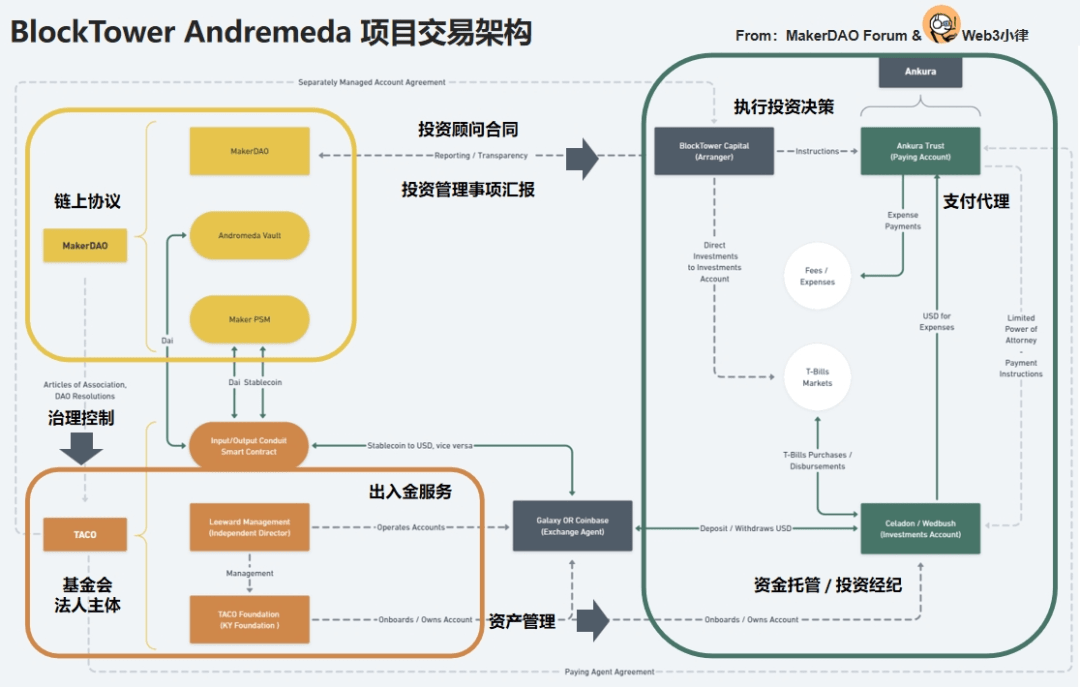 Image source: Web3 Xiaolu
In the project structure of BlockTower Andremeda, the main participants include:
TACO Cayman Foundation, established in 2022, operates the BlockTower S3/S4 credit asset RWA project with a previous asset management scale limit of US$150 million. Like the RWA Foundation, the foundation is controlled by MakerDAO governance. According to Article 4.16 of the Foundation Charter (Articles of Association), the Foundation Director needs to make any resolution or exercise any rights based on MakerDAO's governance vote (MakerDAO Resolutions).
As the investment advisor for this project, BlockTower Capital signed an investment advisory contract with TACO Foundation and is responsible for managing the funds in each account of TACO Foundation and making investment decisions; Coinbase and Galaxy Digital act as deposit and withdrawal service providers; Celadon Financial Group acts as a broker. Execute the investment decisions of the investment adviser; Wedbush Securities Inc. serves as the fund custodian; Ankura Trust serves as the paying agent.
In this structure, MakerDAO uses the TACO Foundation as a legal entity to perform off-chain investment related matters, and separates investment decision-making and asset custody in traditional finance to achieve risk control and compliance.
Comparing the BlockTower Credit project, we see the same point: at the DAO governance level, the MakerDAO on-chain governance + foundation off-chain governance system is used to ensure that MakerDAO can achieve full control at the legal entity governance level.
The difference is: at the level of underlying asset value capture, Andremeda directly invests funds in U.S. debt assets through deposits and withdrawals, investment consultants, investment brokers, fund custody, and payment agents, and implements this through the TACO Foundation; while BlockTower Due to the different underlying assets, the S3/S4 project has joined the structure of the foundation and SPV. The SPV is specifically used to capture the underlying assets tokenized through the Centrifuge platform.
3.4 MakerDAO——Monetalis Clydesdale(美債 RWA)
Although we have seen that several Blocktower projects are operating very successfully on MakerDAO, some members still express concerns about the excessive concentration of counterparties. For example, Blocktower plays multiple important roles in the project, such as investment consultants, asset sponsors, etc.
Therefore, the Monetalis Clydesdale project initiated by Monetalis founder Allan Pedersen aims to explore a safer RWA path. The project was proposed in January 2022, adopted and implemented in October 2022. The initial debt limit of the project was US$500 million, and the debt limit was increased to US$1.25 billion in May 2023, with assets invested in U.S. bond ETFs.
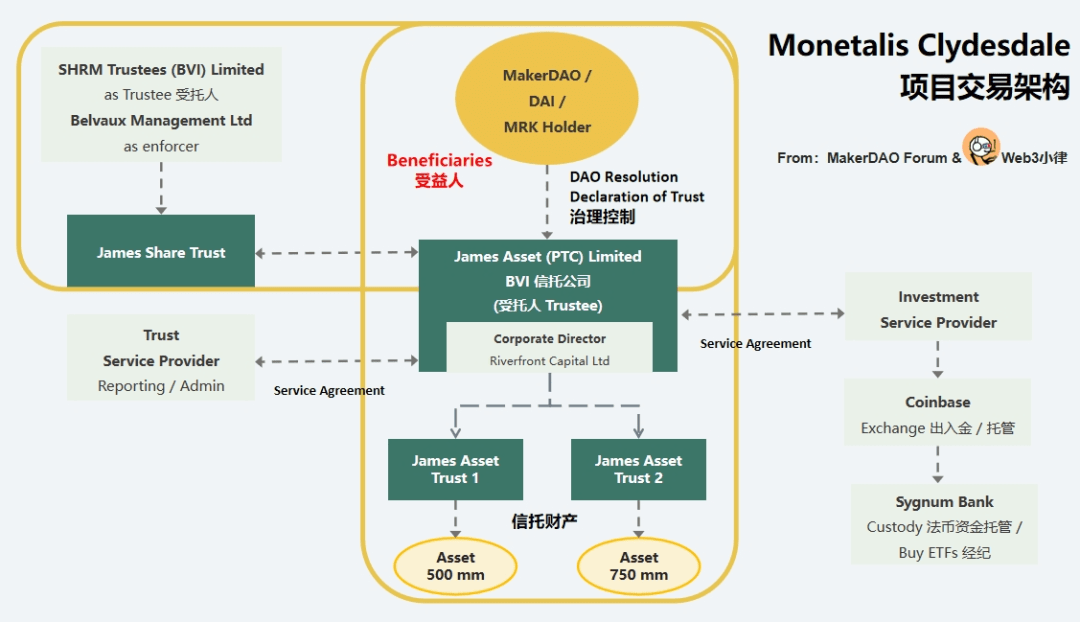 Image source: Web3 Xiaolu
In the transaction structure of Monetalis Clydesdale, it is crucial to the operation of the capital side, that is, how to convert on-chain assets to off-chain security and compliance, and still control them in the hands of MakerDAO:
Establishment of property trust: First, a BVI trust company named JAL is established, which establishes James Asset Trust through a Declaration of Trust. As a trustee, JAL holds the $DAI and ETF trust assets provided by MakerDAO. MakerDAO MKR token holders are the beneficiaries. It controls the trustee through trust governance documents and instructs the purchase and disposal of trust assets.
MakerDAO’s governance control: According to the Declaration of Trust, the trustee JAL must take any action based on the MakerDAO Resolution; and any action taken must be approved and agreed by the transaction manager on the MakerDAO Resolution; the trustee JAL must not take any action Actions unrelated to MakerDAO Resolution.
Establishment of Equity Trust: After taking care of MakerDAO's governance control over trustee JAL's trust property, it is necessary to set up James Asset Share Trust with trustee JAL's equity as trust property, with SHRM Trustees (BVI) Limited as the trustee and Belvaux Management Ltd As enforcers, MakerDAO MKR token holders are the beneficiaries.
As a result, MakerDAO has achieved control over JAL's trust assets on the one hand (corresponding to the $DAI trust assets provided by MakerDAO), and on the other hand it has also achieved equity control over JAL (corresponding to trustee JAL). In this case, any operation needs to go through/verify MakerDAO Resolution, and the flow of funds is not controlled by any third party (MakerDAO Vault - JAL Trust Property Custody Account - Sygnum Bank Custody Account).
Under such a transaction structure, MakerDAO achieves:
Less or no counterparty risk, that is, third parties or investment managers have no ability to change legal terms and have no access to related funds;
Barrier-free on-chain and off-chain governance structure;
Through trust protection, MakerDAO $MKR token holders have the ability to promptly handle the default relief and liquidation risks of the underlying assets;
Clarify the fixed purpose of the funds and the absence of risk of misappropriation.
Next, trustee JAL's asset investment is relatively simple. Withdraw $DAI into $USD through Coinbase, and conduct fund custody and ETF transactions through Sygnum Bank.
3.5 Centrifuge——RWA Roadmap(美債 RWA)
Centrifuge has participated in multiple previous credit asset RWA projects of MakerDAO in the early stages, such as the above-mentioned New Silver Restructuring and BlockTower Credit. The specific process will not be discussed here. If you are interested, you can read our previous article analyzing Centrifuge - looking at the decentralized asset financing protocol Centrifuge from the essence of RWA.
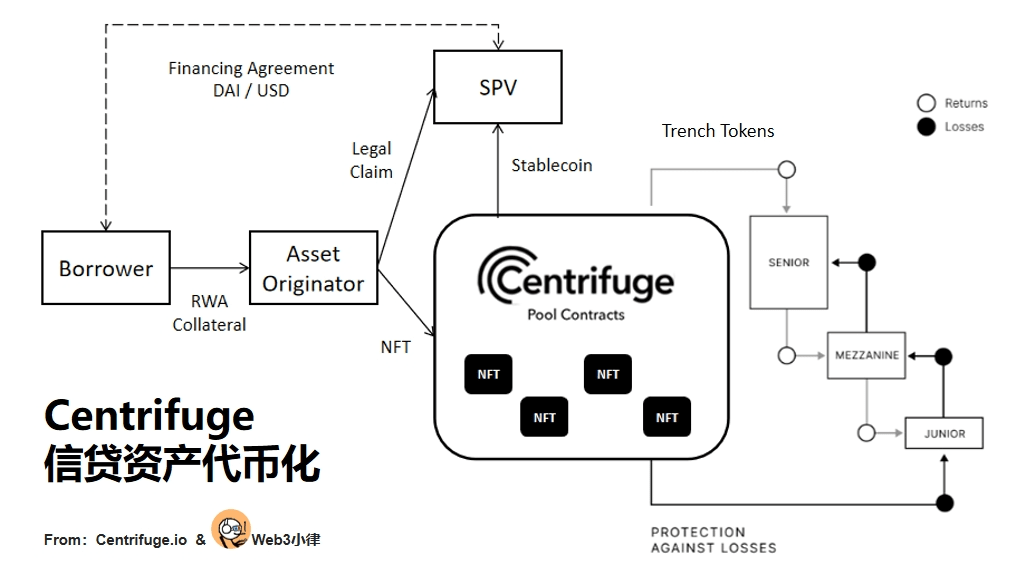 Image source: Web3 Xiaolu
What I want to talk more about here is the Centrifuge Prime service, which is designed to help crypto capital, DeFi protocols, and DAO treasury capture the return value of real-world assets (such as U.S. debt risk-free returns). Previously, the Aave community proposed on August 8, 2023, to capture the 5% risk-free return based on U.S. debt RWA by investing the stablecoins in the Aave vault in RWA assets through cooperation with Centrifuge.
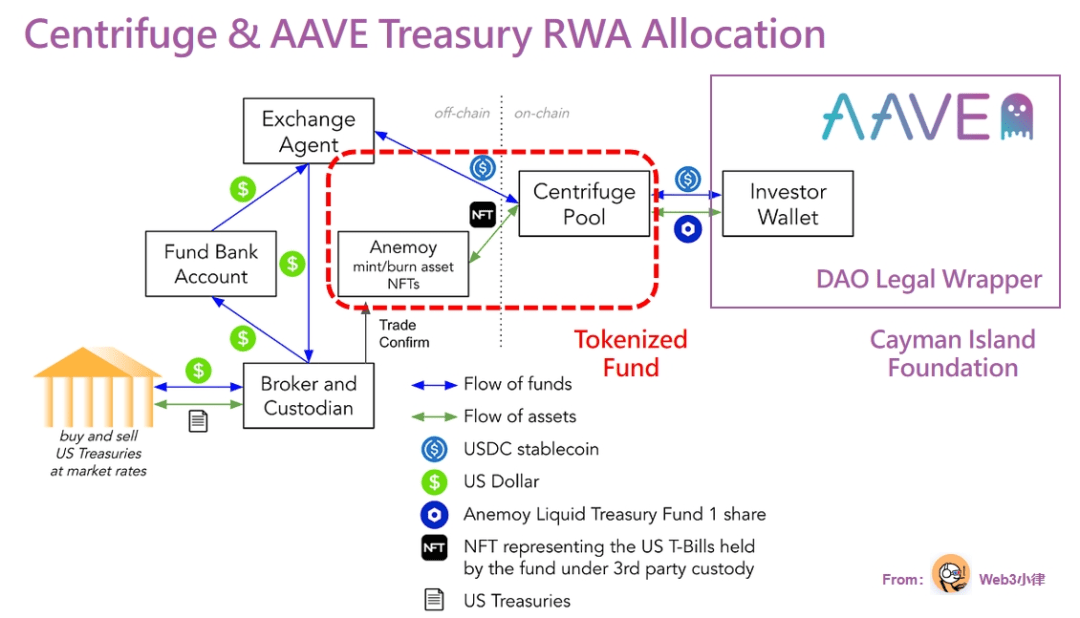 Source: Web3 Xiaolu POP: Anemoy Liquid Treasury Fund 1
The Centrifuge Prime service pictured above is divided into two parts:
The first step: Legal Wrapper needs to be carried out for the DeFi protocol on the chain, such as setting up a special legal entity for Aave - the Cayman Foundation. On the one hand, this legal subject can replace the unlimited liability of DAO members. On the other hand, it can also serve as an independent subject for implementing RWA value capture. It is governed and controlled by the Aave community and serves as a bridge between DeFi and TradiFi.
Step 2: Centrifuge will set up a dedicated asset pool of Anemoy Liquid Treasury Fund 1. Different from the underlying credit assets of previous asset pools (load the assets into SPV, generate NFT and mortgage them into the corresponding Centrifuge asset pool), this time the underlying assets of the Anemoy Liquid Treasury Fund 1 asset pool are U.S. debt, and you need to hold U.S. debt Assets of the Anemoy LTF Fund are directly tokenized.
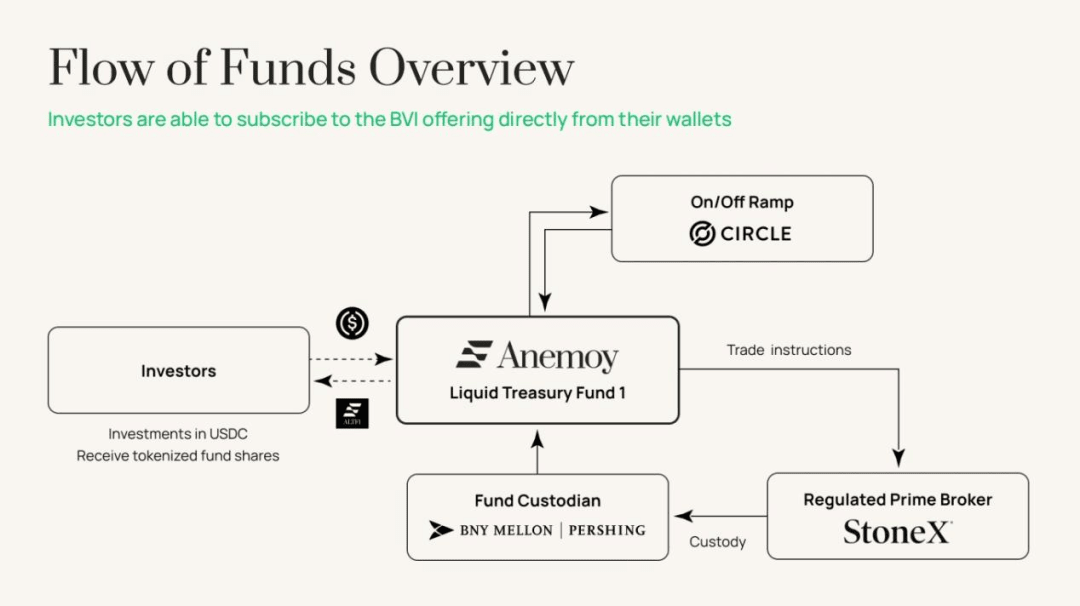 Source: Web3 Xiaolu Anemoy Liquid Treasury Fund 1
Anemoy LTF is a fund registered in the BVI. First, the fund is tokenized through the Centrifuge protocol; then, Aave invests the treasury funds in the Centrifuge asset pool corresponding to Anemoy LTF, and generates fund token certificates; after that, Centrifuge assets The pool allocates the assets invested by the Aave vault to the Anemoy LTF fund through the agreement; finally, the Anemoy LTF fund purchases U.S. Treasury bonds through deposits and withdrawals, custody, and brokers to realize the return of U.S. debt on the chain.
In the same way, Centrifuge helped the stablecoin project Frax Finance’s $20 million to capture off-chain asset returns through the above method.
4. The combination of RWA and DeFi does not require permission
We have seen that including the projects covered in this article, as well as most RWA projects on the market, they are only for a single, limited funder, or only for qualified investors, and retail investors cannot participate. This is because due to regulatory compliance and the requirements of the local Securities Law, if retail investors participate, they will face the same issuance costs as an IPO. Therefore, not all RWA platforms will be open to all users after putting assets on the chain.
In our previous research report "RWA Ten Thousand Words Research Report: Dismantling the current implementation path of RWA and exploring the development logic of future RWA-Fi", we can still see that some projects can find a way without permission by combining with DeFi. The path for retail investors to participate.
For example, the DeFi lending path of Ondo Finance & Flux Financ, Matrixdock & T protocal uses the restricted Token required by qualified investors as collateral to set up a DeFi lending pool. Retail investors can deposit stable coins into the DeFi lending pool to obtain income from the lending rate. . In addition, there are interest-bearing stablecoin paths of Ondo & USDY, MatrixDock & USDV, which use restricted Tokens required by qualified investors as collateral to issue stablecoins, and retail investors can deposit stablecoins in exchange for interest-bearing stablecoins.
The composability of DeFi is self-evident. We have also seen Pendle access RWA assets to achieve interest rate swaps before. We are also actively exploring the combination of RWA and DeFi, and are currently building a U.S. debt RWA platform to explore the infinite possibilities of RWA.
5. Write at the end
The projects currently on the market can be called RWA version 1.0, which more address the financing needs of the off-chain asset side (whether through Security Token Offering or mortgage lending) and the investment needs of the on-chain capital side. (How to capture real-world assets that are low-risk, stable interest-earning, scalable, and independent of crypto fluctuations is the key).
RWA will also develop versions 2.0 and 3.0 that are more integrated with the real world in the near future. Before that, plan ahead.
This article is reprinted with permission from: "MarsBit"
Original author: Web3 Xiaolu