

Author: Ying Ning Haruka
Cryptocurrency has always been under the sword of Damocles, namely SEC regulation. This article will start with the history of the development of US securities law and explain the most important qualitative standard for securities in securities law, the Howey Test, to provide a reference for determining whether various cryptocurrencies should be considered securities.
1. U.S. Securities Law
At the height of the Great Depression, Congress and President Roosevelt enacted the first federal securities laws.
The Securities Act of 1933 is about companies raising money from the public. Investors can decide what risks to take; companies that issue securities to the public must provide full, fair, and true disclosures to the public to protect the interests of investors. Roosevelt called this law the "Truth in Securities Act."
In 1934, Congress passed the Securities Exchange Act. This statute covers intermediaries, such as the exchanges themselves and broker-dealers. The basic idea is that the public should be disclosed and protected not only when securities are initially issued, but also when they are traded in the secondary market.
In 1940, Congress passed the Investment Company Act and the Investment Advisers Act, requiring funds and advisers to register in order to manage other people’s money and prevent additional opportunities for conflicts of interest.
The U.S. Securities Act of 1933 and the Securities Exchange Act of 1934 have a very broad definition of securities, which includes securities used for investment in the general sense, such as stocks and bonds, as well as a variety of non-standard securities, such as "certificates of income or certificates of participation in income-sharing arrangements", "investment contracts" and "generally speaking, all income or instruments that are generally recognized as securities."
In describing the scope of securities laws, U.S. Supreme Court Justice Thurgood Marshall said, “Congress has drawn a broad line on the definition of a security and has enacted securities laws to regulate investments, whatever their form or name.”
2. Securities Judgment Standard - Howey Test
The Howey Test is a standard used in 1946 in the U.S. Supreme Court case SEC v. W.J. Howey Co. to determine whether a particular transaction constitutes a securities offering.
Howe & Well is a real estate company in Florida, USA, which developed large orange groves and sold ordinary land to investors. While signing a land sales contract with the investor, the company also signed a management service contract with the investor, which means that the land sold will be managed by the defendant company.
The more elements of the Howey test are met, the closer the nature of the particular transaction is to that of a security.
(1) Investment of Money
This requirement requires the purchaser to provide funds to the project sponsor in the form of cash consideration.
(2) Investing in Common Enterprise
This requirement is intended to distinguish investment contracts from one-on-one private contracts. In response to this requirement, the Supreme Court requires that joint undertakings must have "horizontal commonality", "broad vertical commonality" and "narrow vertical commonality".
“Horizontal commonality” requires tying each investor’s wealth to the fate of other investors through the pooling of funds, usually combined with a pro rata distribution of profits;
“Broad vertical commonality” requires that whether investors can obtain returns depends on the efforts of the project initiator;
"Narrow vertical commonality" requires that the returns of investors and the efforts of others be combined with the final operating results;
(3) Investors have expectations of profit
The "return" here can be capital appreciation from the initial investment or business, or income from the use of the buyer's funds. Price appreciation that is entirely due to external market forces (such as general inflation trends or economic developments) affecting the supply and demand of the underlying assets does not qualify as "return" under the Howey test.
(4) Derived From The Efforts of Others
This requirement requires that the project initiator, organizer or other related third party has made necessary management efforts, and that such efforts will have a critical impact on the success of the business. Investors only need to pay specified fees and costs and do not actually participate in the operation and management of the project.
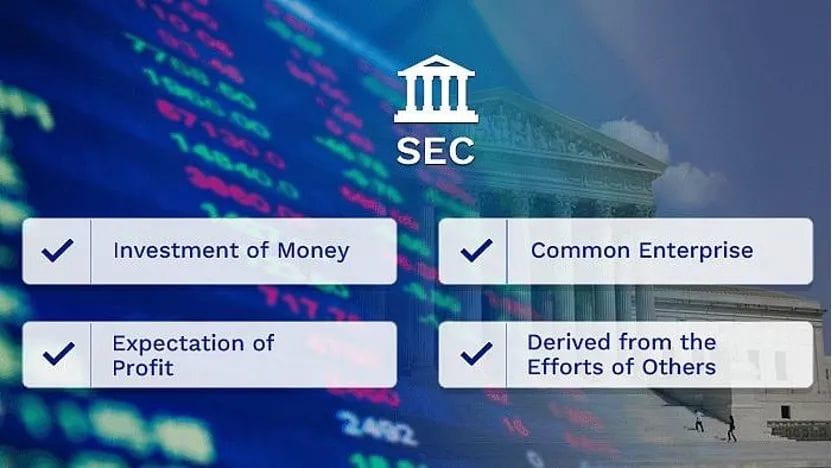
The core concept of Howe's test in setting the above requirements is to "protect the legitimate rights and interests of investors."
For example, the reason why Standard 2 requires a "common undertaking" is that the Supreme Court believes that in the "common undertaking" scenario, due to the high cost of individual due diligence and communication, individual investors have no motivation to obtain information through coordination with other investors, nor can they prevent the collective from negotiating with the project sponsor. Therefore, investors can only rely entirely on the sponsor to obtain benefits. The sponsor plays a vital role in the project, which creates an unequal position between them and the investors.
To make up for this disparity in power, defining investment contracts as securities is more conducive to investors’ evaluation and pricing of investment projects and protects investors’ interests. For example, Standard 4 specifies “others’ efforts” in order to clarify the responsible party of the investment contract and accurately identify the information disclosure obligor when implementing securities disclosure obligations. [1]
3. The U.S. Securities and Exchange Commission (SEC) and Cryptocurrency
On April 3, 2019, the U.S. Securities and Exchange Commission (SEC) released a framework for analyzing digital asset investment contracts based on the Howey test, providing official guidance for determining whether digital currencies are securities. The SEC believes that most digital currencies on the market currently meet the two criteria of "capital investment" and "investment in a common cause."
Regarding the other two criteria, the SEC states that if the development of a digital currency relies on the efforts of a company or centralized entity and purchasers have reasonable expectations of making a profit from their investment, then the digital currency is considered a security. It should be noted that if a digital currency is sufficiently decentralized, has clear application scenarios, and its price changes are related to the application rather than from investors' expectations of profits, then the digital currency is not a security. The SEC has stated that Bitcoin and Ethereum are not securities. [2]
3.1 BTC
Bill Hinman, former director of the U.S. Securities and Exchange Commission (SEC) Financial Division, pointed out in a speech in 2018 that Bitcoin (BTC) is not a security and is regulated by the Commodity Futures Trading Commission (CFTC). The CFTC is mainly responsible for regulating the derivatives market, including futures, swaps, and certain types of options. This also echoes that BTC mining is like commodities such as gold and oil.
3.2 ETH
3.2.1 ETH(ICO)
Ethereum's initial coin offering (ICO) began in August 2014. The 42-day ICO raised 31,000 bitcoins and sold 60,102,216 ethers, which was equivalent to about $18.4 million at the exchange rate at the time. From the history of this ICO, it should be classified as a security.
3.2.2 ETH(PoW)
Ethereum's POW phase is similar to Bitcoin.
3.2.3 ETH(PoS)
Ethereum completed the merger of the mainnet and beacon chain on September 15, 2022, and the consensus mechanism was switched to Proof of Stake (PoS). The operating process of PoS is that the staker puts 32 ETH into the smart contract and receives a certificate at the same time to prove the withdrawal right of Staking.
It can be seen that, first, the smart contract does not use these 32 ETH. In the case of investment, the company will spend this asset and put it into production. Due to the existence of extraction proof, the identities of all stakers are identifiable, not a bound community of destiny, and do not have the characteristics of "horizontal commonality". Second, Staking income is issued by the PoS algorithm, not by the service provider (such as Coinbase), so the income does not come from the efforts of others. If it is regarded as an investment, the ETH should be handed over to the verification node, which earns income by putting these assets into production, and then distributes part of the income to the stakers.
3.3 Stablecoins
On February 14, law enforcement officers from the U.S. Securities and Exchange Commission (SEC) issued a "Wells notice" to Paxos, the issuer of the BUSD stablecoin. In the afternoon of the same day, the New York State Department of Financial Services ordered Paxos Trust Co. to stop issuing more BUSD Tokens.
Regarding cryptocurrency stablecoins, current SEC Chairman Gary Gensler mentioned in a speech on September 8, 2022 that stablecoins have similar and potentially competitive characteristics to money market funds, other securities, and bank deposits, and will raise important policy issues. It is important to ensure that we have appropriate investor protection and safeguards to prevent illegal activities.
Stablecoins are primarily used as a means of participating in crypto platforms, or as settlement tokens within crypto platforms. Whether they are shares of money market funds or other types of securities depends on their attributes, such as whether these instruments pay interest directly or indirectly through affiliates or other means; what mechanism is used to maintain value; or how the tokens are offered, sold, and used in the crypto ecosystem.
3.4 Other Tokens
Gary Gensler, chairman of the U.S. Securities and Exchange Commission (SEC), has repeatedly stated that most virtual assets are securities.
It is supported by a 1990 opinion by U.S. Supreme Court Justice Thurgood Marshall: When someone raises funds from the public and the public participates in its profits, it is a security. The SEC regulates these virtual assets that are considered securities, including requiring issuers to comply with information disclosure and registration requirements under securities laws to ensure that investors have access to sufficient information to make wise investment decisions. In addition, the SEC also regulates fraud and manipulation in the virtual asset market to protect the rights and interests of investors.
4. Is Staking a Security?
Coinbase believes that staking does not meet the four conditions of the Howey test.
The staking service does not constitute an investment of money, and the pledger retains full ownership of their assets;
The providers of staking services are not ordinary companies. The entire process is executed through smart contracts on a decentralized network.
Staking rewards are wages for blockchain validation providers, not returns on investment, and do not constitute “reasonable profit expectations”;
Providers of staking services only use publicly available software and computers to perform verification services and do not perform any management work. These are IT services, not investment services, so rewards are not paid based on "other people's efforts."
The purpose of securities laws is to correct information asymmetry and protect the legitimate rights and interests of investors. However, there is no information asymmetry in staking because all participants have equal access to the same information to verify transactions on a public and transparent blockchain. Trying to impose securities laws on a process like staking will not help users at all. On the contrary, unnecessarily aggressive authorization will prevent users from accessing basic crypto services and push them to offshore, unregulated platforms. [3]
references:
[1] Zhang Chao. The legal nature of security token issuance and the shift in regulatory paradigm: From the perspective of the US digital asset investment contract analysis framework [J]. Financial Law, 2020(01):85-100.
[2] Xiao Feng, Blockchain: Distributed Business and the Future of Intelligence, CITIC Press, 2020.
[3] Paul Grewal.Coinbase’s staking services are not securities. And here's why.
https://www.coinbase.com/blog/coinbases-staking-services-are-not-securities-and-heres-why, 2023-2-10