


Original author: Thinking Weird
Posting a long thread to record my thoughts: Why #Bittensor is a scam, and $TAO is heading towards zero?
First, although Bittensor officially touts itself as a 'fair mining' project, in reality, the underlying Subtensor is neither a PoW public chain nor a PoS public chain; rather, it is a standalone chain managed by the Opentensor Foundation (the foundation of Bittensor), and the mechanisms are extremely opaque.
As for the so-called 'Three Giants + Senate' dual governance structure, the three giants are three employees of the Opentensor Foundation, and the Senate consists of the top 12 validator nodes, all of whom are insiders or interested parties.


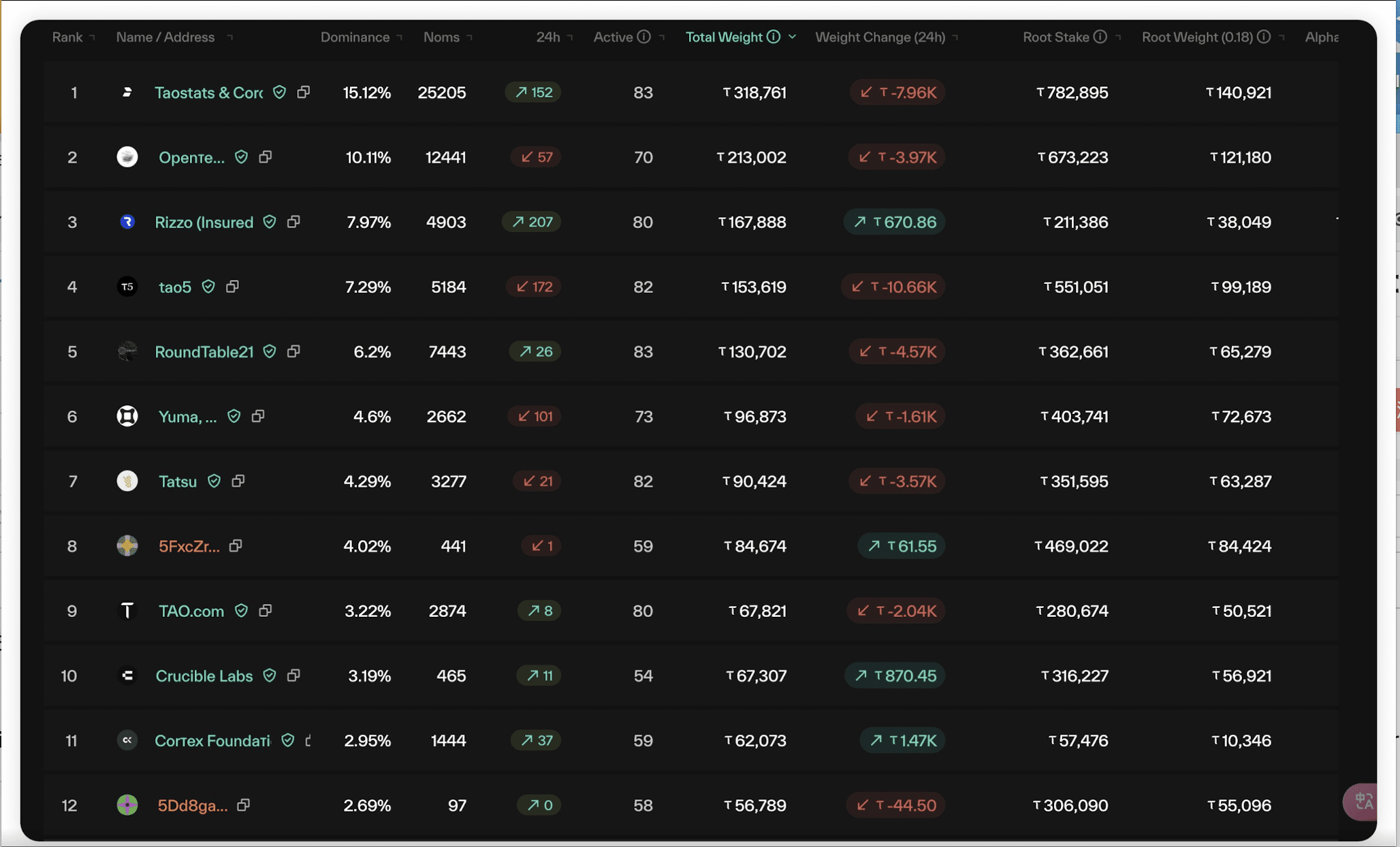
Secondly, the release of 'Kusanagi' on January 3, 2021, marked the activation of the Bittensor network, allowing miners and validators to start receiving the first batch of TAO rewards. From network activation to the launch of the subnet on October 2, 2023, Bittensor has mined a total of 5.38 million TAO. However, there are no documents or materials indicating the rules for distributing the tokens generated during the period from January 3, 2021, to October 2, 2023, and their final destination.
It can be reasonably speculated that this portion of tokens is being divided among internal members and interest groups, as Bittensor is not like Bitcoin; it is incubated and invested by VCs.
If we divide this portion of tokens by the current issuance of 8.61 million, it means that at least 62.5% of the TAO is in the hands of internal members and interest groups. Additionally, the Opentensor Foundation and some invested VCs also operate validator node businesses on Bittensor, so their share of chips will only exceed the 62.5% figure.

Like the OM that collapsed a few days ago, all the projects whose market caps you do not understand, their distorted market caps are often created by poor circulation.
Billions in market cap backed by poor liquidity.
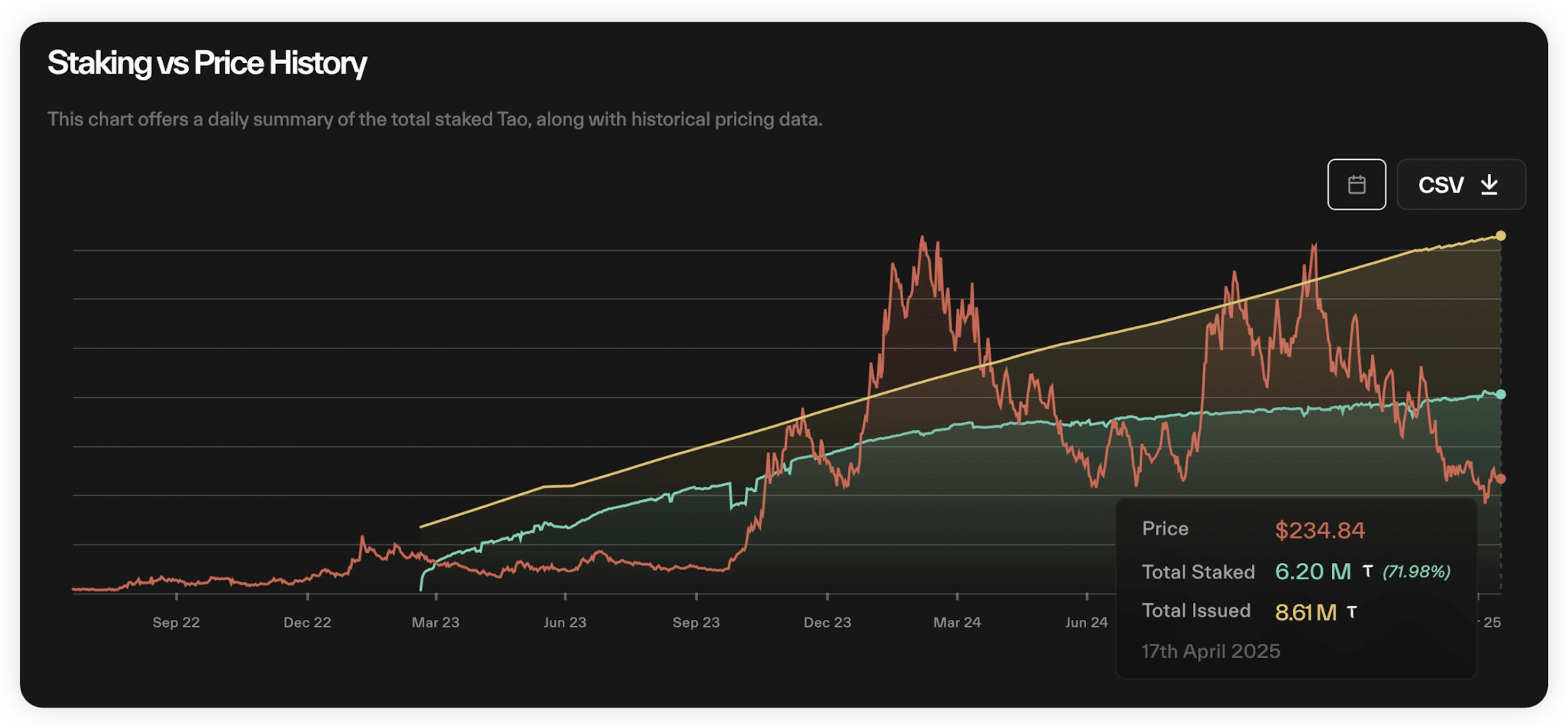
The chart below shows the historical staking situation of TAO; do not be deceived into thinking that the staking rate of TAO gradually increased from low to high. It is drawn this way because TAO is undergoing severe inflation.
In fact, the staking rate of TAO has never been lower than 70%, peaking at nearly 90%. Based on TAO's current market value of $2 billion, this means that at least $1.4 billion worth of TAO has never participated in circulation. The actual market value of TAO is only $600 million, while the corresponding FDV is as high as $5 billion, a typical low circulation, high market value project.
The so-called AI project with the highest market cap, how its bubble was inflated by the major players, please enjoy the details.
Finally, the so-called dTAO upgrade is more like providing an exit liquidity opportunity for OGs. It forces you to buy high-multiple subnet tokens, taking over TAO from the interest groups.
According to the Three Plate Theory, the dTAO upgrade in February this year occurred when the 'dividend plate' was difficult to sustain, forcing the introduction of new Ponzi models 'splitting plate' and 'mutual assistance plate' to deleverage. The core purpose is to fabricate a new narrative to attract new external liquidity while the old narrative weakens and external liquidity is rapidly drained.
First is the 'Splitting Plate': By allowing all subnets to issue tokens, TAO has successfully positioned itself as the base currency for all Bittensor subnet tokens, with its value supported by dozens of (and increasing) subnet tokens.
Due to poor trading pool depth, subnet tokens often experience astonishing price increases. Through this, Bittensor presents a façade to the outside world of an ecosystem capable of providing high ROI opportunities. The exaggerated nominal ROI provided by subnet Alpha tokens artificially creates significant buying pressure for TAO and provides cover for validator nodes to sell TAO.
Unfortunately, Bittensor's closed ecosystem, combined with the market environment transitioning from bull to bear, has resulted in the dTAO upgrade failing to attract sufficient external liquidity, and even the internal liquidity (those TAO staked in the root network) has not been adequately mobilized or activated.
At the same time, the lowered entry threshold and unlimited number of subnets have led to an excessive and rapid issuance of tokens, diluting the already limited overall liquidity of the Bittensor ecosystem.
Secondly, there is the 'mutual assistance plate'. Unfortunately, the issuance of subnet tokens by Bittensor cannot establish a mutual assistance model like Pump.fun on Solana that allows for high capital flow, because Bittensor's network infrastructure is very poor. Different subnet tokens cannot even be exchanged, making it difficult for participants in subnet tokens to migrate liquidity between different subnets. This further exacerbates the liquidity dilution issue caused by high splitting rates, making it impossible to retain funds for continued speculation.
Once the major stakers of the root network start to flee en masse, the liquidity both on and off the market will quickly dry up.
The moment you sell, game over.

So, are the big players fleeing? The answer is 'they are fleeing'!
Since the launch of dTAO:
➤ The Bittensor protocol injects 450,000 TAO into the subnet pool.
➤ 150,000 TAO (33%) flows to root network validator nodes through the 'automatic selling' mechanism.
➤ The staked amount of the root network (τ₀) decreased by 150,000 (5.86 million → 5.71 million).
This means:
300,000 TAO (≈ $70 million) successfully escaped from the root network and may be liquidated on CEX.


Moreover, Bittensor's previous foundation was the subnet and miners. The previous model of Bittensor was like a VC, providing funds to projects so they could focus on building valuable business models without needing to worry about how to make money immediately to ensure a balance. This is the core reason for attracting projects to create subnets on Bittensor.
Moreover, the projects attract miners who provide computing power (in Bittensor's terms, 'intelligence'), creating a 'you scratch my back, I scratch yours' situation that is the core reason Bittensor can become the largest market-cap cryptocurrency AI project.
However, after the dTAO upgrade, the interests of subnet project parties, miners, and validator nodes are no longer aligned; the original 'you scratch my back, I scratch yours' no longer exists. The dTAO model offers no benefits for subnet project parties, and the collapse of the economic model is currently the biggest and most fundamental issue for Bittensor.
In Bittensor's dTAO model, subnet Alpha tokens are a type of 'warrant' obtained from staking TAO in the subnet, and are not general tokens that can be circulated. This makes it difficult for subnet project parties to devise effective tokenomics for these tokens. These Alpha tokens, aside from generating more Alpha tokens, are of no use to retail investors. Based on my observations, subnet project parties commonly announce repurchasing Alpha tokens with project income to boost token prices, such as Chutes (SN64).
But if Subnet Owners can only empower Alpha tokens in this way, then a funny situation arises. The 18% Alpha tokens allocated to subnet project parties from dTAO will forever be stuck in the project parties' hands. After all, if you have announced that you will use project income to repurchase, why would you still sell your own tokens?
Selling and repurchasing are contradictory.
Therefore, subnet owners not only cannot earn any income from the dTAO model, but even have to subsidize it: generating external revenue and injecting it into their subnet Alpha tokens. This means that subnet project parties and miners are essentially working for the validator nodes. The validator nodes, as the privileged class of the Bittensor network, not only cannot do anything of value, but can continuously sell subnet Alpha tokens from the start of the dTAO upgrade, with up to 1/3 of the TAO flowing to the root network daily.
The reason Bittensor can attract other projects to build subnets on it is fundamentally because the previous TAO emissions serve as a good subsidy mechanism for emerging projects without income, allowing these projects to focus solely on running their business models.
If this subsidy mechanism not only disappears but also reverses, why would subnet project parties still want to establish subnets on Bittensor? Why not go solo and keep all the income for themselves? Isn't that more appealing?
Thus, the dTAO model, as a means for interest groups to offload tokens, is harming the foundational basis of Bittensor's development to date. Although most subnet business models in the Bittensor ecosystem are not worth looking at, without them, Bittensor would lose its last fig leaf.
Reference materials:
1. Bittensor official documentation: docs.bittensor.com
2. @harry_xymeng's research report (Bittensor: When Does the Music Stop): prism-pancake-61a.notion.site/Bittensor-432c…
3. @thecryptoskanda's (Three Plate Theory - The Ultimate Guide to Ponzi Construction): x.com/thecryptoskand…
Original link