
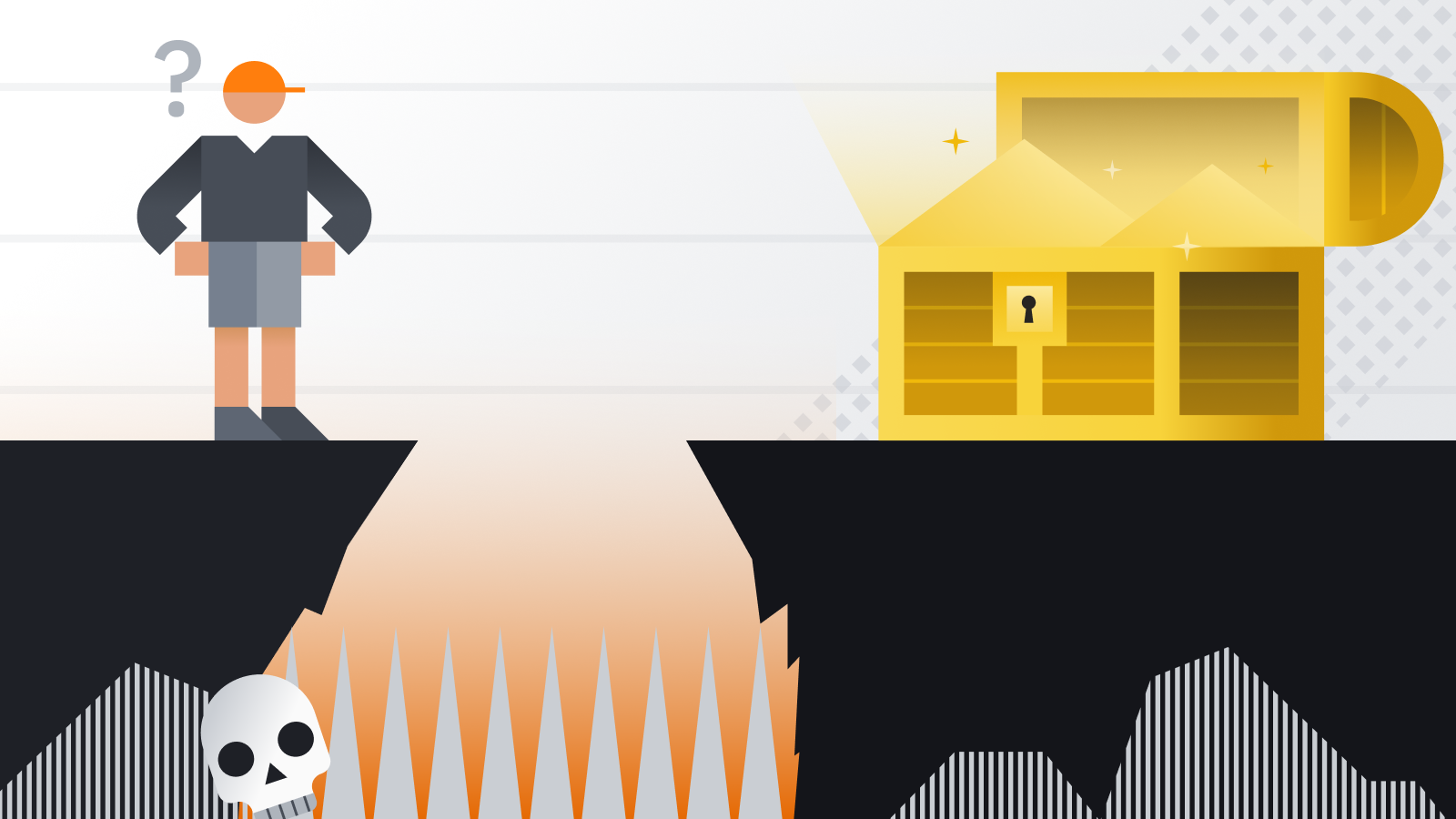

Should I risk wasting my time to get the reward of the information in this article?
The risk/reward ratio shows how much risk you take to get the potential reward or reward.
Good traders and investors act very carefully. They look for the highest potential profit with the lowest potential loss. If an investment can provide the same results as another, but with less risk, then the investment can be said to be better.
Interested in learning how to calculate it yourself? Please continue reading.
Content
Introduction
What is the risk/reward ratio?
How to calculate the risk/reward ratio
Reward/risk ratio
Explanation of risk vs. rewards
Conclusion
Introduction
Whether you do day trading or swing trading, there are some basic concepts regarding risk that you should understand. This will form the basis of your understanding of the markets and provide a foundation to guide your trading activities and investment decisions. If you don't know this concept, you won't be able to protect and grow your trading account.
We've discussed risk management, position sizing, and setting stop-losses. However, if you are actively trading, there is something very important to understand. How much risk are you taking in relation to the potential reward? How does your potential profit compare to your potential loss? In other words, what is your risk/reward ratio?
In this article, we will discuss how to calculate the risk/reward ratio in your trading.
What is the risk/reward ratio?
The risk/reward ratio (R/R ratio or R) calculates how much risk a trader takes to gain potential rewards. In other words, this formula shows what the potential reward is for every $1 you risk on an investment.
The calculation itself is very simple. You divide the maximum risk by your target net profit. How to? First, look at where you want to enter the trade. Then, decide where you will take profit (if the trade is successful), and where you will place your stop-loss (if the trade is losing). This is important if you want to manage risk properly. Good traders set profit targets and stop-losses before entering a trade.
Now, you have your entry and exit targets, which means you can calculate the risk/reward ratio. This is done by dividing your potential risk by your potential reward. The lower the ratio, the greater the potential reward obtained per “unit” of risk. Let's see how it works.
How to calculate the risk/reward ratio
Let's say you want to enter a Long Bitcoin position. You perform analysis and determine that your take profit order is 15% of the entry price. At the same time, you're also wondering: Where does the invalidation point of your trade lie? It is at this point that you must set a stop-loss order. In this case, you decide that the invalidation point is 5% of the entry point.
It should be noted that this generally should not be based on arbitrary percentage figures. You must determine profit targets and stop-losses based on market analysis. Technical analysis indicators can be very helpful.
So, our profit target is 15% and potential loss is 5%. What is the risk/reward ratio? The ratio is calculated as 5/15 = 1:3 = 0.33. Quite simple. This means that for every unit of risk, we have the potential to win three times the reward. In other words, for every dollar of risk we take, we are able to make three dollars. So, if we have a position worth $100, we risk losing $5 with a potential profit of $15.
We can move the stop loss closer to the entry to lower the ratio. However, as previously mentioned, entry and exit points should not be calculated based on arbitrary numbers, they should be calculated based on analysis. If a trade has a high risk/reward ratio, it may not be worth trying to “game” the numbers. Maybe we would be better off looking for a different trade with a good risk/reward ratio.
Note that positions of different sizes can have the same risk/reward ratio. For example, if we have a position worth $10,000, we risk losing $500 with a potential profit of $1,500 (the ratio is still 1:3). The ratio changes only if we change the target and stop-loss positions.
Reward/risk ratio
It should be noted that many traders do this calculation in reverse, they instead calculate the reward/risk ratio. Why? Well, it's just a matter of preference. Some people find this way easier to understand. The calculation is the opposite of the risk/reward ratio formula. Thus, our reward/risk ratio in the example above is calculated as 15/5 = 3. As you might have guessed, a high reward/risk ratio is better than a low reward/risk ratio.

Example of a trade with a reward/risk ratio of 3.28.
➟ Want to own cryptocurrency? Buy Bitcoin on Binance!
Explanation of risk vs. rewards
Suppose we are at the zoo and we are betting. I'll give you 1 BTC if you sneak into the bird cage and feed the parrot from your hand. What are the potential risks? Well, because you did something you shouldn't have done, you could be arrested and taken to the police station. On the other hand, if successful, you will get 1 BTC.
At the same time, I propose an alternative. I will give you 1.1 BTC if you sneak into the tiger's cage and feed the tiger raw meat with your bare hands. What are the potential risks here? Of course, you could be arrested by the police. However, there is also the possibility that the tiger will attack and tear your body to pieces. On the other hand, the returns are slightly better than parrot betting, as you get more BTC if you are successful.
Which seems better? Technically, both are bad deals, because you can't just sneak in. However, you are taking more risk with tiger betting just to get a little more potential reward.
With the same idea, many traders will look for trades where they think they will make a profit rather than trades where they think they will lose. This is called an asymmetric opportunity (potential profit is greater than potential loss).
Also important to discuss here is your win rate. Win rate is the number of profitable trades divided by the number of losing trades. For example, if you have a 60% win rate, you make a profit on 60% of your trades (on average). You can use this in risk management.
Even so, some traders can make huge profits with very low win rates. Why? Because the risk/reward ratio on trading they accommodate it. If they only set up a risk/reward ratio of 1:10, they could lose nine trades in a row and still break-even on one trade. In this case, they only need to win two out of ten trades to make a profit. This is why calculating risk vs. rewards are very important.
Conclusion
We've looked at what the risk/reward ratio is and how traders can incorporate it into their trading plan. Calculating the risk/reward ratio is very important when it comes to the risk profile in any money management strategy.
Something also worth considering in managing risk is keeping a trading journal. By documenting your trades, you can get a more accurate picture of your strategy's performance. Plus, you can adapt it to different market environments and asset classes.
Do you have further questions about calculating risk and reward? Check out our question and answer platform, Ask Academy, a place where the community will answer your questions.