


Content
Introduction
What is a bear market?
Example of a bear market
Bear markets vs. bull market – what's the difference?
How to trade in a bear market
Conclusion
Introduction
Financial markets move within trends. It is important to understand the differences between existing trends to be able to make better investment decisions. How could that be? Well, different market trends can cause different market conditions. If you don't know what the underlying trends are, how will you adapt to changing conditions?
Market trend is the direction the market is moving as a whole. In a bear market, prices decrease. Bear markets can be a difficult time to trade or invest, especially for beginners.
Most crypto traders and technical analysts agree that Bitcoin has been in a macro bullish trend throughout its existence. Even so, there have been several crypto bear markets that have been very severe. If conditions in the market bring an 80% drop in Bitcoin prices, altcoins could easily experience a drop of more than 90%. What can you do during these times?
In this article, we will discuss what a bear market is, how to prepare, and how you can make a profit in it.
If you want to read about bull markets first, check out What Is a Bull Market?.
What is a bear market?
A bear market can be described as a period of falling prices in the financial markets. Can be very risky and difficult to trade for inexperienced traders. It can also easily lead to huge losses, and scare investors away from ever returning to the financial markets. How could that be?
There is a saying among traders: “Stairs go up, elevator goes down.” This means that upward moves may be slow and steady, while downward moves tend to be sharper and rougher. Why is that? When prices started falling, many traders rushed out of the market. The act of leaving the market is done either in cash or by locking in profits from a long position. This situation can quickly produce a domino effect, where some sellers rush to the exit causing more and more other sellers to also exit their positions, and so on. This decline can be further magnified if you are in a market with high leverage. Mass liquidations will have a more pronounced cascading effect, resulting in a violent sell-off.
Thus, bull markets can also experience a euphoric phase. During these times, prices rise to the extreme, correlations are higher than usual, and the majority of assets rise together.
Usually, investors are "bearish" in a bear market, they expect prices to fall. Also means that market sentiment is generally quite low. However, this does not mean that all market participants open short positions. They expect the price to fall and may open a position accordingly if the opportunity arises.
Example of a bear market
As we have discussed, many investors consider that Bitcoin has been in a macro bullish trend since it started trading. Does that mean no bear market occurs in a bull run? After Bitcoin moved to $20,000 in December 2017, the charts showed a pretty brutal bear market.
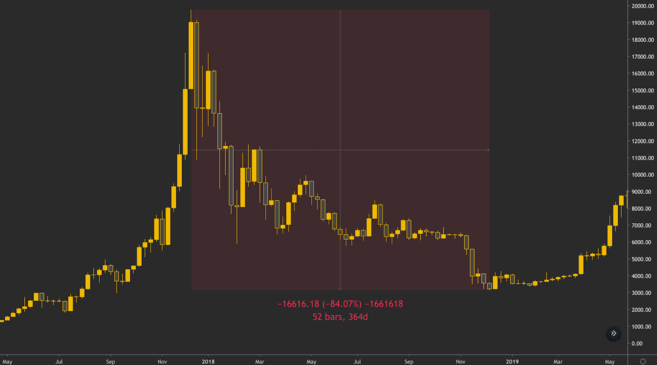
Bitcoin prices fell after the 2017 bull market.
And before the 2018 bear market, Bitcoin experienced an 86% decline in 2014.

Bitcoin price crashed 86% from 2013 peak.
In July 2020, the previous bear market low of around $3,000 was retested but never breached. If that low is broken, that the multi-year Bitcoin bear market is still ongoing could be a strong argument.

Bitcoin retests previous bear market low range.
Since that level has not yet been broken, an argument can be made that the price crash due to COVID-19-induced fears is simply a retest of the range. However, there are no certainties in technical analysis, only probabilities.
Another famous bear market example comes from the stock market. The Great Depression, the Financial Crisis of 2008, or the stock market crash of 2020 due to the coronavirus pandemic are all notable examples. All of these events have caused a major crash on Wall Street and impacted stock prices everywhere. Market indices such as the Nasdaq 100, Dow Jones Industrial Average (DJIA), or S&P 500 index can experience significant price declines at times like this.
Bear markets vs. bull market – what's the difference?
The difference is quite easy. In a bull market, prices rise, while in a bear market, prices fall.
One important difference is that bear markets can have long periods of consolidation, also known as sideways or ranging price action. These are times when market volatility is quite low, and there is little trading activity taking place. While the same may be true in a bull market, this type of behavior is more common in a bear market. However, falling prices over a long period of time is not very attractive to most investors.
Another thing to consider is whether it is possible to enter a short position. If there is no ability to open short positions with margin or use derivatives, traders can only express their bearish views on the market by selling assets to secure cash or stablecoins. This can lead to a longer, protracted downtrend with little buying interest, resulting in slow sideways price movement.
➟ Want to own cryptocurrency? Buy Bitcoin on Binance!
How to trade in a bear market
One of the simplest strategies traders can use in a bear market is to stay sheltered by holding cash (or stablecoins). If you are not comfortable with falling prices, it may be better to wait until the market is out of bear market territory. If there is hope that a new bull market will come in the future, you can take advantage of it when it happens. At the same time, if you are HODLing long term for years or decades, a bear market is not necessarily an immediate signal to sell.
When it comes to trading and investing, trading in the direction of the market trend is generally a good idea. This is why another strategy emerged, one that profits in bear markets by opening short positions. This way, when the asset price falls, traders can profit from the decline. This can be done in day trading, swing trading, position trading – the main idea is quite simple: trade in the direction of the trend. In this way, there will be many counter-trend traders looking for “counter-trend” trades, that is, trades that go against the direction of the main trend. Let's see how it works.
In the case of a bear market, the counter-trend is executed by entering a long position on the bounce. This move is sometimes called a “bear market rally” or “dead cat bounce”. These counter-trend price movements are known to have high volatility, therefore, many traders will take advantage of the opportunity by opening long positions on short-term bounces. However, until the overall bear market is confirmed to be over, expect the downtrend to resume immediately after the bounce.
This is why experienced traders will take profits (around the current high) and exit before the bear trend resumes. Otherwise, they could be trapped in a long position while the bear market continues. Having said that, it is important to note that this is a very risky strategy. Even advanced traders can experience significant losses when trying to catch falling knives.
Conclusion
We have discussed what a bear market is, how traders protect themselves and take profit. In short, the easiest strategy is to stick with cash in a bear market – and wait for a safer opportunity to trade. Alternatively, many traders will look for opportunities to open short positions. As we know, when it comes to trading, it is very wise to follow the direction of the market trend.
Do you have further questions about bear markets? Check out our question and answer platform, Ask Academy, a place where the community will answer your questions.